
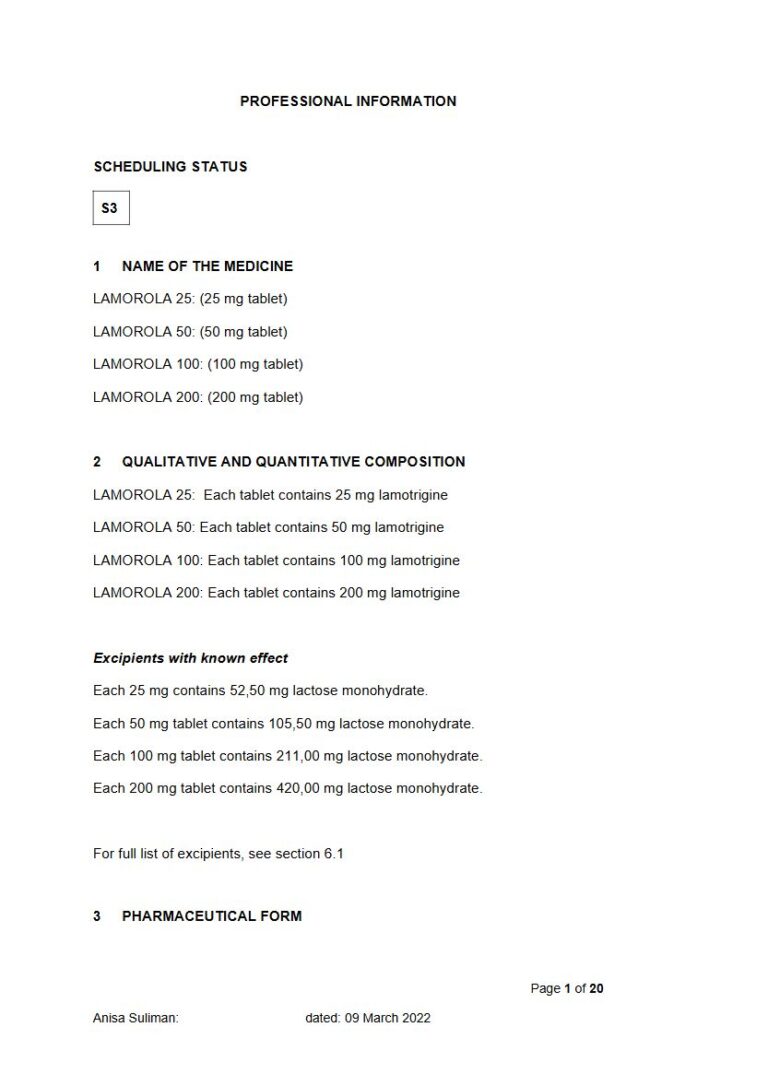
Lamorola 25mg. 50mg. 100mg. 200mg Tablet.
PDF Leaflet Revision Date: 09 March 2022
Clinical Summary
Quick overview from the medicine insert
Indication
Monotherapy or add-on treatment of partial epilepsy and Lennox-Gastaut syndrome.
Dosage (summary)
Adults: Start at 25 mg/day, increase to 100-200 mg/day. Children: 2 mg/kg/day, max 15 mg/kg/day.
Special Populations
- Hepatic impairment
- Renal impairment
- Elderly patients
Pregnancy & Breastfeeding
Safety in pregnancy and breastfeeding not established.
Key Drug Interactions
- Sodium valproate increases half-life
- Enzyme inducers decrease half-life
Contraindications
- Hypersensitivity to lamotrigine
- Hepatic or renal impairment
- Age over 65
Common side effects
- Rash
- Headache
- Dizziness
- Nausea
- Insomnia
Counselling Points
- Report any rash immediately
- Avoid abrupt discontinuation
- Monitor weight in children
Serious warnings
- Risk of serious skin reactions
- Abrupt withdrawal may cause rebound seizures
- Monitor for HLH symptoms
Important Disclaimer
The Lamorola 25mg. 50mg. 100mg. 200mg Tablet. professional information leaflet below is the property of Strides Pharma Sa and is provided on Medinsert exactly as issued, with no.. alterations or editorial changes. We make every effort to keep content current by updating documents as soon as new versions become available. Medinsert serves as a trusted access point for healthcare professionals, but does not replace official sources or clinical judgement. For more details, please read our full disclaimer. read more>>
 Healthcare Professionals Only
This content is for registered healthcare professionals
Sign in or create a free account to read the full package insert.
Free for HPCSA-registered professionals. Powered by Medinsert.
Clinical Particulars
Section 4 of the official insert — extracted exactly as issued, no alterations
4.1 Therapeutic indications
Adults and children over 12 years: LAMOROLA is indicated as monotherapy or add-on treatment of partial epilepsy with or without secondary generalised tonic-clonic seizures and in primary generalised tonic-clonic seizures.
Children 2 to 12 years: LAMOROLA is indicated as add-on treatment of partial epilepsy with or without secondary generalised tonic-clonic seizures not satisfactorily controlled with other antiepileptic medicines. Monotherapy in children under 12 years of age is not recommended until such time as adequate information is made available from controlled trials in this particular target population.
Lennox-Gastaut syndrome: LAMOROLA in indicated as add-on treatment for seizures associated with Lennox-Gastaut syndrome.
4.2 Posology and method of administration
It is important to adhere to the recommended dosages especially in combination with therapy with valproate where one-tenth to one-fifth of the normal dose is used. Do not exceed the maximum dosage (see section 4.4). To ensure a therapeutic dose is maintained the weight of a child must be monitored and the dose reviewed as weight changes occur. If the doses calculated for children, according to bodyweight, do not equate to whole tablets, the dose to be administered is equal to the lower number of whole tablets.
Dosage in monotherapy: Adults and children over 12 years of age: The initial dose in monotherapy is 25 mg once a day for two weeks, followed by 50 mg once a day for two weeks. Thereafter, the dose should be increased by a maximum of 50 mg u2013 100 mg every 1 u2013 2 weeks until the optimal response is achieved. The usual maintenance dose to achieve optimal response is 100 u2013 200 mg/day given once a day or as two divided doses. Some patients have required 500 mg/day of lamotrigine to achieve the desired response.
ADULTS AND CHILDREN OVER 12 YEARS (TOTAL DAILY DOSES):
- Weeks 1&2: 25 mg (once a day)
- Weeks 3 & 4: 50 mg (once a day)
- Maintenance Dose: 100 u2013 200 mg (once a day or two divided doses).
To achieve maintenance, doses may be increased by 50 u2013 100 mg every 1 u2013 2 weeks. The recommended initial dose and subsequent dose escalation should not be exceeded to minimise the risk of skin rash (see section 4.4).
Dosage in add-on therapy: Adults and children over 12 years of age: The initial LAMOROLA dose in those not taking sodium valproate is 50 mg once a day for two weeks, followed by 100 mg/day given in two divided doses for two weeks. Thereafter, the dose should be increased by a maximum of 100 mg every 1 u2013 2 weeks until the optimal response is achieved. The usual maintenance dose to achieve optimal response is 200 u2013 400 mg/day given in two divided doses.
In those patients taking sodium valproate, the initial LAMOROLA dose is 25 mg every alternate day for two weeks, followed by 25 mg once a day for two weeks. Thereafter, the dose should be increased by a maximum of 25 u2013 50 mg every 1 u2013 2 weeks until the optimal response is achieved. The usual maintenance dose to achieve optimal response is 100 u2013 200 mg/day given once a day or in two divided doses.
In patients taking antiepileptic drugs where the pharmacokinetic interaction with lamotrigine is currently not known, the dose escalation as recommended for lamotrigine with concurrent valproate should be used. Thereafter, the dose should be increased until the optimal response is achieved.
ADULTS AND CHILDREN OVER 12 YEARS (TOTAL DAILY DOSE):
- Patients not taking sodium valproate:
- Weeks 1 & 2: 50 mg (once a day)
- Weeks 3 & 4: 100 mg (two divided doses)
- Maintenance Dose: 200 u2013 400 mg (two divided doses). To achieve maintenance, doses may be increased by 100 mg every 1 u2013 2 weeks.
- Patients taking sodium valproate:
- Weeks 1 & 2: 25 mg (on alternate days)
- Weeks 3 & 4: 25 mg (once a day)
- Maintenance Dose: 100 u2013 200 mg (once a day or two divided doses). To achieve maintenance, doses may be increased by 25 u2013 50 mg every 1 u2013 2 weeks.
The recommended initial dose and subsequent dose escalation should not be exceeded to minimise the risk of skin rash (see section 4.4).
Children aged 2 u2013 12 years: The initial LAMOROLA dose in those not taking sodium valproate is 2 mg/kg body mass/day given in two divided doses for two weeks, followed by 5 mg/kg/day for two weeks. Thereafter, the dose should be increased by a maximum of 2 u2013 3 mg/kg every 1 u2013 2 weeks until the optimal response is achieved. The usual maintenance dose to achieve optimal response is 5 u2013 15 mg/kg/day given in two divided doses. A maximum daily dose of 400 mg must not be exceeded.
In those patients taking sodium valproate, the initial LAMOROLA dose is 0,2 mg/kg body mass/day given once a day for two weeks, followed by 0,5 mg/kg/day given once a day for two weeks. Thereafter, the dose should be increased by a maximum of 0,5 u2013 1 mg/kg every 1 u2013 2 weeks until the optimal response is achieved. The usual maintenance dose to achieve optimal response is 1 u2013 5 mg/kg/day given once a day or in two divided doses. A maximum daily dose of 200 mg must not be exceeded.
In patients taking antiepileptic medicines where the pharmacokinetic interaction with lamotrigine is currently not known, the dose escalation as recommended for lamotrigine with concurrent valproate should be used. Thereafter, the dose should be increased until the optimal response is achieved.
CHILDREN AGED 2 TO 12 YEARS (TOTAL DAILY DOSE):
- No sodium valproate:
- Weeks 1 & 2: 2 mg/kg (two divided doses)
- Weeks 3 & 4: 5 mg/kg (two divided doses)
- Maintenance Dose: 5 - 15 mg/kg (two divided doses) or 400 mg. To achieve maintenance, doses may be increased by 2 u2013 3 mg/kg every 1 u2013 2 weeks.
- With sodium valproate:
- Weeks 1 & 2: 0,2 mg/kg (once a day)
- Weeks 3 & 4: 0,5 mg/kg (once a day)
- Maintenance Dose: 1 u2013 5 mg/kg (once a day or two divided doses) or 200 mg. To achieve maintenance, doses may be increased by 0,5 u2013 1 mg/kg every 1 u2013 2 weeks.
The recommended initial dose and subsequent dose escalation should not be exceeded to minimise the risk of skin rash (see section 4.4).
Note: If the calculated daily dose is 2,5 u2013 5 mg, then 5 mg lamotrigine (of a suitable formulation) may be taken on alternate days for the first two weeks. If the calculated daily dose is less than 12,5 mg, then LAMOROLA should not be administered, in which case lamotrigine of a suitable formulation should be used.
Patients aged 2 u2013 6 years may require a maintenance dose at the higher end of the recommended range.
Dosage in seizures associated with Lennox-Gastaut syndrome: The doses used for seizures associated with Lennox-Gastaut syndrome correspond to the dosing guidelines outlined above for both adults and children aged 2 to 12 years.
Children aged less than 2 years: There is insufficient information on the use of lamotrigine in children aged less than two years.
4.3 Contraindications
- Hypersensitivity to Lamotrigine or to any of the excipients (see section 6.1)
- Patients with impairment of hepatic or renal function
- Patients over the age of 65 years
4.4 Special warnings and precautions for use
Severe convulsive seizures, including status epilepticus, may lead to rhabdomyolysis, multi-organ dysfunction and disseminated intravascular coagulation, usually with fatal outcome. Similar cases have occurred in association with the use of lamotrigine. It is recommended that the doctor closely monitor patients (including hepatic, renal and clotting parameters) who acutely develop any combinations of unexplained rash, fever, flu-like symptoms, drowsiness or worsening of seizure control, especially within the first month of starting treatment with lamotrigine. Exceeding the recommended dose at the initiation of lamotrigine therapy may be associated with an increased incidence of rash requiring withdrawal of therapy. Abrupt withdrawal of lamotrigine may provoke rebound seizures. The risk may be reduced by tapering off the withdrawal of lamotrigine over a period of two weeks.
To ensure a therapeutic dose is maintained the weight of a child must be monitored and the dose reviewed as weight changes occur. If the doses calculated for children, according to bodyweight, do not equate to whole tablets the dose to be administered is that equal to the lower number of whole tablets.
Skin Reactions: There have been reports of adverse skin reactions, which have generally occurred within the first 8 weeks after initiation of lamotrigine treatment. The majority of rashes are mild and self-limiting, however serious, potentially life-threatening skin rashes, including Stevens-Johnson syndrome and toxic epidermal necrolysis, have been reported especially in children and in patients (adults and children) who also used valproate (see section 4.4 and 4.8). Isolated cases have been reported after prolonged treatment (6 months). Skin reactions in all clinical studies occurred in adults in approximately 10 % and in children 17 %. In patients on concomitant valproate, skin reactions occurred in 21 % of adults and in 34 % of children, of whom 12 % and 17 % respectively withdrew from treatment. Although the majority recover on medicine withdrawal, some patients experience irreversible scarring and there have been rare cases of associated death. The estimated incidence of serious skin rashes in adults is 1 in 1 000. The risk is higher in children than in adults. Available data suggest the incidence in children requiring hospitalisation ranges from 1 in 300 to 1 in 100. In children, the initial presentation of a rash can be mistaken for an infection; doctors should consider the possibility of a medicine reaction in children that develop symptoms of rash and fever during the first eight weeks of therapy.
Additionally, the overall risk of rash appears to be strongly associated with:
- High initial doses of lamotrigine and exceeding the recommended dose escalation of lamotrigine (see section 4.2).
- Concomitant use of valproate, which increases the mean half-life of lamotrigine nearly two-fold (see section 4.2 and 5.2)
As it cannot be predicted reliably which rashes will be life-threatening, all patients (adults and children) who develop a rash should be promptly evaluated and lamotrigine withdrawn immediately unless the rash is clearly not medicine related.
Dihydrofolate reductase: Lamotrigine is a weak inhibitor of dihydrofolate reductase, hence there is a possibility of interference with folate metabolism during long-term therapy. However, during prolonged human dosing of up to 1 year, lamotrigine did not induce significant changes in the haemoglobin concentration, mean corpuscular volume, serum or red blood cell folate concentrations.
Haemophagocytic lymphohistiocytosis (HLH): HLH has been reported in patients taking lamotrigine (see section 4.8). HLH is characterised by signs and symptoms, like fever, rash, lymphadenopathy, hepatosplenomegaly, neurological symptoms, cytopenias, high serum ferritin, hypertriglyceridaemia and abnormalities of liver function and coagulation. Symptoms generally occur within 4 weeks of the initiation treatment. HLH can be life threatening.
Rash has also been reported as part of a hypersensitivity syndrome associated with a variable pattern of systemic symptoms, including fever, lymphadenopathy, pruritis, facial oedema, abnormalities of the blood and liver and thrombocytopenia. The syndrome shows a wide spectrum of clinical severity and may lead to disseminated intravascular coagulation and multi-organ failure. It is important to note that early manifestations of hypersensitivity (e.g. fever, lymphadenopathy) may be present even though rash is not evident. If such signs and symptoms are present the patient should be evaluated immediately and LAMOROLA discontinued if an alternative aetiology cannot be immediately established.
Patients should be advised of the symptoms associated with HLH and should be told to seek medical attention immediately if they experience these symptoms while on lamotrigine therapy. Immediate evaluation of patients who develop these signs and symptoms are required and one should consider a diagnosis of HLH. Unless an alternative aetiology can be established, lamotrigine should be promptly discontinued.
Aseptic meningitis: Aseptic meningitis was seen to be reversible on withdrawal of the lamotrigine in most cases. However, it recurred in several cases on re-exposure to lamotrigine. This re-exposure resulted in a rapid return of symptoms and were often more severe. If a patient has discontinued lamotrigine due to aseptic meningitis they should not be restarted on lamotrigine.
Photosensitivity reactions: There have been several cases of photosensitivity reactions when there has been a dose escalation or rapid up-titration. These reactions occurred with a high dose (400 mg or more). Treatment discontinuation should be considered if lamotrigine-associated photosensitivity is believed (for example exaggerated sunburn). However, if considered clinically justified to continue treatment with lamotrigine, the patient should be advised to take protective measures like protective clothing and sunscreens and avoid exposure to artificial UV light and sunlight.
Renal failure: Accumulation of the glucuronide metabolite is to be expected with end stage renal failure. Therefore, caution should be exercised in treating patients with renal failure.
Brugada-type ECG: The use of lamotrigine should be carefully considered in patients with Brugada syndrome as typical Brugada ECG pattern and arrhythmogenic ST-T abnormality has been reported in patients treated with lamotrigine.
Precautions relating to epilepsy: Abrupt withdrawal of LAMOROLA may induce rebound seizures. The gradual decrease of dose over a period of two weeks should be performed for LAMOROLA; unless there are safety concerns require an abrupt withdrawal (e.g., rash). Literature reports and similar cases with Lamotrigine indicate that severe convulsive seizures including status epilepticus may lead to disseminated intravascular coagulation, multiorgan dysfunction and rhabdomyolysis and sometimes with fatal outcomes. Lamotrigine may worsen myoclonic seizures. Instead of an improvement there may be a clinically significant worsening of seizure frequency. The observed benefit of control for one seizure type should be weighed against any observed worsening in another seizure type: for patients with more than one seizure type. There is an unclear reason from data that suggests that responses in combination with enzyme inducers is less than in combination with non-enzyme inducing antiepileptic agents. Efficacy may not be maintained in all patients for children taking lamotrigine for the treatment of typical absence seizures.
Lactose Intolerance: LAMOROLA contains lactose. Patients with rare hereditary problems of galactose intolerance, the Lapp lactase deficiency or glucosegalactose malabsorption should not take this medicine.
4.5 Interaction with other medicines and other forms of interaction
There is no evidence that lamotrigine causes clinically significant induction or inhibition of hepatic oxidative medicine-metabolising enzymes. Lamotrigine may induce its own metabolism, but the effect is modest and unlikely to have significant clinical consequences. Increases in the plasma concentrations of other antiepileptic medicines have been reported in a few patients, however controlled studies have shown no evidence that lamotrigine affects the plasma concentrations of concomitant antiepileptic medicines. Evidence from in vitro studies indicates that lamotrigine does not displace other antiepileptic medicines from protein binding sties. In one study in normal volunteers on valproic acid, plasma valproic acid levels decreased slightly when lamotrigine was added. In a study of 12 female volunteers, lamotrigine did not affect plasma concentration of ethinyloestradiol and levonorgestrel following the administration of the oral contraceptive pill. However, as with the introduction of other chronic therapy in patients taking oral contraceptives, any change in the menstrual bleeding pattern should be reported to the patientu2019s doctor. Antiepileptic agents (such as phenytoin, carbamazepine, phenobarbitone and primidone) which induce hepatic medicine-metabolising enzymes significantly enhance the metabolism of lamotrigine leading to a halving of the elimination half-life of lamotrigine. Sodium valproate, which inhibits hepatic medicine-metabolising enzymes, significantly reduces the metabolism of lamotrigine leading to a mean doubling of the elimination half-life of lamotrigine.
4.6 Fertility, pregnancy and lactation
Women of childbearing potential /Contraception in males and females
Pregnancy: Safety of lamotrigine in pregnancy has not been established.
Breastfeeding: Safety of lamotrigine in breastfeeding has not been established.
4.7 Effects on ability to drive and use machines
No studies on the effects on the ability to drive and use machines have been performed.
4.8 Undesirable effects
Tabulated summary of adverse reactions
MedDRA system organ class Frequency Adverse reactions
Blood and lymphatic system disorders Frequency unknown Neutropenia, leucopenia and thrombocytopenia, haematological abnormalities including neutropenia, leucopenia, anaemia, thrombocytopenia, pancytopenia, aplastic anaemia, agranulocytosis
Haemophagocytic lymphohistiocytosis (see section 4.4), Lymphadenopathy
Immune system disorders Frequency unknown Hypersensitivity syndrome Hypogammaglobulinaemia
Psychiatric disorders Frequent Irritability/aggression, depression
Frequency unknown Confusion, hallucinations, tics Nightmares
Nervous system disorders Frequent Headache, dizziness, insomnia, tremor, ataxia
Frequency unknown Unsteadiness, nystagmus, paraesthesia, aseptic meningitis (see section 4.4), movement disorders, worsening of Parkinson's disease, extrapyramidal effects, choreoathetosis, increase in seizure frequency
Eye disorders Frequent Diplopia, blurred vision, conjunctivitis
Gastrointestinal disorders Frequent Nausea, vomiting, diarrhoea, dry mouth
Hepato-biliary disorders Frequency unknown Hepatic failure, hepatic dysfunction, increased liver function tests
Skin and subcutaneous tissue disorders Frequent Rash, angioedema, Stevens-Johnson syndrome
Less Frequent Alopecia, photosensitivity reaction, toxic epidermal necrolysis, drug reaction with eosinophilia and systemic symptoms
Musculoskeletal and connective tissue disorders Frequent Arthralgia
Less Frequent Lupus-like reactions
Renal and urinary disorders Frequency unknown Tubulointerstitial nephritis, tubulointerstitial nephritis and uveitis syndrome
General disorders and administration site conditions Frequent Tiredness, pain, back pain
Reporting of suspected adverse reactions: Reporting suspected adverse reactions after authorisation of the medicine is important. It allows continued monitoring of the benefit/risk balance of the medicine. Health care providers are asked to report any suspected adverse reactions to SAHPRA via the u201c6.04 Adverse Drug Reactions Reporting Formu201d, found online under SAHPRAu2019s publications: https://www.sahpra.org.za/Publications/Index/8
4.9 Overdose
Symptoms and signs: There is no experience of over dosage with lamotrigine, but some patients with very high serum lamotrigine concentrations of more than 15 u03bcg/mL have been reported sedation, ataxia, diplopia, nausea and vomiting.
Treatment: In the event of over dosage, the patient should be admitted to hospital and given appropriate supportive therapy. Gastric lavage should be performed if indicated.
