
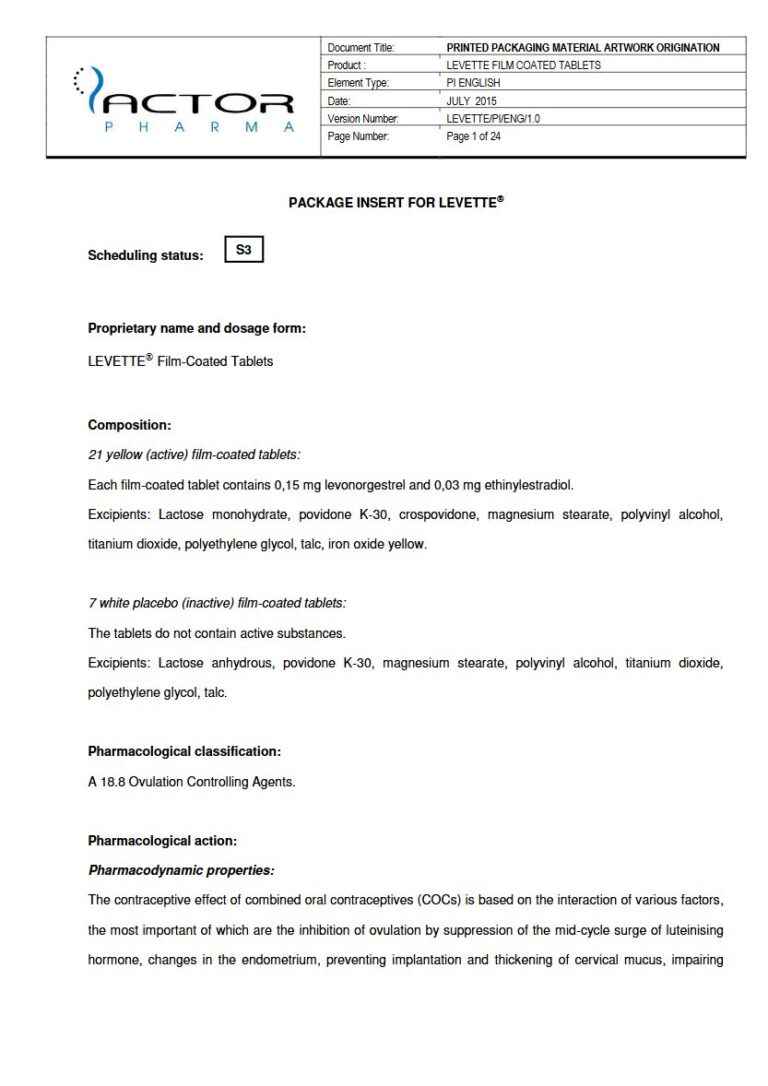
Levette 0.15mg. 0.03mg Tablets
PDF Leaflet Revision Date: July 2015
Clinical Summary
Quick overview from the medicine insert
Indication
Oral contraception and control of dysfunctional uterine bleeding.
Dosage (summary)
One tablet daily for 28 days, starting on day 1 of the menstrual cycle.
Special Populations
- Obesity
- Hypertension
- Migraine
Pregnancy & Breastfeeding
Contraindicated in pregnancy; not recommended during lactation.
Key Drug Interactions
- Antibiotics
- Antiepileptics
- St. John's Wort
Contraindications
- Venous/arterial thrombosis
- Severe hepatic disease
- Pregnancy
Common side effects
- Nausea
- Headache
- Mood swings
- Breast tenderness
Counselling Points
- Take at the same time daily
- Use additional contraception if missed doses
- Monitor for signs of thrombosis
Serious warnings
- Increased risk of thromboembolism
- Cervical cancer risk
- Breast cancer risk
Important Disclaimer
The Levette 0.15mg. 0.03mg Tablets professional information leaflet below is the property of Actor Pharma and is provided on Medinsert exactly as issued, with no.. alterations or editorial changes. We make every effort to keep content current by updating documents as soon as new versions become available. Medinsert serves as a trusted access point for healthcare professionals, but does not replace official sources or clinical judgement. For more details, please read our full disclaimer. read more>>
 Healthcare Professionals Only
This content is for registered healthcare professionals
Sign in or create a free account to read the full package insert.
Free for HPCSA-registered professionals. Powered by Medinsert.
Clinical Particulars
Section 4 of the official insert — extracted exactly as issued, no alterations
4.1 Therapeutic indications
- Oral contraception.
- Control of dysfunctional uterine bleeding.
- Symptomatic treatment of primary dysmenorrhoea where contraception is also desired.
4.2 Posology and method of administration
LEVETTE must be taken as directed at approximately the same time each day, if necessary with a little liquid. Tablet taking is continuous. One tablet is to be taken daily for 28 consecutive days following the order shown on the blister strip. Each subsequent pack is started the day after the last tablet of the previous pack.
Withdrawal bleeding usually starts on day 2 to 4 after starting the placebo (inactive) tablets (last row) and may not have finished before the next pack is started.
How to start LEVETTE:
No preceding hormonal contraceptive use (in the past month): Tablet taking is started on day 1 of the menstrual cycle (i.e. the first day of menstrual bleeding), starting with one yellow tablet for the first 21 days followed by the placebo (inactive) white tablets for 7 days. If tablet-taking begins on day 2 - 5, an additional barrier contraceptive method (e.g. condom) should be used during the first 7 days of the first cycle.
Changing from another combined hormonal contraceptive (COC): The use of LEVETTE should be preferably started either on the day following the usual tablet-free interval or the last placebo (inactive) tablet of the previous COC is taken, or on the day after taking the last active tablet of the previously used COC.
Changing from a progestogen-only method (minipill, injection, implant) or intrauterine system (IUS): If the minipill was used previously, the change can take place on any day. If an implant or IUS was used previously, the change must take place on the day of removal. If an injectable contraceptive was used previously, the change must take place at the time when the next injection would be due. In each case, the use of an additional barrier contraceptive method (e.g. condom) is necessary during the first 7 days taking LEVETTE.
Following a miscarriage or a first-trimester abortion: LEVETTE may be started immediately. In such a case, no additional contraceptive measure is required.
Following childbirth or second-trimester abortion: LEVETTE should be started 21 to 28 days after delivery or after second-trimester abortion. An additional barrier contraceptive method (e.g. condom) should be used during the first 7 days of tablet-taking if you start taking LEVETTE later. If sexual intercourse has already taken place, pregnancy should be ruled out before starting use, or the woman must wait until her first menstrual period.
4.3 Contraindications
LEVETTE is contra-indicated in any of the conditions listed below. Should any of the conditions appear for the first time during LEVETTE use, it must be stopped immediately.
- Presence or history of venous thrombosis (deep vein thrombosis, pulmonary embolism).
- Presence or history of arterial thrombosis (myocardial infarction) or prodromal conditions (e.g. angina pectoris and transient ischaemic attack).
- Presence or history of cerebrovascular accident.
- The presence of severe or multiple risk factor(s) for arterial thrombosis:
- Diabetes mellitus with vascular symptoms.
- Severe hypertension.
- Severe dyslipoproteinaemia.
- History of migraine with focal neurological symptoms, such as aura.
- Presence or history of severe hepatic disease as long as liver function values have not returned to normal.
- Presence or history of liver tumours.
- Known or suspected oestrogen-dependent malignancies (e.g. of the genital organs or the breasts).
- Undiagnosed vaginal bleeding.
- Known or suspected pregnancy (see PREGNANCY AND LACTATION) or a history during pregnancy of pruritus or cholestatic jaundice, chorea, herpes gestationis, pemphigoid gestationis, or deteriorating otosclerosis.
- Hypersensitivity to the active substances or to any of the excipients of LEVETTE.
- Hereditary or acquired predisposition for venous or arterial thrombosis.
- Amenorrhoea of unknown cause.
4.4 Special warnings and precautions for use
Cigarette smoking: Smoking cigarettes increases the risk of serious cardiovascular adverse reactions from combined oral contraceptive (COC) use such as LEVETTE. This risk increases with age and the extent of smoking (15 or more cigarettes per day was associated with a significantly increased risk) and is marked in women over 35 years of age. Women who use LEVETTE should be strongly advised not to smoke.
Thromboembolic diseases and other vascular disorders: Some epidemiological studies have suggested an association between the use of COCs such as LEVETTE and an increased risk of venous and arterial thrombotic and thromboembolic diseases such as myocardial infarction, cerebrovascular accident/stroke, deep venous thrombosis and pulmonary embolism. The use of COCs such as LEVETTE is associated with an increased risk of venous and arterial thrombotic and thromboembolic events compared with no use. The increased risk is highest during the first year a women ever uses a COC. Symptoms of venous or arterial thrombotic/thromboembolic events can include:
- Unusual leg pain and/or swelling in one leg.
- Sudden severe pain in the chest, whether or not it radiates to the left arm.
- Sudden breathlessness.
- Sudden onset of coughing.
- Any unusual, severe, prolonged headache.
- First occurrence or worsening of migraine.
- Sudden partial or complete loss of vision.
- Diplopia.
- Slurred speech or aphasia.
- Vertigo.
- Collapse with or without focal seizure.
- Weakness or very marked numbness suddenly affecting one side or one part of the body.
- Motor disturbances.
- u201cAcuteu201d abdomen.
Occurrence of one or more of these symptoms may be a reason for immediate discontinuation of LEVETTE. The risk for venous thromboembolic complications in LEVETTE users increases with:
- Increasing age.
- A positive family history (venous thromboembolism in a sibling or parent at relatively early age). If a hereditary predisposition is suspected, the woman should be referred to a specialist for advice before deciding about LEVETTE use.
- Prolonged immobilisation, major surgery, any surgery to the legs, or major trauma. In these situations it is advised to discontinue LEVETTE use (in the case of elective surgery at least four weeks in advance) and not resume until two weeks after complete remobilisation. Antithrombotic treatment should be considered if the tablets have not been discontinued in advance.
- Obesity (body mass index over 30 kg/m2).
There is no consensus about the possible role of varicose veins and superficial thrombophlebitis in the onset or progression of venous thrombosis. The risk for arterial thromboembolic complications in COC such as LEVETTE users increases with:
- Increasing age.
- Smoking (women over 35 years should be strongly advised not to smoke if they wish to use a COC such as LEVETTE).
- Dyslipoproteinaemia.
- Obesity (body mass index over 30 kg/m2).
- Hypertension.
- Atrial fibrillation.
- Migraine, especially migraine with focal neurological symptoms.
- Valvular heart disease.
The presence of one serious risk factor or multiple risk factors for venous or arterial disease, respectively, can also constitute a contra-indication. The possibility of anticoagulant therapy should also be taken into account. LEVETTE users should be specifically pointed out to contact their doctors in case of possible symptoms of thrombosis. In case of suspected or confirmed thrombosis, LEVETTE use should be discontinued. The increased risk of thromboembolism in the puerperium must be considered (see PREGNANCY AND LACTATION). Other medical conditions which have been associated with adverse vascular events include: Diabetes mellitus, systemic lupus erythematosus, haemolytic uraemic syndrome and chronic inflammatory bowel disease (Crohn's disease or ulcerative colitis) and sickle cell disease.
An increase in frequency or severity of migraine during LEVETTE use (which may be signs of a cerebrovascular event) may be a reason for immediate discontinuation of LEVETTE. Biochemical factors that may be indicative of hereditary or acquired predisposition for venous or arterial thrombosis include Activated Protein C (APC) resistance, hyperhomocysteinaemia, antithrombin-III deficiency, protein C deficiency, protein S deficiency, antiphospholipid antibodies (anticardiolipin antibodies, lupus anticoagulant).
Ocular lesions: If there are signs or symptoms such as visual changes, onset of proptosis or diplopia, papilloedema, or retinal vascular lesions or optic neuritis, LEVETTE should be discontinued and the cause immediately evaluated.
Carcinoma: Some epidemiological studies have reported an increased risk of cervical cancer in long-term users of COCs such as LEVETTE but there continues to be controversy about the extent to which this finding is attributable to the confounding effects of sexual behaviour and other factors such as human papilloma virus (HPV). A meta-analysis of 54 epidemiological studies reported that there is a slightly increased relative risk (RR = 1,24) of having breast cancer diagnosed in women who are currently using COCs such as LEVETTE. This increased risk gradually disappears during the course of the 10 years after cessation of COC use. Because breast cancer occurs less frequently in women under 40 years of age, the excess number of breast cancer diagnoses in current and recent COC users is small in relation to the overall risk of breast cancer. The increased risk may be due to an earlier diagnosis of breast cancer in COC users, from undergoing regular check-ups, the biological effects of COCs or a combination of the two. Breast cancers diagnosed in COC users tend to be less clinically advanced than those diagnosed in non-users of COCs. Benign and malignant liver tumours have been reported with COC such as LEVETTE users. These tumours have led to life-threatening intra-abdominal bleeding. The possibility of a liver tumour should be considered in the differential diagnosis of women taking LEVETTE who report severe upper abdominal pain, liver enlargement or signs of intra-abdominal bleeding. A slight increase in the relative risk of cervical cancer and cervical intraepithelial neoplasia has been observed. Given the biological influence of LEVETTE on these lesions, periodical smear tests are recommended when LEVETTE is prescribed. In cases of undiagnosed, persistent or recurrent vaginal bleeding, appropriate diagnostic measures should be taken to eliminate the possibility of malignancy. Woman with a strong familial history of breast cancer or who have breast nodules, fibrocystic disease, or abnormal mammograms should be carefully monitored.
Headache: The onset or exacerbation of migraine or development of a headache with a new pattern that is recurrent, persistent or severe requires discontinuation of LEVETTE and evaluation of the cause. Women with migraine (particularly migraine with aura) who take LEVETTE may be at increased risk of stroke.
Other conditions: Women with hypertriglyceridaemia, or a family history thereof, may be at an increased risk of pancreatitis when using LEVETTE. Women who have been treated for hyperlipidaemia should be monitored if they decide to use LEVETTE.
Small increases in blood pressure have been observed in many women taking COCs such as LEVETTE. If a sustained clinically significant hypertension develops during LEVETTE use, then it is prudent for the doctor to discontinue LEVETTE and treat the hypertension. When considered appropriate, LEVETTE use may be resumed if anti-hypertensive treatment manages to achieve normal blood pressure values. If LEVETTE is used in women with hypertension, a history of hypertension or hypertension-related conditions, such as certain kidney diseases, close monitoring is recommended, with treatment being discontinued if a significant increase in blood pressure is detected. In women with endometrial hyperplasia, the doctor should carefully evaluate the risk-benefit relationship before prescribing LEVETTE and should carefully monitor the patient during the treatment period, carrying out periodic cervical cytology screening.
In women with hereditary angioedema, exogenous oestrogens can trigger or exacerbate angioedema symptoms. Acute or chronic disturbances of liver function may necessitate discontinuation of LEVETTE use until the liver function values return to normal. Recurrence of cholestatic jaundice and/or cholestasis-related pruritus which previously occurred during pregnancy or previous use of sex steroids necessitates discontinuation of LEVETTE. LEVETTE may have an effect on peripheral insulin resistance and glucose tolerance. Diabetic women should be carefully monitored while taking LEVETTE. LEVETTE should not be used during active trophoblastic disease, or until urine and plasma gonadotrophin concentrations have returned to normal after treatment.
LEVETTE should be used with caution in those with varicose veins, and should be avoided during sclerosing treatment. Chloasma may occasionally occur, especially in women with a history of chloasma gravidarum. Women with a tendency to chloasma should avoid exposure to the sun or ultraviolet radiation whilst taking LEVETTE. Worsening of endogenous depression, epilepsy, Crohnu2019s disease and ulcerative colitis have been reported during COC such as LEVETTE use. If severe depression presents, LEVETTE should be discontinued and an alternative method of contraception used. Women with a history of depression should be monitored.
Medical examinations: Prior to the initiation or reinstitution of LEVETTE a complete medical history (including family history) should be taken. This should be guided by the contraindications and warnings and should also be repeated regularly while LEVETTE is being used. The scope and frequency of these checkups should be determined on an individual basis. In particular, the following tests should be done: blood pressure measurement, examination of the breasts, abdomen and pelvic organs, including cervical cytology, as well as determination of the relevant laboratory parameters. Women should be informed that LEVETTE does not protect against HIV infection (AIDS) and other sexually transmitted diseases.
Reduced efficacy: The contraceptive efficacy of COCs such as LEVETTE may be reduced if tablets are missed (see DOSAGE AND DIRECTIONS FOR USE). in the event of gastrointestinal disorders (see DOSAGE AND DIRECTIONS FOR USE). if certain other medicines are being taken concomitantly (see INTERACTIONS).
4.5 Interactions with other medicines
Interactions between oral contraceptives such as LEVETTE and other medicines can cause breakthrough bleeding, menstrual irregularities, and/or contraceptive failure. The following medicinal products may lead to reduced absorption of LEVETTE:
- Medicines that increase gastrointestinal motility.
- Antacids (mainly those which contain magnesium).
- Laxatives.
- Some antibiotics such as erythromycin.
- Metoclopramide.
- Medicines that induce metabolism (cytochrome P450 3A4 isoenzyme).
- Antiepileptic medicines: Hydantoins (phenytoin), barbiturates (phenobarbital), primidone, carbamazepine, oxcarbazepine, topiramate. Oral contraceptive failure and breakthrough bleeding have been reported during antiepileptic therapy. These medicines increase clearance of oral contraceptives by enzyme induction, so diminishing their effect.
- Antituberculosis medicines: Rifampicin, rifabutin.
- Others: Lansoprazole, modafinil, Hypericum perforatum (St. John's Wort). In the case of St. John's Wort, intermenstrual bleeding and altered menstrual bleeding has been reported in women on oral contraceptives such as LEVETTE who started taking St. Johnu2019s Wort. Several pregnancies have also been reported. The metabolism-inducing effect of St. Johnu2019s Wort can last for at least 2 weeks after stopping treatment.
- Medicines that reduce enterohepatic circulation.
- Penicillin and derivatives.
- Tetracyclines.
- Others.
It has been reported that some antiretroviral medicines, such ritonavir (HIV protease inhibitor), nevirapine (non-nucleoside reverse transcriptase inhibitor) and some combinations thereof, may potentially affect hepatic metabolism. During treatment with any of these medicines, a barrier method such as a condom should be temporarily used in addition to LEVETTE, or another method of contraception should be chosen if these medicines are going to be used for prolonged periods. With microsomal enzyme-inducing medicines, the barrier method should be used for the duration of the concomitant administration and for 28 days after discontinuation of the medicine. Women treated with antibiotics (except rifampicin and griseofulvin) should use the barrier method during the use of the antibiotics and until seven days after completing the course. If the antibiotic course is used longer than the active tablets in the LEVETTE pack, then the next pack of LEVETTE should be started without the usual placebo (inactive) tablet period. Griseofulvin: Menstrual irregularities and pregnancies have been reported in women receiving oral contraceptives such as LEVETTE and griseofulvin. Additional contraceptive measures should be considered during concomitant use and after stopping griseofulvin.
The following medicinal products may increase the serum concentration of LEVETTE:
- Atorvastatin.
- Medicines which inhibit the cytochrome P450 3A4 isoenzyme, such as indinavir and fluconazole.
LEVETTE may influence the metabolism of other substances:
- Oral anticoagulants.
- Oral antidiabetics and insulin: LEVETTE reduces glucose tolerance, resulting in hyperglycaemia and possibly reducing the efficacy of oral antidiabetics and insulin. LEVETTE may interfere with the metabolism of other medicinal products by inhibiting the microsomal hepatic enzymes or by inducing hepatic conjugation of the medicines, particularly glucuronidation. Accordingly, plasma and tissue concentration may be:
A. Increased:
- Ciclosporin: Concomitant administration with LEVETTE increases the risk of severe hepatotoxicity and raises plasma-ciclosporin trough values.
- u03b2-blockers: LEVETTE increases the AUC and the plasmatic concentrations of metoprolol, oxprenolol and propanolol but this is only statistically significant for metoprolol.
- Theophylline: Oral contraceptives have been reported to decrease the clearance of theophylline by about 30 %, and serum concentrations may be increased.
- Corticosteroids: LEVETTE may enhance the effect of corticosteroids, with budesonide less affected than prednisolone. The dose of corticosteroids may need to be reduced.
- Flunarizine: It has been observed that concomitant treatment with flunarizine and oral contraceptives increases the risk of galactorrhoea.
- Lidocaine (Lignocaine): Oestrogens as contained in LEVETTE reduces the lidocaine (lignocaine) binding-proteins leading to a higher free fraction of lidocaine (lignocaine).
- Selegiline: The total area under the concentration time curve for selegiline given in single doses of 5 to 40 mg was raised 10- to 20-fold in women who were using oral hormonal contraceptives such as LEVETTE when compared with women receiving no other medication. It is recommended that the use of selegiline and LEVETTE be avoided, or the dosage of selegiline reduced.
B. Decreased:
- Analgesics: LEVETTE antagonises the actions of paracetamol and morphine, resulting in increased clearance.
- Clofibrates: LEVETTE increases the clearance of clofibrate and antagonises its effect.
- Lamotrigine: LEVETTE may halve plasma concentrations of lamotrigine. Some reduction in plasma concentration of levonorgestrel, and to a lesser extent ethinylestradiol, may also occur, and there have been reports of breakthrough bleeding and unexpected pregnancies. Significant adjustments in maintenance dose of lamotrigine may be needed if LEVETTE is started or stopped, and patients should be warned not to make changes in their LEVETTE therapy without consulting their medical practitioner.
- Levothyroxine: LEVETTE therapy increases serum concentrations of thyroxine-binding globulin (TBG), thus increasing the amount of bound thyroxine. Normal thyroid function stimulates thyroxine synthesis to compensate for this effect and maintain normal free-thyroxine serum concentrations. In hypothyroidism, however, patients treated with exogenous levothyroxine who receive oestrogens, as contained in LEVETTE, may require an increase in levothyroxine dose. In a pharmacokinetic study of healthy women, the area under the concentration-time curve (AUC) of both ethinylestradiol and norethisterone were reduced by bosentan, probably by enzyme induction. The possibility of contraceptive failure should be considered, and an additional or alternative method of contraception should be used during bosentan therapy. Melatonin should not be taken with oestrogens as contained in LEVETTE, which increases melatonin concentrations through inhibition of its metabolism. Studies with alprazolam, chlordiazepoxide, and diazepam suggest that oral contraceptives such as LEVETTE may inhibit the biotransformation of benzodiazepines metabolised by oxidation, although no significant pharmacokinetic alterations have occurred with clotiazepam or triazolam. It has been noted that psychomotor impairment due to oral diazepam was greater during the menstrual pause than during the 21 u2013 daily oral contraceptive cycle. This may have been due to an effect of oral contraceptives on diazepam absorption. The prescribing information accompanying the concomitant medicines should be consulted in order to identify possible interactions.
4.6 Fertility, pregnancy and lactation
Pregnancy: LEVETTE should not be used during pregnancy. If the woman becomes pregnant while using LEVETTE, further intake must be stopped immediately (See CONTRA-INDICATIONS).
Lactation: Lactation may be influenced by COCs such as LEVETTE as they may reduce the amount of breast milk and change its composition. Therefore, the use of LEVETTE is not recommended until the nursing mother has weaned her child off breast milk (see DOSAGE AND DIRECTIONS FOR USE). Small amounts of the contraceptive steroids and/or their metabolites may be excreted in breast milk (see WARNINGS and SPECIAL PRECAUTIONS regarding postpartum use).
4.7 Effects on ability to drive and use machines
LEVETTE may cause headache and vertigo which may have an influence on the ability to drive and use machines. Patients should be advised to exercise caution until they know how LEVETTE affects them.
4.8 Undesirable effects
The following serious side effects have been reported with the use of combined oral contraceptives and are also relevant to LEVETTE:
- Increased risk of arterial and venous thrombotic and thromboembolic disorders, including myocardial infarction, venous thrombosis and pulmonary embolism (see WARNINGS and SPECIAL PRECAUTIONS).
- Increased risk of cervical intraepithelial neoplasia and cervical cancer (see WARNINGS and SPECIAL PRECAUTIONS).
- Increased risk of breast cancer diagnosis (see WARNINGS and SPECIAL PRECAUTIONS).
The following side effects have been observed with use of combined oral contraceptives containing ethinylestradiol/levonorgestrel such as LEVETTE.
Infections and infestations: Frequent: Vaginitis, including candidiasis.
Neoplasms benign, malignant and unspecified: Less frequent: Hepatocellular carcinomas.
Immune system disorders: Less frequent: Hypersensitivity reactions: anaphylactic/anaphylactoid reactions, including urticaria, angioedema and severe reactions with respiratory and circulatory symptoms, exacerbation of systemic lupus erythematosus.
Metabolism and nutrition disorders: Less frequent: Changes in appetite (increase or decrease), glucose intolerance, exacerbation of porphyria.
Psychiatric disorders: Frequent: Mood swings including depression, change in libido.
Nervous system disorders: Frequent: Headache, migraine, nervousness, vertigo. Less frequent: Exacerbation of chorea.
Eye disorders: Less frequent: Contact lens intolerance, optical neuritis*, retinal vascular thrombosis.
Vascular disorders: Less frequent: Worsening of varicose veins.
Gastrointestinal disorders: Frequent: Nausea, abdominal pain, vomiting, diarrhoea. Less frequent: Colic, bloating, pancreatitis.
Hepatobiliary disorders: Less frequent: Cholestatic jaundice, liver adenomas, hepatocellular carcinoma, cholecystopathy including gallstones**.
Skin and subcutaneous tissue disorders: Frequent: Acne. Less frequent: Rash, chloasma which may be persistent, hirsutism, alopecia, erythema nodosum, erythema multiforme.
Renal and urinary disorders: Less frequent: Haemolytic uremic syndrome.
Reproductive system and breast disorders: Frequent: Bleeding, spotting, breast pain, breast tenderness, breast enlargement, breast discharge, dysmenorrhoea, changes in menstrual flow, changes in vaginal discharge and cervical ectropion, amenorrhoea.
General disorders and administration site conditions: Frequent: Fluid retention, oedema, weight changes (increase or decrease).
Investigations: Less frequent: Increased in blood pressure, changes in serum lipid levels, including hypertriglyceridemia, reduction in levels of serum folates***.
(*) Optical neuritis can cause complete or partial loss of vision.
(**) LEVETTE may worsen pre-existing gallbladder conditions and accelerate the development of these in previously asymptomatic women.
(***) Serum folate levels can be reduced by therapy with LEVETTE. This may be of clinical importance in women who become pregnant shortly after ceasing to take them.
4.9 Overdose
Symptoms of overdosage may include nausea, vomiting, breast tenderness, dizziness, abdominal pain, drowsiness/fatigue, withdrawal bleeding in females. There are no antidotes and the treatment is symptomatic and supportive.
