
Entop Spray 5 mg, 50 mg NASAL SPRAY
PDF Leaflet Revision Date: 22 November 2022
Clinical Summary
Quick overview from the medicine insert
Indication
Topical anaesthesia and vasoconstriction for nasal and pharyngeal procedures.
Dosage (summary)
Adults and children over 12 years: 5 sprays per nostril or throat.
Onset of Action / Duration
Onset: Rapid, Duration: 1 hour
Special Populations
- Elderly patients
- Renal impairment
- Hepatic impairment
Pregnancy & Breastfeeding
Contraindicated in pregnancy and breastfeeding.
Key Drug Interactions
- MAOIs
- Antihypertensives
- Digoxin
- Propranolol
Contraindications
- Hypersensitivity to lidocaine or phenylephrine
- Pregnancy and breastfeeding
- Hypovolaemia
- Hypertension
- Acute ischaemic heart disease
- Complete heart block
- Thyrotoxicosis
- Glaucoma
- Urinary retention
- Children under 12 years
Common side effects
- Transient bitter taste
- Palpitations
- Dizziness
- Nausea
- Vomiting
Counselling Points
- Avoid food/drink for 2 hours post-application
- Use caution in patients with cardiovascular issues
- Monitor for signs of systemic toxicity
Serious warnings
- Caution in cardiovascular disease
- Risk of aspiration after use
- May cause bronchospasm in asthmatics
Important Disclaimer
The Entop Spray 5 mg, 50 mg NASAL SPRAY professional information leaflet below is the property of Medfour Healthcare Cc and is provided on Medinsert exactly as issued, with no.. alterations or editorial changes. We make every effort to keep content current by updating documents as soon as new versions become available. Medinsert serves as a trusted access point for healthcare professionals, but does not replace official sources or clinical judgement. For more details, please read our full disclaimer. read more>>
 Healthcare Professionals Only
This content is for registered healthcare professionals
Sign in or create a free account to read the full package insert.
Free for HPCSA-registered professionals. Powered by Medinsert.
Clinical Particulars
Section 4 of the official insert — extracted exactly as issued, no alterations
4.1 Therapeutic indications
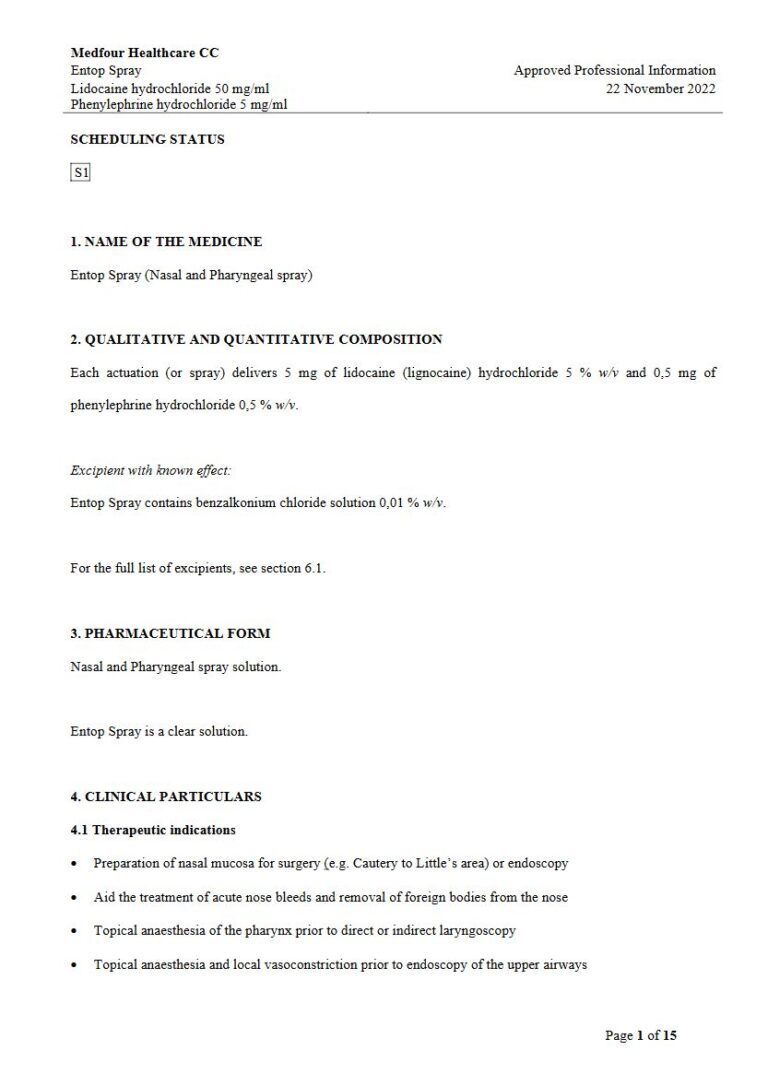
- Preparation of nasal mucosa for surgery (e.g. Cautery to Littleu2019s area) or endoscopy
- Aid the treatment of acute nose bleeds and removal of foreign bodies from the nose
- Topical anaesthesia of the pharynx prior to direct or indirect laryngoscopy
- Topical anaesthesia and local vasoconstriction prior to endoscopy of the upper airways
4.2 Posology and method of administration
Posology
- Do not exceed the recommended dosage regimes
- Do not administer to children under 12 years of age
- Doses are to be administered once only
Adults and children over 12 years: 5 sprays per nostril, or 5 sprays to the throat. Each spray measures 100 microlitres. A new spray nozzle must be used for each patient.
Method of administration
Nasal or pharyngeal.
4.3 Contraindications
- Known hypersensitivity to lidocaine hydrochloride, local anaesthetics of the amide type or phenylephrine hydrochloride or to any of the excipients listed in section 6.1
- Hypersensitivity to other local anaesthetics of the amide type and to other sympathomimetic medicines
- Pregnancy and breastfeeding
- Hypovolaemia, hypertension, acute ischaemic heart disease and complete heart block
- Thyrotoxicosis
- Glaucoma
- Urinary retention
- Children under 12 years of age
4.4 Special warnings and precautions for use
- Elderly and debilitated patients should be given reduced dosages.
- Eating and drinking: the use of topical anaesthetic medicines in the oral cavity and upper airway tissues may interfere with swallowing and thus enhance the danger of aspiration of food or drink. For this reason, food or drink should not be ingested within 2 hours of using local anaesthetics in the mouth area. Numbness of the tongue or buccal mucosa may increase the risk of trauma from hot drinks or biting.
- Patients with cardiovascular diseases. Entop Spray should be given with caution to patients with cardiovascular disease, especially those suffering from hypertension, severe bradycardia, conduction disturbances or severe digoxin intoxication. There is a small but transient increase in pulse rate (up to 12 beats per minute) and blood pressure (average 8,2 mmHg systolic and 7,5 mmHg diastolic) lasting for 10 minutes after the administration of this medication to healthy individuals. This must be taken into account if this medication is given to hypertensive patients.
- Entop Spray should be administered with caution to taking u03b2-adrenoceptor blocking medicines (see section 4.5) and those with cardiovascular disease, diabetes mellitus, hypertension or hyperthyroidism, hypoxia, hypercapnia and porphyria.
- Patients with impaired kidney or liver function. Lidoocaine is metabolised in the liver and must be given with caution to patients with hepatic insufficiency. Metabolites of lidocaine may accumulate in patients with renal impairment.
- Asthmatic patients: This preparation contains Sodium metabisulfite. A sulphite that may cause allergic-type reactions including anaphylactic symptoms and life-threatening or less severe asthmatic episodes in certain susceptible people. The overall prevalence of sulphite sensitivity in the general population is unknown and probably low. Sulphite sensitivity is seen more frequently in asthmatic than non-asthmatic people.
- General precautions: genetic predisposition to malignant hyperthermia and pre-existing abnormal neurological conditions.
- Entop Spray should be used with caution in patients with traumatised mucosa and/or sepsis in the region of the proposed application.
- Entop Spray should also be used with caution in patients with epilepsy, impaired cardiac conduction, bradycardia, impaired hepatic function and in severe shock.
- The medical practitioner or pharmacist should check that sympathomimetic containing preparations are not simultaneously administered by several routes i.e. orally and topically (nasal, aural and eye preparations).
- Sympathomimetic-containing products should be used with great care in patients suffering from angina pectoris.
- Mydriasis (prolonged dilation of the pupils of the eye) has been reported with phenylephrine. Patients should be advised to notify their medical practitioner if they have a history of glaucoma or a history of increased intraocular pressure.
- Entop Spray contains benzalkonium chloride. Long-term use may cause oedema of the nasal mucosa. Benzalkonium chloride may cause wheezing and breathing difficulties (bronchospasm), especially in asthmatic patients. Benzalkonium chloride may cause local irritation.
4.5 Interaction with other medicines and other forms of interaction
Monoamine Oxidase Inhibitors (MAOIs)
Phenylephrine is metabolised by MAOs in the gut. Irreversible MAOIs may therefore increase the effect of oral phenylephrine resulting in a dangerous hypertensive crisis. This effect has not been reported with MAOIs and phenylephrine given by nasal spray. In view of this risk however this product should not be used on patients taking irreversible MAOIs or within three weeks of their discontinuation.
Antihypertensive medicines, anti-dysrythmics and cardiac glycosides (digoxin)
Anti-hypertensive medicines such as u03b2-adrenoceptor blocking medicines may have their effects reversed by the co-administration of phenylephrine, with possible fatal reactions. Hypertensive reactions have been reported in a patient stabilised on debrisoquine when given phenylephrine by mouth, in patients receiving reserpine or guanethidine when given phenylephrine eye drops, and a fatal reaction occurred in a patient receiving propranolol and hydrochlorothiazide also after the instillation of phenylephrine eye drops.
Products that contain phenylephrine should be used with caution in patients receiving guanethedine, reserpine, digoxin and methyldopa.
Lidocaine may cause an increased risk of myocardial depression: increased risk of lidocaine toxicity with propranolol. Lidocaine should be used with caution in patients receiving anti-dysrhythmic medicines, such as tocainide, since the toxic effects are additive.
Diuretics
Effects of lidocaine may be antagonised by hypokalaemia with acetazolamide, loop diuretics and thiazide diuretics.
Antidepressants
Sympathomimetic-containing products should be used with great care in patients receiving phenothiazines or tricyclic antidepressants.
Cimetidine
Cimetidine may reduce the clearance of lidocaine (lignocaine) so that patients given these medicines together may show signs of lidocaine toxicity. They should be observed closely.
Muscle relaxants
Lidocaine (lignocaine) prolongs the action of suxamethonium. Phenylephrine may cause hypertension when used concomitantly with doxapram or oxytocin. There is an increased risk of ergotism when phenylephrine and ergot alkaloids are taken concomitantly.
Phenytoin
Lidocaine (lignocaine) and phenytoin have additive cardiac depressant effects.
Halogenated anaesthetic medicines
Concurrent use with halogenated anaesthetic medicines such as chloroform, cyclopropane, halothane, enflurane or isoflurane may provoke or worsen ventricular dysrhythmias.
4.6 Fertility, pregnancy and lactation
Pregnancy
Entop Spray should not be used during pregnancy (see section 4.3).
Breastfeeding
Entop Spray should not be used by breastfeeding mothers.
4.7 Effects on ability to drive and use machines
Entop Spray has no or negligible influence on the ability to drive and use machines.
4.8 Undesirable effects
a) Summary of safety profile
The most frequently occurring adverse reaction is a transient bitter taste in the mouth.
Tabulated list of adverse reactions due to the Entop Spray administration
Cardiac disorders
Less frequent Palpitations.
Nervous system disorders
Less frequent Tremor, nervousness, dizziness, numbness or disorientation.
Vascular disorder
Frequency unknown Hypertension.
Gastrointestinal disorders
Frequent Transient bitter taste in the mouth lasting one to two minutes and then disappearing. Less frequent Nausea, vomiting.
Eye disorders
Frequency unknown Mydriasis.
Ear and labyrinth disorders
Less frequent Tinnitus.
Local anaesthetics (e.g. lidocaine) and sympathomimetics (e.g. phenylephrine) may produce systemic adverse effects as a result of the raised plasma concentrations which ensue when the rate of absorption into the circulation exceeds the rate of breakdown, for example, by absorption of large amounts through mucous membranes or damaged skin or from highly vascular areas.
Possible systemic side effects due to Lidocaine
The systemic toxicity of local anaesthetics mainly involves the central nervous system and the cardiovascular system. Excitation of the CNS may be manifested by restlessness, excitement, nervousness, dizziness, tinnitus, blurred vision, nausea and vomiting, muscle twitching and tremors and convulsions. Numbness of the tongue and perioral region may appear as an early sign of systemic toxicity. Excitation may be transient and followed by depression with drowsiness, respiratory failure and coma. There may be simultaneous effects on the cardiovascular system with myocardial depression and peripheral vasodilation resulting in hypotension and bradycardia: dysrhythmias and cardiac arrest may occur. Some local anaesthetics cause methaemoglobinaemia.
Possible systemic side effects due to Phenylephrine
Sympathomimetics may produce a wide range of adverse effects, most of which mimic the results of excessive stimulation of the sympathetic nervous system. These effects are mediated via the various types of adrenergic receptor and the adverse effects of an individual drug depend to some extent upon its relative agonist activity on these different types of receptor at a given dose. Central effects of sympathomimetic medicines include fear, anxiety, nervousness, restlessness, tremors, insomnia, confusion, irritability, psychotic states and epileptiform convulsions. Appetite may be reduced and nausea and vomiting may occur. Effects on the cardiovascular system are complex. Stimulation of alpha-adrenergic receptors produced vasoconstriction with resultant hypertension. This vasoconstriction is sometimes sufficiently severe to produce gangrene when sympathomimetics are infiltrated into the digits. The rise of blood pressure may produce cerebral haemorrhage and pulmonary oedema. There may also be a reflex bradycardia but stimulation of u03b21-adrenergic receptors of the heart may produce tachycardia and cardiac dysrhythmias, angina pectoris, palpitations and cardiac arrest: hypotension with dizziness and fainting and flushing may occur. An increased incidence of sudden death, sometimes attributed to the induction of ventricular dysrhythmias has been associated with the excessive use of sympathomimetic medicines in aerosol form; although the association has been questioned by some authorities, it is important to avoid excessive doses. Other effects that may occur with sympathomimetic medicines include difficulty in micturition, particularly in the case of prostatic hypertrophy, and urinary retention, dyspnoea, weakness, altered metabolism, sweating, hyperpyrexia and hypersalivation. Headache is also common.
Reporting of suspected adverse reactions
Reporting suspected adverse reactions after authorisation of the medicine is important. It allows continued monitoring of the benefit/risk balance of the medicine. Healthcare providers are asked to report any suspected adverse reactions to SAHPRA via the u201c6.04 Adverse Drug Reaction Reporting Formu201d, found online under SAHPRAu2019s publications: https://www.sahpra.org.za/wp-content/uploads/2020/01/6.04 ARF1 v5.1 27Jan2020.pdf
4.9 Overdose
Symptoms of overdosage: Systemic toxicity is manifested by central nervous system excitation such as restlessness, excitement, blurred vision, nausea and vomiting, muscle twitching and in more severe cases convulsions. Toxicity due to alpha adrenergic over stimulation may result in tachycardia and dysrhythmia.
Treatment: Consists of insuring adequate ventilation and arresting convulsions with intravenous diazepam if required. Cardiac resuscitation may be required to reverse pathologic dysrhythmias. Injection of a rapidly acting vasodilator.
