
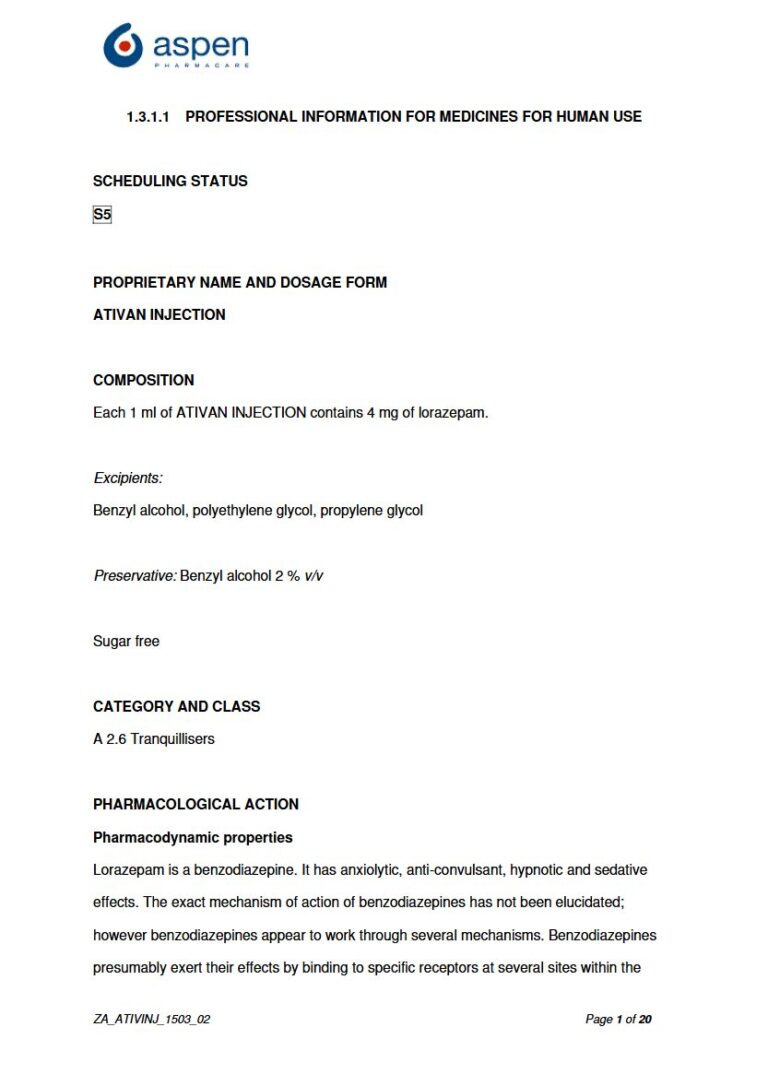
Ativan Injection
Clinical Summary
Quick overview from the medicine insert
Indication
Management of anxiety disorders, preoperative sedation, and as an adjunct in the treatment of status epilepticus.
Dosage (summary)
Initial dose of 1-2 mg IV, may be repeated every 4-6 hours as needed, not to exceed 10 mg/day.
Onset of Action / Duration
Onset of action is typically within 15-30 minutes; duration of effect is approximately 6-8 hours.
Special Populations
- Elderly patients
- Patients with hepatic impairment
- Patients with renal impairment
Pregnancy & Breastfeeding
Use during pregnancy only if the potential benefit justifies the potential risk to the fetus. Lorazepam is excreted in breast milk; caution is advised when administered to nursing mothers.
Key Drug Interactions
- CNS depressants (e.g., alcohol, opioids) may enhance sedative effects.
- CYP3A4 inhibitors may increase lorazepam levels.
- CYP3A4 inducers may decrease lorazepam levels.
Contraindications
- Hypersensitivity to lorazepam or any component of the formulation.
- Severe respiratory insufficiency.
- Sleep apnea syndrome.
Common side effects
- Drowsiness
- Dizziness
- Confusion
- Ataxia
- Hypotension
Counselling Points
- Avoid alcohol and other CNS depressants while taking lorazepam.
- Do not abruptly discontinue use after prolonged therapy to avoid withdrawal symptoms.
- Inform healthcare provider if pregnant, planning to become pregnant, or breastfeeding.
Serious warnings
- Risk of dependence and withdrawal symptoms with prolonged use.
- Caution in patients with a history of substance abuse.
- May impair ability to drive or operate machinery.
Important Disclaimer
The Ativan Injection professional information leaflet below is the property of Pharmacare and is provided on Medinsert exactly as issued, with no.. alterations or editorial changes. We make every effort to keep content current by updating documents as soon as new versions become available. Medinsert serves as a trusted access point for healthcare professionals, but does not replace official sources or clinical judgement. For more details, please read our full disclaimer. read more>>
 Healthcare Professionals Only
This content is for registered healthcare professionals
Sign in or create a free account to read the full package insert.
Free for HPCSA-registered professionals. Powered by Medinsert.
Clinical Particulars
Section 4 of the official insert — extracted exactly as issued, no alterations
4.1 Therapeutic indications
u2022 As premedication to relieve anxiety and tension, and to diminish recall of events associated with major or minor surgical and diagnostic procedures.
u2022 Symptomatic relief of acute anxiety (IV administration preferred).
u2022 ATIVAN INJECTION is indicated only when the disorder has not responded to non medicine therapy, and is severe, disabling, or subjecting the individual to unacceptable distress. Anxiety or tension associated with the stress of everyday life usually does not require treatment with an anxiolytic.
u2022 Control of status epilepticus caused by various partial and generalised types. Among the seizures known to respond to ATIVAN INJECTION are: generalised (tonic-clonic, u201cgrand - malu201d) seizures, generalised absence (u201cpetit malu201d) seizures or spike-wave stupor, partial elementary (focal motor) seizures, partial complex (psychomotor) seizures, and combinations such as generalised seizures with focal onset. Initial treatment with ATIVAN INJECTION results in prolonged cessation of seizure activity. ATIVAN INJECTION is not recommended for maintenance treatment of epilepsy. After seizures are controlled, medicines useful in the prevention of further seizures should be administered. In the treatment of status epilepticus due to reversible metabolic derangement (e.g. hypoglycaemia, hypocalcaemia, hyponatraemia, etc.), immediate efforts should be made to correct the specific defect.
4.2 Posology and method of administration
Dosage and duration of therapy should be individualised. The lowest effective dose should be prescribed for the shortest time possible. Treatment in all patients should be withdrawn gradually to minimise possible withdrawal symptoms (see WARNINGS AND SPECIAL PRECAUTIONS).
Route of administration
ATIVAN INJECTION can be given intravenously or intramuscularly. However, the intravenous route is to be preferred. Care should be taken to avoid injection into small veins and intra-arterial injection (see WARNINGS AND SPECIAL PRECAUTIONS).
Absorption from the injection site is considerably slower if the intramuscular route is used and as rapid an effect may be obtained by oral administration of lorazepam. ATIVAN INJECTION should not be used for long-term chronic treatment.
Preparation of the injection
To facilitate withdrawal of solution from the ampoule of ATIVAN INJECTION, 1 ml of sterile water for injection or normal saline for injection may be added to the ampoule immediately before injection (i.e. 1:1 dilution).
For IM administration, inject deeply into the upper outer quadrant of the gluteal region with a 21 gauge needle. For IV administration, inject with a 21 to 23 gauge needle. Intravenous injection should be made slowly and with repeated aspiration.
Premedication
For maximum beneficial effect, dosage should be based on body weight (usual dose will be 2 mg to 4 mg) and administration as follows:
- IV - 0,05 mg/kg (3,5 mg for an average 70 kg man), 30 to 45 minutes before the anticipated operative procedure for optimum effect. Sedation will be evident after 5 to 10 minutes and maximal loss of recall will occur after 30 to 45 minutes. This dose will suffice for sedating most adult patients, and should not ordinarily be exceeded in patients over 50 years of age.
- IM - 0,05 mg/kg at least two hours before the anticipated operative procedure for optimum effect. Sedation will be evident after 30 to 45 minutes and maximal loss of recall will occur after 60 to 90 minutes.
Note: In the elderly and/or debilitated patients, and in those with serious respiratory or cardiovascular disease, a reduction of dosage is recommended. In the case of local anaesthesia and diagnostic procedures requiring patient co-operation, concomitant use of an analgesic is recommended. It is recommended that any concomitant medications be administered in separate syringes.
Administering lorazepam 1 mg to 2,5 mg orally is recommended on the evening before surgery to relieve anxiety and promote sleep.
Acute anxiety
In acute cases of anxiety with or without psychomotor agitation (and depending on its aetiology, severity, and the mass of the patient), the recommended initial dose is 0,025 mg/kg to 0,03 mg/kg (1,75 mg to 2,1 mg for an average 70 kg man). Repeat 6 hourly. Once the acute symptomatology has been controlled, the patient should be placed on oral treatment if further treatment is required.
Status epilepticus
Status epilepticus due to various partial and generalised seizure types: The usual recommended initial dose of ATIVAN INJECTION is 4 mg given by slow intravenous injection (2 mg/min) for patients 18 years and older. If seizures continue or recur after a 10 to 14 minute observation period, an additional intravenous dose of 4 mg may be administered. If the second dose does not result in seizure control after another 10 to 15 minute observation period, other measures to control status epilepticus should be employed. A maximum of 8 mg only of lorazepam should be administered during a 12 hour period. The elderly may respond to lower doses and half the adult dose may be sufficient. Patients with renal or hepatic impairment: Lower doses may be sufficient in these patients. Use in patients with severe hepatic insufficiency is contraindicated (see CONTRAINDICATIONS and WARNINGS AND SPECIAL PRECAUTIONS).
4.3 Contraindications
ATIVAN INJECTION is contraindicated in:
- Safety in pregnancy has not been established.
- Known sensitivity or history of hypersensitivity to benzodiazepines, or to any ingredients contained in ATIVAN INJECTION.
- Pre-existing central nervous system (CNS) depression or coma.
- Respiratory insufficiency.
- Sleep apnoea syndrome.
- Myasthenia gravis.
- Severe hepatic insufficiency.
- ATIVAN INJECTION is not recommended for out-patient use unless the patient is accompanied.
- Children less than 12 years of age.
4.4 Special warnings and precautions for use
Severe anaphylactic/anaphylactoid reactions have been reported with the use of benzodiazepines, including ATIVAN INJECTION. Angioedema involving the tongue, glottis or larynx have been reported in patients after taking the first or subsequent doses of benzodiazepines, including ATIVAN INJECTION. Some patients taking benzodiazepines, such as ATIVAN INJECTION, have had additional symptoms such as dyspnoea, pharangeal closing, or nausea and vomiting. Some patients have required medical therapy in the emergency department. If angioedema involves the tongue, glottis or larynx, airway obstruction may occur and be fatal. Patients who develop angioedema after treatment with ATIVAN INJECTION should not be rechallenged.
Patients should be warned not to operate dangerous machinery or motor vehicles until it is known that they do not become drowsy or dizzy from ATIVAN INJECTION. Patients should be advised that since their tolerance for alcohol and other central nervous system depressants will be diminished in the presence of ATIVAN INJECTION, these substances should either be avoided or taken in reduced dosage.
ATIVAN INJECTION is not intended for the primary treatment of psychotic illness or depressive disorders, and should not be used alone to treat patients with depression. The use of benzodiazepines, such as ATIVAN INJECTION, may have a disinhibiting effect and may release suicidal tendencies in patients with depression. The need for continued therapy with ATIVAN INJECTION should be determined periodically. ATIVAN INJECTION therapy should be discontinued gradually.
Pre-existing depression may emerge or worsen during ATIVAN INJECTION use. The use of ATIVAN INJECTION may unmask suicidal tendencies in depressed patients and should not be used without adequate antidepressant therapy. Caution should be exercised in treating patients suffering from anxiety accompanied by an underlying depressive disorder. Anxiety may be a symptom of several other disorders. The possibility should be considered that the complaint may be related to an underlying physical or psychiatric disorder for which there is specific treatment. In patients with anxiety accompanying depression, the possibility of attempted suicide should be borne in mind.
In patients where gastrointestinal or cardiovascular disorders coexist with anxiety, it should be noted that ATIVAN INJECTION has not been shown to be of significant benefit in treating the gastrointestinal or cardiovascular component.
The possibility that respiratory arrest may occur or that the patient may have partial airway obstruction should be considered in heavily sedated patients. Intravenous ATIVAN INJECTION, when given alone in greater than the recommended dose, or at the recommended dose and accompanied by other medicines used during the administration of anaesthesia, may produce heavy sedation; and equipment necessary to maintain a patientu2019s airway and to support respiration/ventilation should be available (see CONTRAINDICATIONS).
Potentially fatal respiratory depression due to depressant effects on the respiratory centre, and cardiovascular collapse may occur following intravenous and intramuscular administration.
ATIVAN INJECTION should not be injected intra-arterially since intra-arterial injection may produce arterial vasospasm resulting in gangrene, which may require amputation.
Withdrawal symptoms can occur following cessation of recommended doses after as little as one week of therapy or abrupt cessation of ATIVAN INJECTION treatment. Symptoms reported following discontinuation of oral benzodiazepines include headaches, muscle pain, anxiety, tension, depression, insomnia, restlessness, confusion, irritability, sweating, and the occurrence of u201creboundu201d phenomena whereby the symptoms that led to treatment with benzodiazepines recur in an enhanced form. These symptoms may be difficult to distinguish from the original symptoms for which ATIVAN INJECTION was prescribed.
In severe cases the following symptoms may occur: derealisation; depersonalisation; hyperacusis; tinnitus; numbness and tingling of the extremities; hypersensitivity to light, noise, and physical contact; involuntary movements; vomiting; hallucinations; convulsions. Convulsions may be more common in patients with pre-existing seizure disorders or who are taking other medicines that lower the convulsive threshold, such as antidepressants.
Transient amnesia or memory impairment has been reported in association with the use of ATIVAN INJECTION. Disturbance in behaviour and/or thought has been reported.
ATIVAN INJECTION contains the excipients polyethylene glycol and propylene glycol. There have been rare reports of propylene glycol toxicity (e.g. lactic acidosis, hyperosmolality, hypotension) and polyethylene glycol toxicity (e.g. acute tubular necrosis) during administration of ATIVAN INJECTION at higher than recommended doses. Central nervous system toxicity, including seizures, as well as unresponsiveness, tachypnoea, tachycardia and diaphoresis have also been associated with propylene glycol toxicity. Symptoms may be more likely to develop in patients with renal or hepatic impairment and in paediatric patients.
It is recommended that patients receiving ATIVAN INJECTION should remain under observation for at least 24 hours after the last injection and preferably overnight. When ATIVAN INJECTION is used for short procedures on an outpatient basis, the patient should be accompanied when discharged.
Some patients taking benzodiazepines, such as ATIVAN INJECTION, have developed blood dyscrasias, and some have had elevations in liver enzymes. Periodic blood counts and liver function tests are recommended for patients on long-term therapy.
Caution should be exercised in the treatment of patients with acute narrow-angle glaucoma or myasthenia gravis (see CONTRAINDICATIONS). Patients suffering from impairment of renal or hepatic function should be treated with caution and should be monitored frequently and have their dosage adjusted carefully according to patient response. Lower doses are indicated in these patients (see DOSAGE AND DIRECTIONS FOR USE). The same precautions apply to elderly or debilitated patients who are at particular risk of over sedation, respiratory depression and ataxia (initial dosage should be reduced in these patients) and patients with severe respiratory insufficiency (e.g. Chronic Obstructive Pulmonary Disease, sleep apnoea syndrome) (see CONTRAINDICATIONS).
The use of benzodiazepines, such as ATIVAN INJECTION, may precipitate encephalopathy in patients with severe hepatic insufficiency. Therefore, ATIVAN INJECTION should be used with caution in patients with severe hepatic insufficiency and/or encephalopathy.
Paradoxical reactions such as restlessness, agitation, irritability, aggressiveness, delusion, rage, nightmares, hallucinations, psychoses, and inappropriate behaviour have been reported during ATIVAN INJECTION use (see SIDE EFFECTS). Such reactions may be more likely to occur in children and the elderly. Should these occur, administration of ATIVAN INJECTION should be discontinued.
Although hypotension has occurred, ATIVAN INJECTION should be administered with caution to patients in whom a drop in blood pressure might lead to cardiovascular or cerebrovascular complications. This is particularly important in elderly patients.
Lack of clinical experience with ATIVAN INJECTION precludes its use in patients less than 12 years of age (see CONTRAINDICATIONS).
A reduction in the dose of narcotics and/or analgesics may be required when used in combination with ATIVAN INJECTION. There is a potential for abuse. The use of ATIVAN INJECTION may lead to physical and psychological dependence. When used at appropriate doses for short-term treatment of anxiety, the dependence potential is low. The risk of dependence increases with higher doses and longer term use and is further increased in patients with a history of alcoholism or drug abuse or in patients with significant personality disorder. Therefore, use in persons who are drug addicts or alcoholics should be avoided.
If physical dependence develops, abrupt termination of treatment may be accompanied by withdrawal symptoms. Withdrawal symptoms, especially the more serious ones, are more common in those patients who have received high doses over an extended period of time. However, withdrawal symptoms have also been reported following abrupt discontinuance of benzodiazepines, such as ATIVAN INJECTION, taken continuously at therapeutic levels, especially when discontinuation was abrupt. Since the risk of withdrawal/rebound phenomena is greater after abrupt discontinuation, ATIVAN INJECTION should be discontinued gradually.
Care should be exercised when administering ATIVAN INJECTION to a patient with status epilepticus, especially when the patient has received other central nervous system depressants or is severely ill. The possibility that respiratory arrest may occur or that the patient may have partial airway obstruction, should be considered. Proper resuscitation equipment should be available.
The duration of treatment should be as short as possible (see DOSAGE AND DIRECTIONS FOR USE). Extension beyond these periods should not take place without revaluation of the situation. It is important that the patients should be aware of the possibility of rebound phenomena, thereby minimising anxiety over such symptoms, should they occur while ATIVAN INJECTION is being discontinued.
4.5 Interactions with other medicines
Alcohol: The sedative effects of ATIVAN INJECTION may be enhanced when used in combination with alcohol. This affects the ability to drive or use machines (see Effects on ability to drive and use machines).
CNS depressants: The benzodiazepines, including ATIVAN INJECTION , produce additive CNS depressant effects when co-administered with other medications which themselves produce CNS depression, e.g. barbiturates, antipsychotics, sedatives/hypnotics, anxiolytics, antidepressants, narcotic analgesics, sedative antihistamines, anticonvulsants and anaesthetics.
Clozapine: Concomitant use of clozapine and ATIVAN INJECTION may produce marked sedation, excessive salivation, and ataxia.
Loxapine: There have been reports of stupor, significant reduction in respiratory rate, and hypotension when ATIVAN INJECTION and loxapine were given concomitantly.
Sodium valproate: Concurrent administration of ATIVAN INJECTION with sodium valproate may result in reduced clearance (20 % to 40 %) and increased concentrations of ATIVAN INJECTION . ATIVAN INJECTION dosage should be reduced to approximately 50 % when co-administered with valproate. Clinical monitoring is advised and ATIVAN INJECTION dosage should be reduced when appropriate.
Probenecid: Concurrent administration of ATIVAN INJECTION with probenecid may result in reduced clearance, increased elimination half-life and increased concentrations of ATIVAN INJECTION . Clinical monitoring is advised and ATIVAN INJECTION dosage should be reduced when appropriate.
Narcotic analgesics: An enhancement of the euphoria induced by narcotic analgesics may occur with benzodiazepine use, including ATIVAN INJECTION , leading to an increase in psychic dependence.
Cytochrome P450 inhibitors: Medicines which inhibit certain hepatic enzymes (particularly cytochrome P450 such as certain antibiotics (clarithromycin, ciprofloxacin)) may enhance the activity of benzodiazepines, including ATIVAN INJECTION . To a lesser degree this also applies to benzodiazepines which are metabolised only by conjugation.
Hyoscine butyl bromide: The addition of hyoscine butyl bromide to ATIVAN INJECTION is not recommended, since their combination has been observed to cause an increased incidence of sedation, hallucination and irrational behaviour.
Xanthine: Administration of theophylline or aminophylline may reduce the sedative effects of benzodiazepines, including ATIVAN INJECTION .
Haloperidol: There have been reports of apnoea, coma, bradycardia, heart arrest and death with the concomitant use of ATIVAN INJECTION and haloperidol.
4.6 Fertility, pregnancy and lactation
Pregnancy
Safety in pregnancy has not been established. ATIVAN INJECTION should not be used during pregnancy (see CONTRAINDICATIONS). ATIVAN INJECTION may cause foetal damage when administered to pregnant women. An increased risk of congenital malformations associated with the use of benzodiazepines has been suggested in studies. Neonates born from women using benzodiazepines such as ATIVAN INJECTION may present with withdrawal symptoms during the postnatal period. Symptoms such as hypoactivity, hypotonia, hypothermia, respiratory depression, apnoea, feeding problems, and impaired metabolic response to cold stress have been reported in neonates born of mothers who have received benzodiazepines during the late phase of pregnancy or at delivery. Given during labour, it crosses the placenta and may cause the floppy-infant syndrome characterised by central respiratory depression, hypothermia and poor sucking. Neonates appear to conjugate lorazepam slowly, the glucuronide being detectable in the urine for more than seven days. Glucuronidation of lorazepam may competitively inhibit the conjugation of bilirubin, leading to hyperbilirubinaemia in the newborn. ATIVAN INJECTION is not recommended for obstetrical use (see CONTRAINDICATIONS).
Lactation
ATIVAN INJECTION should not be administered to breastfeeding women. Evidence to date indicates that ATIVAN INJECTION is excreted in breast milk. Sedation and inability to suckle have occurred in neonates of lactating mothers taking benzodiazepines. Infants of lactating mothers should be observed for pharmacological effects (including sedation and irritability).
4.7 Effects on ability to drive and use machines
Patients should be warned not to operate dangerous machinery or motor vehicles until it is known that they do not become drowsy or dizzy from ATIVAN INJECTION (see SIDE EFFECTS). Sedation, amnesia, impaired concentration and impaired muscular function may adversely affect the ability to drive or use machines. Therefore, patients should not drive or undertake activities requiring maximum attentiveness within 24 hours to 48 hours of administration of ATIVAN INJECTION and should be advised not to take alcohol. In these situations, impaired decision-making could lead to accidents (see INTERACTIONS).
4.8 Undesirable effects
Blood and the lymphatic system disorders
Less frequent: Blood dyscrasia, thrombocytopenia, agranulocytosis, pancytopenia
Immune system disorders
Less frequent: Hypersensitivity reactions, anaphylactic/anaphylactoid reactions, angioedema
Endocrine disorders
Less frequent: Syndrome of Inappropriate Antidiuretic Hormone secretion (SIADH)
Metabolism and nutrition disorders
Less frequent: Hyponatraemia
Psychiatric disorders
Frequent: Confusion, depression, unmasking of depression
Less frequent: Paradoxical reactions such as anxiety, agitation, excitation, hostility, aggression, rage, insomnia, sexual arousal and hallucinations, disinhibition, euphoria, suicidal ideation/attempt
Nervous system disorders
Frequent: Drowsiness, sedation, ataxia, dizziness
Less frequent: Vertigo, extrapyramidal symptoms, tremor, vertigo, dysarthria/slurred speech, headache, convulsions, amnesia, coma
Eye disorders
Less frequent: Visual disturbances
Vascular disorders
Less frequent: Hypertension, hypotension
Respiratory, thoracic and mediastinal disorders
Less frequent: Respiratory depression, apnoea, worsening of sleep, worsening of obstructive pulmonary disease
Gastrointestinal disorders
Less frequent: Nausea, vomiting, appetite changes, changes in salivation, constipation
Hepato-biliary disorders
Less frequent: Jaundice, abnormal liver function tests including increases in bilirubin, increase in liver transaminases, increase in alkaline phosphatase
Skin and subcutaneous tissue disorders
Less frequent: Allergic skin reactions, alopecia
Musculoskeletal, connective tissue and bone disorders
Frequent: Muscle weakness, asthenia
Renal and urinary disorders
Less frequent: Urinary retention or incontinence
Reproductive system and breast disorders
Less frequent: Change in libido, impotence, decreased orgasm
General disorders and administrative site conditions
Frequent: Fatigue
Less frequent: Lethargy, stinging or painful sensation at the injection site, hypothermia
4.9 Overdose
Symptoms
Overdosage of benzodiazepines, such as ATIVAN INJECTION, is usually manifested by degrees of central nervous system depression ranging from drowsiness to coma. In mild cases, symptoms include drowsiness, mental confusion and lethargy. In more serious cases, and especially when other CNS-depressant medicines or alcohol are ingested, symptoms may include ataxia, hypotension, hypotonia, respiratory depression, cardiovascular depression, coma and, very rarely, death. Propylene glycol toxicity and polyethylene glycol toxicity have been reported following higher than recommended doses of ATIVAN INJECTION.
Treatment
Treatment of overdosage is mainly supportive including monitoring of vital signs and close observation of the patient. An adequate airway should be maintained and assisted respiration used as needed. Hypotension, though unlikely, may be controlled with noradrenaline. ATIVAN INJECTION is poorly dialysable. The benzodiazepine antagonist, flumazenil, may be useful in hospitalised patients for the management of benzodiazepine overdosage. Flumazenil product information should be consulted prior to use. The physician should be aware of a risk of seizure in association with flumazenil treatment, particularly in long-term benzodiazepine users and in tricyclic antidepressant overdose.
