
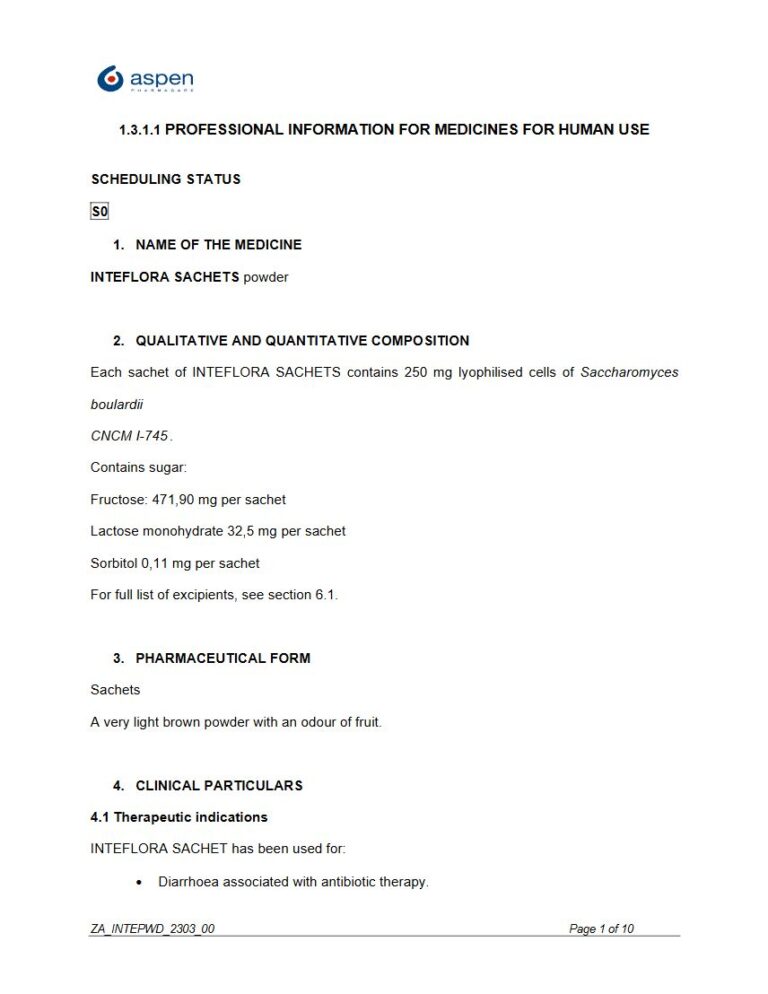
Inteflora Sachets 250 mg
PDF Leaflet Revision Date: 31 March 2023
Clinical Summary
Quick overview from the medicine insert
Indication
Diarrhoea associated with antibiotic therapy and non-specific acute diarrhoea.
Dosage (summary)
Adults: 2 sachets twice daily for antibiotic-associated diarrhoea; 1 sachet twice daily for non-specific diarrhoea. Infants/children: 1 sachet twice daily.
Special Populations
- Infants
- Elderly
- Immunocompromised
Pregnancy & Breastfeeding
Not established; preferable to avoid during pregnancy and lactation.
Key Drug Interactions
- Oral or systemic antifungals
- Alcohol
Contraindications
- Hypersensitivity to components
- Central venous catheter
- Critically ill patients
- Lactose intolerance
- Fructose intolerance
Common side effects
- Flatulence
- Constipation
- Allergic reactions
Counselling Points
- Rehydrate adequately
- Do not open sachets near patients with catheters
- Consult if diarrhoea persists after 2 days
Serious warnings
- Risk of fungaemia in immunocompromised patients
- Do not mix with hot beverages or alcohol
Important Disclaimer
The Inteflora Sachets 250 mg professional information leaflet below is the property of Pharmacare and is provided on Medinsert exactly as issued, with no.. alterations or editorial changes. We make every effort to keep content current by updating documents as soon as new versions become available. Medinsert serves as a trusted access point for healthcare professionals, but does not replace official sources or clinical judgement. For more details, please read our full disclaimer. read more>>
 Healthcare Professionals Only
This content is for registered healthcare professionals
Sign in or create a free account to read the full package insert.
Free for HPCSA-registered professionals. Powered by Medinsert.
Clinical Particulars
Section 4 of the official insert — extracted exactly as issued, no alterations
4.1 Therapeutic indications
INTEFLORA SACHET has been used for:
- Diarrhoea associated with antibiotic therapy.
- Non-specific acute diarrhoea. Suitable for use in infants, children, adults and in the elderly.
4.2 Posology and method of administration
May be taken in conjunction with antibiotics and other anti-diarrhoeal medication. Length of treatment can range from 1 week to 3 weeks.
Diarrhoea associated with antibiotic therapy
- Adults: Take two sachets twice a day.
Non-specific acute diarrhoea
- Adults: Take one sachet twice a day.
Paediatric population
Diarrhoea associated with antibiotic therapy
- Infants and children: Give one sachet twice a day.
Non-specific acute diarrhoea
- Infants and children: Give one sachet twice a day.
Method of administration
For oral administration. Pour the contents of the sachet(s) in a little amount of water or sweetened beverage, mix and drink immediately (see section 4.4). Due to a risk of airborne contamination, sachets should not be opened in patient rooms. Healthcare providers should wear gloves during handling of probiotics for administration, then promptly discard the gloves and properly wash their hands (see section 4.4).
4.3 Contraindications
INTEFLORA SACHET is contraindicated in:
- Patients with a known hypersensitivity to any component contained in INTEFLORA SACHET (see sections 2 and 6.1).
- Patients with a central venous catheter in situ.
- Critically ill patients or immunocompromised patients due to risk of fungaemia (see section 4.4).
- Because of the presence of lactose, this medicine is contraindicated in patients with congenital galactosaemia, glucose and galactose malabsorption syndrome or lactase deficiency (see section 4.4).
- Because of the presence of fructose and sorbitol, this medicine is contraindicated in patients with fructose intolerance (see section 4.4).
- Patients taking alcohol.
- Patients taking oral or systemic antifungal medicines (see section 4.5).
4.4 Special warnings and precautions for use
INTEFLORA SACHET should not be opened in close proximity of patients with a venous central catheter or with a peripheral catheter, even not treated with Saccharomyces boulardii to avoid any colonisation of the catheter, transmitted by the hands and/or the spread of microorganisms by air (see section 4.2 Method of administration). There have been cases of fungaemia (and blood cultures positive for Saccharomyces strains) and sepsis reported mostly in patients with central venous catheter, critically ill or immunocompromised patients, most often resulting in pyrexia. In most cases, the outcome has been satisfactory after cessation of treatment by Saccharomyces boulardii, administration of antifungal treatment and removal of the catheter when necessary. However, the outcome was fatal in some critically ill patients (see sections 4.3 and 4.8). In infants and children, if diarrhoea persists after 2 days of treatment, treatment must be reviewed and the need for rehydration using an oral or intravenous solution envisaged. Diarrhoea may be a symptom of a more serious underlying disease. If diarrhoea persists for more than 2 days, or there is blood in stools, or fever develops, treatment should be reconsidered. In infants, children and adults be aware of the following:
- Rehydration by drinking copious amounts of salty or sweet drinks is recommended, in order to compensate for fluid losses due to diarrhoea.
- INTEFLORA SACHET should not be used concomitantly with antifungals (see sections 4.3 and 4.5).
- Since INTEFLORA SACHET consist of living cells, do not mix the content of INTEFLORA SACHET with liquid or food which are too hot (more than 50 u00b0C), iced or contains alcohol (see sections 4.2 and 4.3). Therefore INTEFLORA SACHET should not be used concomitantly with hot beverages, ice cream and alcohol (see section 4.2 and 4.3).
Excipients INTEFLORA SACHET contains lactose, fructose and sorbitol. Patients with hereditary fructose intolerance (HFI), rare hereditary problems of galactose intolerance, total lactase deficiency or glucose-galactose malabsorption should not take INTEFLORA SACHET.
4.5 Interaction with other medicines and other forms of interaction
Because of its fungal nature, do not combine INTEFLORA SACHET with an oral or systemic antifungal medication (see section 4.3).
4.6 Fertility, pregnancy and lactation
Safety of INTEFLORA SACHET in pregnancy and lactation has not been established.
Pregnancy
It is preferable, as a precautionary measure, not to use this medicine during pregnancy.
Lactation
It is preferable, as a precautionary measure, not to use this medicine during lactation.
Fertility
No data.
4.7 Effects on ability to drive and use machines
INTEFLORA SACHET is not expected to influence on the ability to drive and use machines as Saccharomyces boulardii CNCM I - 745, as contained in INTEFLORA SACHET, is not absorbed into the blood.
4.8 Undesirable Effects
a) Tabulated list of adverse reactions
System organ class
- Rare
- Very rare
- Unknown
Infections and infestations
- Fungemia in patients with a central venous catheter, and in hospitalised, immunocompromised patients (see section 4.4).
- Sepsis in critically ill or immunocompromised patients
Immune system disorders
- Anaphylactic reaction or even shock
Gastrointestinal disorders
- Flatulence
- Constipation
Skin and subcutaneous tissue disorders
- Allergic reactions: pruritus, wheal formation (urticaria), skin rash, either locally restricted or affecting the entire body (local or generalized exanthema), swelling of the connective tissue of the face (angioedema).
Reporting of suspected adverse reactions
Reporting suspected adverse reactions after authorisation of the medicine is important. It allows continued monitoring of the benefit/risk balance of the medicine. Healthcare providers are asked to report any suspected adverse reactions to: SAHPRA: https://www.sahpra.org.za/Publications/Index/8 Aspen Pharmacare: E-mail: [email protected] Tel: 0800 118 088
4.9 Overdose
Saccharomyces boulardii CNCM I - 745 is not absorbed into the blood circulation and any overdose is merely excreted via the gastrointestinal tract.
