
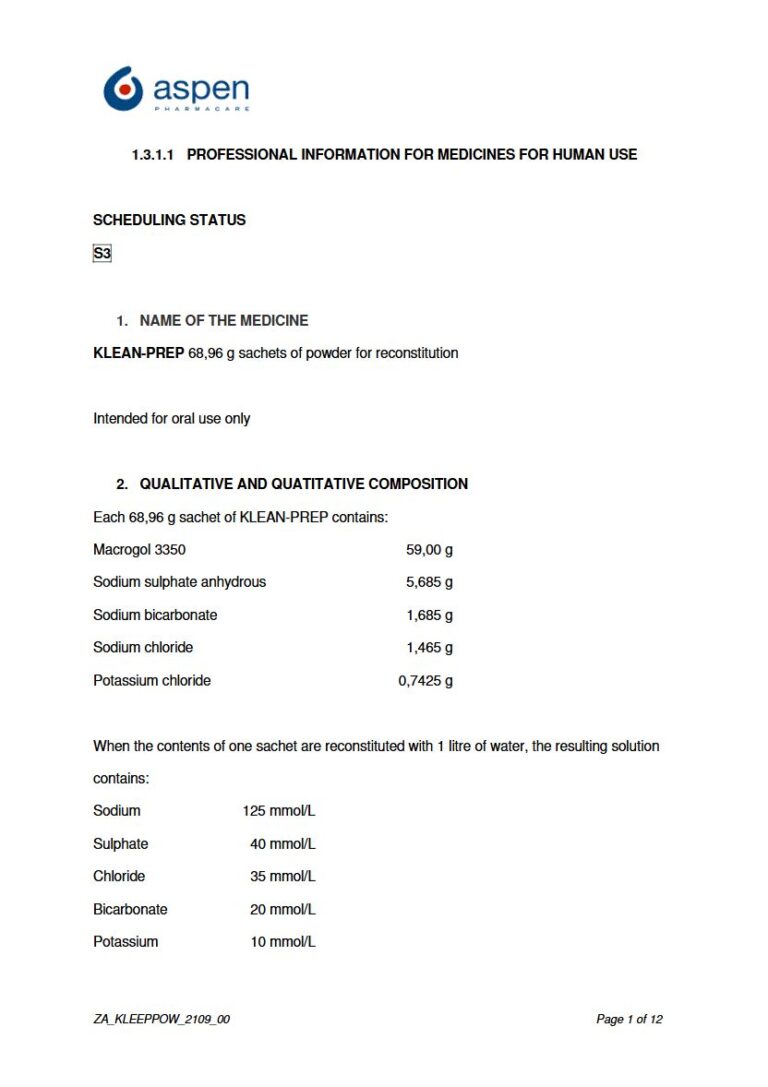
Klean-Prep 68.96 g Sachets of powder for reconstitution
PDF Leaflet Revision Date: 23 September 2021
Clinical Summary
Quick overview from the medicine insert
Indication
Bowel preparation before colonoscopy and related procedures.
Dosage (summary)
3 to 4 sachets dissolved in 1 litre of water, consumed within 4-6 hours.
Onset of Action / Duration
Onset: 1-2 hours, Duration: Not specified
Special Populations
- Renal impairment
- Paediatric population
Pregnancy & Breastfeeding
Safety in pregnancy not established; use in lactation only if essential.
Key Drug Interactions
- Oral medicines should be given at least one hour prior
- Iron tablets should be discontinued four days before
Contraindications
- Hypersensitivity to ingredients
- Gastrointestinal obstruction
- Congestive cardiac failure
- Body mass < 20 kg
- Children < 12 years
- Pregnancy
Common side effects
- Nausea
- Vomiting
- Abdominal pain
- Electrolyte disturbances
- Dizziness
Counselling Points
- Maintain adequate fluid intake
- No solid food 2 hours before use
- Monitor for abdominal pain or rectal bleeding
Serious warnings
- Risk of serious dysrhythmias
- Caution in patients with electrolyte disturbances
- Aspiration risk in unconscious patients
Important Disclaimer
The Klean-Prep 68.96 g Sachets of powder for reconstitution professional information leaflet below is the property of Pharmacare and is provided on Medinsert exactly as issued, with no.. alterations or editorial changes. We make every effort to keep content current by updating documents as soon as new versions become available. Medinsert serves as a trusted access point for healthcare professionals, but does not replace official sources or clinical judgement. For more details, please read our full disclaimer. read more>>
 Healthcare Professionals Only
This content is for registered healthcare professionals
Sign in or create a free account to read the full package insert.
Free for HPCSA-registered professionals. Powered by Medinsert.
Clinical Particulars
Section 4 of the official insert — extracted exactly as issued, no alterations
4.1. Therapeutic indications
KLEAN-PREP is indicated for
- Bowel preparation before colonoscopy, colonic surgery, radiological examination and other related procedures.
4.2. Posology and method of administration
Extended use is not recommended. Iron tablets should be discontinued four days before hand and no constipating medicines (e.g. codeine) should be taken on the day of examination. Eat no solid food from at least 2 hours before taking KLEAN-PREP until after the investigation.
However, clear fluids (tea or coffee without milk, soft drinks, clear soup) may be drunk during this time.
Adults Each sachet should be dissolved in 1 litre of water. The usual dose is 3 to 4 sachets, usually taken at a rate of 250 ml every 10 to 15 minutes until all the solution has been consumed, the rectal effluent is clear, or as directed by the physician. The solution is more palatable if chilled. The solution from all four sachets should be drunk within 4 to 6 hours. KLEAN-PREP can either be given in the evening before or on the morning of the procedure. Alternatively, administration may be divided, for example, taking 2 sachets during the evening before the examination, and the remaining 2 sachets on the morning of the examination. KLEAN-PREP is designed to cleanse the bowel and will cause diarrhoea-like watery bowel movements. The first of these liquid bowel movements should occur within 1 to 2 hours of starting to drink KLEAN-PREP solution. No dosage changes need to be made for patients with renal insufficiency. If administered by nasogastric tube, the rate of administration should be 20 ml to 30 ml per minute (see section 4.4).
Special populations Renal impairment No dosage adjustment need be made. Paediatric population There is no recommended dosage. Method of administration For oral administration
4.3. Contraindications
KLEAN-PREP is contraindicated in:
- Patients with hypersensitivity to macrogol 3350, sodium sulphate anhydrous, sodium bicarbonate, sodium chloride, potassium chloride or to any of the excipients in KLEAN-PREP (section 6.1).
- Patients with gastrointestinal obstruction or perforation, ileus, gastric retention, acute intestinal or gastric ulceration, toxic colitis or toxic megacolon.
- Patients with congestive cardiac failure (NYHA class III of IV)
- Patients with a body mass of less than 20 kg or children under the age of 12 years.
- Pregnancy (see section 4.6).
4.4. Special warnings and precautions for use
Fluid intake The fluid content of KLEAN-PREP when reconstituted with water does not replace regular fluid intake and adequate fluid intake must be maintained.
Solid food intake No solid food should be eaten for at least 2 hours before taking KLEAN-PREP. The product should only be administered with caution to patients with impaired gag reflex, reflux oesophagitis, or those with diminished levels of consciousness and patients with ulcerative colitis or Crohnu2019s disease.
Patients with concomitant conditions KLEAN-PREP should be administered with caution to patients with an impaired gag reflex, reflux oesophagitis, those with diminished levels of consciousness and patients with ulcerative colitis or Crohnu2019s disease. KLEAN-PREP should be used with caution in patients with severe acute inflammatory bowel disease.
Dysrhythmias There have been reports of serious dysrhythmias including atrial fibrillation associated with the use of ionic osmotic laxatives for bowel preparation. These occur predominantly in patients with underlying cardiac risk factors and electrolyte disturbance.
Unconscious or semi-conscious patients or patients prone to aspiration Unconscious, semi-conscious patients or patients prone to aspiration or regurgitation should be observed during administration especially if this is via the nasogastric route. When KLEAN-PREP is administered by nasogastric tube, precautions should be taken to ensure that the tube is and remains appropriately placed. There have been reports of pulmonary oedema resulting from aspiration of macrogol lavage solutions, such as KLEAN-PREP, requiring immediate treatment.
Electrolyte disturbances Although not expected, due to the isotonic composition of KLEAN-PREP, cases of electrolyte disturbances have been reported in at-risk patients. Therefore, KLEAN-PREP should be used with care in patients at risk of electrolyte disturbance, such as patients with renal failure, mild (NYHA class I and II) congestive cardiac impairment (see section 4.3), or those simultaneously treated with diuretics. Convulsions associated with severe hyponatraemia in patients taking KLEAN-PREP have been reported (see section 4.8). Patients may also develop confusional state/disorientation associated with hyponatraemia (see section 4.8).
Gastrointestinal side effects Should nausea, vomiting, abdominal distension or pain arise, the rate of administration should be slowed down or temporarily stopped until symptoms subside.
Debilitated patient baseline tests In debilitated patients, patients with poor health, those with clinically significant renal impairment, dysrhythmia and those at risk of electrolyte imbalance, the medical practitioner should consider performing a baseline and post-treatment electrolyte, renal function test and ECG as appropriate.
Ischaemic colitis Post-marketing cases of ischaemic colitis, including serious, have been reported in patients treated with macrogol for bowel preparation. Macrogol should be used with caution in patients with known risk factors for ischaemic colitis or in case of concomitant use of stimulant laxatives (such as bisacodyl or sodium picosulfate). Patients presenting with sudden abdominal pain, rectal bleeding or other symptoms of ischaemic colitis should be evaluated promptly.
KLEAN-PREP contains 125 mmol (2,9 g) sodium per sachet of treatment and this must be taken into consideration in patients on a controlled sodium diet.
Excipients KLEAN-PREP contains aspartame, which is metabolised to phenylalanine. This may be harmful for patients with phenylketonuria.
4.5. Interaction with other medicines and other forms of interaction
All oral medicines (e.g. oral contraceptive tablet, anti-epileptics) should be given at least one hour prior to the administration of KLEAN-PREP. It should be noted that any oral medicine administered within an hour of administration of KLEAN-PREP may be flushed from the gastrointestinal tract and not absorbed. Iron tablets should be discontinued four days beforehand and no constipating medicines (e.g. codeine) taken on the day of examination (see section 4.2).
4.6. Fertility, pregnancy and lactation
The safety of KLEAN-PREP in pregnancy has not been established (see section 4.3).
Pregnancy There is no experience of use during pregnancy.
Lactation There is no data on the excretion of KLEAN-PREP in breast milk. As macrogol 3350, as in KLEAN-PREP is poorly absorbed, KLEAN-PREP may be taken if considered essential by the physician.
Fertility No data are available
4.7 Effects on ability to drive and use machines
There is no known effect on the ability to drive and use machines. Since adverse reactions such as dizziness have been reported in patients taking KLEAN-PREP, patients should not drive, use machinery or perform any tasks that require concentration, until they are certain that KLEAN-PREP does not adversely affect their ability to do so (see section 4.8).
4.8.Undesirable effects
a) Tabulated list of adverse reactions
System organ class Frequency unknown (cannot be estimated from the available data)
- Immune system disorders Allergic reactions including anaphylactic reaction, dyspnoea, skin reactions
- Metabolism and nutrition disorders Electrolyte disturbances, specifically hypokalaemia, hyponatraemia and dehydration.
- Nervous system disorders Convulsions, confusional state/disorientation, headaches and dizziness
- Cardiac disorders Transient increase in blood pressure, arrhythmia, palpitations.
- Gastrointestinal disorders Vomiting, nausea, abdominal pain, cramps, anal discomfort or irritation, abdominal distension, flatulence, borborygmi
- Skin and subcutaneous tissue disorders Allergic skin reactions including angioedema, urticaria, pruritus, rash, erythema.
- General disorders and administrative site conditions Rigors, malaise, pyrexia and thirst.
Reporting of suspected adverse reactions Reporting suspected adverse reactions after authorisation of the medicine is important. It allows continued monitoring of the benefit/risk balance of the medicine. Healthcare providers are asked to report any suspected adverse reactions to: SAHPRA: https://www.sahpra.org.za/health-products-vigilance/ Aspen Pharmacare: E-mail: [email protected] Tel: 0800 118 088
4.9.Overdose
Symptoms In cases of accidental overdose, where diarrhoea is severe, conservative measures are usually sufficient.
Treatment Generous amounts of fluid, especially fruit juices should be given. Monitoring and correction of electrolyte abnormalities.
