
Forcyl 16% 160 mg Solution for injection
PDF Leaflet Revision Date: 12 October 2021
Clinical Summary
Quick overview from the medicine insert
Indication
Treatment of respiratory and intestinal infections in cattle and pigs.
Dosage (summary)
Cattle: 10 mg/kg IM; Pigs: 8 mg/kg IM.
Special Populations
- Pregnant cows
- Pregnant sows
Pregnancy & Breastfeeding
Use only if benefit/risk assessed; safety not established in pregnant cows or sows.
Contraindications
- Hypersensitivity to fluoroquinolones
- Resistance to other fluoroquinolones
Common side effects
- Local reactions at injection site
- Transient pain and swelling
Counselling Points
- Avoid contact with skin and eyes
- Wash hands after use
- Seek medical care if self-injected
Serious warnings
- Risk of resistance development
- Potential for anaphylactic reactions
Important Disclaimer
The Forcyl 16% 160 mg Solution for injection professional information leaflet below is the property of Afrivet Business Management and is provided on Medinsert exactly as issued, with no.. alterations or editorial changes. We make every effort to keep content current by updating documents as soon as new versions become available. Medinsert serves as a trusted access point for healthcare professionals, but does not replace official sources or clinical judgement. For more details, please read our full disclaimer. read more>>
 Healthcare Professionals Only
This content is for registered healthcare professionals
Sign in or create a free account to read the full package insert.
Free for HPCSA-registered professionals. Powered by Medinsert.
Clinical Particulars
Section 4 of the official insert — extracted exactly as issued, no alterations
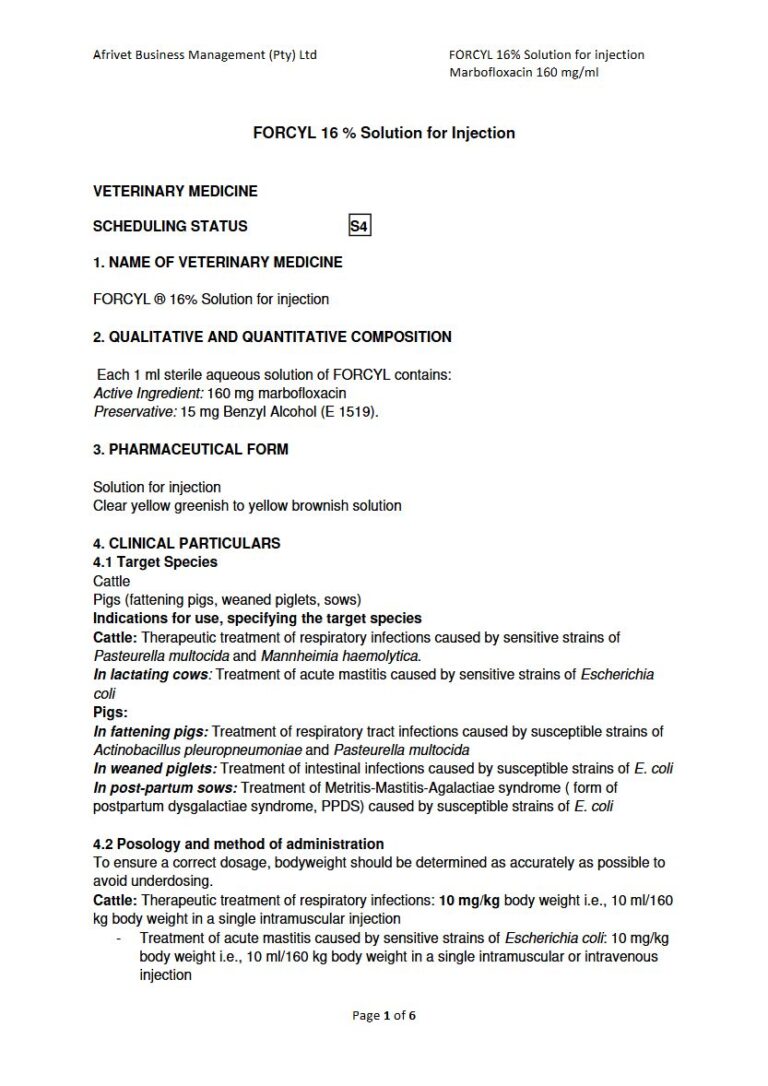
4.1 Target Species
Cattle
Pigs (fattening pigs, weaned piglets, sows)
Indications for use, specifying the target species
Cattle: Therapeutic treatment of respiratory infections caused by sensitive strains of Pasteurella multocida and Mannheimia haemolytica. In lactating cows: Treatment of acute mastitis caused by sensitive strains of Escherichia coli
Pigs: In fattening pigs: Treatment of respiratory tract infections caused by susceptible strains of Actinobacillus pleuropneumoniae and Pasteurella multocida. In weaned piglets: Treatment of intestinal infections caused by susceptible strains of E. coli. In post-partum sows: Treatment of Metritis-Mastitis-Agalactiae syndrome (form of postpartum dysgalactiae syndrome, PPDS) caused by susceptible strains of E. coli
4.2 Posology and method of administration
To ensure a correct dosage, bodyweight should be determined as accurately as possible to avoid underdosing.
Cattle: Therapeutic treatment of respiratory infections: 10 mg/kg body weight i.e., 10 ml/160 kg body weight in a single intramuscular injection - Treatment of acute mastitis caused by sensitive strains of Escherichia coli: 10 mg/kg body weight i.e., 10 ml/160 kg body weight in a single intramuscular or intravenous injection
If the volume to be injected in more than 20 ml, it should be divided between two or more injection sites.
Pigs: The recommended dose is 8 mg/kg body weight i.e., 1 ml/20 kg body weight in a single intramuscular injection in the side of the pig neck.
4.3 Contraindications
- Do no use in animals with known hypersensitivity to fluoroquinolones or to any of the excipients
- Do not use in cases where the pathogen involved is resistant to other fluoroquinolones (cross resistance)
4.4 Special warnings and precautions for use
Special warnings < for each target species >
Piglets: To limit development of resistance, do not use fluoroquinolones as prophylaxis or metaphylaxis during weaning
Lactating cows: The efficacy of the product has not been tested on mastitis caused by Gram positive bacteria
Special precautions for use
i) Special precautions for use in animals
Official and local antimicrobial policies should be considered when this product is used. Fluoroquinolones should be reserved for the treatment of clinical conditions which have responded poorly, or are expected to respond poorly, to other classes of antimicrobials. Wherever possible, use of the product should only be based on susceptibility testing.
Use of the product deviating from the instructions given in this PI may increase the prevalence of bacteria resistant to the fluoroquinolones and may decrease the effectiveness of treatment with other quinolones due to the potential for cross resistance.
ii) Special precautions to be taken by the person administering the veterinary medicine
People with known hypersensitivity to fluoroquinolones and benzyl alcohol should avoid any contact with the product. Wash hands after use. Avoid contact of the skin and eyes with the product. If the product comes into contact with the skin or eyes, rinse with copious amounts of water. Care should be taken to avoid accidental self-injection. In the event of accidental self-administration, the user should immediately seek professional medical care. Accidental self-injection can induce a slight irritation.
4.5 Interactions with other medicinal products and other forms of interaction
None known
4.6 Fertility, pregnancy, and lactation
Studies in laboratory animals (rats, rabbits) did not show any evidence of a teratogenic, embryotoxic or maternotoxic effect associated with the use of marbofloxacin.
Safety of the product at:
- 10 mg/kg has not been determined in pregnant cows or in suckling calves when used in cows.
- 8 mg/kg in pregnant sows or in suckling piglets when used in sows.
Use only according to the benefit/risk assessment by the responsible veterinarian.
4.7 Adverse reactions (frequency and seriousness)
In Cattle: Very rare cases (less than 1 animal in 10,000 animals, including isolated reports), of administration by the intramuscular route may cause transient local reactions such as pain and swelling at the injection site which may persist up to 7 days after injection. In very rare cases, anaphylactic-type reactions with a potentially fatal outcome might occur. Fluoroquinolones are known to induce arthropathies. In cattle, such lesions were observed after a three day treatment with the 16% marbofloxacin solution. These lesions did not induce clinical signs and should be reversible, particularly if they were to be observed after a single administration.
In Pigs: Local reactions can be observed at the injection site, which disappear within 36 days. Pain at the injection site has been commonly reported (more than 1 but less than 10 animals in 100 animals).
4.8 Overdose (symptoms, emergency procedures, antidotes), if necessary
In Cattle: Lesions of the joint cartilage were observed in some animals treated at 10 mg/kg or 30 mg/kg for three times the recommended treatment duration but did not induce clinical signs. Moreover, no other signs of overdosage was observed throughout this study.
In Pigs: Lesions of the joint cartilage, potentially leading to difficulties in movement, were observed in some animals treated at three times the recommended dose and treatment duration.
