
Carbocaine 3 % Dental 54 mg Injection
PDF Leaflet Revision Date: 02 May 2022
Clinical Summary
Quick overview from the medicine insert
Indication
Local anaesthesia for dental procedures.
Dosage (summary)
Average dose: 1 cartridge; max: 400 mg (7 mg/kg).
Special Populations
- Children under 4 years
- Elderly
- Hepatic impairment
- Renal impairment
Pregnancy & Breastfeeding
Use in pregnancy not established; caution in lactation.
Key Drug Interactions
- Cimetidine
- Sedatives
- Antiarrhythmics
Contraindications
- Hypersensitivity to amide local anaesthetics
- Porphyria
- Severe AV conduction disorders
- Uncontrolled epilepsy
Common side effects
- Dizziness
- Headache
- Nausea
- Hypersensitivity reactions
Counselling Points
- Avoid chewing until sensation returns
- Monitor for CNS toxicity
- Discard unused portion of cartridge
Serious warnings
- Risk of anaesthesiophagia
- Caution in myasthenia gravis
- Cardiotoxicity risk
Important Disclaimer
The Carbocaine 3 % Dental 54 mg Injection professional information leaflet below is the property of Adcock Ingram and is provided on Medinsert exactly as issued, with no.. alterations or editorial changes. We make every effort to keep content current by updating documents as soon as new versions become available. Medinsert serves as a trusted access point for healthcare professionals, but does not replace official sources or clinical judgement. For more details, please read our full disclaimer. read more>>
 Healthcare Professionals Only
This content is for registered healthcare professionals
Sign in or create a free account to read the full package insert.
Free for HPCSA-registered professionals. Powered by Medinsert.
Clinical Particulars
Section 4 of the official insert — extracted exactly as issued, no alterations
4.1. Therapeutic indications
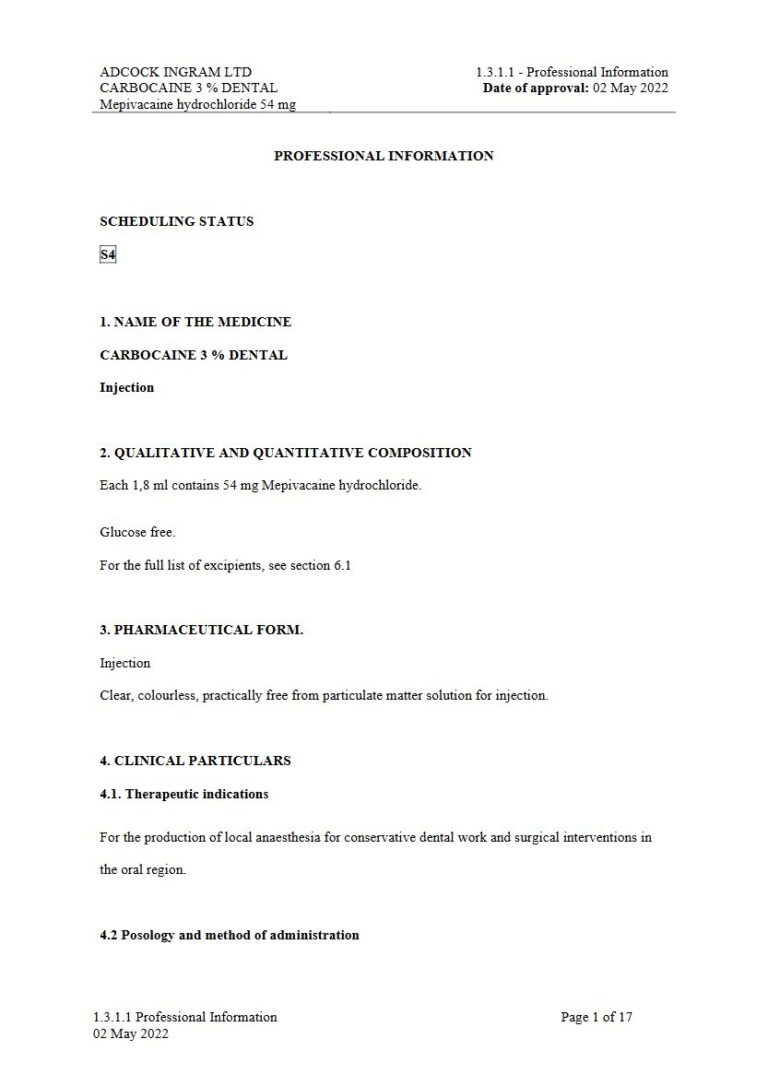
For the production of local anaesthesia for conservative dental work and surgical interventions in the oral region.
4.2 Posology and method of administration
Posology
The dose varies and depends on the area to be anaesthetized, vascularity of the tissues, number of neuronal segments to be blocked, individual tolerances and the technique of anaesthesia. The lowest dose needed to provide effective anaesthesia should be administered. The average dose of one dental cartridge will usually suffice. This dose may be doubled if necessary, to effect anaesthesia. The maximum adult dose should not exceed 400 mg mepivacaine hydrochloride, (approximately 7 mg/kg) at any one time and the total dose should not exceed 1g in any twenty-four hour period. Do not exceed the recommended dose. Any unused portion of a dental cartridge should be discarded. Local anaesthetics should only be administered by dental medical practitioners or other suitable qualified healthcare professionals.
RESUSCITATIVE EQUIPMENT, OXYGEN AND EMERGENCY MEDICINES SHOULD BE IMMEDIATELY AVAILABLE WHEN ANY ANAESTHETIC IS USED.
DISINFECTION OF CARBOCAINE 3 % DENTAL injection cartridges: The diaphragm should be disinfected before needle puncture. Immerse only the metal cap in undiluted isopropyl alcohol or 70 % ethyl alcohol for at least fifteen minutes. Only enough cartridges for one dayu2019s use should be stored in the alcohol.
4.3. Contraindications
CARBOCAINE 3 % DENTAL injection is contraindicated in patients with a known hypersensitivity to the amide type of local anaesthetic or excipients. Children below 4 years of age (ca. 20 kg body weight). Porphyria. Patient with severe disorders of the atrioventricular conduction not compensated by pacemaker. Epilepsy not controlled by appropriate treatment.
4.4 Special warnings and precautions for use
DO NOT AUTOCLAVE. Safe use of CARBOCAINE 3 % DENTAL injections during pregnancy has not been established with respect to fetal development. Patients with myasthenia gravis are particularly susceptible to the effects of local anaesthetics.
Warnings
Risk of anaesthesiophagia: various biting trauma (lips, cheeks, mucosa, tongue); advise the patient to avoid chewing gum or foodstuffs as long as there is no sensitivity. In children under 4 years of age, the product is not recommended. Athletes should be warned that this medicinal product contains an active substance likely to induce a positive reaction to tests undertaken in anti-doping controls.
Precautions for use
Practitioners who use local anaesthetic agents should be well versed in the diagnosis and management of emergencies which may arise from their use. Resuscitation equipment, oxygen and other resuscitation medicines should be available for immediate use. Mepivacaine use requires:
- Consultation to assess medical history and ongoing concomitant medication.
- Aspiration before the local anaesthetic solution is injected, so as to minimize the risk of intravascular injection.
- Slow injection while talking to the patient.
Restlessness, anxiety, tinnitus, dizziness, blurred vision, tremors, depression of consciousness or drowsiness should alert the practitioner to the possibility of central nervous system toxicity. Signs and symptoms of depressed cardiovascular function may commonly result from a vasovagal reaction, particularly if the patient is in an upright position. Dose should be minimised for patients suffering from hepatic (due to hepatic metabolism) or renal disease. Use with caution when there is inflammation and/or sepsis in the area of the proposed injection site. Injection into highly vascular areas especially if these are inflamed or traumatised, may result in reduced effect and increased absorption. The effect of mepivacaine hydrochloride may be reduced if the injection is made into an inflamed or infected area with a low tissue pH. Monitoring should be increased in patients under anti-coagulant treatment (monitoring of the INR). Mepivacaine should be used cautiously (reduce the dose) in case of hypoxia, hyperkalemia and acidosis. Due to its cardiotoxicity effect, mepivacaine should be used with caution in patients with repolarisation disorders such as QT prolongation; the indication and Posology must be considered to prevent increased plasma concentration, which might cause severe ventricular arrhythmia.
In common with other local anaesthetics, Mepivacaine hydrochloride should be given with caution to patients with epilepsy, impaired cardiac conduction, or impaired respiratory function, or with liver damage. The product is for single use on one patient during one treatment only. Any remaining contents should be discarded.
4.5 Interaction with other medicines and other forms of interaction
Increased serum levels of amide anaesthetics have been reported after concurrent administration of cimetidine. If sedatives are employed to reduce patient apprehension, reduced doses of anaesthetic solution should be used since local anaesthetic agents, like sedatives, are central nervous system depressants which in combination may have an additive effect. There is an increased risk of myocardial depression when amide-type local anaesthetics are given with antiarrhythmics.
4.6 Fertility, pregnancy and lactation
Pregnancy
On the basis of long usage, anaesthetics of the mepivacaine type are considered to be reasonably safe for use on pregnant women. Retrospective studies of pregnant women receiving local anaesthetics for emergency surgery early in pregnancy have not shown that local anaesthetics cause birth defects. However, no controlled studies have been carried out in pregnant women. Moreover, no reproduction studies have been performed with the product.
Therefore, risk to benefit consideration should be evaluated before administering this anaesthetic during early pregnancy.
Lactation
It is not known whether local anaesthetics are excreted in human milk. Because many drugs are excreted in human milk, caution should be exercised when mepivacaine is administered to a nursing woman.
4.7 Effects on ability to drive and use machines
Mepivacaine hydrochloride may have a minor influence on the ability to drive and use machines. Dizziness (including vertigo, vision disorder and fatigue) may occur following the administration of mepivacaine hydrochloride (see section 4.8). Patients experiencing these symptoms should not drive or use machinery until any such symptoms have completely resolved.
4.8 Undesirable effects
The reported adverse effects come from spontaneous reporting and literature. The frequency classification follows the convention: Very common (u22651/10), Common (u22651/100 to <1/10), Uncommon ((u22651/1000 to <1/100), Rare ((u22651/10,000 to <1/1000) and Very rare (<1/10,000). Frequency u201cnot knownu201d: cannot be estimated from the available data.
MedDRA system organ classes (SOC)
Frequency
Undesirable effect
Blood and the lymphatic system disorders
Methaemoglobinaemia.
Immune system disorders
Rare
Hypersensitivity
Anaphylactic / anaphylactoid reactions
Angioedema (Face/ tongue/ lip/throat/ larynx/ periorbital oedema)
Bronchospasm/ asthma
Urticaria
Psychiatric disorders
Not known
Anxiety/ Nervousness, Euphoric mood, Apprehension
Nervous system disorders
Common
Rare
Headache
Neuropathy: Neuralgia (neuropathic pain)
Paresthesia (i.e. burning, prickling, itching, tingling, local sensation of heat or cold, with no apparent physical cause) of oral and perioral structures
Hypoesthesia / numbness of the tongue and perioral region, Dysesthesia (oral and perioral), including dysgeusia (e.g., taste metallic, taste distorted), ageusia,
Not known
dizziness (light-headedness), Tremor.
Deep CNS depression: Loss of consciousness, Coma, Convulsions (including tonic clonic seizure), Presyncope, syncope
Confusional state, disorientation, Vertigo, Speech disorder (e.g. dysarthria, logorrhoea) Restlessness, agitation
Balance disorder (disequilibrium), Somnolence, Nystagmus.
Eye disorders
Rare
Not known
Visual impairment
Blurred vision
Accommodation disorders
Horneru2019s syndrome
Eyelid ptosis
Enophthalmos
Diplopia (paralysis of oculomotor muscles)
Amaurosis, blindness
Mydriasis
Miosis
Ear and labyrinth disorders
Not known
Ear discomfort
Tinnitus
Hyperacusis
Cardiac disorders
Rare
Myocardial depression, Cardiac arrest
Bradyarrhythmia
Bradycardia
Tachydysrhythmia (including ventricular extrasystoles and ventricular fibrillation)
Angina pectoris
Conduction disorders (atrioventricular block)
Tachycardia
Palpitations
Dysrhythmia
Vascular disorders
Rare
Very rare
Not known
Hypotension (with possible circulatory collapse)
Hypertension
Vasodilatation
Respiratory, thoracic and mediastinal disorders
Rare
Not known
Respiratory depression
Bradypnoea
Apnoea (respiratory arrest)
Yawning
Dyspnoea
Hypoxia (including cerebral)
Hypercapnia
Dysphonia (hoarseness)
Gastrointestinal disorders
Rare
Not known
Nausea
Vomiting
Gingival / oral mucosal exfoliation (sloughing) / ulceration
Swelling of tongue, lip, gums
Stomatitis, glossitis, gingivitis
Skin and subcutaneous disorders
Rare
Rash (eruption)
Pruritus
Swelling face
Musculoskeletal and connective tissue disorders
Rare
Muscle twitching
Chills (shivering)
General disorders and administration site conditions
Rare
Not known
Local swelling
Injection site swelling
Oedema
Chest pain
Fatigue, asthenia (weakness)
Feeling hot
Injection site pain
General injury, poisoning and procedural complications
Not known
Nerve injury
Reporting of suspected adverse reactions
Reporting suspected adverse reactions after authorisation of the medicine is important. It allows continued monitoring of the benefit/risk balance of the medicine. Healthcare providers are asked to report any suspected adverse reactions to SAHPRA via the u201c6.04 Adverse Drug Reactions Reporting Formu201d, found online under SAHPRAu2019s publications: https://sahpra.org.za/wp-content/uploads/2020/01/6.04_ARF1_v5.1_27Jan2020.pdf
4.9 Overdose
Symptoms of overdosage correspond to the side effects. Cardio-respiratory arrest and convulsions as well as somnolence may occur. Treatment is symptomatic and supportive. Resuscitative equipment and emergency medicines should always be immediately available, as symptomatic treatment is recommended. Acute emergencies from local anaesthetics are generally related to high plasma levels encountered during therapeutic use of excessive dosages of local anaesthetics or to unintended intravascular injections of local anaesthetic solution (see section 4.4 Special warnings and precautions for use, and section 4.8, Undesirable effects).
Symptomatology
The symptoms are dose-dependent and have progressive severity in the realm of neurological manifestations, followed by vascular, respiratory and finally cardiac toxicity (see section 4.8). Central Nervous System toxicity is typical of the entire class of local anaesthetics. Symptoms may include light-headedness, dizziness, restlessness, auditory and visual disturbances, drowsiness, disorientation, slurred speech, shivering, muscle twitching, tremors of the face, fingers and toes, generalized seizures and respiratory arrest. Hypoxia and hypercapnia occur rapidly following convulsions due to increased muscular activity, together with the interference with normal respiration. In severe cases, apnoea may occur. Acidosis increases the toxic effects of local anaesthetics.
Effects on the cardiovascular system may be seen in the severe cases. Hypotension, bradycardia, arrhythmia and cardiac arrest may occur as a result of high systemic concentrations, with potentially fatal outcome. Recovery occurs as a consequence of redistribution of the local anaesthetic drug from the central nervous system and metabolism and may be rapid unless large amounts of the drug have been injected.
Management of local anaesthetic emergencies
The first consideration is prevention, best accomplished by careful and constant monitoring of cardiovascular and respiratory vital signs and the patient's state of consciousness after each local anaesthetic injection. At the first sign of change, oxygen should be administered. The first step in the management of convulsions consists of immediate attention to the maintenance of a patent airway and assisted or controlled ventilation with oxygen and a delivery system capable of permitting immediate positive airway pressure by mask. Immediately after the institution of these ventilatory measures, the adequacy of the circulation should be evaluated, keeping in mind that drugs used to treat convulsions sometimes depress the circulation when administered intravenously. Should convulsions persist despite adequate respiratory support and if the status of the circulation permits, small increments of an ultra-short acting barbiturate or a benzodiazepine may be administered intravenously.
The clinician should be familiar, prior to use of local anaesthetics, with these anticonvulsant drugs. Supportive treatment of circulation depression may require administration of intravenous fluids and, when appropriate, a vasopressor as directed by the clinical situation (e.g., Ephedrine). If not treated immediately, both convulsions and cardiovascular depression can result in hypoxia, acidosis, bradycardia, arrhythmias and cardiac arrest. If cardiac arrest should occur, standard cardio-pulmonary resuscitative measures should be instituted. Endotracheal intubation, employing drugs and techniques familiar to the clinician, may be indicated, after initial administration of oxygen by mask, if difficulty is encountered in the maintenance of a patent airway or if prolonged ventilatory support (assisted or controlled) is indicated. Dialysis is of negligible value in the treatment of acute overdosage with mepivacaine.
