
Meropenem 500 mg & 1 g Injection
PDF Leaflet Revision Date: 04 December 2024
Clinical Summary
Quick overview from the medicine insert
Indication
Treatment of infections caused by susceptible bacteria.
Dosage (summary)
Adults: 500 mg to 1 g IV every 8 hours; adjust for renal impairment.
Special Populations
- Renal impairment
- Hepatic impairment
- Elderly
Pregnancy & Breastfeeding
Not recommended in pregnancy; avoid in breastfeeding.
Key Drug Interactions
- Probenecid
- Valproic acid
- Oral anticoagulants
Contraindications
- Hypersensitivity to meropenem
- History of hypersensitivity to beta-lactams
Common side effects
- Nausea
- Diarrhoea
- Headache
- Rash
Counselling Points
- Report any allergic reactions
- Monitor for gastrointestinal symptoms
- Avoid mixing with other medications
Serious warnings
- Serious hypersensitivity reactions
- Seizures
- Antibiotic-associated colitis
Important Disclaimer
The Meropenem 500 mg & 1 g Injection professional information leaflet below is the property of Ranbaxy Pharmaceuticals and is provided on Medinsert exactly as issued, with no.. alterations or editorial changes. We make every effort to keep content current by updating documents as soon as new versions become available. Medinsert serves as a trusted access point for healthcare professionals, but does not replace official sources or clinical judgement. For more details, please read our full disclaimer. read more>>
 Healthcare Professionals Only
This content is for registered healthcare professionals
Sign in or create a free account to read the full package insert.
Free for HPCSA-registered professionals. Powered by Medinsert.
Clinical Particulars
Section 4 of the official insert — extracted exactly as issued, no alterations
4.1. Therapeutic indications
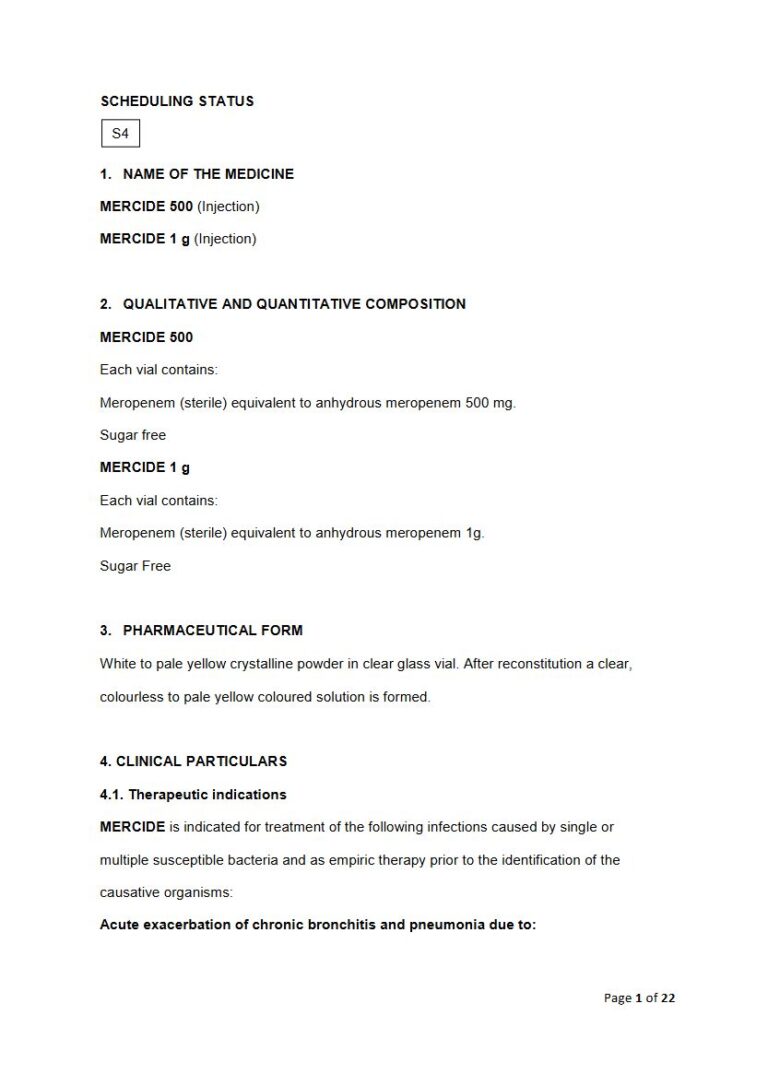
MERCIDE is indicated for treatment of the following infections caused by single or multiple susceptible bacteria and as empiric therapy prior to the identification of the causative organisms:
Acute exacerbation of chronic bronchitis and pneumonia due to:
- Staphylococcus aureus
- Streptococcus pneumoniae
- Streptococcus spp
- Escherichia coli
- Haemophilus influenzae
- Haemophilus parainfluenzae
- Pseudomonas aeruginosa
- Branhamella catarrhalis
- Klebsiella pneumoniae
- Klebsiella spp
- Enterobacter cloacae
- Enterobacter spp.
- Acinetobacter.
Pneumonia in children due to:
- Staphylococcus aureus
- Streptococcus pneumoniae
- Haemophilus influenzae
- Pseudomonas aeruginosa.
Urinary tract infections in adults and children, including complicating infections due to:
- Escherichia coli
- Haemophilus influenzae
- Pseudomonas aeruginosa
- Enterobacter cloacae
- Morganella morganii
- Proteus mirabilis
- Serratia marcescens
- Citrobacter freundii.
Pelvic inflammatory Disease (including tubo-ovarian abscess) and endometritis due to:
- Staphylococcus aureus
- Staphylococcus epidermidis
- Streptococcus haemolyticus
- Staphylococcus spp.
- Staphylococcus spp. (coagulase negative)
- Streptococcus agalactiae Group B
- Pseudomonas aeruginosa
- Streptococcus beta-haemolytic
- Streptococcus faecalis
- Streptoccocus gamma haemolyticus
- Group D Streptoccocus (enterococcus and non-enterococcus)
- Streptococcus viridans
- Acinetobacter anitratus
- Acinetobacter Iwoffii
- Enterobacter aerogenes
- Enterobacter cloacae
- Escherichia coli
- Gardnerella vaginalis
- Klebsiella pneumoniae
- Neisseria gonorrhoeae
- Proteus mirabilis.
Skin and Skin Structure Infections in adults due to:
- Escherichia coli
- Klebsiella pneumoniae
- Proteus mirabilis
- Pseudomonas aeruginosa
- Staphylococcus aureus
- Coagulase negative staphylococcus
- Streptococcus agalactiae
- Streptococcus faecalis
- Group A Streptococcus
- Streptococcus viridans
- Bacteroides fragilis
- Peptostreptococcus spp.
Meningitis in adults and children due to:
- Streptococcus pneumoniae
- Haemophilus influenzae
- Neisseria meningitides
Septicaemia in adults and children due to:
- Streptococcus pneumoniae
- Escherichia coli
- Klebsiella pneumoniae.
Empiric treatment, including initial monotherapy, for presumed bacterial infections in host-compromised neutropenic patients due to:
- Staphylococcus aureus
- Micrococcus spp.
- Streptococcus sanguis
- Escherichia coli
- Pseudomonas aeruginosa
Intra-abdominal abscess and peritonitis due to:
- Streptococcus milleri
- Streptococcus mitior
- Enterococcus faecalis
- Escherichia coli
- Klebsiella pneumoniae
- Pseudomonas aeruginosa
- Bacteroides fragilis
- Bacteroides ovatus
- Bacteroides distasonis
- Klebsiella oxytoca
- Clostridium perfinges.
Polymicrobial infections In the treatment of infections caused by Pseudomonas aeruginosa, an aminoglycoside should be administered concomitantly.
4.2 Posology and method of administration
Intravenous administration:
Adults:
Usual dose: 500 mg to 1 g by intravenous administration every 8 hours depending on the type and severity of infection, the known or expected susceptibility of the pathogen(s), and the condition of the patient.
Exceptions:
- Febrile episodes in neutropenic patients u2013 the dose should be 1 g every 8 hours.
- Meningitis u2013 the dose should be 2 g every 8 hours.
Caution may be required in using beta-lactam antibiotics such as MERCIDE in critically ill patients with known or suspected Pseudomonas aeruginosa lower respiratory tract infections. Concomitant use of an aminoglycoside is recommended.
Regular sensitivity testing is recommended when treating Pseudomonas aeruginosa.
MERCIDE should be given as an intravenous bolus injection over approximately 5 minutes or by intravenous infusion over approximately 15 to 30 minutes (see Constitution, compatibility and stability below)
Dosage schedule for adults with impaired renal function:
Dosage should be reduced in patients with creatinine clearance less than 51 ml/min, as scheduled below:
Creatinine Clearance (ml/min) Dose (based on u201cunitu201d dose range of 500 mg to 2 g every 8 hours) Frequency
- 26 - 50 One unit dose Every 12 hours
- 10 - 25 One - half unit dose Every 12 hours
- <10 One - half unit dose Every 24 hours
MERCIDE is cleared by haemodialysis. If continued treatment with MERCIDE is necessary, the unit dose based on the infection type and severity is recommended at the completion of the haemodialysis procedure to re-institute effective treatment. There is no experience with peritoneal dialysis.
Use in adults with hepatic insufficiency: No dosage adjustment is necessary in patients with impaired hepatic metabolism.
Elderly: No dosage adjustment is required for the elderly with normal renal function or creatinine clearance values above 50 ml/min.
Children: For infants and children over 3 months and up to 12 years of age the IV dose is 10 to 40 mg/kg every 8 hours depending on type and severity of infection, the known or suspected susceptibility of the pathogen(s) and the condition of the patient. In children over 50 kg weight, adult dosage should be used.
Exceptions: Meningitis - the dose should be 40 mg/kg every 8 hours.
MERCIDE should be given as an IV bolus over approximately 5 minutes or by intravenous infusion over approximately 15 to 30 minutes.
There is no experience in children with renal impairment.
Constitution, compatibility and stability: MERCIDE to be used for bolus intravenous injection should be constituted with sterile water for injection (10 ml/500 mg and 20 ml/1 g). This provides an approximate available concentration of 50 mg/ml. For intravenous infusion MERCIDE IV vials may be directly constituted with a compatible infusion fluid (as listed below) and then further diluted with the compatible infusion fluid as needed.
Freshly prepared solutions of MERCIDE IV should be used whenever possible, however, constituted solutions of MERCIDE IV, as supplied in injection and infusion vials, and constituted as noted above maintain satisfactory potency at room temperature (up to 25 u00b0C) or under refrigeration (4 u00b0C) as shown in the following table: MERCIDE should not be mixed with or physically added to solutions containing other medicines.
4.3 Contraindications
- MERCIDE is contra-indicated in patients who have demonstrated hypersensitivity to this product.
- Patients who have a history of hypersensitivity to carbapenems, penicillins or other beta-lactam antibiotics may also be hypersensitive to MERCIDE.
- As with all beta-lactam antibiotics hypersensitivity reactions have been reported.
- Pregnancy and breastfeeding.
4.4 Special warnings and precautions for use
The selection of meropenem to treat an individual patient should take into account the appropriateness of using a carbapenem antibacterial agent based on factors such as severity of the infection, the prevalence of resistance to other suitable antibacterial agents and the risk of selecting for carbapenem-resistant bacteria.
Enterobacteriaceae, Pseudomonas aeruginosa and Acinetobacter spp. resistance Prescribers are advised to take into account the local prevalence of resistance in these bacteria to penems.
Hypersensitivity reactions As with all beta-lactam antibiotics, serious and occasionally fatal hypersensitivity reactions (including anaphylactoid and severe cutaneous reactions) have been reported in patients on penicillin therapy (see sections 4.3 and 4.8).
Hypersensitivity reactions can also progress to Kounis syndrome, a serious allergic reaction that can result in myocardial infarction (see section 4.8).
Patients who have a history of hypersensitivity to carbapenems, penicillins or other beta-lactam antibiotics may also be hypersensitive to meropenem. Before initiating therapy with meropenem, careful inquiry should be made concerning previous hypersensitivity reactions to beta-lactam antibiotics.
If a severe allergic reaction occurs, the medicinal product should be discontinued and appropriate measures taken.
Severe cutaneous adverse reactions (SCAR), such as Stevens-Johnson syndrome (SJS), toxic epidermal necrolysis (TEN), drug reaction with eosinophilia and systemic symptoms (DRESS), erythema multiforme (EM) and acute generalised exanthematous pustulosis (AGEP) have been reported in patients receiving meropenem (see section 4.8). If signs and symptoms suggestive of these reactions appear, meropenem should be withdrawn immediately and an alternative treatment should be considered.
Antibiotic-associated colitis Antibiotic-associated colitis and pseudomembranous colitis have been reported with nearly all anti-bacterial agents, including meropenem, and may range in severity from mild to life threatening. Therefore, it is important to consider this diagnosis in patients who present with diarrhoea during or subsequent to the administration of meropenem (see section 4.8). Discontinuation of therapy with meropenem and the administration of specific treatment for Clostridium difficile should be considered. Medicinal products that inhibit peristalsis should not be given.
Seizures Seizures have infrequently been reported during treatment with carbapenems, including meropenem (see section 4.8).
Hepatic function monitoring Hepatic function should be closely monitored during treatment with meropenem due to the risk of hepatic toxicity (hepatic dysfunction with cholestasis and cytolysis) (see section 4.8).
Use in patients with liver disease: patients with pre-existing liver disorders should have liver function monitored during treatment with meropenem. There is no dose adjustment necessary (see section 4.2).
Renal Insufficiency Pharmacokinetic studies in patients with renal insufficiency have shown that the plasma clearance of meropenem correlates with creatinine clearance Dosage adjustments are necessary in subjects with renal impairment (see section 5.2).
Direct antiglobulin test (Coombs test) seroconversion A positive direct or indirect Coombs test may develop during treatment with meropenem.
Concomitant use with valproic acid/sodium valproate/valpromide The concomitant use of meropenem and valproic acid/sodium valproate/valpromide is not recommended (see section 4.5).
MERCIDE contains sodium. MERCIDE 500: This medicinal product contains 104 mg sodium per 500 mg vial, equivalent to 5,2 % of the WHO recommended maximum daily intake of 2 g sodium for an adult. MERCIDE 1 g: This medicinal product contains 208 mg sodium per 1 g vial, equivalent to 10,4 % of the WHO recommended maximum daily intake of 2 g sodium for an adult.
Paediatric use: Efficacy and tolerability in infants under 3 months old have not been established. Therefore, meropenem is not recommended for use below this age.
Overgrowth of non-susceptible organisms may occur and repeated evaluation of each patient is necessary. Infrequently, pseudomembranous colitis has been reported on MERCIDE. Therefore, it is important to consider its diagnosis in patients who develop diarrhoea in association with MERCIDE use.
4.5 Interaction with other medicines and other forms of interaction
Probenecid competes with meropenem for active tubular secretion and thus inhibits the renal excretion of meropenem with the effect of increasing the elimination half-life and plasma concentration of meropenem. As the potency and duration of action of meropenem dosed without probenecid are adequate, the co-administration of probenecid with meropenem is not recommended.
The potential effect of meropenem on the protein binding of other drugs or metabolism has not been studied. However, the protein binding is so low that no interactions with other compounds would be expected.
Meropenem has been administered concomitantly with many other medications without apparent adverse interactions.
Decreases in blood levels of valproic acid have been reported when it is co-administered with carbapenem agents resulting in a 60-100 % decrease in valproic acid levels in about two days. Due to the rapid onset and the extent of the decrease, co-administration of valproic acid/sodium valproate/valpromide with carbapenem agents is not considered to be manageable and therefore should be avoided (see section 4.4).
Meropenem may reduce serum valproic acid levels. Sub therapeutic levels may be reached in some patients.
Oral anti-coagulants Simultaneous administration of antibiotics with warfarin may augment its anti-coagulant effects. There have been many reports of increases in the anti-coagulant effects of orally administered anti-coagulant agents, including warfarin inpatients who are concomitantly receiving antibacterial agents. The risk may vary with the underlying infection, age and general status of the patient so that the contribution of the antibiotic to the increase in INR (international normalised ratio) is difficult to assess. It is recommended that the INR should be monitored frequently during and shortly after co-administration of antibiotics with an oral anti-coagulant agent.
Paediatric population Interaction studies have only been performed in adults. However, no specific data regarding other potential drug interactions are available.
4.6 Fertility, pregnancy and lactation
Pregnancy The safety of meropenem in human pregnancy has not been established.
Breast-feeding Meropenem is detectable at very low concentrations in animal breast milk. Meropenem should not be used in breast-feeding women. (See section 4.3).
4.7 Effects on ability to drive and use machines
No studies on the effect on the ability to drive and use machines have been performed. However, when driving or operating machines, it should be taken into account that headache, paraesthesia and convulsions have been reported for meropenem.
4.8 Undesirable effects
System Organ Class Frequent Less frequent Frequency Unknown
Blood and the lymphatic system disorders Thrombocythaemia Thrombocytopenia, leukopenia, neutropenia, agranulocytosis, haemolytic anaemia, Eosinophilia A positive direct or indirect Coombu2019s test may develop.
Immune system disorders Systemic allergic reactions (hypersensitivity) including angioedema and manifestations of anaphylaxis.
Psychiatric disorders Delirium
Nervous system disorders Headache Paraesthesia, Convulsions (See section 4.4)
Gastro - intestinal disorders Nausea, vomiting, diarrhoea, constipation, Abdominal pain Pseudomembranous colitis. Antibiotic-associated colitis (see section 4.4)
Hepato - biliary disorders Increases in serum transaminases, increase blood alkaline phosphatases, increased lactic dehydrogenase Blood bilirubin increased
Skin and subcutaneous tissue disorders Rash, pruritus Urticaria, Severe skin reactions, such as erythema multiforme (see section 4.4), Stevens-Johnson Syndrome and toxic epidermal necrolysis. Drug reaction with eosinophilia and systemic symptoms, acute generalised exanthematous pustulosis (see section4.4) Linear IgA disease
Renal and urinary disorders Blood creatinine increased, blood urea increased
General disorders and administration site conditions Inflammation, pain Thrombophlebitis, oral and vaginal candidiasis
Cardiac disorders Kounis syndrome
Paediatric population MERCIDE is registered for children over 3 months of age. There is no reported evidence of an increased risk of any adverse drug reaction in children. All reported reactions were consistent with events observed in adult population.
Reporting of suspected adverse reactions Reporting suspected adverse reactions after authorisation of the medicine is important. It allows continued monitoring of the benefit/risk balance of the medicine. Health care providers are asked to report any suspected adverse reactions to SAHPRA via the u201c6.04 Adverse Drug Reaction Reporting Formu201d, found online under SAHPRAu2019s publications: https://www.sahpra.org.za/Publications/Index/8
4.9 Overdose
Treatment of over dosage/accidental or deliberate poisoning: The pharmacological properties and mode of administration make it unlikely that intentional overdose will occur. Accidental overdosage could occur during therapy particularly in patients with renal impairment. Treatment of overdosage should be symptomatic. In normal individuals rapid renal elimination will occur. In subjects with renal impairment haemodialysis will remove meropenem such as in MERCIDE and its metabolite.
