
Buscopan Co 20 mg/2.5 g Injection
PDF Leaflet Revision Date: 03 February 2021
Clinical Summary
Quick overview from the medicine insert
Indication
Acute, severe colicky pains of the biliary, urinary and gastro-intestinal tract.
Dosage (summary)
1 ampoule (5 ml) IV slowly; may repeat 2-3 times daily.
Special Populations
- Elderly
- Renal impairment
- Hepatic impairment
Pregnancy & Breastfeeding
Use only if benefits outweigh risks; avoid during breastfeeding if possible.
Key Drug Interactions
- Methotrexate
- Chlorpromazine
- Acetylsalicylic acid
- Bupropion
- Cyclosporin
Contraindications
- Hypersensitivity to pyrazolone
- Granulocytopenia
- Analgesic-induced asthma
- Acute intermittent hepatic porphyria
- Glaucoma
- Prostate hypertrophy
- Myasthenia gravis
- Pregnancy (3rd trimester)
- Children under 12 months
Common side effects
- Dry mouth
- Hypotension
- Dizziness
- Anaphylactic reactions
Counselling Points
- Monitor for signs of blood dyscrasia
- Avoid alcohol
- Report severe skin reactions immediately
- Do not drive if drowsy
Serious warnings
- Risk of agranulocytosis
- Severe skin reactions
- Hypotensive reactions
- Anaphylactic shock
Important Disclaimer
The Buscopan Co 20 mg/2.5 g Injection professional information leaflet below is the property of Sanofi-Aventis South Africa _ and is provided on Medinsert exactly as issued, with no.. alterations or editorial changes. We make every effort to keep content current by updating documents as soon as new versions become available. Medinsert serves as a trusted access point for healthcare professionals, but does not replace official sources or clinical judgement. For more details, please read our full disclaimer. read more>>
 Healthcare Professionals Only
This content is for registered healthcare professionals
Sign in or create a free account to read the full package insert.
Free for HPCSA-registered professionals. Powered by Medinsert.
Clinical Particulars
Section 4 of the official insert — extracted exactly as issued, no alterations
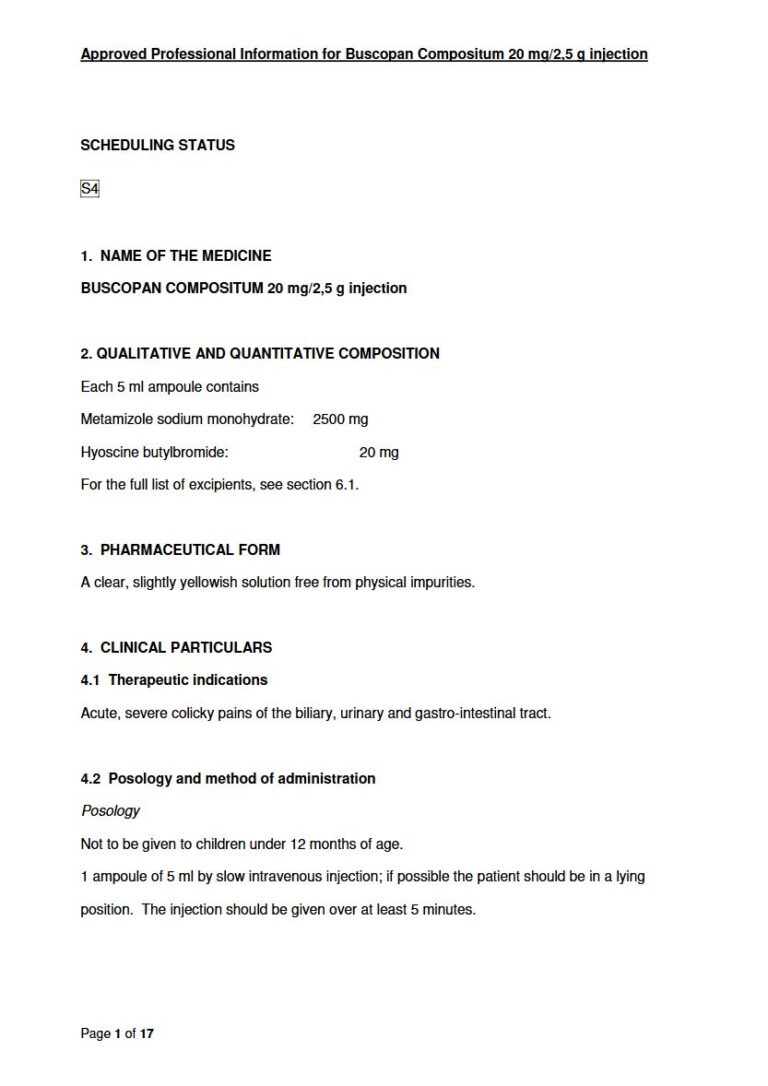
4.1 Therapeutic indications
Acute, severe colicky pains of the biliary, urinary and gastro-intestinal tract.
4.2 Posology and method of administration
Posology
Not to be given to children under 12 months of age. 1 ampoule of 5 ml by slow intravenous injection; if possible the patient should be in a lying position. The injection should be given over at least 5 minutes.
If necessary the same dose may be repeated 2 to 3 times daily at intervals of several hours. Should intravenous injection be impossible, the preparation may be given by intramuscular injection.
Method of administration
Not to be administered subcutaneously. The administration of BUSCOPAN COMPOSITUM 20 mg/2,5 g injection should be under medical supervision and be monitored. BUSCOPAN COMPOSITUM 20 mg/2,5 g injection should only be injected intravenously or intramusculary. Inadvertent intra-arterial use may cause necrosis in the distal vascular area.
Precaution
With intramuscular injection the following technique should be carefully observed: Site of injection: Only in the upper, outer quadrant of the buttock. Direction: Sagittally and directed towards the iliac crest. Depth: A sufficiently long needle to ensure the injection reaches the muscle.
4.3 Contraindications
BUSCOPAN COMPOSITUM 20 mg/2,5 g injection is contra-indicated in:
u2022 patients who have demonstrated prior hypersensitivity to pyrazolone or pyrazolidines (e.g., metamizole, isopropylaminophenazone, propyphenazone, phenazone or phenylbutazone), or to hyoscine butylbromide, or to any other component of the product included in section 6.1. This includes patients who developed agranulocytosis, for example, following use of one of these substances.
u2022 patients with granulocytopenia.
u2022 patients with known analgesic-induced asthma syndrome or known analgesic intolerance of the urticaria-angioedema type, i.e. patients who develop bronchospasm or other anaphylactoid reactions in response to salicylates, paracetamol or other non-narcotic analgesics such as diclofenac, ibuprofen, indomethacin or naproxen.
u2022 the potential of cross-sensitivity with aspirin and other non-steroidal anti-inflammatory agents exists. BUSCOPAN COMPOSITUM 20 mg/2,5 g injection should not be given to patients in whom aspirin or other nonsteroidal anti-inflammatory drugs induce symptoms of asthma, rhinitis or urticaria.
u2022 impaired bone marrow function (e.g., after treatment with cytostatic agents) or diseases of the haemopoietic system.
u2022 genetic glucose-6-phosphate-dehydrogenase deficiency (risk of haemolysis).
u2022 patients with acute intermittent hepatic porphyria (risk of triggering a porphyria attack).
u2022 Glaucoma
u2022 hypertrophy of the prostate with urinary retention
u2022 mechanical stenosis in the gastrointestinal tract
u2022 paralytic or obstructive ileus
u2022 pronounced tachycardia
u2022 megacolon
u2022 myasthenia gravis
u2022 three months of pregnancy (see section 4.6)
u2022 asthma
u2022 patients with existing arterial hypotension and unstable circulatory state
u2022 in patients being treated with anticoagulant drugs as intramuscular injection, since intramuscular haematoma may occur. In these patients, the intravenous route may be used.
u2022 subcutaneous injection (see section 4.2)
u2022 intraarterial injection (see section 4.2 and 4.4)
u2022 in case of rare hereditary conditions that may be incompatible with an excipient of the product (see section 4.4)
u2022 the third trimester of pregnancy (see section 4.6)
u2022 children under 12 months of age. This medicinal product it is not recommended in children nor adolescents (under 18 years old), as safety and efficacy is not demonstrated in these patients.
u2022 patients with existing arterial hypotension and unstable circulatory state
4.4 Special warnings and precautions for use
Unexplained abdominal pain
In case severe, unexplained abdominal pain persists or worsens, or occurs together with symptoms like fever, nausea, vomiting, changes in bowel movements, abdominal tenderness, decreased blood pressure, fainting or blood in stool, appropriate diagnostic measures are needed to investigate the etiology of the symptoms.
Haematologic reactions (such as agranulocytosis or pancytopenia)
BUSCOPAN COMPOSITUM 20 mg/2,5 g injection contains metamizole, a derivative of pyrazolone, which presents a risk of agranulocytosis, which is rare but life-threatening (see section 4.8). In the event of clinical signs of haematologic reactions (such as agranulocytosis, aplastic anaemia, thrombocytopenia or pancytopenia), treatment with BUSCOPAN COMPOSITUM 20 mg/2,5 g injection must be discontinued immediately and the blood count (including differential blood count) must be monitored until it has returned to normal (see section 4.8). Discontinuation of treatment must not be delayed until the results of the lab tests are available. All patients should be advised to immediately consult a physician if during treatment with BUSCOPAN COMPOSITUM 20 mg/2,5 g injection signs and symptoms occur which are suggestive of blood dyscrasia (e.g. general malaise, infection, persistent fever, bruising, bleeding or pallor). Patients who show an immunological reaction such as agranulocytosis to BUSCOPAN COMPOSITUM 20 mg/2,5 g injection are also at high risk of responding similarly to other pyrazolones and pyrazolidines.
Anaphylactic/anaphylactoid reactions
When choosing the administration route, it should be borne in mind that parenteral administration of BUSCOPAN COMPOSITUM 20 mg/2,5 g injection presents a higher risk of anaphylactic or anaphylactoid reactions. The risk of potentially severe anaphylactoid reactions to BUSCOPAN COMPOSITUM 20 mg/2,5 g injection is markedly higher for patients with:
u2022 analgesic-induced asthma syndrome or analgesic intolerance of the urticaria-angioedema type (see section 4.3)
u2022 bronchial asthma, in particular in the presence of rhinosinusitis and nasal polyps
u2022 chronic urticaria
u2022 intolerance to colouring agents (e.g. tartrazine) and/or preservatives (e.g. benzoates)
u2022 alcohol intolerance. These patients react to even minute amounts of alcoholic drinks with symptoms such as sneezing, watering eyes and severe facial flushing. Alcohol intolerance of this kind may be an indication of as yet undiagnosed analgesic-induced asthma syndrome (see section 4.3). Metamizole may cause the rare, but life-threatening risk of shock (see section 4.8). The likelihood of anaphylactic shock is greater in susceptible patients. Particular caution is therefore required when using BUSCOPAN COMPOSITUM 20 mg/2,5 g injection in patients with asthma or atopy. Prior to administration of BUSCOPAN COMPOSITUM 20 mg/2,5 g injection, the patient must be questioned appropriately. In patients at high risk of anaphylactoid reactions, BUSCOPAN COMPOSITUM 20 mg/2,5 g injection should only be used after consideration of the potential risks in relation to the expected benefit. If BUSCOPAN COMPOSITUM 20 mg/2,5 g injection is administered in such cases, the patient must be monitored very closely and emergency standby guaranteed.
Patients who show an anaphylactic or other immunological reaction to BUSCOPAN COMPOSITUM 20 mg/2,5 g injection are also at high risk of responding similarly to other pyrazolones, pyrazolidines and other non-narcotic analgesics.
Isolated hypotensive reactions
BUSCOPAN COMPOSITUM 20 mg/2,5 g injection can cause hypotensive reactions (see section 4.8). These reactions may be dose-dependent and are more likely with parenteral rather than enteral administration. The risk of such reactions is also increased in the case of:
u2022 too rapid intravenous injection (see section 4.2)
u2022 patient with e.g. previous arterial hypotension, volume depletion or dehydration, unstable circulation or incipient circulatory failure (such as patients with heart attack or polytrauma)
u2022 patients with a high fever. As a result, careful diagnosis and close monitoring is essential for these patients. Preventive measures (e.g., stabilization of the circulation) may be necessary in order to reduce the risk of hypotensive reactions. BUSCOPAN COMPOSITUM 20 mg/2,5 g injection requires close monitoring of the haemodynamic parameters when used in patients for whom a fall in blood pressure must be avoided at all costs, such as in the case of severe coronary artery disease or relevant stenosis of the cerebral blood vessels.
Severe skin reaction
Life-threatening skin reactions, such as Stevens-Johnson syndrome (SJS) and toxic epidermal necrolysis (TEN) were reported under treatment of metamizole. If signs or symptoms of SJS or TEN develop (such as skin rash often progressive with blisters or mucosal injury), treatment with BUSCOPAN COMPOSITUM 20 mg/2,5 g injection must be discontinued immediately and never be reintroduced. Patients should be advised of the signs and symptoms of these severe skin reactions, so that in case they develop, medical advice is sought, and these reactions can be monitored closely, particularly in the first weeks of treatment.
Gastrointestinal bleeding
Gastrointestinal bleeding has been reported in patients treated with metamizole. Many patients had concomitantly received other treatment (e.g., NSAIDs) associated with gastrointestinal bleeding, or used an overdose of metamizole.
Intraocular pressure
Elevation of intraocular pressure may be produced by the administration of anticholinergic agents such as hyoscine butylbromide in patients with undiagnosed and therefore untreated narrow angle glaucoma. Therefore, patients should be advised to seek urgent ophthalmological advice in case they should develop a painful, red eye with loss of vision after the injection of BUSCOPAN COMPOSITUM 20 mg/2,5 g injection
Risk associated with incorrect route of administration
When administered parenterally, attention should be paid to proper injection technique. Inadvertent intraarterial use may cause necrosis potentially leading to amputation in the distal vascular area.
Risk in specific populations
BUSCOPAN COMPOSITUM 20 mg/2,5 g injection should only be used after consideration of the benefit-risk ratio and appropriate precautions must be taken for elderly or patients with impaired renal or hepatic function (see section 4.2). Caution is required when administering parenterally BUSCOPAN COMPOSITUM 20 mg/2,5 g injection to patients with a history of cardiovascular disease risk factors. Special monitoring is required in patient suffering from tachycardia. Patients receiving BUSCOPAN COMPOSITUM 20 mg/2,5 g injection should be monitored for hypotension and tachycardia, especially those with a history of cardiac disease or hypertension.
Interference with laboratory tests
In diabetic patients the pyrazolone derivative can affect the enzymatic blood sugar assay by the glucose-oxidase method (GOD).
4.5 Interaction with other medicines and other forms of interaction
Methotrexate
Concomitant administration of BUSCOPAN COMPOSITUM 20 mg/2,5 g injection with methotrexate may increase blood toxicity of methotrexate particularly in elderly patients. Therefore, this combination should be avoided.
Chlorpromazine
Concomitant use of metamizole and chlorpromazine can cause severe hypothermia.
Acetylsalicylic acid
BUSCOPAN COMPOSITUM 20 mg/2,5 g injection can reduce the antiplatelet effect of acetylsalicylic acid if administered concomitantly. BUSCOPAN COMPOSITUM 20 mg/2,5 g injection should therefore be used with caution in patients who are taking low-dose acetylsalicylic acid for cardioprotection.
Bupropion
Blood levels of bupropion can be reduced by metamizole. Caution is therefore required if metamizole and bupropion are used concomitantly.
Cyclosporin
If BUSCOPAN COMPOSITUM 20 mg/2,5 g injection is taken concomitantly with cyclosporin, cyclosporin blood levels may be reduced and should therefore be monitored.
Medicines with anticholinergic effects
The anticholinergic effect of medicines such as tri- and tetracyclic antidepressants, antihistamines, antipsychotics, quinidine, amantadine, disopyramide and other anticholinergics (e.g. tiotropium, ipratropium, atropine-like compounds) may be intensified by BUSCOPAN COMPOSITUM 20 mg/2,5 g injection.
Dopamine antagonists
Concomitant treatment with dopamine antagonists such as metoclopramide may result in diminution of the effects of both medicines on the gastrointestinal tract.
Beta-adrenergic agents
The tachycardic effects of beta-adrenergic agents may be enhanced by BUSCOPAN COMPOSITUM 20 mg/2,5 g injection.
Alcohol
The effect of alcohol and BUSCOPAN COMPOSITUM 20 mg/2,5 g injection can be potentiated when taken concurrently.
Additional interactions of pyrazolones
Pyrazolones may also cause interactions with oral anticoagulants, captopril, lithium and triamterene. The efficacy of antihypertensives and diuretics may be affected by pyrazolones. It is not known to what extent metamizole causes these interactions BUSCOPAN COMPOSITUM 20 mg/2,5 g injection may also alter the effect of other active substances such as digoxin.
4.6 Fertility, pregnancy and lactation
Pregnancy and Breastfeeding
Hyoscine butylbromide: Safety during pregnancy and lactation has not been established.
Metamizole sodium monohydrate: Metamizole sodium monohydrate passes the placental barrier and is excreted in breast milk and should therefore only be used during pregnancy and lactation after careful consideration of the indications. The breakdown products of metamizole are excreted into breast milk in considerable amounts and a risk to the breastfed infant cannot be excluded. Especially the repeated use of metamizole during breastfeeding must therefore be avoided. In case of a single administration of metamizole mothers are advised to collect and discard the breastmilk for 48 hours from its administration.
Fertility
No studies on the effects on human fertility have been conducted.
4.7 Effects on ability to drive and use machines
No studies on the effects on the ability to drive and use machines have been performed. Patients should be advised that they may experience undesirable effects such as accommodation disturbances and dizziness during parenteral treatment with hyoscine butylbromide. If taken in the recommended dose, metamizole is not expected to affect concentration or reactions. As a precaution, at least if higher doses are taken, the possibility of impaired reactions should be borne in mind, and patients should be advised not to drive, operate machinery or conduct hazardous activities. This applies in particular in combination with alcohol.
4.8 Undesirable effects
Hyoscine butylbromide:
Side-effects of antimuscarinic agents include dryness of the mouth with difficulty of swallowing and talking, thirst, dilation of the pupils (mydriasis) with loss of accommodation (cycloplegia) and photophobia, flushing and dryness of the skin, transient bradycardia followed by tachycardia, with palpitation and arrhythmias, and urinary urgency, difficulty and retention, as well as reduction in the tone and mobility of the gastro-intestinal tract leading to constipation. Occasionally vomiting, giddiness and staggering may occur. Retrosternal pain may occur due to increased gastric reflux. Tricyclic anti-depressants, quinidine and amantadine can potentiate the anticholinergic effect of hyoscine butylbromide. Hyoscine butylbromide does not readily cross the blood-brain barrier, so central effects are rare. Hyoscine butylbromide may cause drowsiness; patients so affected should not drive or operate machinery. Patients should abstain from alcohol.
Metamizole:
Severe anaphylactic reaction may occur. Other signs of allergy which can affect the skin, mucosa, the granulopoetic system (leucopoenia, agranulocytosis) or the circulation (shock) may also occur. Very serious or even life-threatening bullous skin reactions, generally with mucous membrane involvement (Stevens-Johnson Syndrome, Lyell Syndrome), have been reported with medications containing metamizole. Should such a reaction occur, BUSCOPAN COMPOSITUM 20 mg / 2,5 g injection should be discontinued at once and a physician immediately consulted.
Patients suffering from existing disturbances of blood cell formation (e.g. under cytostatic treatment) should only use BUSCOPAN COMPOSITUM under medical supervision. Particular care is required in patients with systolic blood pressure values below 100 mm Hg in patients with unstable circulation (myocardial infarction, multiple injuries, initial shock). Should symptoms of agranulocytosis, such as high fever, chills, sore throat, difficulty in swallowing, inflammation in the mouth, nose and throat as well as in the genital or anal region, occur during treatment, it should be discontinued immediately and the doctor concerned informed at once. Shock may occur immediately or up to 1 hour after administration. If anaphylactic shock should occur intensive treatment for shock should be commenced without delay. In parenteral administration the injection should be stopped immediately at the first sign of shock; the cannula should be left in the vein or access to the vein should be sought; the patient should be laid on his side and the respiratory passages kept free of obstruction. Counter-measures: administration of adrenaline, monitoring of pulse rate and blood pressure (attention : dysrhythmia!); anti-histamine agents; glucocorticoids (e.g. prednisolone up to 1 g i.v.); administration of plasma volume expanders; artificial respiration.] Frequency of undesirable effects is classified according to MedDRA system:
Very common u2265 1/10
Common u2265 1/100, < 1/10
Uncommon u2265 1/1000, < 1/100
Rare u2265 1/10 000, < 1/1000
Very rare < 1/10 000, including isolated reports
Not known (cannot be estimated from available data)
Blood and lymphatic system disorders
Uncommon: leukopenia, agranulocytosis (including fatal cases) Very rare: thrombocytopenia
Not known: sepsis (including fatal cases), aplastic anaemia, pancytopenia (including fatal cases). These are presumably immunological reactions. They can occur even if BUSCOPAN COMPOSITUM 20 mg/2,5 g injection was administered on previous occasions without complications. There are signs to suggest that the risk of agranulocytosis may be elevated if BUSCOPAN COMPOSITUM 20 mg/2,5 g injection is used for more than one week. Agranulocytosis is manifest in the form of pyrexia, chills, oropharyngeal pain, dysphagia, stomatitis, rhinitis, pharyngitis, genital tract inflammation, and anal inflammation. These signs may be minimal in patients on antibiotics. There is little or no lymphadenopathy or splenomegaly. The red blood cell sedimentation rate is markedly increased; the granulocytes are considerably reduced or absent altogether. Haemoglobin, red blood cell count and platelet counts may be abnormal. It is strongly recommended that BUSCOPAN COMPOSITUM 20 mg/2,5 g injection be discontinued immediately and a doctor be consulted, and not only when the lab test results are available, if there is an unexpected deterioration in the patientu2019s general condition, the fever does not subside or reappears, or if there are painful changes in the mucosa of the mouth, nose and throat.
Immune system disorders, skin and subcutaneous tissue disorders
Uncommon: drug eruption, skin reactions. Rare: anaphylactic reaction, anaphylactoid reaction (especially after parenteral administration), asthma in patients with analgesic asthma syndrome, rash maculo-papular Very rare: toxic epidermal necrolysis, Stevens-Johnson syndrome Not known: anaphylactic shock including fatal outcome, dyspnoea; hypersensitivity; sweating abnormal Milder reactions (e.g. skin and mucosal reactions, such as pruritus, burning sensation, erythema, swelling, as well as dyspnoea and gastro-intestinal disorders) may lead on to more severe reactions (e.g. generalised urticaria, severe angioedema including the laryngeal region, severe bronchospasm, arrhythmia, decreased blood pressure with sometimes initially increased blood pressure). BUSCOPAN COMPOSITUM 20 mg/2,5 g injection must therefore be discontinued immediately if skin reactions occur. In case of severe skin reactions, a physician should immediately be consulted. Anaphylactic reactions can develop during or immediately after injection, but can also develop some hours later. Reactions generally occur, however, within the first hour of administration.
Eye disorders
Uncommon: accommodation disorders Not known: mydriasis; increased intraocular pressure
Cardiac disorders
Not known: tachycardia, Kounis Syndrome
Vascular disorders
Common: hypotension, dizziness Uncommon: shock, injection site pain; flushing Very rare: phlebitis Not known: injection site reaction Hypotensive reactions occurring during or after use may be medicine-induced, and do not go hand in hand with other signs of anaphylactoid and/or anaphylactic reactions. Such a reaction can lead to a severe fall in blood pressure. Rapid intravenous injection increases the risk of hypotensive reactions. In case of hyperpyrexia, or after a too rapid injection, there may be a dose-dependent and critical drop in blood pressure with no other signs of medicine intolerance.
Gastrointestinal disorders
Common: dry mouth
Not known: gastrointestinal haemorrhage
Renal and urinary disorders: Very rare: acute renal failure, anuria; interstitial nephritis, oliguria, proteinuria, renal impairment Not known: urinary retention, chromaturia Excretion of rubazonic acid, a harmless metabolite of metamizole, may cause a red colouration of the urine, which disappears on discontinuation of treatment.
4.9 Overdose
Symptoms : Hyoscine butylbromide : In the case of overdose, anticholinergic effects may be observed. Toxic doses cause tachycardia, rapid respiration, hyperpyrexia and central nervous system stimulation marked by restlessness, confusion and, excitement, paranoid and psychotic reactions, hallucinations and delirium, and occasionally seizures or convulsions. A rash may appear on the face and upper trunk.
Metamizole: Acute overdosage or chronic use in excessive dosage lead to dizziness, nausea, emesis, gastro-intestinal pains, state of agitation, convulsion, clonic cramp, shock, coma, respiratory paralysis, liver and renal damage, sodium and fluid retention with pulmonary oedema in cardiac patients, risk of allergy and anaphylactic reactions, leucopoenia, thrombocytopenia, agranulocytosis and aplastic anaemia.]
Therapy: Hyoscine butylbromide: Treat spastic conditions first - diazepam 10 - 20 mg i.v./i.m. Symptoms of BUSCOPAN COMPOSITUM overdosage respond to parasympathomimetics. In patients with glaucoma, pilocarpine should be used locally. Further treatment: Symptomatic and supportive. If required, parasympathomimetic medicines should be administered. Opthalmological advice should be sought urgently in cases of glaucoma. Cardiovascular complications should be treated according to usual therapeutic principles. In case of respiratory paralysis: intubation or artificial respiration should be considered. Catheterisation may be required for urinary retention. In addition, appropriate supportive measures should be used as required.
Metamizole: There is no known specific antidote for metamizole. If metamizole was administered only recently, absorption-reducing measures (e.g. activated charcoal) can be administered in an effort to limit absorption by the body. The major metabolite (4-N-methyl-amino-antipyrine) can be eliminated by means of haemodialysis, haemofiltration, haemoperfusion or plasma filtration. Treatment of intoxication and prevention of severe complications may require general and specific intensive medical monitoring and treatment.
Acute measures in the event of severe medicine intolerance (shock): At the first signs (e.g. skin reactions such as urticaria and flushing, restlessness, headache, profuse sweating, nausea) stop the administration immediately.
