
Mylospas 750 mg FC tablets
PDF Leaflet Revision Date: 01 February 2024
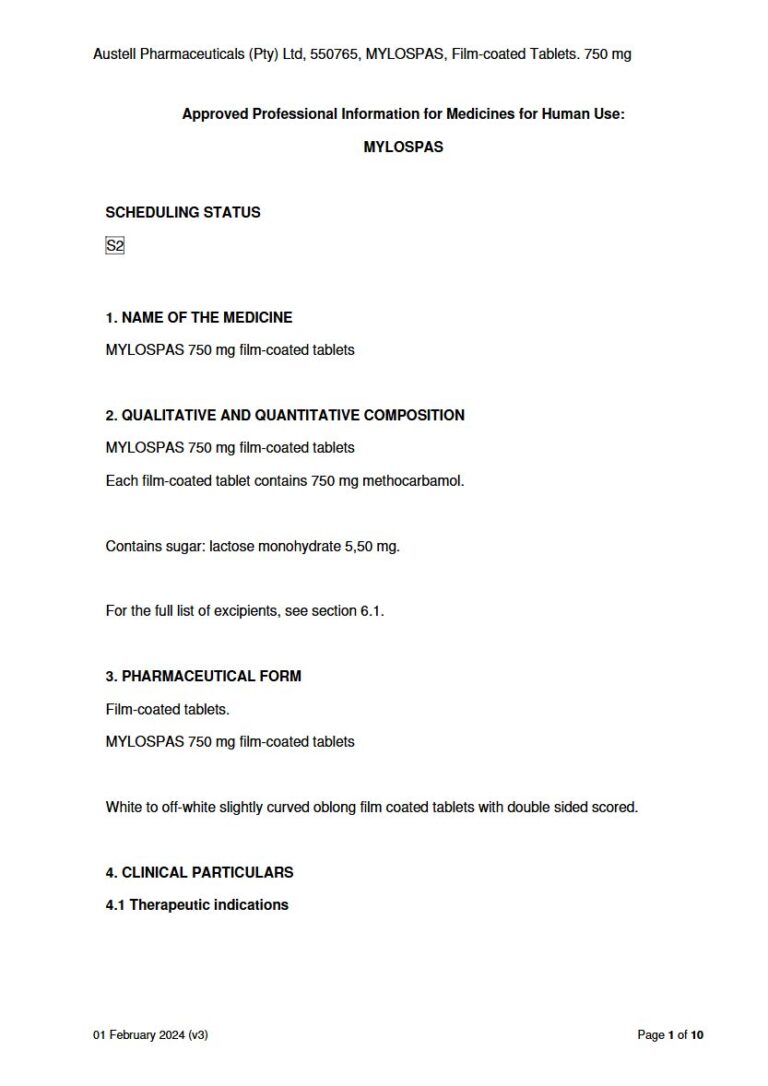
Clinical Summary
Quick overview from the medicine insert
Indication
Relief of muscle spasm associated with acute musculoskeletal conditions.
Dosage (summary)
Adults: Initial 2 tablets four times daily; Maintenance 1 tablet every four hours or 2 tablets three times daily.
Onset of Action / Duration
Onset: 30 mins, Duration: 4-6 hours
Special Populations
- Elderly
- Renal impairment
- Hepatic impairment
Pregnancy & Breastfeeding
Not established as safe in pregnancy; unknown if excreted in breast milk.
Key Drug Interactions
- CNS depressants
- Anticholinergics
- Pyridostigmine bromide
Contraindications
- Hypersensitivity to methocarbamol
- CNS depression
- Brain damage
- Myasthenia gravis
- History of epilepsy
Common side effects
- Drowsiness
- Dizziness
- Nausea
- Hypotension
- Flushing
Counselling Points
- Avoid driving or operating machinery
- Report any adverse reactions
- Take with caution if using other CNS depressants
Serious warnings
- Caution in renal/hepatic insufficiency
- May cause drowsiness
Important Disclaimer
The Mylospas 750 mg FC tablets professional information leaflet below is the property of Austell Pharmaceuticals and is provided on Medinsert exactly as issued, with no.. alterations or editorial changes. We make every effort to keep content current by updating documents as soon as new versions become available. Medinsert serves as a trusted access point for healthcare professionals, but does not replace official sources or clinical judgement. For more details, please read our full disclaimer. read more>>
 Healthcare Professionals Only
This content is for registered healthcare professionals
Sign in or create a free account to read the full package insert.
Free for HPCSA-registered professionals. Powered by Medinsert.
Clinical Particulars
Section 4 of the official insert — extracted exactly as issued, no alterations
4.1 Therapeutic indications
MYLOSPAS (methocarbamol) is indicated as an adjunct to rest, physical therapy, and other measures for the relief of muscle spasm associated with acute, painful, musculoskeletal conditions.
4.2 Posology and method of administration
Posology
Adults
Initial dosage: 2 tablets four times a day. Maintenance dosage: 1 tablet every four hours or 2 tablets three times a day. Six grams a day are recommended for the first 48 to 72 hours of treatment. (For severe conditions, 8 grams a day may be administered). Thereafter, the dosage can usually be reduced to approximately 4 grams a day.
Special populations
Elderly population
Half the maximum recommended adult daily dose or less, may be sufficient to produce a therapeutic response in the elderly.
Paediatric population
Not recommended.
Method of administration
MYLOSPAS is for oral administration.
4.3 Contraindications
- Hypersensitivity to methocarbamol or to any of the excipients listed in section 6.1 as in MYLOSPAS.
- CNS depressed, coma or pre-coma states
- Brain damage
- Myasthenia gravis
- Patients with a history of epilepsy
4.4 Special warnings and precautions for use
MYLOSPAS should be used with caution in patients with renal and hepatic insufficiency. Safety and efficacy in children below the age of 12 years has not been established.
Excipients: lactose intolerance
This medicine contains lactose: Patients with rare hereditary problems of galactose intolerance, total lactase deficiency or glucose - galactose malabsorption should not take this medicine.
4.5 Interaction with other medicines and other forms of interaction
MYLOSPAS may potentiate the effects of other central nervous system depressants and stimulants including alcohol, barbiturates, anaesthetics and appetite suppressants. The effects of anticholinergics, e.g. atropine and some psychotropic medicines, may be potentiated by methocarbamol as in MYLOSPAS. Methocarbamol as in MYLOSPAS may inhibit the effect of pyridostigmine bromide. Little is known about the possibility of interactions with other medicines. Methocarbamol as in MYLOSPAS may cause colour interference in certain screening tests for 5-hydroxyindolacetic acid (5-HIAA) using nitrosoaphthol reagent and in screening tests for urinary vanillymandelic acid (VMA) using the Gitlow method.
4.6 Fertility, pregnancy and lactation
Pregnancy
Safe use of methocarbamol as in MYLOSPAS has not been established with regard to possible adverse effects upon foetal development. There have been reports of foetal and congenital abnormalities following in utero exposure to methocarbamol as in MYLOSPAS. Therefore, MYLOSPAS should not be used in women who are or may become pregnant and particularly during early pregnancy.
Breastfeeding
Methocarbamol and/or its metabolites are excreted in the milk of dogs: however, it is not known whether methocarbamol or its metabolites are excreted in human milk. Safe use of MYLOSPAS in breastfeeding has not been established.
Fertility
Animal reproductive studies have not been conducted with methocarbamol as in MYLOSPAS. It is also not known whether methocarbamol as in MYLOSPAS can affect reproduction capacity.
4.7 Effects on ability to drive and use machines
This product may cause drowsiness and patients receiving it should not drive nor operate machinery unless their physical and mental capabilities remain unaffected - especially if other medication capable of causing drowsiness is also being taken.
4.8 Undesirable effects
Adverse reactions reported coincident with the administration of methocarbamol include
Immune system disorders: Frequency unknown: angioedema. anaphylactic reaction. fever
Cardiac disorders: Frequency unknown: Bradycardia.
Vascular disorders: hypotension. syncope. Flushing
Gastrointestinal disorders: Frequency unknown: Dyspepsia, jaundice (including cholestatic jaundice), nausea and vomiting, metallic taste.
Metabolism and nutritional disorders: Frequency unknown: anorexia
Blood and lymphatic system: Less frequent: Leucopenia.
Nervous system: Frequency unknown: Restlessness, anxiety, amnesia, confusion, diplopia, dizziness or light-headedness, drowsiness, insomnia, mild muscular incoordination, nystagmus, headache. Less frequent: vertigo, tremor, seizures (including grand mal)
Skin and subcutaneous tissue disorders: metallic taste, pruritus, rash, urticaria.
Eye disorders: Frequency unknown: blurred vision, conjunctivitis with nasal congestion.
General disorders and administration site conditions: Frequency unknown: Lassitude
Reporting of suspected adverse reactions
Reporting suspected adverse reactions after authorisation of the medicine is important. It allows continued monitoring of the benefit/risk balance of the medicine. Healthcare professionals are asked to report any suspected adverse reactions to SAHPRA via the u201c6.04 Adverse Drug Reaction Reporting Formu201d, found online under SAHPRAu2019s publications: https://www.sahpra.org.za/Publications/Index/8 Suspected adverse reactions can also be reported directly to the HCR via [email protected]
4.9 Overdose
Limited information is available on the acute toxicity of methocarbamol as in MYLOSPAS. Overdose of methocarbamol as in MYLOSPAS is frequently in conjunction with alcohol or other CNS depressants and includes the following symptoms: nausea, drowsiness, blurred vision, hypotension, seizures and coma. One adult survived the deliberate ingestion of 22 to 30 grams of methocarbamol without serious toxicity. Another adult survived a dose of 30 to 50 grams. The principal symptom in both cases was extreme drowsiness. Treatment was symptomatic and recovery was uneventful. However, there have been cases of fatal overdose. Management of overdose includes symptomatic and supportive treatment. Supportive measures include maintenance of an adequate airway, monitoring urinary output and vital signs, and administration of intravenous fluids if necessary. The usefulness of haemodialysis in managing overdose is unknown.
