
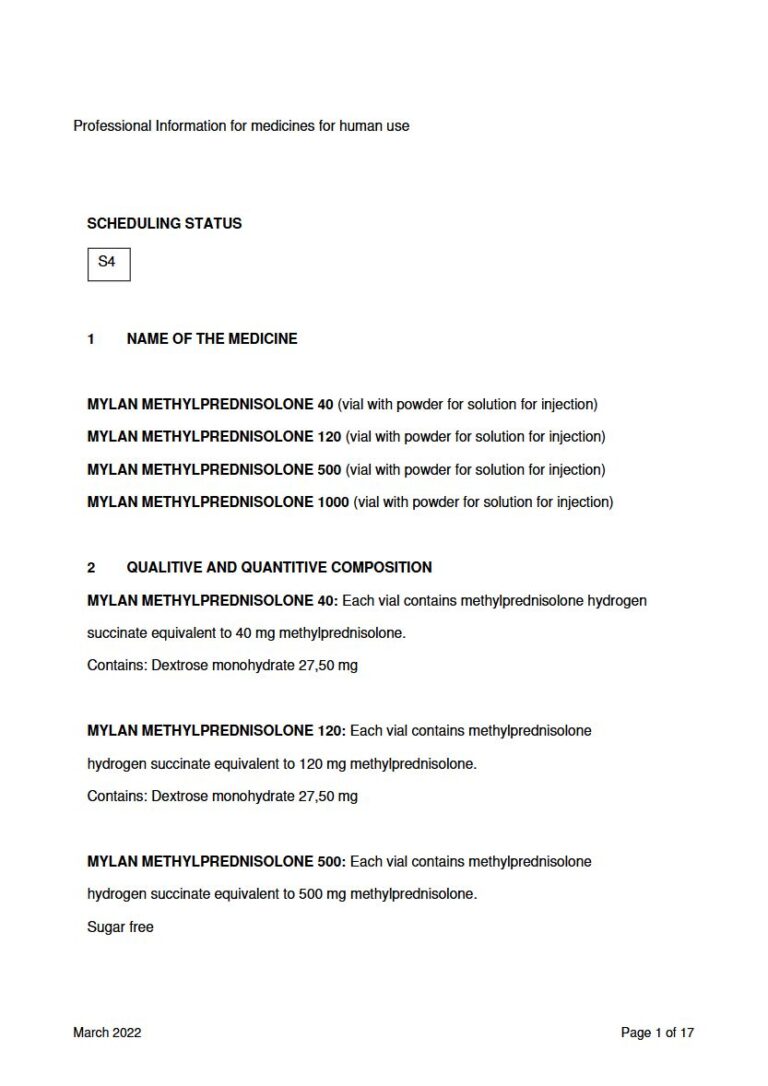
Mylan Methylprednisolone 40 mg/120 mg/500 mg/1000 mg Solution
PDF Leaflet Revision Date: 24 March 2022
Clinical Summary
Quick overview from the medicine insert
Indication
Corticosteroid for various inflammatory and autoimmune conditions.
Dosage (summary)
IV: 30 mg/kg for life-threatening conditions; 1 g/day for 3 days for SLE or MS.
Special Populations
- Renal impairment
- Hepatic impairment
Pregnancy & Breastfeeding
Safety in pregnancy not established; excreted in breast milk, may cause adrenal suppression in infants.
Key Drug Interactions
- Ciclosporin
- Rifampicin
- Erythromycin
- Diuretics
- Antidiabetic agents
Contraindications
- Active viral infections
- Psychotic states
- Live vaccines
- Hypersensitivity
- Systemic fungal infections
Common side effects
- Gastrointestinal irritation
- Increased appetite
- Weight gain
- Nervousness
- Sleep disturbances
Counselling Points
- Monitor for signs of infection
- Do not stop abruptly after long-term use
- Avoid live vaccines
Serious warnings
- Risk of anaphylaxis
- May mask infections
- Adrenal insufficiency on withdrawal
Important Disclaimer
The Mylan Methylprednisolone 40 mg/120 mg/500 mg/1000 mg Solution professional information leaflet below is the property of Xixia Pharmaceuticals and is provided on Medinsert exactly as issued, with no.. alterations or editorial changes. We make every effort to keep content current by updating documents as soon as new versions become available. Medinsert serves as a trusted access point for healthcare professionals, but does not replace official sources or clinical judgement. For more details, please read our full disclaimer. read more>>
 Healthcare Professionals Only
This content is for registered healthcare professionals
Sign in or create a free account to read the full package insert.
Free for HPCSA-registered professionals. Powered by Medinsert.
Clinical Particulars
Section 4 of the official insert — extracted exactly as issued, no alterations
4.1 Therapeutic indications
MYLAN METHYLPREDNISOLONE is indicated for use in the following conditions:
- Endocrine disorders
- Primary and secondary adrenocortical insufficiency. (Hydrocortisone or cortisone is the medicine of choice; synthetic analogues must be used in conjunction with mineralocorticoids where applicable; in infancy, mineralocorticoid supplementation is of particular importance).
- Rheumatic disorders
- Acute rheumatic carditis.
- Acute symptoms of rheumatoid arthritis if the usual treatment and a conventional dose of corticosteroid therapy should fail.
- Collagen disease (Immune Complex Disease)
- Systemic lupus erythematosus if conventional doses of corticosteroid therapy are unsuccessful.
- Dermatological disorders
- Severe dermatological disorders responsive to steroid therapy.
- Allergic conditions
- The severity of which necessitates the use of intravenous therapy such as angioedema, anaphylactic shock and severe asthma.
- Gastro-intestinal diseases
- Control of severe or incapacitating ulcerative colitis.
- Haematological disorders
- Secondary thrombocytopenia of immunological origin in adults in whom IV therapy is indicated. Idiopathic thrombocytopenic purpura in adults (IV administration only; IM administration is contra-indicated).
- Nervous system
- Cerebral oedema caused by space occupying lesions.
- Acute exacerbations of multiple sclerosis.
- Acute spinal cord injury
- As adjunctive therapy in the treatment of the symptoms of acute spinal cord injury. Treatment should begin within eight hours of injury.
- Cardiovascular conditions
- Shock secondary to adrenocortical insufficiency or shock unresponsive to conventional therapy when adrenal cortical insufficiency may be present. (Hydrocortisone is generally the medication of choice.)
- Organ transplantation
- Treatment of graft rejection.
- Treatment of graft versus host reaction.
- Neoplastic diseases
- For the palliative management of leukaemias and lymphomas.
- As adjunctive therapy for nausea and vomiting associated with cancer therapy
4.2 Posology and method of administration
Posology
Corticosteroid therapy is an adjunct to, and not a replacement for, conventional therapy. As adjunctive therapy in life threatening conditions, the recommended dose of MYLAN METHYLPREDNISOLONE is 30 mg per kg, given IV over a period of at least 30 minutes. This dose may be repeated every 4 u2013 6 hours for up to 48 hours.
For corticosteroid responsive diseases in exacerbation, and unresponsive to standard therapy, pulse dosing may be used. Suggested dosing schedules are :
- Systemic Lupus Erythematosus: 1 g/day for 3 days IV.
- Multiple Sclerosis: 1 g/day for 3 days IV or 1 g/day for 5 days IV.
- Oedematous states (e.g. lupus nephritis): 30 mg/kg every other day for 4 days IV or 1 g/day for 3, 5, or 7 days IV.
The regimen should be administered over at least 30 minutes, and may be repeated if improvement has not occurred within a week after therapy or as the patientu2019s condition dictates.
Acute spinal cord injury: As adjunctive therapy in the treatment of acute spinal cord injury, administer intravenously, 30 mg methylprednisolone per kilogram of body weight in a bolus dose over a 15 minute period, followed by a 45 minute pause, and then a continuous infusion of 5,4 mg/kg per hour for 23 hours and then stopped abruptly. There should be a separate intravenous site for the infusion pump. The treatment should begin within eight hours of injury.
As adjunctive therapy for the prevention of nausea and vomiting associated with cancer chemotherapy the suggested dosage schedules are:
- Mild to moderate emetogenic chemotherapy: Administer 250 mg MYLAN METHYLPREDNISOLONE IV over at least 5 minutes, one hour before chemotherapy, at the initiation of chemotherapy, and at the time of discharge.
- Severe emetogenic chemotherapy: Administer 250 mg of MYLAN METHYLPREDNISOLONE IV over at least 5 minutes with appropriate doses of metoclopramide or a butyrophenone one hour before chemotherapy, then 250 mg MYLAN METHYLPREDNISOLONE IV at the initiation of chemotherapy and at time of discharge.
In other indications, the initial dose will vary from 10 to 500 mg IV depending on the severity of the disorder being treated. Larger doses may be required for short term management of severe acute conditions. The initial dose, up to 250 mg, should be given intravenously over a period of at least 5 minutes, and if greater than 250 mg, should be given over at least 30 minutes. Subsequent doses may be given intravenously or intramuscularly at intervals dictated by the patientu2019s response and clinical condition.
Dosage must be reduced for infants and children but should be governed by the severity of the condition and response of the patient rather than by the age or size. It should, however, not be less than 0,5 mg per kg every 24 hours.
Dosage must be decreased or discontinued gradually when the medicine has been administered for more than a few days. Routine laboratory studies must be performed such as urinalysis, 2 hour postprandial blood sugar, determination of blood pressure and body mass, and a chest X-ray should be taken at regular intervals during prolonged therapy. Upper gastrointestinal X-rays are desirable in patients with an ulcer history or significant dyspepsia.
To avoid compatibility and stability problems, it is recommended that MYLAN METHYLPREDNISOLONE be administered separately from other medicines either through an IV medication chamber, or as an IV u201cpiggy - backu201d solution.
Preparation of Solutions: To prepare solutions for intravenous infusion, first reconstitute MYLAN METHYLPREDNISOLONE 40 and 120 with 2 ml of water for injection, 8 ml water for injection for MYLAN METHYLPREDNISOLONE 500 and 16 ml water for injection for MYLAN METHYLPREDNISOLONE 1000. Therapy may be initiated by administering reconstituted MYLAN METHYLPREDNISOLONE intravenously over a period of at least 5 minutes (for doses up to 250 mg) to at least 30 minutes (for doses of 250 mg or more). Subsequent doses may be withdrawn and administered similarly. If desired, the medication may be administered in dilute solutions by admixing the reconstituted product with Dextrose 5 % in Water; Normal Saline; Dextrose 5 % in 0,45 % or 0,9 % m/v Sodium Chloride. The resulting solutions are physically and chemically stable for 24 hours when refrigerated between 2 u2013 8 u00b0C. The solution must be used immediately if not stored in a refrigerator. Parenteral medicinal products should be inspected visually for particulate matter and discolouration prior to administration whenever solution and container permit. Dosage must be decreased or discontinued gradually when the medicine has been administered for more than a few days.
4.3 Contraindications
MYLAN METHYLPREDNISOLONE is contra-indicated in the following situations:
- Certain active viruses (especially hepatitis, herpes, chickenpox, herpes zoster).
- Psychotic states not yet controlled by treatment.
- Live-attenuated vaccines.
- Hypersensitivity to any of the ingredients.
- Systemic fungal Infections.
- Haemorrhagic disorders or ongoing anti-coagulant treatment, in case of intra- muscular injection.
- Unless considered lifesaving, it should not be given to patients with acute psychosis, peptic ulcers or osteoporosis.
4.4 Special warnings and precautions for use
Rapid intravenous administration of high doses of MYLAN METHYLPREDNISOLONE has been reported to cause angioedema and/or anaphylactic reactions, seizures, and sudden death associated with cardiac dysrhythmias (more than 0,5 g administered over a period of less than 10 minutes).
Risk of bradycardia: Bradycardia, possibly unrelated to the speed of infusion, has been reported during and after administration of MYLAN METHYLPREDNISOLONE . Monitoring of the electrocardiogram (ECG) is recommended. Equipment, medications, and trained personnel necessary for treating these complications should be immediately available.
Tuberculosis, (active positive skin test, latent, or history of) may be exacerbated or reactivated by MYLAN METHYLPREDNISOLONE : appropriate antitubercular chemotherapy or prophylaxis should be administered concurrently.
Concurrent use of MYLAN METHYLPREDNISOLONE and ciclosporin may cause convulsions ( see section 4.5 INTERACTIONS ).
MYLAN METHYLPREDNISOLONE may mask signs of infection or new infections may appear. Patients on MYLAN METHYLPREDNISOLONE require an increase in dosage prior to, during, and for a time following exposure to emotional or physical stress such as severe infection or surgery.
Infants born of mothers who have received prolonged therapy with high doses of MYLAN METHYLPREDNISOLONE should be carefully monitored for signs of adrenal insufficiency (see section 4.7 ).
Patients on MYLAN METHYLPREDNISOLONE , especially in high doses, should not be immunized because of the possible risk of neurological complications and a lack of antibody response ( see section 4.5 ).
MYLAN METHYLPREDNISOLONE should be used with caution in:
- Diverticulitis
- Non -specific ulcerative colitis, if there is a risk of impending perforation, abscess or other infection
- Recent intestinal anastomoses
- Active or latent pep tic ulcer
- Myasthenia gravis, as muscle weakness may initially be increased, leading to possible respiratory distress
- Osteoporosis
- Renal function impairment
- Hypertension
- Ocular herpes simplex, as this may result in corneal perforation
- Acute psychosis, which may be aggravated
- Glucose intolerance
Decrease or discontinue the dosage gradually if MYLAN METHYLPREDNISOLONE has been administered for more than a few days.
Athletes should be warned that the active ingredient, methylprednisolone, in MYLAN METHYLPREDNISOLONE is on the list of banned substances.
Sodium intake may need to be reduced and potassium supplements may be necessary especially with high dose therapy and when prescribed for a long time.
Withdrawal symptoms: Too rapid a reduction of dosage of MYLAN METHYLPREDNISOLONE following prolonged treatment may cause acute, possibly life-threatening, adrenal insufficiency and/or a withdrawal syndrome not related to hypophalamic-pituitary-adrenal (HPA) axis suppression. Symptoms include low-grade fever, muscle or joint pain, weight loss.
4.5 Interaction with other medicines and other forms of Interaction
Concomitant use of MYLAN METHYLPREDNISOLONE with:
- Ciclosporin may result in seizures, especially with high doses in combination with MYLAN METHYLPREDNISOLINE , as the metabolism of both is inhibited. Adverse effects are therefore more likely to occur ( see section 4.4 ).
- Medicines that induce hepatic enzymes, such as rifampicin, carbamazepine, phenytoin , may result in reduced efficacy of MYLAN METHYLPREDNISOLONE.
- Medicines such as erythromycin and ketoconazole that inhibit metabolism , may result in an increase in MYLAN METHYLPREDNISOLONE u2019s adverse effects.
- Live-attenuated vaccines may potentiate the replication of the vaccine virus; also, immunisation with oral poliovirus vaccine should be postponed in persons in close contact with the patient, especially family members. Caution should also be exercised with other vaccines (see section 4.4 ).
- Salicylates may result in an increase in excretion of salicylates, which may require increased doses of salicylates. On withdrawal of MYLAN METHYLPREDNISOLONE , salicylate poisoning may occur. Caution is recommended when salicylates are used concurrently with MYLAN METHYLPREDNISOLONE in patients with hypoprothrombinaemia.
- Non-depolarising neuromuscular blocking agents, such as pancuronium may enhance the blockade of nondepolarising neuromuscular blocking agents, possibly leading to increased or prolonged respiratory depression or paralysis.
- Other immunosuppressant agents may increase the risk of infection.
- Diuretics, especially potassium-depleting diuretics, may result in severe hypokalaemia. Monitoring of serum potassium concentration and cardiac function is recommended. Digoxin may increase the risk of cardiac dysrhythmias associated with hypokalaemia.
- Antidiabetic agents, oral and insulin, may require dosage adjustment of both agents as MYLAN METHYLPREDNISOLONE may increase blood glucose concentration. Dosage readjustment of the hypoglycaemic agent also may be required when MYLAN METHYLPREDNISOLONE is discontinued.
- Coumarin anticoagulants may result in an enhanced anticoagulant effect. Monitoring of INR is recommended.
- Anticholinesterase agents may produce severe weakness in patients with myasthenia gravis. Anticholinesterase agents should be withdrawn at least 24 hours before initiating therapy with MYLAN METHYLPREDNISOLONE.
- Carbonic anhydrase inhibitors or amphotericin B may result in severe hypokalaemia. Serum potassium concentrations and cardiac function should be monitored.
- Antihypertensives may result in reduced hypotension.
4.6 Fertility, pregnancy and lactation
Women of childbearing potential/ Contraception in males and females: No information available.
Pregnancy: Safety and efficacy in pregnancy have not been established.
Lactation: MYLAN METHYLPREDNISOLONE is excreted in breast milk and high doses may cause adrenal suppression in the infant.
Fertility: No information available.
4.7 Effects on ability to drive and use machines
MYLAN METHYLPREDNISOLONE may have no or negligible influence effect mental and/or physical abilities to perform or execute tasks or activities requiring mental alertness, judgment and/or sound coordination and vision.
4.8 Undesirable effects
Immune system disorders : Reported but frequency unknown: Anaphylaxis, hives, shortness of breath, swelling of face, nasal membranes and eyelids, tightness in chest, troubled breathing, wheezing, with or without circulatory collapse, cardiac dysrhythmias, cardiac arrest, bronchospasm, flushing of face or cheeks, seizures. Masking of infections, latent infections becoming active, opportunistic infections.
Endocrine disorders: Less frequent: Diabetes mellitus. Reported but frequency unknown: Cushingu2019s syndrome effects including filling or rounding out othe face, menstrual irregularities, ACTH secretion, occasionally definitive atrophy of the adrenal cortex, reduction in glucose tolerance, suppressed growth in children.
Metabolism and nutrition disorders: Reported but frequency unknown: Hypokalaemic syndrome. Negative nitrogen balance due to protein catabolism.
Psychiatric disorders: Less frequent: Psychic disturbances such as delirium (confusion, excitement, restlessness), disorientation, euphoria, hallucinations, manic-depressive episodes, mental depression or paranoia.
Nervous system disorders: Frequent: Nervousness or restlessness, trouble in sleeping. Reported but frequency unknown: Increased intracranial pressure, pseudotumor cerebri, seizures.
Eye disorders: Less frequent: Sudden blindness. Reported but frequency unknown: Posterior subcapsular, cataracts, glaucoma with possible damage to optic nerves, ocular infection, secondary, fungal or viral.
Cardiac disorders: Less frequent: Congestive heart failure in susceptible individuals. Less frequent but serious: Bradycardia.
Vascular disorders: Reported but frequency unknown: Hypertension.
Gastrointestinal disorders: Frequent: Gastrointestinal irritation, increased appetite, indigestion, weight gain. Reported but frequency unknown: Pancreatitis, peptic ulceration or intestinal perforation, oesophagitis.
Skin and subcutaneous tissue disorders: Less frequent: Generalised allergic reaction (skin rash or hives). Reported but frequency unknown: Acne, adrenal suppression, hirsutism, striae, cutaneous or subcutaneous tissue atrophy, petechiae and ecchymosis, impaired wound healing; thin, fragile skin, facial erythema, thinning of hair and scalp, hyperpigmentation, hypopigmentation.
Musculoskeletal, connective tissue and bone disorders: Reported but frequency unknown: Avascular necrosis, muscular weakness, osteoporosis or bone fractures, steroid myopathy, tendon rupture.
General disorders and administrative site conditions: Less frequent: Burning, numbness, pain or tingling at or near injection site. Local allergic reaction or infection at injection site (redness, swelling, pain or other signs of infection or allergic reaction), scarring at injection site.
Reporting of suspected adverse reactions Reporting suspected adverse reactions after authorisation of the medicine is important. It allows continued monitoring of the benefit/risk balance of the medicine. Healthcare professionals are asked to report any suspected adverse reactions to SAHPRA via the u201cReport Drug Reaction Processu201d, found online under SAHPRAu2019s safety publications: https://www.sahpra.org.za/
4.9 Overdose
See SIDE EFFECTS AND SPECIAL PRECAUTIONS.
