
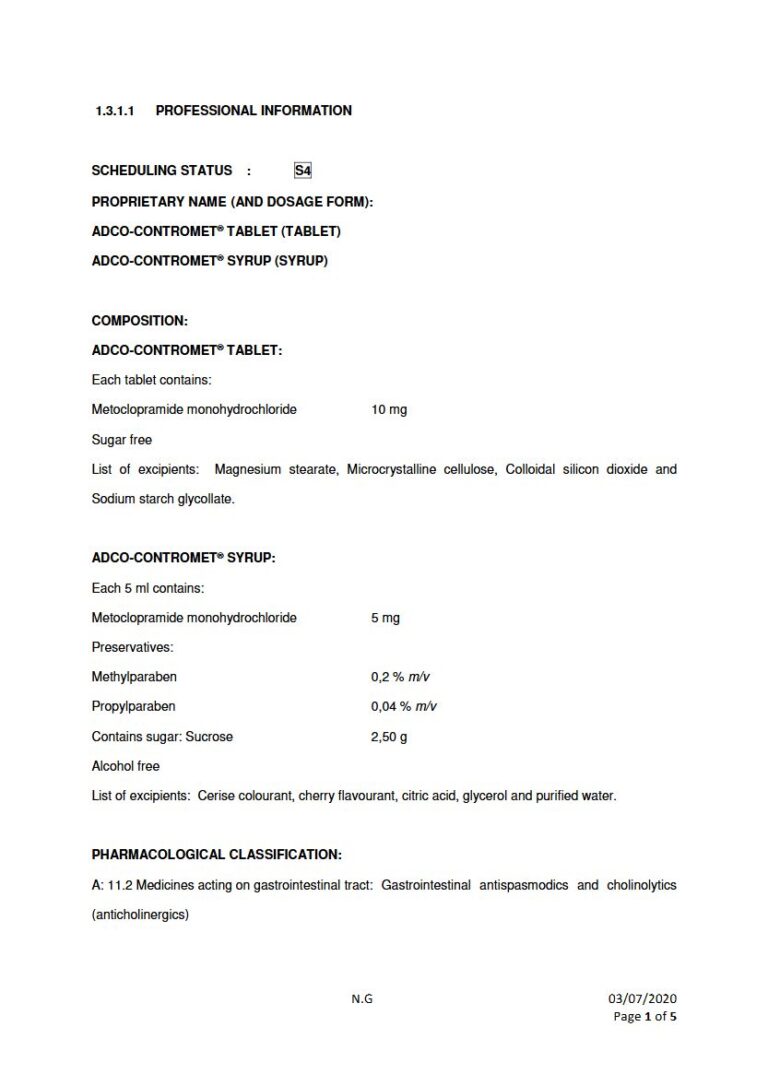
Adco Contromet Tablet & Syrub
Clinical Summary
Quick overview from the medicine insert
Indication
Management of nausea and vomiting, including that associated with chemotherapy, radiotherapy, and postoperative states.
Dosage (summary)
Adults: 10 mg to 20 mg taken 30 minutes before meals and at bedtime. Maximum daily dose: 60 mg. Children: 0.1 mg/kg to 0.15 mg/kg up to a maximum of 10 mg, taken 30 minutes before meals.
Onset of Action / Duration
Onset of action: 30 to 60 minutes; Duration of action: 1 to 2 hours.
Special Populations
- Elderly patients
- Patients with renal impairment
- Patients with hepatic impairment
Pregnancy & Breastfeeding
Use during pregnancy only if the potential benefit justifies the potential risk to the fetus. Metoclopramide is excreted in breast milk; caution is advised when administered to nursing mothers.
Key Drug Interactions
- CNS depressants may enhance sedative effects.
- Anticholinergic agents may reduce the effectiveness of Metoclopramide.
- Drugs that affect gastric emptying may interact with Metoclopramide.
Contraindications
- Hypersensitivity to Metoclopramide or any component of the formulation.
- Gastrointestinal obstruction, perforation, or hemorrhage.
- Pheochromocytoma.
- Seizure disorders.
Common side effects
- Drowsiness
- Fatigue
- Restlessness
- Dizziness
- Diarrhea
- Extrapyramidal symptoms
Counselling Points
- Avoid alcohol while taking this medication.
- Inform healthcare provider if experiencing any unusual movements or symptoms.
- Take the medication as prescribed and do not exceed the recommended dose.
- Report any signs of allergic reaction, such as rash or difficulty breathing.
Serious warnings
- Long-term use may lead to tardive dyskinesia.
- Use with caution in patients with a history of depression.
- Monitor for signs of neuroleptic malignant syndrome.
Important Disclaimer
The Adco Contromet Tablet & Syrub professional information leaflet below is the property of Adcock Ingram and is provided on Medinsert exactly as issued, with no.. alterations or editorial changes. We make every effort to keep content current by updating documents as soon as new versions become available. Medinsert serves as a trusted access point for healthcare professionals, but does not replace official sources or clinical judgement. For more details, please read our full disclaimer. read more>>
 Healthcare Professionals Only
This content is for registered healthcare professionals
Sign in or create a free account to read the full package insert.
Free for HPCSA-registered professionals. Powered by Medinsert.
Clinical Particulars
Section 4 of the official insert — extracted exactly as issued, no alterations
4.1 Therapeutic indications
ADCO-CONTROMET u00ae is used as an adjunct to the X-ray examination of the stomach and duodenum and post-operative hypotonia (postvagotomy syndrome). It is also used as an anti-emetic for the prevention and treatment of irradiation sickness, post-operative vomiting, and drug-induced nausea and vomiting.
4.2 Posology and method of administration
Adults: The average adult dose is 10 mg eight hourly. In diagnostic radiology and duodenal intubation: 20 mg before the barium meal.
Children: 5 to 14 years: 2.5 to 5 mg three times daily. 3 to 5 years: 2 mg two to three times daily. (See u2018WARNINGSu2019)
4.3 Contraindications
ADCO-CONTROMET u00ae should not be used where gastrointestinal conditions might be adversely affected as in intestinal obstruction or immediately after surgery. Patients with phaeochromocytoma or convulsive disorders.
4.4 Special warnings and precautions for use
WARNING: TARDIVE DYSKINESIA
Chronic treatment with ADCO-CONTROMET u00ae can cause tardive dyskinesia, a serious movement disorder that is often irreversible. The risk of developing tardive dyskinesia increases with the duration of treatment and the total cumulative dose. The elderly, especially elderly women, are most likely to develop this condition. ADCO-CONTROMET u00ae therapy should routinely be discontinued in patients who develop signs or symptoms of tardive dyskinesia. There is no known treatment for tardive dyskinesia, however, in some patients symptoms may lessen or resolve after ADCO-CONTROMET u00ae treatment is stopped.
Prolonged treatment (greater than 12 weeks) with ADCO-CONTROMET u00ae should be avoided in all but rare cases where therapeutic benefit is thought to outweigh the risks to the patient of developing tardive dyskinesia. The use of metoclopramide throughout the duration of pregnancy is considered unsafe, as teratogenicity has been demonstrated in animal studies.
4.5 Interactions with other medicines
Care should be exercised when using ADCO-CONTROMET u00ae in patients taking other drugs that can also cause extrapyramidal reactions, such as the phenothiazines. The effects of central nervous system depressants may be enhanced. Anticholinergic agents antagonise the effects of ADCO-CONTROMET u00ae; narcotic analgesics may act similarly. ADCO-CONTROMET u00ae may affect the absorption of other drugs either by diminishing absorption from the stomach or by enhancing absorption from the small intestine. ADCO-CONTROMET u00ae may also increase prolactin blood concentrations and therefore interfere with drugs that have a hypoprolactinaemic effect and with some diagnostic tests.
4.6 Fertility, pregnancy and lactation
The use of metoclopramide throughout the duration of pregnancy is considered unsafe, as teratogenicity has been demonstrated in animal studies.
4.7 Effects on ability to drive and use machines
Not specified in the provided text.
4.8 Undesirable effects
Side effects: Tardive dyskinesia has been reported. See u2018BOXED WARNINGSu2019. ADCO-CONTROMET u00ae may cause extrapyramidal symptoms which usually occur as dystonic reactions, especially in young patients. Parkinsonism and/or tardive dyskinesia may occur, usually during prolonged treatment in elderly patients. Bowel upsets such as diarrhoea or constipation, drowsiness and fatigue, dizziness, restlessness and anxiety, galactorrhoea and gynaecomastia may also occur. Transient increases in plasma aldosterone concentrations have been reported. Hypertensive crises have occurred in patients with phaeochromocytoma. Children, young patients and the elderly should be treated with care. Patients on prolonged therapy should be reviewed regularly. Care should also be taken when ADCO-CONTROMET u00ae is administered to patients with significant renal impairment or to those at risk of fluid retention as in hepatic impairment.
4.9 Overdose
Symptoms as under u2018SIDE EFFECTSu2019. Treatment is symptomatic and supportive.
