
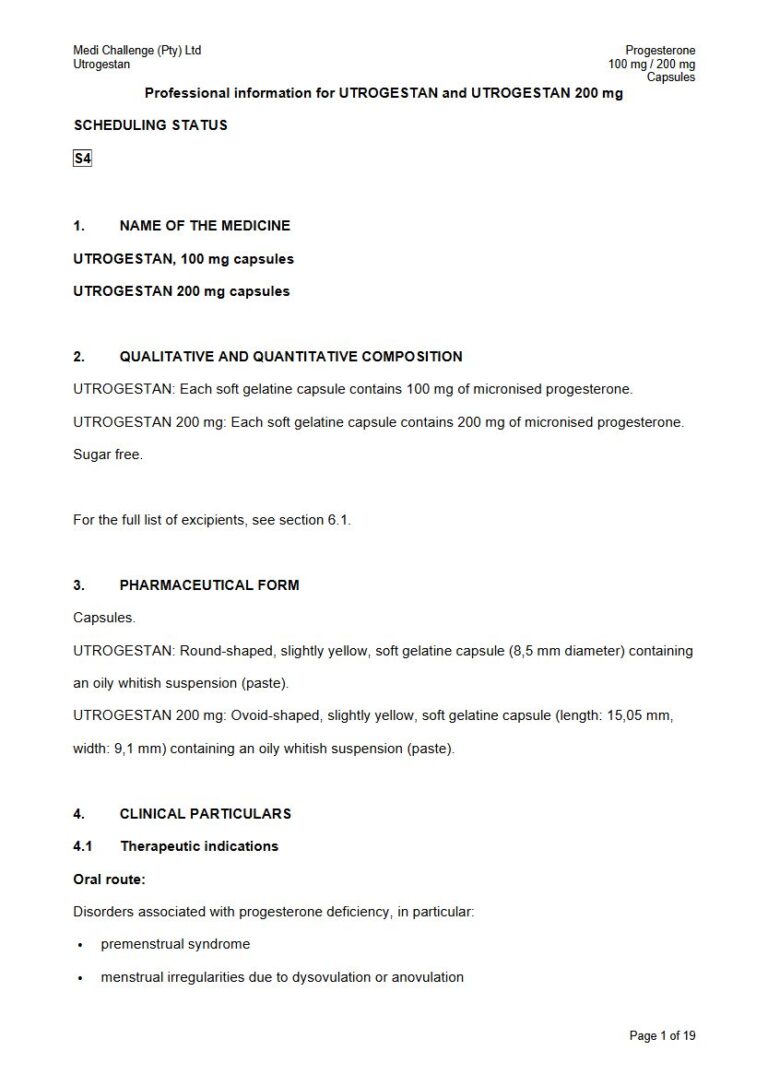
Utrogestan / Utrogestan 200 Mg/100 mg Capsules
PDF Leaflet Revision Date: 13 June 2024
Clinical Summary
Quick overview from the medicine insert
Indication
Progesterone deficiency disorders and luteal phase support.
Dosage (summary)
200-300 mg/day orally; 100-600 mg/day vaginally depending on indication.
Onset of Action / Duration
Onset: 1 hour, Duration: 24 hours
Special Populations
- Elderly
- Renal impairment
- Hepatic impairment
Pregnancy & Breastfeeding
Use restricted to first trimester via vaginal route; not recommended during breastfeeding.
Key Drug Interactions
- Enzyme inducers (e.g., carbamazepine)
- Enzyme inhibitors (e.g., ketoconazole)
- Ciclosporin
Contraindications
- Known sensitivity to progesterone
- Severe liver disease
- Undiagnosed vaginal bleeding
- Breastfeeding
Common side effects
- Dizziness
- Drowsiness
- Abdominal cramping
- Amenorrhoea
Counselling Points
- Take after eating
- May cause drowsiness
- Report any unusual bleeding
Serious warnings
- Discontinue if liver function tests abnormal
- Risk of thromboembolism
- Not contraceptive
Important Disclaimer
The Utrogestan / Utrogestan 200 Mg/100 mg Capsules professional information leaflet below is the property of Medi Challenge and is provided on Medinsert exactly as issued, with no.. alterations or editorial changes. We make every effort to keep content current by updating documents as soon as new versions become available. Medinsert serves as a trusted access point for healthcare professionals, but does not replace official sources or clinical judgement. For more details, please read our full disclaimer. read more>>
 Healthcare Professionals Only
This content is for registered healthcare professionals
Sign in or create a free account to read the full package insert.
Free for HPCSA-registered professionals. Powered by Medinsert.
Clinical Particulars
Section 4 of the official insert — extracted exactly as issued, no alterations
4.1 Therapeutic indications
Oral route: Disorders associated with progesterone deficiency, in particular:
- premenstrual syndrome
- menstrual irregularities due to dysovulation or anovulation
- mastopathy
- perimenopause
- hormone replacement therapy for menopause (in addition to oestrogen therapy).
Vaginal route:
- progesterone support during ovarian insufficiency or complete ovarian failure in women lacking ovarian function (oocyte donation)
- supplementation of the luteal phase during in-vitro fertilisation (IVF) cycles
- supplementation of the luteal phase during spontaneous or induced cycles, in cases of sub-fertility or primary or secondary infertility, particularly due to dysovulation
- in cases of threatened miscarriage or prevention of recurrent miscarriage due to luteal phase deficiency, until week 12 of pregnancy.
- prevention of preterm birth in women with singleton pregnancy who have a short cervix (mid-trimester sonographic cervix u2264 25 mm) and/or a history of spontaneous preterm birth.
For all other indications of progesterone, the vaginal route represents an alternative to the oral route in cases of:
- side effects caused by progesterone (drowsiness following absorption via the oral route).
4.2 Posology and method of administration
Posology
It is important to adhere strictly to the recommended dosages for all therapeutic indications. The dosage must not exceed 200 mg per dose, regardless of the indication and route of administration (oral or vaginal).
Oral route: For progesterone deficiency, an average dose of 200 mg u2013 300 mg UTROGESTAN per day is recommended.
- For luteal phase insufficiency (premenstrual syndrome, mastopathy, irregular menstruation and perimenopause), the usual therapeutic regimen is 200 mg u2013 300 mg per day:
- a single dose of 200 mg in the evening, upon going to bed, or
- 300 mg split over two doses. Ten days per cycle, usually from day 17 to day 26, inclusive.
- When used as a hormone replacement therapy for menopause, oestrogen therapy alone is not advised (due to the risk of endometrial hyperplasia). Instead, UTROGESTAN should be incorporated at a dose of 200 mg per day:
- split over two 100-mg doses, or
- as a single 200-mg dose in the evening, upon going to bed, either from day 12 to day 14 of the month, or during the last two weeks of each treatment course. Following this treatment, all replacement therapies should be suspended for approximately one week, during which time it is normal to observe withdrawal bleeding.
For these indications, the vaginal route should be used, at the same dosage as for the oral route, in the event of side effects caused by UTROGESTAN (drowsiness following oral absorption).
Vaginal route:
- Progesterone replacement therapy in cases of ovarian insufficiency or complete ovarian failure in women lacking ovaries (oocyte donation). The therapeutic regimen (in addition to appropriate oestrogen therapy) is as follows:
- 100 mg UTROGESTAN per day on days 13 and 14 of the transfer cycle, then
- 200 mg of UTROGESTAN per day on days 15 and 25 of the transfer cycle, split over one or two doses per day, then
- from day 26 of the cycle, and in cases of an incipient pregnancy, the dose may be increased up to a maximum of 600 mg per day, split over three doses. This dosage should be adhered to until day 60, or until week 12 of pregnancy at the latest.
- Supplementation of the luteal phase during IVF cycles: The recommended dosage is 400 mg u2013 600 mg per day, over two to three doses per day, from the date of HCG injection until week 12 of pregnancy.
- Supplementation of the luteal phase in cases of spontaneous or induced cycles, in subjects with sub-fertility or primary or secondary sterility, particularly due to dysovulation: The recommended dosage is 200 mg u2013 300 mg per day, over two doses, for ten days, from day 17 of the cycle. If menstruation does not resume and pregnancy is diagnosed, treatment should be quickly resumed until week 12 of pregnancy.
- Threatened early miscarriage or repeated miscarriage due to luteal phase insufficiency: The recommended dosage is 200 mg u2013 400 mg per day, split over two doses, until week 12 of pregnancy.
- For prevention of preterm birth in women with a singleton pregnancy who have a short cervix and/or a history of spontaneous preterm birth: The recommended dosage is 200 mg per day in the evening at bedtime from around week 20 to week 34 of pregnancy.
Method of administration
Oral route: It is recommended to take UTROGESTAN sometime after eating, preferably in the evenings upon going to bed.
Vaginal route: Each capsule should be inserted deep into the vagina.
4.3 Contraindications
- Known sensitivity to progesterone or any of the excipients listed in section 6.1.
- Severe liver disease such as cholestatic jaundice, or hepatitis, or a history of severe liver disease, hepatic cell tumours, Rotor syndrome, or Dubin-Johnson syndrome.
- Undiagnosed vaginal bleeding.
- Mammary or genital tract carcinoma.
- Conditions of rare occurrence known to be affected by sex steroids i.e. herpes gestationis, jaundice of pregnancy, otosclerosis, severe pruritus, or porphyria.
- Previous or current thromboembolism disorders (e.g. deep venous thrombosis, pulmonary embolism) or thrombophlebitis.
- Known thrombophilic disorders.
- Cerebral haemorrhage.
- Breastfeeding (see section 4.6).
4.4 Special warnings and precautions for use
Treatment should be discontinued if the results of liver function tests become abnormal or if cholestatic jaundice appears. More than half early spontaneous abortions are due to genetic defects. Moreover, infections and mechanical disorders may cause early miscarriages. In these cases the only effect of progesterone administration will be to delay the expulsion of the dead egg (or interruption of a terminated pregnancy). Treatment should be discontinued upon diagnosis of a missed abortion. A pre-treatment physical examination prior to the initiation of hormone replacement treatment should include special attention to breast and pelvic organs as well as Papanicolaou smear. The use of UTROGESTAN must be reserved for cases with insufficient secretion of the corpus luteum. Treatment under the recommended conditions of use is not contraceptive. The use of UTROGESTAN during pregnancy is restricted to the first trimester via the vaginal route.
UTROGESTAN, when taken orally, is not suitable for the treatment for the threat of preterm birth. Exceptional cases of cytolytic hepatitis and intrahepatic cholestasis of pregnancy have been reported in patients using UTROGESTAN, during the second and third trimesters of pregnancy. UTROGESTAN contains soybean lecithin and may cause hypersensitivity reactions (urticarial and anaphylactic shock in hypersensitive patients). As there is a possible relationship between allergy to soya and allergy to peanut, patients with peanut allergy should avoid using UTROGESTAN.
4.5 Interaction with other medicines and other forms of interaction
Enzyme inducers
The efficacy of UTROGESTAN may be decreased due to an enhanced metabolism of progesterone by hepatic enzyme inducing medicines, such as carbamazepine, phenobarbital, phenytoin, rifabutin or rifampicin, griseofulvin, some antibiotics (ampicillin, tetracyclines), and herbal products containing St. Johnu2019s wort (Hypericum perforatum).
Enzyme inhibitors
Hepatic metabolic enzyme inhibitors such as ketoconazole, ritonavir, nelfinavir may increase the bioavailability of UTROGESTAN.
Effect of UTROGESTAN on other medicines
UTROGESTAN may increase the plasma concentration of ciclosporin, theophylline and troleandomycin.
4.6 Fertility, pregnancy and lactation
Pregnancy
Safety in pregnancy has not been established. The use of UTROGESTAN during pregnancy is restricted to the vaginal application. Cases of hepatic cytolysis and cases of cholestasis of pregnancy have been reported during administration of micronised progesterone during the 2nd and 3rd trimesters of pregnancy.
Breastfeeding
The use of UTROGESTAN during breastfeeding is not recommended. See section 4.3.
Fertility
UTROGESTAN is indicated to support luteal deficiency in sub fertile or infertile women.
4.7 Effects on ability to drive and use machines
Patients intending to drive or use machines should be warned that they may suffer from drowsiness, dizziness and vertigo after administration of UTROGESTAN. Patients experiencing drowsiness, dizziness, or vertigo during treatment with UTROGESTAN should avoid driving or use of machines.
4.8 Undesirable effects
Summary of the safety profile
The reporting rate of adverse drug reactions with UTROGESTAN oral and vaginal formulations was calculated as 1,43/1 000 patient year's corresponding to approximately 1,5 spontaneously reported cases in every 1 000 patients exposed to UTROGESTAN.
List of adverse reactions
Oral route:
Blood and lymphatic system disorders
- Frequent: Hyperglycaemia.
- Less frequent: Thromboembolism or thrombus formation.
Immune system disorders
- Frequency unknown: Anaphylaxis or anaphylactoid reaction.
Endocrine disorders
- Less frequent: Cushingu2019s syndrome, adrenal suppression or insufficiency.
Metabolism and nutrition disorders
- Frequent: Unusual or rapid weight gain.
Nervous system disorders
- Frequent: Dizziness, drowsiness, fatigue, mild headache, mood changes, nervousness, unusual tiredness or weakness, vertigo, somnolence.
- Less frequent: Mental depression, insomnia.
Vascular disorders
- Frequent: Oedema.
- Less frequent: Hypotension, hot flushes.
Gastrointestinal disorders
- Frequent: Abdominal cramping or pain, abdominal bloating, diarrhoea, nausea.
Hepato-biliary disorders
- Frequency unknown: Jaundice.
Skin and subcutaneous tissue disorders
- Less frequent: Skin rash, acne, loss or gain of body, facial or scalp hair; melasma, chloasma, pruritus.
Musculoskeletal and connective tissue disorders
- Frequent: Joint pain.
- Frequency unknown: Loss of bone mineral density, osteoporosis, osteoporotic fracture.
Renal and urinary disorders
- Frequent: Urinary problems.
Reproductive system and breast disorders
- Frequent: Amenorrhoea, breakthrough menstrual bleeding or metromenorrhagia, menorrhagia, spotting.
- Less frequent: Galactorrhoea, breast pain or tenderness, libido decrease.
- Frequency unknown: Vaginal haemorrhage.
General disorders and administration site conditions
- Frequency unknown: Fatigue.
Vaginal route:
- No local intolerances (such as burning, pruritus or fatty discharge) have been observed during various clinical trials.
- No general side effects, including drowsiness or transient feelings of dizziness, have been reported during clinical studies, at the recommended dosages.
The information given below is based on extensive post marketing experience from vaginal administration of progesterone.
Skin and subcutaneous tissue disorders
- Frequency unknown: Pruritus.
Reproductive system and breast disorders
- Frequency unknown: Vaginal haemorrhage, vaginal discharge.
Description of selective adverse reactions
Somnolence or transient dizziness may occur 1 to 3 hours after intake of the drug. Bedtime dosing and reduction of the dose may reduce these effects.
The following risks apply in relation to systemic oestrogen/progestogen treatment: Breast cancer risk
- An up to 2-fold increased risk of having breast cancer diagnosed is reported in women taking combined oestrogen-progestogen therapy for more than 5 years.
- Any increased risk in users of oestrogen-only therapy is substantially lower than that seen in users of oestrogen-progestogen combinations.
- The level of risk is dependent on the duration of use (see section 4.4).
Results of the largest randomised placebo-controlled trial (WHI-study) and largest epidemiological study (MWS) are presented.
Million Women study (MWS) u2013 Estimated additional risk of breast cancer after 5 years' use
| Age range (years) | Additional cases per 1000 never-users of HRT over a 5-year period*2 | Risk ratio & 95 % Cl | Additional cases per 1000 HRT users over 5 years (95 % Cl) |
|---|---|---|---|
| Oestrogen only HRT | 50 u2013 65 | 9 u2013 12 | 1,2 1 u2013 2 (0 u2013 3) |
| Combined oestrogen-progestogen | 50 u2013 65 | 9 u2013 12 | 1,7 6 (5 u2013 7) |
# Overall risk ratio. The risk ratio is not constant but will increase with increasing duration on use. Note: Since the background incidence of breast cancer differs by region, the number of additional cases of breast cancer will also change proportionately.
* Taken from baseline incidence rates in developed countries.
US WHI studies u2013 additional risk of breast cancer after 5 yearsu2019 use
| Age range (years) | Incidence per 1000 women in placebo arm over 5 years | Risk ratio & 95 % Cl | Additional cases per 1000 HRT users over 5 years (95 % Cl) | |
|---|---|---|---|---|
| CEE oestrogen study | 50 u2013 79 | 21 | 0,8 (0,7 u2013 1.0) | -4 (-7 u2013 0)*3 |
| CEE+MPA oestrogen & progestogen u2021 | 50 u2013 79 | 17 | 1,2 (1,0 u2013 1,5) | +4 (0 u2013 9) |
u2021 When the analysis was restricted to women who had not used HRT prior to the study there was no increased risk apparent during the first 5 years of treatment: after 5 years the risk was higher than in non-users.
3 * WHI study in women with no uterus, which did not show an increase in risk of breast cancer.
Endometrial cancer risk
Postmenopausal women with a uterus. The endometrial cancer risk is about 5 in every 1 000 women with a uterus not using hormone replacement therapy (HRT). In women with a uterus, use of oestrogen-only HRT is not recommended because it increases the risk of endometrial cancer (see section 4.4). Depending on the duration of oestrogen-only use and oestrogen dose, the increase in risk of endometrial cancer in epidemiology studies varied from between 5 and 55 extra cases diagnosed in every 1000 women between the ages of 50 and 65.
Adding progesterone to oestrogen-only therapy for at least 12 days per cycle can prevent this increased risk. In the Million Women Study (MWS) the use of five years of combined (sequential or continuous) HRT did not increase risk of endometrial cancer (RR of 1,0 (0,8 u2013 1,2)).
Ovarian cancer
Use of oestrogen-only and combined oestrogen-progestogen HRT has been associated with a slightly increased risk of having ovarian cancer diagnosed (see section 4.4). A meta-analysis from 52 epidemiological studies reported an increased risk of ovarian cancer in women currently using HRT compared to women who have never used HRT (HRT (RR 1,43, 95% CI 1,31 u2013 1,56). For women aged 50 to 54 years taking 5 years of HRT, this results in about 1 extra case per 2 000 users. In women aged 50 to 54 who are not taking HRT, about 2 women in 2 000 will be diagnosed with ovarian cancer over a 5-year period.
Risk of venous thromboembolism
HRT is associated with a 1,3 - .3-fold increased relative risk of developing venous thromboembolism (VTE), i.e. deep vein thrombosis or pulmonary embolism. The occurrence of such an event is more likely in the first year of using HT (see section 4.4). Results of the WHI studies are presented:
| Age range (years) | Incidence per 1000 women in placebo arm over 5 years | Risk ratio & 95 % Cl | Additional cases per 1000 HRT users. | |
|---|---|---|---|---|
| Oral oestrogen-only*4 | 50 u2013 59 | 7 | 1,2 (0,6 u2013 2,4) | 1 (-3 u2013 10) |
| Oral combined oestrogen-progestogen | 50 u2013 59 | 4 | 2,3 (1,2 u2013 4,3) | 5 (1 u2013 13) |
4* Study in women with no uterus.
Risk of coronary artery disease
The risk of coronary artery disease is slightly increased in users of combined oestrogen-progestogen HRT over the age of 60 (see section 4.4).
Risk of ischaemic stroke
The use of oestrogen-only and oestrogen + progestogen therapy is associated with an up to 1,5-fold increased relative risk of ischaemic stroke. The risk of haemorrhagic stroke is not increased during use of HRT. This relative risk is not dependent on age or on duration of use, but as the baseline risk is strongly age-dependent, the overall risk of stroke in women who use HRT will increase with age, see section 4.4.
WHI studies combined - Additional risk of ischaemic stroke*5 over 5 years' use
| Age range (years) | Incidence per 1000 women in placebo arm over 5 years | Risk ratio & 95 % Cl | Additional cases per 1000 HRT users. |
|---|---|---|---|
| 50 u2013 59 | 8 | 1,3 (1,1 u2013 1,6) | 3 (1 u2013 5) |
5* no differentiation was made between ischaemic and haemorrhagic stroke.
The following adverse reactions have also been reported in association with systemic oestrogen/progestogen treatment:
- Rash.
- Urticaria.
- Chloasma/melasma.
- Pyrexia.
- Insomnia.
- Alopecia.
- Irregular menstruation.
- Amenorrhoea.
- Breast pain/mastodynia.
- Fluid retention/oedema.
- Weight changes.
- Changes in libido.
- Depression.
- Gall bladder disease.
- Probable dementia over the age of 65 (see section 4.4).
- Skin and subcutaneous disorders: erythema multiforme, erythema nodosum, vascular purpura.
Reporting of suspected adverse reactions
Reporting suspected adverse reactions after authorisation of UTROGESTAN is important. It allows continued monitoring of the benefit/risk balance of the medicine. Health care providers are asked to report any suspected adverse reactions to the South African Health Products Regulatory Authority (SAHPRA) via the u201c6.04 Adverse Drug Reaction Reporting Formu201d, found online under SAHPRAu2019s publications: https://www.sahpra.org.za/health-products-vigilance/.
4.9 Overdose
Symptoms of overdosage may include nausea, vomiting, somnolence, dizziness, fatigue euphoria or dysmenorrhoea. Treatment of overdosage consists of discontinuation of UTROGESTAN together with institution of appropriate symptomatic and supportive care.
