
Acegyne 200 mg Tablets
Clinical Summary
Quick overview from the medicine insert
Indication
Medical termination of pregnancy up to 63 days gestation.
Dosage (summary)
200 mg orally, taken as a single dose.
Onset of Action / Duration
Effects typically begin within 24 to 48 hours after administration.
Special Populations
- Patients with adrenal insufficiency
- Patients with hepatic impairment
- Patients with renal impairment
Pregnancy & Breastfeeding
Contraindicated during pregnancy except for medical termination of pregnancy; not recommended during lactation.
Key Drug Interactions
- CYP3A4 inhibitors may increase Mifepristone levels.
- CYP3A4 inducers may decrease Mifepristone levels.
Contraindications
- Confirmed or suspected ectopic pregnancy
- Chronic adrenal failure
- Hemorrhagic disorders
- Concurrent use of long-term corticosteroids
- Hypersensitivity to Mifepristone or any component of the formulation
Common side effects
- Nausea
- Vomiting
- Diarrhea
- Abdominal pain
- Fatigue
- Headache
- Dizziness
Counselling Points
- Inform patients about the expected effects and possible side effects.
- Advise patients to seek immediate medical attention for heavy bleeding or severe abdominal pain.
- Discuss the importance of follow-up appointments to confirm the completion of the abortion.
Serious warnings
- Monitor for signs of infection following administration.
- Use with caution in patients with cardiovascular disease.
- Ensure proper counseling regarding the potential for incomplete abortion.
Important Disclaimer
The Acegyne 200 mg Tablets professional information leaflet below is the property of Ruby Pharmaceuticals and is provided on Medinsert exactly as issued, with no.. alterations or editorial changes. We make every effort to keep content current by updating documents as soon as new versions become available. Medinsert serves as a trusted access point for healthcare professionals, but does not replace official sources or clinical judgement. For more details, please read our full disclaimer. read more>>
 Healthcare Professionals Only
This content is for registered healthcare professionals
Sign in or create a free account to read the full package insert.
Free for HPCSA-registered professionals. Powered by Medinsert.
Clinical Particulars
Section 4 of the official insert — extracted exactly as issued, no alterations
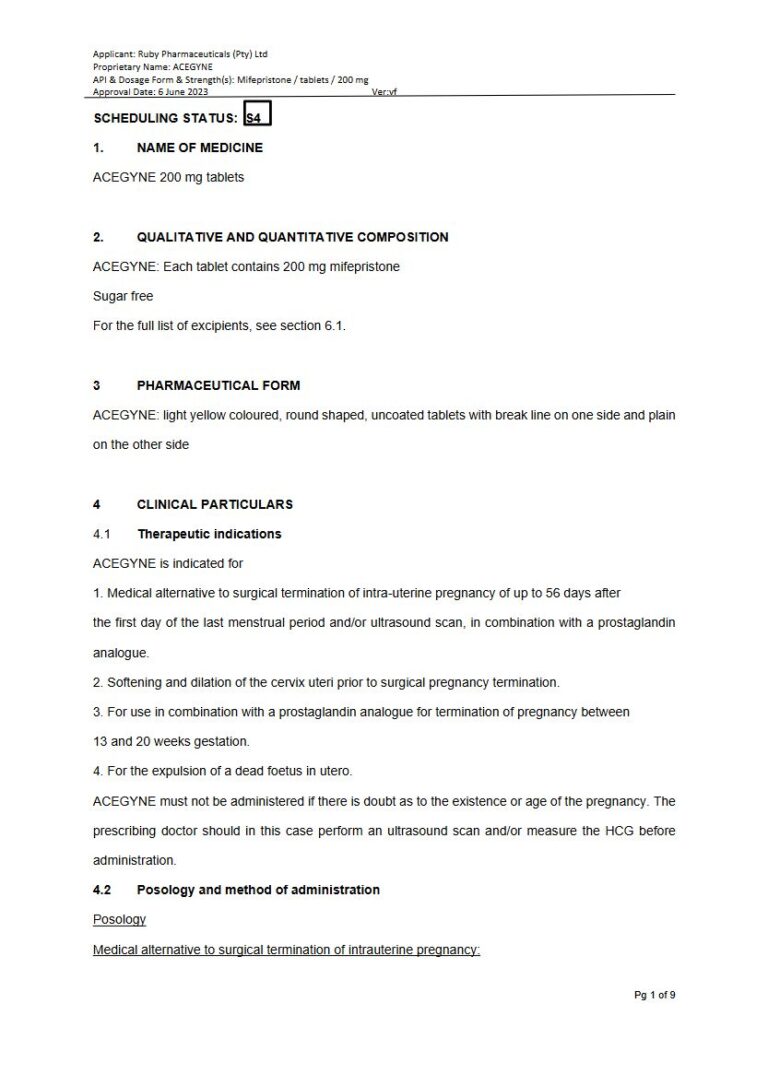
4.1 Therapeutic indications
ACEGYNE is indicated for
- Medical alternative to surgical termination of intra-uterine pregnancy of up to 56 days after the first day of the last menstrual period and/or ultrasound scan, in combination with a prostaglandin analogue.
- Softening and dilation of the cervix uteri prior to surgical pregnancy termination.
- For use in combination with a prostaglandin analogue for termination of pregnancy between 13 and 20 weeks gestation.
- For the expulsion of a dead foetus in utero.
ACEGYNE must not be administered if there is doubt as to the existence or age of the pregnancy. The prescribing doctor should in this case perform an ultrasound scan and/or measure the HCG before administration.
4.2 Posology and method of administration
Posology
Medical alternative to surgical termination of intrauterine pregnancy:
600 mg mifepristone (3 x 200 mg ACEGYNE tablets) is taken by mouth as a single dose. Unless abortion has already been completed, a prostaglandin analogue must be administered orally, 36 to 48 hours later. During the period immediately following the administration of the prostaglandin analogue, the patient may need medication for cramps or gastrointestinal symptoms. The patient should be given instructions on what to do if significant discomfort, excessive bleeding or other adverse reactions occur and should be given a phone number to call if she has questions following the administration of the prostaglandin analogue. In addition, the name and phone number of the medical practitioner who will be handling emergencies should be provided to the patient.
Softening and dilation of the cervix uteri prior to surgical pregnancy termination:
600 mg (3 x 200 mg ACEGYNE tablets), followed 36 to 48 hours later by surgical termination of pregnancy. Softening and dilation has been shown to be detectable from 24 hours after administration and increases to a maximum at approximately 36 to 48 hours after administration. Surgery should be performed no later than 48 hours after administration of ACEGYNE, since when the time elapsed between ACEGYNE administration and surgery is more than 48 hours the risk of bleeding and abortion prior to surgery, particularly with pregnancies of earlier gestations (less than 9 weeks), is increased.
For use in combination with a prostaglandin analogue for termination of pregnancy:
600 mg of mifepristone (3 x 200 mg ACEGYNE tablets) is taken by mouth as a single dose followed 36 to 48 hours later by a prostaglandin analogue. The prostaglandin analogue is to be repeated as many times as necessary. If abortion does not occur within 48 hours after the first prostaglandin analogue administration, an alternative procedure of uterine emptying should be followed. It is not necessary to perform a dilation and curettage procedure if it is clear that a complete abortion has occurred.
For the expulsion of a dead foetus in utero:
600 mg (3 x 200 mg ACEGYNE tablets) taken in a single dose for two consecutive days. Labour should be induced by the usual methods if it has not started within 72 hours following the first administration. The dosage is independent of body weight.
Method of administration
For oral use
4.3 Contraindications
Hypersensitivity to the active substance or to any of the excipients listed in section 6.1. ACEGYNE should not be used:
- Patients with renal failure.
- Asthmatics (severe asthma uncontrolled by corticosteroid therapy) and other patients with chronic obstructive disease.
- Suspected ectopic pregnancy.
- Long-term corticosteroid therapy.
- Haemorrhagic disorders and treatment with anticoagulants.
- Porphyria.
- Unremoved intra-uterine contraceptive device.
- Pregnancy not confirmed by ultrasound scan or biological tests.
Because it is important to have access to appropriate medical care if an emergency develops, the treatment procedure is contra-indicated if a patient does not have adequate access to medical facilities equipped to provide emergency treatment of incomplete abortion, blood transfusions, and emergency resuscitation during the period from the first visit until discharged by the administering doctor. ACEGYNE also should not be used by any patient who may be unable to understand the effects of the treatment procedure or to comply with its regimen.
4.4 Special warnings and precautions for use
ACEGYNE should be used with caution in the following patients:
- Patients with cardiovascular disease or risk factors.
- Patients with hepatic failure.
- Patients with prosthetic heart valves - those patients who have had one previous episode of infective endocarditis should receive chemoprophylaxis.
- Multiparous women and women with a history of caesarean section - The risk of uterine rupture may be increased in such patients.
- Smokers over 35 years of age, especially when used in combination with a prostaglandin analogue.
The patient must be informed that vaginal bleeding occurs in almost all cases. This is not in any way a proof of complete expulsion and that for this reason a follow-up visit is absolutely necessary, to confirm termination of pregnancy. Bleeding may continue for 30 days or more in up to 8% of patients. In some cases, excessive bleeding may require treatment by vasoconstrictor medicines, curettage, administration of saline infusions, and/or blood transfusion. Since heavy bleeding requiring curettage occurs in about 1% of patients, special care should be given to patients with haemostatic disorders hypercoagulability, or severe anaemia. It should be noted that in pregnancies of 8 to 9 weeks gestation, blood loss may be heavier than that seen at earlier gestations. Uterine pain may be experienced, more often during the first few hours after administration. Analgesia may be required. Nulliparous women and those with a history of dysmenorrhoea are more likely to require narcotic analgesia. Serious cases (including fatal cases) of toxic shock and septic shock following infection with atypical pathogens (Clostridium sordellii or Escherichia coli) have been reported after medical abortion with the use of mifepristone 200 mg followed by unauthorised vaginal or buccal administration of misoprostol tablets. Clinicians should be aware of this potentially fatal complication. Patients must be informed that subsequent pregnancy may occur without intervening menstruation and that contraception should be used.
4.5 Interaction with other medicines and other forms of interaction
As the efficacy of treatment could be affected, the use of NSAIDs, including aspirin, should be avoided until pregnancy termination is complete. For termination of pregnancy of up to 63 days gestation, a follow-up visit is mandatory and must take place within a period of 10 to 14 days after administration of ACEGYNE to verify by the appropriate means (clinical examination, ultrasound scan, etc.) that expulsion has been completed and that vaginal bleeding has stopped (apart from light bleeding which should disappear within a few days). Patients must be informed that in the event of the failure or interruption of the method, the pregnancy is liable to continue to develop. The foetus may be exposed to a risk of malformation. It is essential that termination of pregnancy by another method be undertaken at a follow-up visit in the event of such failure. NSAIDs should not be given at least until the follow-up visit 8 to 12 days after mifepristone administration. No interaction studies have been performed. On the basis of this medicine's metabolism by CYP3A4, it is possible that ketoconazole, itraconazole, erythromycin, and grapefruit juice may inhibit its metabolism (increasing serum levels of mifepristone). Furthermore, rifampicin, dexamethasone, St. John's Wort and certain anticonvulsants (phenytoin, phenobarbital, carbamazepine) may induce mifepristone metabolism (lowering serum levels of mifepristone).
4.6 Fertility, pregnancy and lactation
Pregnancy: This product is indicated for the termination of pregnancy and has no other use during pregnancy.
Breastfeeding: It is unknown whether this product is distributed into breast milk. ACEGYNE should be avoided during breastfeeding.
Fertility: Mifepristone does not affect fertility. It is possible that the woman becomes pregnant again as soon as the termination of pregnancy is completed. Therefore, it is important to inform the patient to start contraception immediately after the termination of the pregnancy is confirmed.
4.7 Effects on ability to drive and use machines
No data showing an effect on the ability to drive or using machines are known. Dizziness could occur as a side effect inherent of the abortion process. When driving or using machines one should take this possible side effect into account.
4.8 Undesirable effects
Infections and Infestations:
- Frequent: endometritis, pelvic inflammatory disease
- Frequency unknown: Bacterial infection (systemic), septic shock
Metabolic and nutritional disorders:
- Frequency unknown: Hypoglycaemia
Nervous system disorders:
- Frequent: Dizziness
- Less frequent: headache
Vascular disorders:
- Less frequent: Hypotension
Gastrointestinal disorders:
- Frequent: Abdominal pain, nausea, vomiting, diarrhoea, light or moderate cramping
Hepato-biliary disorders:
- Frequency unknown: Increase in hepatic enzymes
Skin and subcutaneous tissue disorders:
- Less frequent: Skin rash, urticaria, erythroderma, erythema nodosum, toxic epidermal necrolysis, angioderma
Renal and urinary disorders:
- Frequency unknown: Increases in urea and creatine
Reproductive system and breast disorders:
- Frequent: Uterine bleeding, uterine pain or cramping
- Less frequent: Uterine rupture
Other:
- Less frequent: Fever, chills
Reporting of suspected adverse reactions
Reporting suspected adverse reactions after authorisation of the medicinal product is important. It allows continued monitoring of the benefit/risk balance of the medicinal product. Healthcare professionals are asked to report any suspected adverse reactions to SAHPRA via the u201c6.04 Adverse Drug Reaction Reporting Formu201d, found online under SAHPRAu2019s publications: https://www.sahpra.org.za/Publications/Index/8
4.9 Overdose
In overdose, side effects can be precipitated and/or be of increased severity (see section 4.8). Treatment is supportive and symptomatic.
