
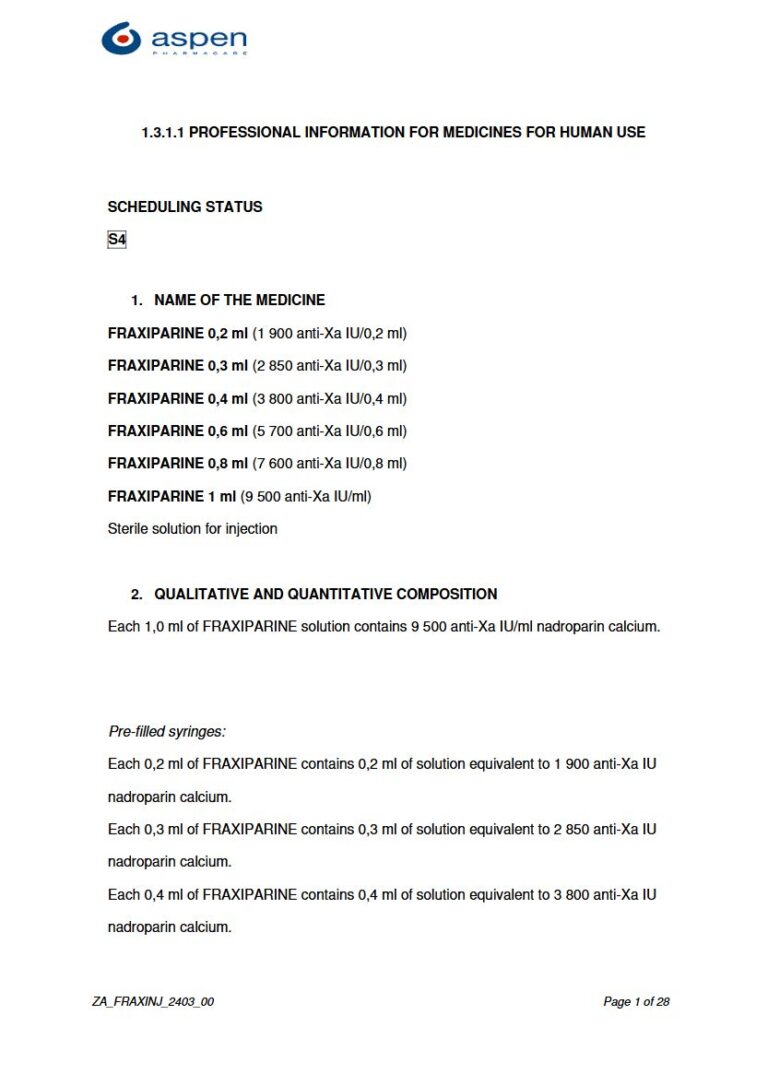
Fraxiparine 0.2 ml/0.3 ml/0.4 ml/0.6 ml/0.8 ml/1.0 ml Solution
PDF Leaflet Revision Date: 26 March 2024
Clinical Summary
Quick overview from the medicine insert
Indication
Prophylaxis and treatment of DVT and thromboembolic disorders.
Dosage (summary)
0.3 ml subcutaneously before and after surgery; adjust based on body weight.
Onset of Action / Duration
Onset: 3 hours, Duration: 18 hours
Special Populations
- Elderly
- Renal impairment
- Hepatic impairment
Pregnancy & Breastfeeding
Not recommended during pregnancy or breastfeeding.
Key Drug Interactions
- Oral anticoagulants
- Aspirin
- NSAIDs
Contraindications
- Hypersensitivity to nadroparin
- Active bleeding
- Severe renal impairment
Common side effects
- Bleeding
- Thrombocytopenia
- Injection site reactions
Counselling Points
- Monitor for signs of bleeding
- Avoid NSAIDs
- Report any allergic reactions
Serious warnings
- Risk of heparin-induced thrombocytopenia
- Caution with neuraxial anesthesia
Important Disclaimer
The Fraxiparine 0.2 ml/0.3 ml/0.4 ml/0.6 ml/0.8 ml/1.0 ml Solution professional information leaflet below is the property of Pharmacare and is provided on Medinsert exactly as issued, with no.. alterations or editorial changes. We make every effort to keep content current by updating documents as soon as new versions become available. Medinsert serves as a trusted access point for healthcare professionals, but does not replace official sources or clinical judgement. For more details, please read our full disclaimer. read more>>
 Healthcare Professionals Only
This content is for registered healthcare professionals
Sign in or create a free account to read the full package insert.
Free for HPCSA-registered professionals. Powered by Medinsert.
Clinical Particulars
Section 4 of the official insert — extracted exactly as issued, no alterations
4.1. Therapeutic indications
FRAXIPARINE is indicated for:
- Prophylaxis of DVT (Deep Vein Thrombosis) which may lead to pulmonary embolism.
- in patients undergoing hip or knee replacement surgery.
- in patients undergoing abdominal surgery who are at risk of thromboembolic complications.
- Patients at risk include patients who are over 40 years of age, obese, undergoing surgery under general anaesthesia lasting longer than 30 minutes or who have additional risk factors such as malignancy or a history of DVT or pulmonary embolism.
- The prophylaxis of thromboembolic disorders, such as those in high risk medical patients (respiratory failure and/or respiratory infection and/or cardiac failure), immobilised due to acute illness or hospitalised in an intensive care unit.
- The treatment of DVT (Deep Vein Thrombosis).
4.2. Posology and method of administration
FRAXIPARINE SHOULD BE ADMINISTERED BY THE SUBCUTANEOUS ROUTE ONLY.
Posology
Adults
Prophylaxis of (DVT) Deep Vein Thrombosis which may lead to pulmonary embolism in patients undergoing abdominal surgery: FRAXIPARINE should be given as a dose of 0,3 ml (2 850 IU AXa anti-Xa IU) administered subcutaneously 2 to 4 hours before surgery and again 8 hours after surgery. Subsequent injections of 0,3 ml (2 850 IU AXa anti-Xa IU) should be administered once daily for at least 7 days after surgery. In all cases prophylaxis should be continued throughout the risk period and at least until the patient is ambulant.
Prophylaxis of Deep Vein Thrombosis which may lead to pulmonary embolism in patients undergoing hip or knee replacement surgery: Initial doses should be given 12 hours before surgery and a second dose 12 hours after the end of surgery. These and subsequent once-daily doses should be adjusted according to the body weight of the patient. The recommended dosage is 38 IU anti-Xa/kg for day 1 to 3 and 57 IU anti-Xa/kg from day 4 onwards. The table below can be used as a guide to the volumes to be injected. Treatment should be for at least 10 days and should continue in all cases throughout the risk period until the patient is ambulant.
Prophylaxis of DVT Hip or Knee Replacement Surgery Volume to be injected subcutaneously once daily Body weight (kg) Pre-operatively And until Day 3 From Day 4 onwards 45-60 0,2 ml 0,3 ml 61-74 0,3 ml 0,4 ml 75-80 0,3 ml 0,5 ml 80-90 0,4 ml 0,5 ml 90-100 0,4 ml 0,6 ml No safe or effective doses in patients under 45 or over 100 kg have been established.
High-risk medical patients (respiratory failure and/or respiratory infection and/or cardiac failure), immobilised due to acute illness or hospitalised in an intensive care unit. FRAXIPARINE is administered subcutaneously once daily. The dose should be adjusted for body weight according to the table below. Treatment should be continued throughout the risk period of thromboembolism.
Body weight (kg) Once daily Volume injected (ml) Anti-Xa IU u2264 70 0,4 3,800 >70 0,6 5,700 In elderly patients, dose reduction to 0,3 ml (2,850 anti-Xa IU) may be appropriate.
Treatment of Deep Vein Thrombosis (DVT): FRAXIPARINE should be given subcutaneously twice daily (every 12 hours) for a usual duration of 10 days with the dose adjusted to body weight as shown below:
Body weight (kg) Twice daily for a usual duration of 10 days Volume injected (ml) Anti-Xa IU <50 0,4 3,800 50-59 0,5 4,750 60-69 0,6 5,700 70-79 0,7 6,650 80-89 0,8 7,600 u2265 90 0,9 8,550
Special populations
Elderly population A dose adaptation for elderly patients is not necessary unless in the presence of renal failure. It is recommended that renal function is assessed before initiating treatment (see section 5.2).
The prophylaxis of thromboembolic disorders, such as: those in high risk medical patients (respiratory failure and/or respiratory infection and/or cardiac failure), immobilised due to acute illness or hospitalised in an intensive care unit. In elderly patients, dose reduction to 0,3 ml (2,850 anti-Xa IU) may be appropriate.
Renal impairment Moderate to severe impairment of the kidney function is associated with increased exposure to FRAXIPARINE. These patients are subject to an increased risk of thromboembolism and haemorrhage.
-Treatment of deep vein thrombosis If patients with renal failure (see section 4.3) are treated due to deep vein thrombosis, the lab parameters should be monitored, preferably by measuring the anti-Xa level (amidolytic assay with chromogenic substrate). Anti-Xa activity can be checked on day 2 and day 4, about 3 hours after subcutaneous application, and should lie within the range of 0,5 to 1,2 IU anti-Xa/ml.
- Prophylaxis of thromboembolic disorders A dose reduction is not necessary in patients with minor impairment of the kidney function (creatinine clearance u2265 50 ml/min). If in light of the individual risk factors for haemorrhage and thromboembolism a dose reduction for patients with moderate impairment of the kidney function (creatinine clearance u2265 30 ml/min. and < 50 ml/min.) is deemed adequate by the prescribing physician, the dose should be reduced by 25 % to 33 % (see sections 4.4 and 5.2). FRAXIPARINE is contraindicated in patients with severe impairment of the kidney function (creatinine clearance below 30 ml/min) (see section 4.3).
Hepatic impairment There have been no studies conducted in patients with hepatic impairment.
Paediatric population FRAXIPARINE should not be administered to children under 18 years of age. The safety and efficacy of FRAXIPARINE in children aged below 18 years has not yet been established (see section 4.3).
Method of administration Subcutaneous injection. The usual site for subcutaneous injection is the lateral abdominal wall, although the thigh may be used as an alternative. The needle should be inserted perpendicularly into a pinched-up fold of skin which should be held gently but firmly until the injection has been completed. Do not rub the injection site.
4.3. Contraindications
FRAXIPARINE is contraindicated in:
- Patients with hypersensitivity to nadroparin calcium, unfractionated heparin, any other low molecular weight heparin or any of the excipients of FRAXIPARINE, especially when severe thrombocytopenia has occurred in recent months.
- Haemorrhagic blood disorders - especially thrombocytopenia and haemophilia.
- Haemorrhage, active or suspected - especially cerebrovascular and gastrointestinal, except in disseminated intravascular coagulation not induced by heparin, FRAXIPARINE or a low molecular weight heparin.
- Acute infectious endocarditis.
- Children under 18 years (see section 4.2).
- Conditions where haemorrhage is a particular risk:
- Aneurysm, cerebral or aortic.
- Hypertension, severe or uncontrolled.
- Threatened abortion.
- Recent childbirth.
- Infective endocarditis.
- Pericarditis.
- Vasculitis, severe.
- Active, cavitating tuberculosis.
- Visceral carcinoma.
- Any intracranial tumour, either primary or secondary.
- During or after eye, brain or spinal cord surgery or trauma.
- Prior to lumbar puncture or regional anaesthetic block.
- Active peptic ulceration.
- Surgical or traumatic wounds resulting in large open surfaces.
- Severe renal function impairment, (creatinine clearance less than 30 ml/min) in patients receiving treatment for thromboembolic disorders (see section 4.2).
- Severe hepatic function impairment.
- Mechanical heart valve prosthesis.
- Pregnancy and lactation as safety and efficacy has not been demonstrated (see section 4.6).
4.4. Special warning and precautions for use
Heparin-induced thrombocytopenia: FRAXIPARINE is to be used with extreme caution in patients with a history of heparin-induced thrombocytopenia, with or without thrombosis. The risk of heparin-induced thrombocytopenia may persist for several years. If a history of heparin-induced thrombocytopenia is suspected, the decision to use FRAXIPARINE in such a case must be made only in consultation with an expert in the field.
The low molecular weight heparins are not shown to be absolutely biologically or therapeutically equivalent. As they differ from one another in having different molecular weight profiles, different specific activities (Anti-Xa to Anti IIa activities), different rates of plasma clearance, different dosage regimes etc., they cannot be accepted as therapeutically equivalent.
Cross-reactivity Cross-reactivity between heparins and LMWH is well documented. Delayed hypersensitivity reactions have been reported in patients presenting cross-reactivity between unfractionated heparins and LMWH. Before initiating therapy with low molecular weight heparins (LMWH), careful assessment should be made concerning previous hypersensitivity reactions to unfractionated heparin.
Hypersensitivity FRAXIPARINE should be used with caution in patients with a history of allergic reactions especially to heparin and low molecular weight heparins, in such cases a test dose may be administered. Generalised allergic reactions, including angioedema and skin allergic reactions may occur. Cases of cutaneous necrosis, usually occurring at the injection site, have been reported with FRAXIPARINE; they are usually preceded by purpura or infiltrated or painful erythematous blotches, with or without general signs (see section 4.8). Treatment with FRAXIPARINE should be discontinued immediately.
Subcutaneous haematoma at the injection site. Pain and bruising are minimised by careful injection technique. In some cases, the emergence of firm nodules which do not indicate an encystment of the heparin may be noted. These nodules usually disappear after a few days.
Lumbar puncture, spinal or epidural anaesthesia are contraindicated in patients who receive curative treatment with nadroparin due to the risk of haematoma formation which can cause persistent neurological deficits and paraplegia (see section 4.3). Nadroparin should be used only with caution and after careful risk/benefit assessment in patients who receive preventive treatment and have a lumbar puncture, spinal or epidural anaesthesia. The risk of a spinal/epidural haematoma is increased by an epidural indwelling catheter or by the simultaneous administration of other medicines which also influence blood clotting such as NSAIDs, platelet aggregation inhibitors or other anticoagulants. The risk also seems to increase by traumatic or repeated epidural or spinal punctures. To date no results from randomized, controlled clinical studies are available which prove the safe use of higher doses of nadroparin (for example, for deep vein thrombosis prophylaxis in patients with high thromboembolic risk) with the simultaneous use of anaesthetic methods applied close to the spinal cord. For this reason neuraxial blockade and therapy with anticoagulants should be prescribed only after careful individual risk/benefit assessment:
- The benefit of neuraxial blockade must be carefully weighed against the risks in patients who receive treatment with anticoagulants.
- The benefit of an anticoagulant therapy must be carefully weighed against the risk in patients where an elective surgery with neuraxial blockade is planned.
At least 12 hours should pass between the FRAXIPARINE injection at a prophylactic dose, or 24 hours if a therapeutic dose was administered, and the insertion or removal of the spinal/epidural catheter or needle in the case of patients with lumbar puncture, spinal or epidural anaesthesia, whereby the product characteristics and the patient profile need to be taken into consideration. Longer intervals can be considered for patients with renal impairment. The following doses should be administered after at least four hours. The additional administration of FRAXIPARINE should be delayed until the surgical procedure has been concluded. The patients should undergo frequent checks with regard to signs and symptoms of neurological deficits such as back pain, sensory and motor deficits (numbness and weakness of the lower limbs), disturbances of rectal and/or bladder functions. If a neurological disorder is determined, treatment should be started immediately. The medical staff should be trained to detect such signs and symptoms. The patients should be instructed to immediately notify their physician should they experience one of these symptoms. If signs or symptoms of spinal haematoma are suspected, diagnostics and treatment should be initiated as soon as possible including a spinal cord decompression. If significant or obvious bleeding occurs while placing a catheter, careful risk/benefit assessment should be performed before starting or continuing the heparin therapy.
4.5. Interaction with other medicines and other forms of interaction
FRAXIPARINE should be used with care in conjunction with oral anticoagulants. When oral anticoagulant therapy is initiated in patients receiving FRAXIPARINE, treatment with FRAXIPARINE should be continued until the International Normalisation Ratio (INR) is stabilised at the target value.
FRAXIPARINE should be used with care in conjunction with the following:
- medicines which affect platelet function such as aspirin, dipyridamole, ibuprofen and indomethacin,
- dextran injections,
- thrombolytic enzymes such as streptokinase.
Digitalis, tetracyclines, nicotine or antihistamines may partly counteract the anticoagulant action of FRAXIPARINE. Careful monitoring of partial thromboplastin time and the anti Xa-effects and adjustment of FRAXIPARINE doses are recommended during co-administration of FRAXIPARINE and IV nitroglycerine.
4.6. Fertility, pregnancy and lactation
The safety of FRAXIPARINE in pregnancy and lactation has not been established (see section 4.3).
Pregnancy Women should not take FRAXIPARINE during pregnancy. Studies in animals have not shown any teratogenic or foetotoxic effects. However, there is only limited clinical data concerning transplacental passage of FRAXIPARINE in pregnant women.
Breastfeeding Women should not breastfeed their infants when taking FRAXIPARINE. There is limited information on the excretion of FRAXIPARINE in breast milk.
Fertility There are no clinical studies available on the effect of nadroparin on fertility.
4.7. Effects on ability to drive and use machines
FRAXIPARINE has no or negligible influence on the ability to drive and use machines. Patients should not drive, use machinery or perform any tasks that require concentration until they are certain that FRAXIPARINE does not adversely affect their ability to do so safely.
4.8. Undesirable effects
a) Tabulated list of adverse reactions
System organ class Frequent Less frequent Frequency unknown Blood and the lymphatic system disorders Haemorrhagic manifestations 1 Thrombocytopenia, heparin-induced thrombocytopenia, thrombocytosis, eosinophilia (reversible following treatment discontinuation). Immune system disorders Hypersensitivity reactions (including angioedema and cutaneous reactions), anaphylactoid reaction. Metabolism and nutrition disorders Reversible hyperkalaemia related to heparin-induced aldosterone suppression particularly in patients at risk, rebound hyperlipidaemia following discontinuation of FRAXIPARINE. Nervous system disorders Headache, migraine. Skin and subcutaneous tissue disorders Rash, urticaria, erythema, pruritis. Musculoskeletal and connective tissue disorders Risk of osteoporosis as well as spontaneous and compression fractures. Reproductive system and breast disorders Priapism. General disorders and administrative site conditions Injection site haematoma 2 . Injection site calcification 3 , injection site necrosis. Investigations Transaminases increased, usually transient
1. Haemorrhagic manifestations at various sites, more frequent in patients with other risk factors.
2. In some cases, the emergence of firm nodules, which do not indicate an encystment of the heparin may be noted. These nodules usually disappear after a few days.
3. Calcification is more frequent in patients with abnormal calcium phosphate product, such as in some cases of chronic renal failure.
4.9. Overdose
Symptoms The protraction of the activated Partial Thromboplastin Time (aPTT) value should be considered only as the extent of the overdose in the acute therapy of deep vein thrombosis. An increase of the dose with the goal of aPTT protraction carry the risk of overdose or bleeding. Bleeding is the main sign of overdose. Monitoring the platelet count and other coagulation parameters is advisable.
Treatment The use of protamine sulphate should be considered only in serious cases. It largely neutralises the anticoagulant effect of FRAXIPARINE but some anti-Xa activity will remain. 0,6 ml of protamine sulphate neutralises about 950 anti-Xa IU FRAXIPARINE. The amount of protamine to be injected, should take into account time elapsed from the injection of heparin, and a dose reduction of protamine may be appropriate.
