
Nifedalat 20 Sr 20 mg FC tablets
PDF Leaflet Revision Date: 31 October 2024
Clinical Summary
Quick overview from the medicine insert
Indication
Prophylaxis of chronic stable angina pectoris and treatment of mild to moderate hypertension.
Dosage (summary)
20 mg to 40 mg twice per day.
Special Populations
- Elderly
- Renal impairment
- Hepatic impairment
Pregnancy & Breastfeeding
Not recommended during pregnancy and breastfeeding.
Key Drug Interactions
- Grapefruit juice
- Macrolide antibiotics
- Anti-HIV protease inhibitors
- Azole antimycotics
- Fluoxetine
Contraindications
- Hypersensitivity to nifedipine
- Hepatic impairment
- Gastrointestinal obstruction
- Inflammatory bowel disease
- Cardiovascular shock
Common side effects
- Headache
- Dizziness
- Hypotension
- Peripheral edema
- Nausea
Counselling Points
- Swallow tablets whole with fluid
- Avoid grapefruit juice
- Monitor for signs of hypotension
- Report any allergic reactions
Serious warnings
- Monitor blood pressure during initiation
- Risk of heart failure in severe aortic stenosis
- May impair ability to drive
Important Disclaimer
The Nifedalat 20 Sr 20 mg FC tablets professional information leaflet below is the property of Biotech Laboratories and is provided on Medinsert exactly as issued, with no.. alterations or editorial changes. We make every effort to keep content current by updating documents as soon as new versions become available. Medinsert serves as a trusted access point for healthcare professionals, but does not replace official sources or clinical judgement. For more details, please read our full disclaimer. read more>>
 Healthcare Professionals Only
This content is for registered healthcare professionals
Sign in or create a free account to read the full package insert.
Free for HPCSA-registered professionals. Powered by Medinsert.
Clinical Particulars
Section 4 of the official insert — extracted exactly as issued, no alterations
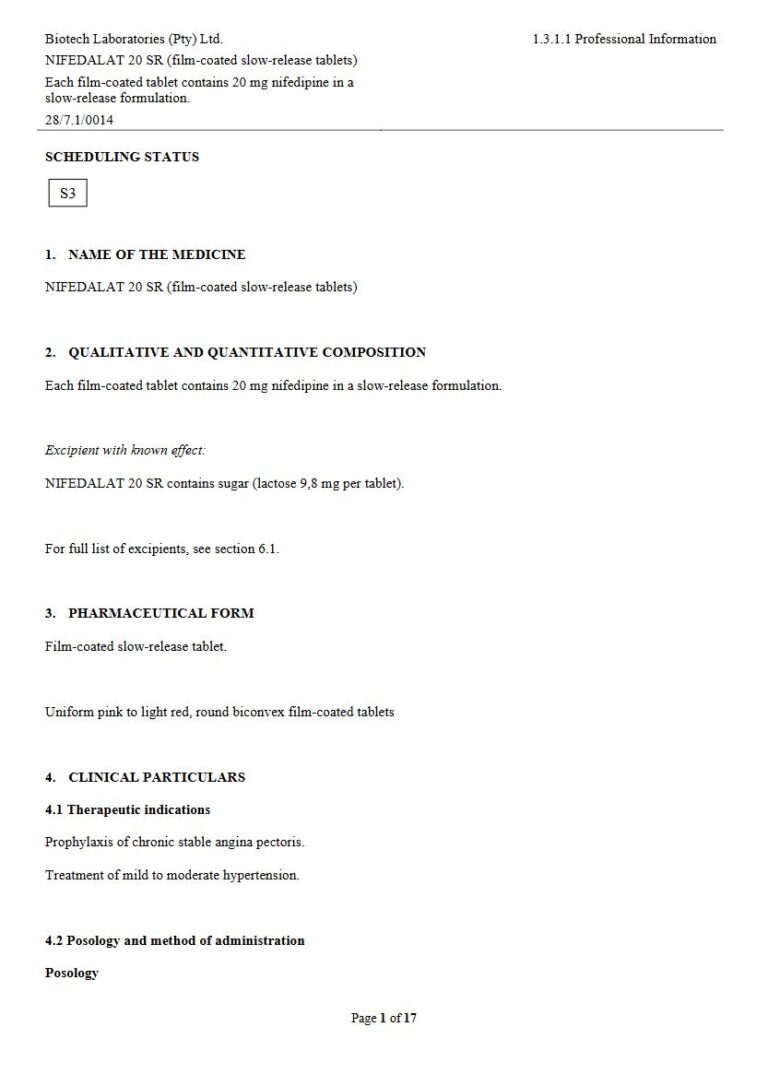
4.1 Therapeutic indications
Prophylaxis of chronic stable angina pectoris.
Treatment of mild to moderate hypertension.
4.2 Posology and method of administration
Posology
The usual dose is 20 mg to 40 mg twice per day.
Special populations
- Elderly population
Based on pharmacokinetic data, no dose adaptation in elderly people above 65 years is necessary. - Renal impairment
Based on pharmacokinetic data no dosage adjustment is required in patients with renal impairment (see section 5.2). - Hepatic impairment
Owing to the duration of action of the formulation, NIFEDALAT 20 SR should not be administered to patients with hepatic impairment (see sections 4.3 and 5.2). - Paediatric population
The safety and efficacy of NIEDALAT 20 SR in children below 18 years has not been established.
Method of administration
Oral use. The tablets should be swallowed whole with a glass of fluid; under no circumstances should they be bitten, chewed or broken up. NIFEDALAT 20 SR may be taken irrespective of meal times. NIFEDALAT 20 SR should not be taken with grapefruit juice (see section 4.5).
4.3 Contraindications
- Hypersensitivity to nifedipine or to any of the excipients listed in section 6.1.
- NIFEDALAT 20 SR should not be administered to patients with hepatic impairment.
- NIFEDALAT 20 SR should not be administered to patients with a history of gastrointestinal obstruction, oesophageal obstruction or any degree of decreased lumen diameter of the gastrointestinal tract.
- NIFEDALAT 20 SR is contraindicated in patients with inflammatory bowel disease.
- Not recommended for use in children.
- Pregnancy and lactation (see section 4.6).
- NIFEDALAT 20 SR must not be used in patients with cardiovascular shock.
4.4 Special warnings and precautions for use
NIFEDALAT 20 SR is not a beta-blocker and therefore gives no protection against the dangers of abrupt withdrawal of beta-blocking medicines. Withdrawal of any previously prescribed beta-blockers should be gradual, preferably over 8 to 10 days.
NIFEDALAT 20 SR may be used in combination with beta-blocking medicines and other anti-hypertensive medicines, but the possibility of an additive effect resulting in postural hypotension should be borne in mind.
NIFEDALAT 20 SR will not prevent possible rebound effects after cessation of other antihypertensive therapy. Blood pressure should be monitored carefully during initiation and upward titration of NIFEDALAT 20 SR, especially if patients are on anti-hypertensive therapy. Some patients may have hypotension, which may be severe.
Care must be exercised in patients with very low blood pressure (severe hypotension with systolic pressure less than 90 mm HG), in cases of manifest heart failure and in the case of severe aortic stenosis. In patients with severe aortic stenosis NIFEDALAT 20 SR may increase the risk of developing heart failure.
NIFEDALAT 20 SR should be used with caution in patients with hypotension and in patients whose cardiac reserve is poor. Deterioration of heart failure has occasionally been observed with NIFEDALAT 20 SR.
In patients who experience ischaemic pain following administration of NIFEDALAT 20 SR, therapy should be discontinued. NIFEDALAT 20 SR does not replace the nitroglycerines in an acute attack of angina pectoris. Pain may occur in the chest region about 15 to 30 minutes after taking NIFEDALAT 20 SR, possibly due to a fall in perfusion pressure and increase in heart rate. In such a case a reduction in dosage or discontinuation of the preparation is recommended. Any accompanying medication should be checked.
A transient increase in blood glucose has been noted. Care must be taken in patients with diabetes mellitus. Adjustment of the control of diabetes patients may be required.
Care should be exercised in dialysis patients with malignant hypertension and irreversible kidney failure with hypovolaemia, as a marked fall in blood pressure may occur.
NIFEDALAT 20 SR is metabolized via the cytochrome P450 3A4 system. Medicines that are known to either inhibit or to induce this enzyme system may therefore alter the first pass or the clearance of nifedipine (see section 4.5).
4.5 Interactions with other medicines
Medicines that affect NIFEDALAT 20 SR
NIFEDALAT 20 SR is metabolised via the cytochrome P450 3A4 system, located both in the intestinal mucosa and in the liver. Medicines that are known to either inhibit or to induce this enzyme system may therefore alter the first pass (after oral administration) or the clearance of nifedipine (see section 4.4).
The extent as well as the duration of interactions should be taken into account when administering NIFEDALAT 20 SR together with the following medicines:
- Rifampicin: Rifampicin strongly induces the cytochrome P450 3A4 system. Upon coadministration with rifampicin, the bioavailability of NIFEDALAT 20 SR is distinctly reduced and thus its efficacy weakened. The use of NIFEDALAT 20 SR in combination with rifampicin is therefore contraindicated.
- Macrolide antibiotics (e.g., erythromycin): Certain macrolide antibiotics are known to inhibit the cytochrome P450 3A4 mediated metabolism of other medicines. Therefore the potential for an increase of nifedipine plasma concentrations upon co-administration of both medicines cannot be excluded (see section 4.4).
- Anti-HIV protease inhibitors (e.g., ritonavir): Medicines of this class are known to inhibit the cytochrome P450 3A4 system. In addition, medicines of this class have been shown to inhibit in vitro the cytochrome P450 3A4 mediated metabolism of nifedipine. When administered together with NIFEDALAT 20 SR, a substantial increase in plasma concentrations of nifedipine due to a decreased first pass metabolism and a decreased elimination cannot be excluded (see section 4.4).
- Azole anti-mycotics (e.g., ketoconazole): Medicines of this class are known to inhibit the cytochrome P450 3A4 system. When administered orally together with NIFEDALAT 20 SR, a substantial increase in systemic bioavailability of nifedipine due to a decreased first pass metabolism cannot be excluded (see section 4.4).
- Fluoxetine: Fluoxetine has been shown to inhibit in vitro the cytochrome P450 3A4 mediated metabolism of nifedipine. Therefore an increase of nifedipine plasma concentrations upon co-administration of both medicines cannot be excluded (see section 4.4).
- Nefazodone: Nefazodone is known to inhibit the cytochrome P450 3A4 mediated metabolism of other medicines. Therefore an increase of nifedipine plasma concentrations upon coadministration of both medicines cannot be excluded (see section 4.4).
- Quinupristin / Dalfopristin: Simultaneous administration of quinupristin / dalfopristin and NIFEDALAT 20 SR may lead to increased plasma concentrations of nifedipine (see section 4.4).
- Valproic acid: As valproic acid has been shown to increase the plasma concentrations of the structurally similar calcium channel blocker nimodipine due to enzyme inhibition, an increase in nifedipine plasma concentrations and hence an increase in efficacy cannot be excluded (see section 4.4).
- Cimetidine: Due to its inhibition of cytochrome P450 3A4, cimetidine elevates the plasma concentrations of nifedipine and may potentiate the anti-hypertensive effect (see section 4.4).
Further studies
Cisapride: Simultaneous administration of cisapride and NIFEDALAT 20 SR may lead to increased plasma concentrations of nifedipine.
Cytochrome P450 3A4 system inducing anti-epileptic medicines, such as phenytoin, carbamazepine and phenobarbitone: Phenytoin induces the cytochrome P450 3A4 system. Upon co-administration with phenytoin, the bioavailability of NIFEDALAT 20 SR is reduced and thus its efficacy weakened. When both medicines are concomitantly administered, the clinical response to NIFEDALAT 20 SR should be monitored and, if necessary, an increase in the NIFEDALAT 20 SR dose considered. If the dose of NIFEDALAT 20 SR is increased during co-administration of both medicines, a reduction of the NIFEDALAT 20 SR dose should be considered when the treatment with phenytoin is discontinued.
Effects of NIFEDALAT 20 SR on other medicines
Blood pressure lowering medicines: NIFEDALAT 20 SR may increase the blood pressure lowering effect of concomitant applied anti-hypertensives, such as:
- diuretics
- beta-receptor blockers
- ACE-inhibitors
- Angiotensin l (AT1) receptor-antagonists
- other calcium antagonists
- alpha-adrenergic blocking medicines
- PDE5 inhibitors
- alpha methyldopa.
When NIFEDALAT 20 SR is administered simultaneously with beta-receptor blockers the patient should be carefully monitored, since deterioration of heart failure is also known to develop in isolated cases.
Digoxin: The simultaneous administration of NIFEDALAT 20 SR and digoxin may lead to reduced digoxin clearance and, hence, an increase in the plasma concentrations of digoxin. The patient should therefore be checked for symptoms of digoxin overdosage as a precaution and, if necessary, the glycoside dose should be reduced taking account of the plasma concentration of digoxin.
Quinidine: When NIFEDALAT 20 SR and quinidine have been administered simultaneously, lowered quinidine or, after discontinuation of NIFEDALAT 20 SR, a distinct increase in plasma concentrations of quinidine has been observed in individual cases. For this reason, when NIFEDALAT 20 SR is either additionally administered or discontinued, monitoring of the quinidine plasma concentration and, if necessary, adjustment of the quinidine dose is recommended. The blood pressure should be carefully monitored if quinidine is added to an existing therapy with NIFEDALAT 20 SR. If necessary, the dose of NIFEDALAT 20 SR should be decreased.
Tacrolimus: Tacrolimus has been shown to be metabolised via the cytochrome P450 3A4 system. Data recently published indicates that the dose of tacrolimus administered simultaneously with NIFEDALAT 20 SR may be reduced in individual cases. Upon co-administration of both medicines, the tacrolimus plasma concentrations should be monitored and, if necessary, a reduction in the tacrolimus dose considered.
Medicine food interactions
Grapefruit juice: Grapefruit juice inhibits the cytochrome P450 3A4 system. Administration of NIFEDALAT 20 SR together with grapefruit juice thus results in elevated plasma concentrations and prolonged action of nifedipine due to a decreased first pass metabolism or reduced clearance. As a consequence, the blood pressure lowering effect of NIFEDALAT 20 SR may be increased. After regular intake of grapefruit juice, this effect may last for at least three days after the last ingestion of grapefruit juice. Ingestion of grapefruit/grapefruit juice is therefore to be avoided while taking NIFEDALAT 20 SR (see section 4.2).
Other forms of interaction
NIFEDALAT 20 SR may increase the spectrophotometric values of urinary vanillylmandelic acid, falsely. However, High-performance Liquid Chromatography (HPLC) measurements are unaffected.
4.6 Fertility, pregnancy and lactation
Pregnancy
NIFEDALAT 20 SR should not be used during pregnancy (see section 4.3).
Breastfeeding
NIFEDALAT 20 SR is not recommended for use during breastfeeding because nifedipine has been reported to be excreted in human breast milk (see section 4.3).
Fertility
Safety and efficacy during fertility has not been established. No fertility studies have been conducted in humans.
4.7 Effects on ability to drive and use machines
NIFEDALAT 20 SR may impair the ability to drive or to operate machinery (see section 4.8). This applies particularly at the start of treatment, on changing the medication and in combination with alcohol.
4.8 Undesirable effects
Tabulated list of adverse reactions
System Organ Class Frequent Less frequent Frequency not known (MedDRA)
- Blood and Lymphatic System disorders
Agranulocytosis, leucopenia. - Immune system disorders
Allergic reaction, allergic oedema/angioedema (incl. larynx oedema) 1, pruritus, urticaria, rash. Anaphylactic/anaphylactoid reaction. - Metabolism and nutrition disorders
Hyperglycaemia. - Psychiatric disorders
Anxiety reactions (nervousness), sleep disorders. Depression. - Nervous system disorders
Headache, vertigo, migraine, dizziness, tremor, par-/dysaesthesia. Hypoaesthesia, somnolence, insomnia 3. - Eye disorders
Visual disturbances. Eye pain. - Cardiac disorders
Tachycardia, palpitations. Chest pain (angina pectoris), myocardial infarction. - Vascular disorders
Oedema (incl. peripheral oedema), vasodilatation, facial flushing. Hypotension, syncope. - Respiratory, thoracic and mediastinal disorders
Nosebleed, nasal congestion. Dyspnoea, pulmonary oedema 2. - Gastrointestinal disorders
Constipation, gastrointestinal disturbances, vomiting, and abdominal pain, nausea, dyspepsia, flatulence, dry mouth, gingival hyperplasia. gastroesophageal sphincter insufficiency. - Hepato-biliary disorders
Transient increase in liver enzymes. Jaundice, abnormalities in liver function (due to hypersensitivity reactions). - Skin and subcutaneous tissue disorders
Erythema. Toxic Epidermal Necrolysis, photosensitivity allergic reaction, palpable purpura. - Musculoskeletal and connective tissue disorders
Muscle cramps, joint swelling. Arthralgia 3, myalgia. - Renal and urinary disorders
Polyuria, dysuria. - Reproductive system and breast disorders
Erectile dysfunction. Reversible gynaecomastia. - General disorders and administration site conditions
Feeling unwell. Unspecific pain, chills. Perspiration, feeling of warmth, tiredness.
1 May result in life-threatening outcome.
2 Cases have been reported when used as tocolytic during pregnancy.
3 Although a u201cstealu201d effect has not been demonstrated, patients experiencing this effect should discontinue NIFEDALAT 20 SR.
In dialysis patients with malignant hypertension and hypovolemia a distinct fall in blood pressure can occur as a result of vasodilation.
4.9 Overdose
Symptoms
The following symptoms are observed in cases of severe NIFEDALAT 20 SR intoxication: Disturbances of consciousness to the point of coma, flushing, headaches and lowering of blood pressure, tachycardiac/bradycardiac heart rhythm disturbances, hyperglycaemia, metabolic acidosis, hypoxia, cardiogenic shock with pulmonary oedema.
Management
As far as treatment is concerned, elimination of NIFEDALAT 20 SR and the restoration of stable cardiovascular conditions have priority. Haemodialysis serves no purpose as NIFEDALAT 20 SR is not dialysable, but plasmapheresis is advisable (high plasma protein binding, relatively low volume of distribution). Hypotension as a result of cardiogenic shock and arterial vasodilatation can be treated with calcium (10-20 ml of a 10 % calcium gluconate solution administered via slow intravenous injection and repeated if necessary). As a result, the serum calcium can reach the upper normal range to slightly elevated levels. If an insufficient increase in blood pressure is achieved with calcium, vasoconstricting sympathomimetics such as dopamine or noradrenaline should be administered. The dosage of these medicines should be determined by the patient's response. Symptomatic bradycardia may be treated with atropine, beta-sympathomimetics or a temporary cardiac pacemaker, as required. Additional liquid or volume must be administered with caution because of the danger of overloading the heart.
Further treatment is symptomatic and supportive.
