
Floxin 400 mg Tablet.
PDF Leaflet Revision Date: 21 May 2023
Clinical Summary
Quick overview from the medicine insert
Indication
Treatment of urinary tract infections.
Dosage (summary)
400 mg every 12 hours for 3 days (uncomplicated) or 7-10 days (complicated).
Special Populations
- Renal impairment
- Elderly
Pregnancy & Breastfeeding
Contraindicated in pregnancy and breastfeeding.
Key Drug Interactions
- Warfarin
- Ciclosporin
- NSAIDs
- Antacids
- Nitrofurantoin
Contraindications
- Hypersensitivity to norfloxacin
- Creatinine clearance <30 ml/min
- Children <18 years
- Pregnancy
- Lactation
Common side effects
- Nausea
- Dizziness
- Photosensitivity
- Hypoglycaemia
Counselling Points
- Take on an empty stomach
- Avoid sun exposure
- Monitor blood glucose in diabetics
- Report severe skin reactions
Serious warnings
- CNS stimulation
- Tendon rupture
- QTc prolongation
- Pseudomembranous colitis
Important Disclaimer
The Floxin 400 mg Tablet. professional information leaflet below is the property of Ranbaxy Pharmaceuticals and is provided on Medinsert exactly as issued, with no.. alterations or editorial changes. We make every effort to keep content current by updating documents as soon as new versions become available. Medinsert serves as a trusted access point for healthcare professionals, but does not replace official sources or clinical judgement. For more details, please read our full disclaimer. read more>>
 Healthcare Professionals Only
This content is for registered healthcare professionals
Sign in or create a free account to read the full package insert.
Free for HPCSA-registered professionals. Powered by Medinsert.
Clinical Particulars
Section 4 of the official insert — extracted exactly as issued, no alterations
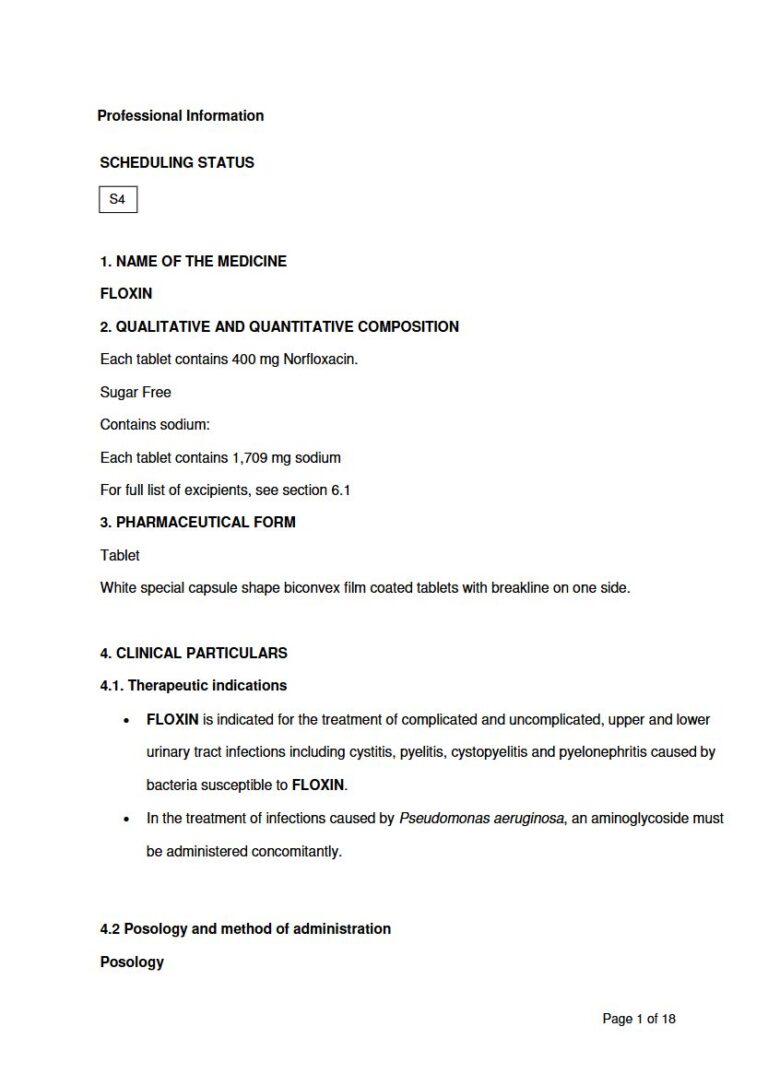
4.1. Therapeutic indications
u2022 FLOXIN is indicated for the treatment of complicated and uncomplicated, upper and lower urinary tract infections including cystitis, pyelitis, cystopyelitis and pyelonephritis caused by bacteria susceptible to FLOXIN .
u2022 In the treatment of infections caused by Pseudomonas aeruginosa , an aminoglycoside must be administered concomitantly.
4.2 Posology and method of administration
Posology S4
Susceptibility of the causative organisms to FLOXIN should be tested.
Adults: Uncomplicated lower urinary tract infections (e.g. cystitis):
- One tablet (400 mg) every twelve hours for three days.
Complicated urinary tract infections:
- One tablet (400 mg) every twelve hours for 7 to 10 days.
Children: Use is not recommended in infants and children, since norfloxacin causes arthropathy in immature animals (See section 4.3).
Geriatrics: No geriatric-specific problems have been demonstrated. However, elderly patients are more likely to have an age-related decrease in renal function, which may require an adjustment in dosage.
Renal impairment: Doses may need to be reduced in renal impairment; 400 mg once daily has been suggested with creatinine clearance is 30 ml per minute (See section 4.3)
The presence of food in the stomach may slightly decrease or delay the absorption of norfloxacin. Therefore, FLOXIN should preferably be taken with a full glass (240 ml) of water on an empty stomach (either 1 hour before or 2 hours after meals or ingestion of milk). Multivitamins, products containing iron or zinc, antacids containing magnesium and aluminium, sucralphate, or products containing didanosine should not be taken within 2 hours administration of FLOXIN (See section 4.5).
Method of administration
For oral administration
4.3 Contraindications
FLOXIN is contra-indicated:
- In patients with a known hypersensitivity to the active substance, norfloxacin or any chemically related quinolone antibacterial or to any of the excipients in listed in section 6.1.
- In patients with a creatinine clearance of less than 30ml per minute.
- With the concomitant use of angiotensin converting enzyme (ACE) inhibitors/renin-angiotensin blockers in patients with moderate to severe renal impairment.
- In children or adolescents under the age of 18 years, as experimental evidence indicates that species variable, reversible lesions of the cartilage of weight bearing joints has been seen in immature members of certain animal species.
- In pregnancy and lactation.
- In patients with moderate to severe renal impairment.
- In patients with confirmed mitral valve and /aortic valve regurgitation unless no safer appropriate alternative antibiotic is available, has failed or is not well tolerated.
4.4 Special warnings and precautions for use
As flouroquinolones may cause central nervous system (CNS) stimulation or toxicity, FLOXIN should not be used in patients with CNS disorders including cerebral arteriosclerosis, epilepsy, a history of convulsions, or known factors that predispose to seizures. Convulsions have been reported with norfloxacin, as in FLOXIN . (See section 4.8)
Tendinitis and/or tendon rupture, particularly affecting the Achilles tendon, may occur with FLOXIN (See section 4.8). Such reactions have been reported, particularly in older patients and in those treated concurrently with corticosteroids. At the first sign of pain or inflammation, patients should discontinue FLOXIN and rest the affected limbs. These reactions may occur even after treatment has been stopped.
Quinolones have been associated with prolongation of the QTc interval on the electrocardiogram and cases of dysrhythmia (including torsade de pointes) have been reported (See section 4.8). Caution should be exercised when using FLOXIN in patients with hyperkalaemia, significant bradycardia or undergoing concurrent treatment with class Ia or class IIII antidysrhythmics. FLOXIN should therefore be used with caution in patients taking cisapride, erythromycin, antipsychotics, tricyclic antidepressants or who have any personal or family history of QTc prolongation.
Disturbances in blood glucose, including both hyperglycaemia and hypoglycaemia have been reported, usually in diabetic patients receiving concomitant treatment with an oral hypoglycaemic medicine or with insulin. Cases of hypoglycaemic coma have been reported. In diabetic patients, careful monitoring of blood glucose is recommended (See section 4.5 and 4.8).
The maximum recommended dosage of 400 mg twice daily should not be exceeded and the patient should drink sufficient fluids to ensure a proper state of hydration and adequate urinary output. Care is necessary in patients with impaired hepatic or renal function, or glucose-6-phosphate dehydrogenase deficiency. Haemolytic reactions have been reported in patients with latent or actual defects in glucose-6-phosphate dehydrogenase activity who take quinolone antibacterial agents, including FLOXIN (See section 4.8).
Exposure to strong sunlight or sun lamps should be avoided. Photosensitivity reactions have been observed in patients who were exposed to excessive sunlight while receiving FLOXIN . FLOXIN therapy should be discontinued if photosensitivity occurs.
Exacerbation of myasthenia gravis has been reported with FLOXIN and may lead to life-threatening weakness of the respiratory muscles. Caution should be exercised when using quinolones, including FLOXIN , in patients with myasthenia gravis (See section 4.8).
Pseudomembranous colitis has been reported with FLOXIN and may range in severity from mild to life-threatening (see section 4.8). Therefore, it is important to consider this diagnosis in patients who present with diarrhoea subsequent to administration of FLOXIN. A toxin produced by produced by Clostridium difficile is a primary cause of pseudomembranous colitis. If Clostridium difficile u2013 associated diarrhoea (CDAD) is suspected or confirmed, ongoing use not directed against C. difficile should be discontinued. Appropriate fluid and electrolyte management, protein supplementation, antibiotic treatment of C. difficile , and surgical evaluation should be instituted as clinically indicated.
Concomitant use of fluoroquinolones and ACE inhibitors/renin-angiotensin receptor blockers may precipitate acute kidney injury in patients, especially those with moderate to severe renal impairment and elderly patients (see section 4.3). Renal function should be assessed before initiating treatment, and monitored during treatment, with fluoroquinolones or ACE inhibitors/renin- angiotensin receptor blockers.
There is some evidence, although inconclusive, of a possible association between fluoroquinolone use and mitral valve and/or aortic valve regurgitation. A thorough cardiovascular examination including an echocardiogram, should be performed before oral fluoroquinolones are prescribed. Fluoroquinolones should not be prescribed to patients with mitral valve and or aortic valve regurgitation (See section 4.3).
Superinfection with organisms not susceptible to norfloxacin is possible. Such organisms include Candida, Clostridium difficile , and Streptococcus pneumoniae . In the treatment of infections caused by Pseudomonas aeruginosa , an aminoglycoside must be administered concomitantly (see section 4.2).
Severe cutaneous adverse reactions Severe cutaneous adverse reactions (SCARs) including toxic epidermal necrolysis (TEN) Stevens Johnson syndrome (SJS) and drug reaction with eosinophilia and systemic symptoms (DRESS), which could be life-threatening or fatal, have been reported with FLOXIN (see section 4.8). At the time of prescription, patients should be advised of the signs and symptoms of severe skin reactions and be closely monitored. If signs and symptoms suggestive of these reactions appear, FLOXIN should be discontinued immediately, and an alternative treatment should be considered. If the patient has developed a serious reaction such as SJS, TEN or DRESS with the use of FLOXIN , treatment with FLOXIN must not be restarted in this patient at any time.
Use in children: FLOXIN has been reported to cause arthropathy in immature animals. The safety of FLOXIN in children has not been established and therefore the use of FLOXIN in prepubertal children or growing adolescents is contraindicated (See section 4.2 and 4.3).
4.5 Interaction with other medicines and other forms of interaction
Nitrofurantoin: Antagonism has been demonstrated between FLOXIN and nitrofurantoin and they should not be prescribed together.
Urinary alkalisers: Urinary alkalisers, such as citrates and sodium bicarbonate, may reduce solubility of FLOXIN in the urine. Patients should be observed for signs of crystalluria and nephrotoxicity.
Antacids and multivitamins: Antacids, multivitamins, products containing ferrous sulphate or zinc and sucralphate may reduce the absorption of FLOXIN by chelation, resulting in lower serum and urine concentrations. FLOXIN should be taken at least 2 hours before or after any of these medicines.
Ciclosporin: Concurrent use with ciclosporin has been reported to evaluate serum creatinine concentrations. Elevated serum levels of ciclosporins have been reported with concomitant use of FLOXIN . Ciclosporin serum levels should be monitored and appropriate ciclosporin dosage adjustments made when these medicines are used concomitantly.
Didanosine: Didanosine should not be administered concurrently with or within 2 hours of the administered of FLOXIN , because it may interfere with absorption, resulting in lower serum and urine level FLOXIN .
Probenecid: Concurrent use with probenecid decrease the renal tubular secretion of FLOXIN , resulting in decreased urinary excretion of FLOXIN , prolonged elimination half-life, and increased risk of toxicity.
Warfarin: Concurrent use with warfarin has been reported to increase the anticoagulant effect of warfarin (by displacing significant amounts from serum albumin binding sites), increasing the chance of bleeding. When concomitant administration of warfarin and FLOXIN cannot be avoided, the prothrombin time (INR) should be carefully monitored in all patients.
Medicines metabolized by CYP1A2: Quinolones, including FLOXIN , have been shown in vitro to inhibit CYP1A2. Concomitant use with medicines metabolized by CYP1A2 (e.g. caffeine, clozapine, ropinirole, theophylline) may results in increase levels of these medicines, with the potential risk of increased toxicity. Patients taking any concomitant medicines metabolized by CYP1A2 should be carefully monitored. Specially in relation to this interaction:
- Monitoring if theophylline plasma levels should be considered and dosage of theophylline adjusted as required.
- The dose of clozapine or ropinirole may need to be adjusted in patients already taking these medicines if FLOXIN is introduced or withdrawn.
Glibenclamide: The concomitant administration of quinolones, including FLOXIN , with glibenclamide (a sulphonylurea agent) may result in severe hypoglycaemia. Therefore, monitoring of blood glucose is recommended when these agents are co-administered (See section 4.4 and 4.8).
Non-steroidal anti-inflammatory drugs (NSAIDs): The concomitant administration of a non-steroidal anti-inflammatory drug (NSAID) with a quinolone, including FLOXIN , may increase the risk of CNS stimulation and convulsive seizures. Therefore, FLOXIN should be used with caution in patients receiving NSAIDs concomitantly. Use of tizanidine and norfloxacin is contraindicated.
Norfloxacin should be used with caution in patients with cisapride, erythromycin, antipsychotics, tricyclic antidepressants, anti-arrhythmics or who have any personal or family history of QTc prolongation. Renal tubular section of methotrexate may be inhibited by nofloxacin, potentially increasing its toxicity. A case series of 16 reports of acute kidney injury (AKI) associated with enalapril and ciprofloxacin as co-suspect or interacting medicines was identified in VigiBase, the WHO global database of individual case safety reports. Analysis of 11 cases indicated that in most patients although clinical conditions and a number of medicines were likely to have increased their risk of AKI, including ACE inhibitor-related AKI, the event did not occur until after a ciprofloxacin prescription lending weight to ciprofloxacin being the cause or a combined action of ciprofloxacin and enalapril. Furthermore, the interaction between ACE inhibitors and fluoroquinolones to precipitate acute kidney injury is a class effect for all ACE inhibitors and not just enalapril, and also a class effect of all the fluroquinolones not just with ciprofloxacin. The publication signal April 2017 from Uppsala Monitoring Centre also indicated that with a nested control study in older men, there was a greater than additive risk to develop acute kidney injury with the concomitant use of fluoroquinolones and renin angiotensin receptor blockers. Thus, concomitant use of fluoroquinolones and ACE inhibitors/renin-angiotensin receptor blockers may precipitate acute kidney injury (see section 4.3).
4.6 Fertility, pregnancy and lactation
Pregnancy
The safe use of FLOXIN in pregnant women has not been established; quinolones such as norfloxacin has been reported to cause arthropathy in immature animals and therefore its use during pregnancy is contraindicated (See section 4.3).
Breastfeeding
It is not known whether FLOXIN is excreted in human milk; administration to mothers breastfeeding their infants is contraindicated (See section 4.3).
4.7 Effects on ability to drive and use machines
The ability to drive or operate machinery may be impaired by FLOXIN , especially when alcohol is also taken. FLOXIN may cause dizziness and light-headedness and, therefore, patients should know how they react to FLOXIN before they drive or operate machinery, or engage in activities requiring mental alertness and coordination.
4.8 Undesirable Effects
System Organ Class Frequent Less frequent Frequency Unknown
Infections and infestations Vaginal candidiasis
Blood and the lymphatic system disorders eosinophilia, leucopenia, thrombocytopenia, neutropenia, agranulocytosis, haemolytic anaemia, sometimes associated with glucose-6- phosphate dehydrogenase deficiency (see section 4.4)
Immune system disorders Hypersensitivity reactions, including skin rash, photosensitivity, itching or redness, Stevens-Johnsons syndrome (see u201cSkin and subcutaneous tissue disordersu201d ), shortness of breath (dyspnoea), swelling of face and neck (angioedema), vasculitis Anaphylaxis, urticaria, arthritis, myalgia, arthralgia and interstitial nephritis (as part of a hypersensitivity reaction)
Metabolism and nutrition disorders Hypoglycaemia, particularly in diabetic patients, Hyperglycaemia, Hypoglycaemic coma (see section 4.4 and 4.5)
Psychiatric disorders Insomnia, nervousness. Psychosis , depression, agitation, hallucinations, sleep disturbances, anxiety, irritability, euphoria.
Nervous system disorders Central nervous system toxicity (dizziness, headache, drowsiness). Central nervous stimulation (convulsions, confusion, tremors), disorientation. Peripheral neuropathy, including Guillian-Barru00e9 syndrome, paraesthesia, hypoaesthesia, myoclonus, dysgeusia (see section 4.4)
Eye disorders Visual disturbances, epiphora
Peripheral neuropathy
Ear and labyrinth disorders Tinnitus. Hearing loss.
Cardiac disorders Prolonged QTc interval and ventricular dysrhythmia (including torsade de pointes) (see section 4.4)
Mitral valve and/ or aortic valve regurgitation
Vascular disorders Leukocytoclasticvasculi tis (see u201cImmune system disordersu201d).
Gastro-intestinal disorders Cramps, anorexia, heartburn, nausea, vomiting, diarrhoea, abdominal pain and dyspepsia. Pseudomembranous colitis has been reported
Pancreatitis Pseudomembranous colitis
Hepato-biliary disorders Transient increases in serum creatinine or blood urea and acute renal failure secondary to interstitial nephritis; crystalluria
Hepatitis, jaundice including cholestatic jaundice, elevated liver function tests (see u201cInvestigationsu201d )
Skin and subcutaneous tissue disorders Rash and hypersensitivity - type reactions affecting the skin
Vasculitis, Anaphylaxis has been reported, photosensitivity. Stevens - Johnson syndrome, toxic epidermal necrolysis, exfoliative dermatitis, erythema multiforme (see u201cImmune system disordersu201d ), pruritis.
DRESS (Drug reaction with eosinophilia and systemic symptoms
Musculoskeletal and connective tissue disorders Reversible arthralgia and joint erosions have been documented in immature animals. Tendon damage has been reported. Myalgia.
Tendinitis, tendon rupture, exacerbation of myasthenia gravis (see section 4.4)
Renal and urinary disorders Interstitial nephritis (bloody or cloudy urine, fever, rash, swelling of feet or lower legs). Crystalluria, especially when the dosage has exceeded the recommended dosage, renal failure.
Reproductive system and breast disorders gynaecomastia
Investigations Abnormal laboratory values observed include elevation of ALT (SGPT), AST (SGOT), alkaline phosphatase, bilirubin, blood urea and creatinine, elevated creatine kinase (CK).
Reporting of suspected adverse reactions Reporting suspected adverse reactions after authorisation of the medicine is important. It allows continued monitoring of the benefit/risk balance of the medicine. Health care providers are asked to report any suspected adverse reactions to SAHPRA via the u201c6.04 Adverse Drug Reaction Reporting Formu201d, found online under SAHPRAu2019s publications: https://www.sahpra.org.za/Publications/Index/8
4.9 Overdose
Adequate hydration must be maintained. Treatment is symptomatic and supportive. ECG monitoring should be undertaken, because of the possibility or QT interval prolongation.
