
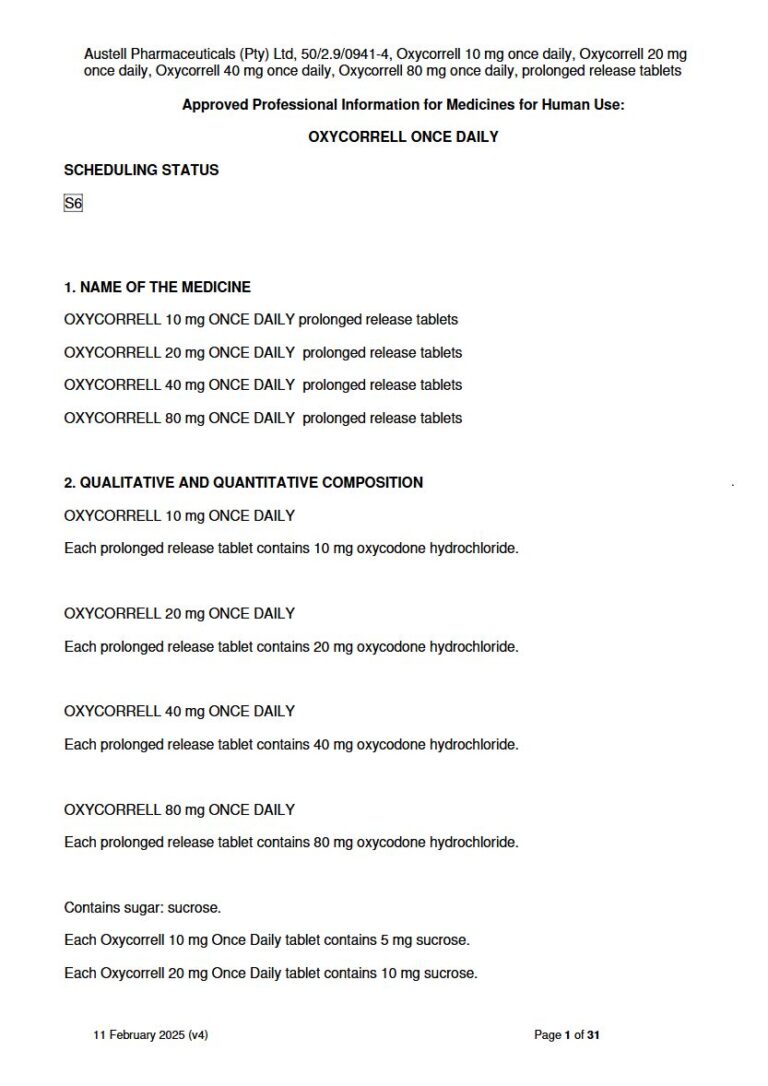
Oxycorrell Once Daily 10 mg/20 mg/40 mg/80 mg Prolonged-Release
PDF Leaflet Revision Date: 11 February 2025
Clinical Summary
Quick overview from the medicine insert
Indication
Moderate to severe pain management.
Dosage (summary)
Adults: Start with 20 mg once daily; titrate based on pain severity.
Special Populations
- Elderly
- Renal impairment
- Hepatic impairment
Pregnancy & Breastfeeding
Not recommended during pregnancy or breastfeeding.
Key Drug Interactions
- CNS depressants
- Benzodiazepines
- Serotonergic agents
- Alcohol
Contraindications
- Hypersensitivity
- Severe respiratory depression
- Acute abdomen
- Pregnancy
- Children under 18
Common side effects
- Constipation
- Nausea
- Dizziness
- Somnolence
Counselling Points
- Do not crush or chew tablets.
- Monitor for signs of respiratory depression.
- Avoid alcohol while taking this medication.
Serious warnings
- Risk of respiratory depression
- Potential for addiction and dependence
- Caution in opioid-nau00efve patients
Important Disclaimer
The Oxycorrell Once Daily 10 mg/20 mg/40 mg/80 mg Prolonged-Release professional information leaflet below is the property of Austell Pharmaceuticals and is provided on Medinsert exactly as issued, with no.. alterations or editorial changes. We make every effort to keep content current by updating documents as soon as new versions become available. Medinsert serves as a trusted access point for healthcare professionals, but does not replace official sources or clinical judgement. For more details, please read our full disclaimer. read more>>
 Healthcare Professionals Only
This content is for registered healthcare professionals
Sign in or create a free account to read the full package insert.
Free for HPCSA-registered professionals. Powered by Medinsert.
Clinical Particulars
Section 4 of the official insert — extracted exactly as issued, no alterations
4.1 Therapeutic indications
Oxycorrell Once Daily tablets are indicated for the treatment of moderate to severe pain in patients with cancer and post-operative pain after gastrointestinal function has returned. Oxycorrell Once Daily tablets are indicated for the treatment of severe pain requiring the use of a strong opioid analgesic.
4.2 Posology and method of administration
Posology
Elderly and adults over 18 years
Oxycorrell Once Daily tablets should be taken at 24-hour intervals. The dosage is dependent on the severity of the pain, and the patientu2019s previous history of analgesic requirements.
Dose titration
Increasing severity of pain will require an increased dosage of Oxycorrell Once Daily tablets, using the 10 mg, 20 mg, 40 mg or 80 mg tablet strengths, either alone or in combination, to achieve pain relief. The correct dosage for any individual patient is that which controls the pain and is well tolerated for a full 24 hours. Patients should be titrated to pain relief unless unmanageable adverse medicine reactions prevent this. If higher doses are necessary, increases should be made in 25 % - 50 % increments. The need for escape medication more than once a day indicates that the dosage of Oxycorrell Once Daily tablets should be increased. The usual starting dose for opioid nau00efve patients presenting with severe pain uncontrolled by weaker opioids is 20 mg, 24-hourly. Some patients may benefit from a starting dose of 10 mg, 24-hourly to minimise the incidence of side effects. If a lower starting dose is required, another medicine should be used. Patients already receiving opioids may start treatment with higher dosages taking into account their experience with former opioid therapies. The dose should then be carefully titrated, as frequently as once per day, if necessary, to achieve pain relief. For the majority of patients, the maximum dose is 400 mg 24-hourly. However, a few patients may require higher doses. Doses in excess of 1000 mg daily have been recorded.
Conversion from oral morphine
Patients receiving oral morphine before Oxycorrell Once Daily therapy should have their daily dose based on the following ratio: 10 mg of oral oxycodone is equivalent to 20 mg of oral morphine. It must be emphasised that this is a guide to the dose of Oxycorrell Once Daily tablets required. Inter-patient variability requires that each patient is carefully titrated to the appropriate dose.
Duration of treatment
Oxycorrell Once Daily should not be taken longer than necessary. If long-term treatment is necessary due to the type and severity of the illness, careful and regular monitoring is required to determine whether and to what extent treatment should be continued.
Cessation of treatment
When a patient no longer requires therapy with Oxycorrell Once Daily, it may be advisable to taper the dose gradually to prevent symptoms of withdrawal.
Special populations
Elderly population
A dose adjustment is not usually necessary in elderly patients. Controlled pharmacokinetic studies in elderly patients (aged over 65 years) have shown that, compared with younger adults, the clearance of oxycodone is only slightly reduced. No untoward adverse drug reactions were seen based on age, therefore adult doses and dosage intervals are appropriate (see section 5.2).
Paediatric population
Oxycorrell Once Daily should not be used in patients under 18 years of age (see section 4.4).
Patients with renal or hepatic impairment
The plasma concentration in this population may be increased. Therefore, the dose initiation should follow a conservative approach in these patients. The recommended adult starting dose should be reduced by 50 % (for example a total daily dose of 10 mg orally in opioid nau00efve patients), and each patient should be titrated to adequate pain control according to their clinical situation (see section 5.2).
Use in non-malignant pain
Opioids are not first-line therapy for chronic non-malignant pain, nor are they recommended as the only treatment. Types of chronic pain which have been shown to be alleviated by strong opioids include chronic osteoarthritic pain and intervertebral disc disease. The need for continued treatment in non-malignant pain should be assessed at regular intervals.
Method of administration
Oxycorrell Once Daily tablets are for oral use. Oxycorrell Once Daily tablets must be swallowed whole and not chewed or crushed. The breaking of the Oxycorrell Once Daily 20 mg, 40 mg and 80 mg tablets along the break line for administration does not destroy the prolonged release activity of the tablets, whereas the crushing and chewing of the tablets destroys the intended prolonged release mechanism (see section 3). This can lead to rapid oxycodone release due to the damage of the prolonged release properties. The administration of chewed or crushed Oxycorrell Once Daily tablets destroys the intended prolonged release mechanism and leads to a rapid release and absorption of a potentially fatal dose of oxycodone (see sections 4.4 and 4.9). The prolonged release tablets may be taken with or independent of meals with a sufficient amount of liquid.
4.3 Contraindications
- Hypersensitivity to the active substance or to any of the excipients listed in section 6.1.
- Any situation where opioids are contraindicated:
- severe respiratory depression with hypoxia
- head injury
- paralytic ileus
- acute abdomen
- delayed gastric emptying
- severe chronic obstructive lung disease
- cor pulmonale
- severe bronchial asthma
- hypercarbia (elevated carbon dioxide levels in the blood)
- moderate to severe hepatic impairment
- severe renal impairment (creatinine clearance < 10 mL/min)
- chronic constipation
- pregnancy
- concurrent administration of monoamine oxidase inhibitors or within 2 weeks of discontinuation of their use
- Pre-operative use or for the first 24 hours post-operatively
- Children under 18 years
- Oxycorrell 40 mg and 80 mg Once Daily tablets should not be used in patients not previously exposed to opioids. These dosage strengths may cause total respiratory depression when administered to opioid-nau00efve patients (see section 4.4).
4.4 Special warnings and precautions for use
Respiratory depression
Patients at risk
The major risk of Oxycorrell Once Daily tablets excess is respiratory depression. Caution must be exercised when administering Oxycorrell Once Daily tablets to the debilitated elderly; patients with severely impaired pulmonary function, patients with impaired hepatic or renal function; patients with myxoedema, hypothyroidism, Addison's disease, toxic psychosis, prostate hypertrophy, adrenocortical insufficiency, alcoholism, delirium tremens, diseases of the biliary tract, pancreatitis, inflammatory bowel disorders, hypotension, hypovolaemia, raised intracranial pressure, head injury (due to risk of increased intracranial pressure) or patients taking MAO inhibitors (see sections 4.3 and 4.5).
Opioid-nau00efve patients
Oxycorrell Once Daily 40 mg and 80 mg tablets should not be used in patients not previously exposed to opioids. These tablets strengths may cause fatal respiratory depression when administered to opioid-nau00efve patients (see section 4.3).
Benzodiazepines
Concomitant use of benzodiazepines and opioids may result in sedation, respiratory depression, coma and death. Because of these risks, concomitant prescribing of sedative medicines such as benzodiazepines or related medicines with opioids should be reserved for patients for whom alternative treatment options are not possible. If a decision is made to prescribe benzodiazepines concomitantly with opioids, the lowest effective dose should be used, and the duration of treatment should be as short as possible (see section 4.2). The patients should be followed closely for signs and symptoms of respiratory depression and sedation. In this respect, it is strongly recommended to inform patients and their environment to be aware of these symptoms (see section 4.5).
Paralytic ileus
Oxycorrell Once Daily tablets should not be used where there is possibility of paralytic ileus occurring. Should paralytic ileus be suspected or occur during use, Oxycorrell Once Daily tablets should be discontinued immediately (see section 4.3).
Surgical procedures
Oxycorrell Once Daily tablets are not recommended for pre-operative use or within the first 12 - 24 hours post-operatively. Oxycorrell Once Daily tablets should be used with caution following abdominal surgery as opioids are known to impair intestinal motility and should not be used until the medical practitioner is assured of normal bowel function.
Patients about to undergo additional pain-relieving procedures (e.g. surgery, plexus blockade), should not receive Oxycorrell Once Daily tablets for 24 hours prior to the intervention. If further treatment with Oxycorrell Once Daily tablets is then indicated, the dosage should be adjusted to the new post-operative requirement.
Chronic non-malignant pain
Treatment programme
For appropriate patients who suffer with chronic non-malignant pain, opioids, such as Oxycorrell Once Daily, should be used as part of a comprehensive treatment programme involving other medications and treatment modalities. A crucial part of the assessment of a patient with chronic non-malignant pain is the patient's addiction and substance abuse history (see Dependence producing potential and abuse liability).
Dosing
If opioid treatment, such as Oxycorrell Once Daily, is considered appropriate for the patient, then the main aim of treatment is not to minimise the dose of opioid but rather to achieve a dose, which provides adequate pain relief with a minimum of side effects. There must be frequent contact between the doctor and patient so that dosage adjustments can be made. It is strongly recommended that the doctor defines treatment outcomes in accordance with pain management guidelines. The doctor and patient can then agree to discontinue treatment if these objectives are not met.
Tolerance and dependence
The patient may develop tolerance to Oxycorrell Once Daily with chronic use and require progressively higher doses to maintain pain control. Prolonged use of Oxycorrell Once Daily, may lead to physical dependence and a withdrawal syndrome may occur upon abrupt cessation of therapy. When a patient no longer requires therapy with Oxycorrell Once Daily, it may be advisable to taper the dose gradually to prevent symptoms of withdrawal. The opioid abstinence or withdrawal syndrome is characterised by some or all of the following: restlessness, lacrimation, rhinorrhoea, yawning, perspiration, chills, myalgia, mydriasis and palpitations. Other symptoms also may develop, including irritability, anxiety, backache, joint pain, weakness, abdominal cramps, insomnia, nausea, anorexia, vomiting, diarrhoea, or increased blood pressure, respiratory rate or heart rate.
Hyperalgesia
Hyperalgesia that will not respond to a further dose increase of oxycodone, such as Oxycorrell Once Daily may occur, particularly in high doses. An Oxycorrell Once Daily dose reduction or change to an alternative opioid may be required.
Abuse
Addiction disorders
Oxycodone, such as Oxycorrell Once Daily tablets, has a dependence producing potential and an abuse profile similar to other strong opioids. Oxycodone may be sought and abused by people with latent or manifest addiction disorders. There is potential for development of psychological dependence (addiction) to opioid analgesics, such as Oxycorrell Once Daily. There is an increased risk of addiction in patients with a personal or family history of substance abuse or mental health disorders. Oxycorrell Once Daily tablets should be used with particular care in patients with a history of alcohol and substance abuse.
Infants born to dependent mothers
As with other opioids, infants who are born to dependent mothers may exhibit withdrawal symptoms and may have respiratory depression at birth (see section 4.6).
Abuse by parenteral administration
Abuse of the Oxycorrell Once Daily tablets by parenteral administration can be expected to result in serious adverse events, such as local tissue necrosis, infection, pulmonary granulomas, increased risk of endocarditis and valvular heart injury, which may be fatal.
Abuse by chewing or crushing
Oxycorrell Once Daily, tablets must be swallowed whole, and not chewed or crushed (see section 4.2). The administration of chewed or crushed Oxycorrell Once Daily tablets leads to a rapid release and absorption of a potentially fatal dose of oxycodone (see section 4.9).
Alcohol
Concomitant use of alcohol and Oxycorrell Once Daily may increase the undesirable effects of Oxycorrell Once Daily; concomitant use should be avoided (see section 4.5).
Anti-doping warning
Athletes must be aware that this medicine may cause a positive reaction to u2018anti - dopingu2019 tests. Use of Oxycorrell Once Daily as a doping agent may become a health hazard.
Hormonal changes
Opioids may influence the hypothalamic-pituitary-adrenal u2013 or gonadal axes. Some changes that can be seen include an increase in serum prolactin, and decreases in plasma cortisol and testosterone. Clinical symptoms may manifest from these hormonal changes.
Paediatric population
The safety and efficacy Oxycorrell Once Daily in patients under 18 years of age has not been established. Oxycorrell Once Daily should not be used in patients under 18 years of age because of safety and efficacy concerns.
Special precaution necessary relating to excipients
Oxycorrell Once Daily tablets contain sucrose. Patients with rare hereditary conditions of fructose intolerance, glucose-galactose malabsorption or sucrase-isomaltase insufficiency should not take Oxycorrell Once Daily.
4.5 Interaction with other medicines and other forms of interaction
Central nervous system (CNS) depressants
Oxycorrell Once Daily tablets can enhance the CNS depressant effect during concomitant therapy with medicines which affect the CNS such as tranquilisers, anaesthetics, hypnotics, anti-depressants, non-benzodiazepine sedatives, phenothiazines, neuroleptic medicines, alcohol, other opioids, muscle relaxants and antihypertensives. The concomitant use of sedative medicines such as benzodiazepines or related medicines with opioids increases the risk of sedation, respiratory depression, coma and death because of additive CNS depressant effect. The dosage and duration of concomitant use should be limited (see section 4.4).
Serotonergic medicines
Concomitant administration of oxycodone with serotonin agents, such as a Selective Serotonin Re- uptake Inhibitor (SSRI) or a Serotonin Norepinephrine Re-uptake Inhibitor (SNRI) may cause serotonin toxicity. The symptoms of serotonin toxicity may include mental-status changes (e.g., agitation, hallucinations, coma), autonomic instability (e.g., tachycardia, labile blood pressure, hyperthermia), neuromuscular abnormalities (e.g., hyperreflexia, incoordination, rigidity), and/or gastrointestinal symptoms (e.g., nausea, vomiting, diarrhoea). Oxycorrell Once Daily tablets should be used with caution and the dosage may need to be reduced in patients using these medicines.
Anticholinergics
Concomitant administration of Oxycorrell Once Daily tablets with anticholinergics or medicines with anticholinergic activity (e.g. tricyclic anti-depressants, antihistamines, antipsychotics, muscle relaxants, anti-Parkinson medicines) may result in increased anticholinergic adverse effects. Oxycorrell Once Daily tablets should be used with caution and the dosage may need to be reduced in patients using these medicines.
Monoamine oxidase (MAO) inhibitors
Monoamine oxidase (MAO) inhibitors are known to interact with narcotic analgesics, producing CNS excitation or depression with hypertensive or hypotensive crisis (see section 4.4).
Alcohol
Alcohol may enhance the pharmacodynamic effects of Oxycorrell Once Daily tablets and concomitant use should be avoided (see section 4.4).
Coumarin anticoagulants
Clinically relevant changes in International Normalised Ratio (INR) in both directions have been observed in individuals if coumarin anticoagulants are taken concomitantly with Oxycorrell Once Daily.
Effects of other medicines on Oxycorrell Once Daily
Cytochrome P450 isoenzyme interactions
Oxycodone is metabolised mainly by CYP3A4, with a contribution from CYP2D6. The activities of these metabolic pathways may be inhibited or induced by various co-administered medicines or dietary supplements.
CYP3A4 inhibitors
CYP3A4 inhibitors, such as macrolide antibiotics (e.g. clarithromycin, erythromycin and telithromycin), azole-antifungals (e.g. ketoconazole, voriconazole, itraconazole, and posaconazole), protease inhibitors (e.g. boceprevir, ritonavir, indinavir, nelfinavir and saquinavir), cimetidine and grapefruit juice may cause a reduced clearance of oxycodone that could cause an increase of the plasma concentrations of oxycodone. Therefore, the Oxycorrell Once Daily dose may need to be adjusted accordingly. Some specific examples are provided below:
u2022 Itraconazole, a potent CYP3A4 inhibitor, administered 200 mg orally for five days, increased the AUC of oral oxycodone. On average, the AUC was approximately 2,4 times higher (range 1,5 u2013 3,4).
u2022 Voriconazole, a CYP3A4 inhibitor, administered 200 mg twice-daily for four days (400 mg given as first two doses), increased the AUC of oral oxycodone. On average, the AUC was approximately 3,6 times higher (range 2,7 u2013 5,6).
u2022 Telithromycin, a CYP3A4 inhibitor, administered 800 mg orally for four days, increased the AUC of oral oxycodone. On average, the AUC was approximately 1,8 times higher (range 1,3 u2013 2,3).
u2022 Grapefruit juice, a CYP3A4 inhibitor, administered as 200 mL three times a day for five days, increased the AUC of oral oxycodone. On average, the AUC was approximately 1,7 times higher (range 1,1 u2013 2,1).
CYP3A4 inducers
CYP3A4 inducers, such as rifampicin, carbamazepine, phenytoin and St Johnu00b4s Wort may induce the metabolism of oxycodone and cause an increased clearance of oxycodone that could cause a reduction of the plasma concentrations of oxycodone. The dose of Oxycorrell Once Daily may need to be adjusted accordingly. Some specific examples are provided below:
u2022 St Johnu00b4s Wort, a CYP3A4 inducer, administered as 300 mg three times a day for fifteen days, reduced the AUC of oral oxycodone, such as Oxycorrell Once Daily. On average, the AUC was approximately 50 % lower (range 37 u2013 57 %).
u2022 Rifampicin, a CYP3A4 inducer, administered as 600 mg once-daily for seven days, reduced the AUC of oral oxycodone, such as Oxycorrell Once Daily. On average, the AUC was approximately 86 % lower.
CYP2D6 inhibitors
Medicines that inhibit CYP2D6 activity, such as paroxetine and quinidine, may cause decreased clearance of oxycodone which could lead to an increase in oxycodone plasma concentrations. Concurrent administration of quinidine resulted in an increase in oxycodone C max by 11 %, AUC by 13 %, and t u00bd elim. by 14 %. Also, an increase in noroxycodone level was observed, (C max by 50 %; AUC by 85 %, and t u00bd elim. by 42 %. The pharmacodynamic effects of oxycodone were not altered.
4.6 Fertility, pregnancy and lactation
Pregnancy
Oxycorrell Once Daily tablets are not recommended for use in pregnancy nor during labour. There are limited data from the use of oxycodone in pregnant women. Infants born to mothers who have received opioids during the last 3 to 4 weeks before giving birth should be monitored for respiratory depression. Withdrawal symptoms may be observed in the newborn of mothers undergoing treatment with oxycodone (see section 4.4).
Breastfeeding
Oxycodone may be secreted in breast milk and may cause respiratory depression in the newborn. Oxycorrell Once Daily tablets should, therefore, not be used in breast-feeding mothers.
Fertility
No human data on the effect of oxycodone on fertility are available. It is reported that in rats, there was no effect on mating or fertility with oxycodone treatment (see section 5.3).
4.7 Effects on ability to drive and use machines
Oxycorrell Once Daily can impair cognitive (alertness and reactivity) function and may modify patients' reactions to a varying extent depending on the dosage and individual susceptibility thereby affecting a patient's ability to drive and use machines safely. Therefore, patients should not drive or operate machinery if affected.
4.8 Undesirable effects
a) Summary of the safety profile
Adverse medicine reactions are typical of full opioid agonists. Tolerance and dependence may occur (see section 4.4). Constipation may be prevented with an appropriate laxative. If nausea and vomiting are troublesome, oxycodone may be combined with an anti-emetic.
b) Tabulated list of adverse reactions
The table below shows all adverse drug reactions (ADRs) observed during clinical trials and postmarket spontaneous reports with oxycodone. Frequency estimate: Frequent (u2265 1/100) Less frequent (< 1/100) Not known (cannot be estimated from the available data).
System Organ Class Frequency Frequent Less Frequent Not known
Immune system disorders hypersensitivity. anaphylactic reaction, anaphylactoid reaction.
Metabolism and nutrition disorders decreased appetite. dehydration.
Psychiatric disorders anxiety, confusional state, depression, insomnia, nervousness, abnormal thinking, abnormal dreams. agitation, affect lability, euphoric mood, hallucinations, decreased libido, medicine dependence (see section 4.4), disorientation, mood altered, restlessness, dysphoria. aggression.
Nervous system disorders somnolence, dizziness, headache, tremor, lethargy, sedation. amnesia, convulsion, hypertonia, hypoaesthesia, involuntary muscle contractions, speech disorder, hyperalgesia. syncope, paraesthesia, dysgeusia, hypotonia.
Eye disorders visual impairment, miosis.
Ear and labyrinth disorders vertigo.
Cardiac disorders palpitations (in the context of withdrawal syndrome), supraventricular tachycardia.
Vascular disorders vasodilatation, facial flushing, hypotension, orthostatic hypotension.
Respiratory, thoracic and dyspnoea, bronchospasm, cough decreased. respiratory depression, hiccups.
Gastrointestinal disorders constipation, nausea, vomiting, abdominal pain, diarrhoea, dry mouth, dyspepsia. dysphagia, flatulence, eructation, ileus, gastritis. dental caries.
Hepatobiliary disorders increased hepatic enzymes, biliary colic. cholestasis.
Skin and subcutaneous tissue disorders pruritus, rash, hyperhidrosis. dry skin, exfoliative dermatitis, urticaria.
Renal and urinary disorders urinary retention, ureteral spasm.
Reproductive system and breast disorders erectile dysfunction, hypogonadism. amenorrhoea.
General disorders and administration site conditions asthenia, fatigue. medicine withdrawal syndrome, malaise, oedema, peripheral oedema, medicine tolerance, thirst, pyrexia, chills. neonatal medicine withdrawal syndrome.
c) Description of selected adverse reactions
Tolerance and dependence
The patient may develop tolerance to the medicine with chronic use and require progressively higher doses to maintain pain control. Prolonged use with Oxycorrell Once Daily may lead to physical dependence and a withdrawal syndrome may occur upon abrupt cessation of therapy. The opioid abstinence or withdrawal syndrome is characterised by some or all of the following: restlessness, lacrimation, rhinorrhoea, yawning, perspiration, chills, myalgia, mydriasis and palpitations. Other symptoms also may develop, including: irritability, anxiety, backache, joint pain, weakness, abdominal cramps, insomnia, nausea, anorexia, vomiting, diarrhoea, or increased blood pressure, respiratory rate or heart rate. When a patient no longer requires therapy with Oxycorrell Once Daily, it may be advisable to taper the dose gradually to prevent symptoms of withdrawal. The development of psychological dependence (addiction) to opioid analgesics in properly managed patients with pain has been reported to be rare. However, data are not available to establish the true incidence of psychological dependence (addiction) in chronic pain patients. Oxycorrell Once Daily should be used with particular care in patients with a history of alcohol and substance abuse.
4.9 Overdose
Signs and symptoms
Acute overdose with oxycodone can be manifested by miosis, respiratory depression, hypotension and hallucinations. Circulatory failure and somnolence progressing to stupor or deepening coma, hypotonia, bradycardia, pulmonary oedema and death may occur in more severe cases. The effects of overdosage will be potentiated by the simultaneous ingestion of alcohol or other psychotropic medicines (see section 4.5).
Treatment
Primary attention should be given to the establishment of a patent airway and institution of assisted or controlled ventilation. The pure opioid antagonists such as naloxone are specific antidotes against symptoms from opioid overdose. Other supportive measures should be employed as needed. In the case of massive overdosage, administer naloxone intravenously (0,4 to mg for an adult and 0,01 mg/kg body weight for children) if the patient is in a coma or respiratory depression is present. Repeat the dose at 2-minute intervals if there is no response. If repeated doses are required, an infusion of 60 % of the initial dose per hour is a useful starting point. A solution of 10 mg made up in 50 mL dextrose will produce 200 micrograms/mL for infusion using an IV pump (dose adjusted to the clinical response). Infusions are not a substitute for frequent review of the patient's clinical state. Intramuscular naloxone is an alternative in the event that IV access is not possible. As the duration of action of naloxone is relatively short, the patient must be carefully monitored until spontaneous respiration is reliably re-established. Naloxone is a competitive antagonist and large doses (4 mg) may be required in seriously poisoned patients.
For less severe overdosage, administer naloxone 0,2 mg intravenously followed by increments of 0,1 mg every 2 minutes if required.
The patient should be observed for at least 6 hours after the last dose of naloxone. Naloxone should not be administered in the absence of clinically significant respiratory or circulatory depression secondary to oxycodone overdosage. Naloxone should be administered cautiously to persons who are known, or suspected, to be physically dependent on oxycodone. In such cases, an abrupt or complete reversal of opioid effects may precipitate pain and an acute withdrawal syndrome.
Additional/other considerations: Consider activated charcoal (50 g for adults, 10 u2013 15 g for children), if a substantial amount has been ingested within 1 hour, provided the airway can be protected. It may be reasonable to assume that late administration of activated charcoal may be beneficial for prolonged release preparations; however there is no evidence to support this. Oxycorrell Once Daily tablets will continue to release and add to the oxycodone load for up to 14 hours after administration and the management of oxycodone overdosage should be modified accordingly. Gastric contents may therefore need to be emptied as this can be useful in removing unabsorbed medicine, particularly when a prolonged release formulation has been taken.
