
Oxytocin 10 Iu Solution
PDF Leaflet Revision Date: 16 May 2023
Clinical Summary
Quick overview from the medicine insert
Indication
Induction and enhancement of labour, prevention and treatment of postpartum haemorrhage.
Dosage (summary)
5 IU by i.v. infusion for induction; 5 IU i.m. after delivery for postpartum haemorrhage.
Onset of Action / Duration
Onset: <1 min (i.v.), Duration: 30-60 mins (i.m.)
Special Populations
- Renal impairment
- Cardiovascular disease
- Elderly
Pregnancy & Breastfeeding
Unlikely to cause fetal abnormalities; may be present in breast milk but unlikely to harm newborn.
Key Drug Interactions
- Prostaglandins
- Inhalation anaesthetics
- QT prolonging medications
Contraindications
- Hypersensitivity to oxytocin
- Foetal distress
- Uterine hypertonicity
Common side effects
- Nausea
- Vomiting
- Tachycardia
- Hypotension
Counselling Points
- Avoid driving or operating machinery
- Report any unusual symptoms
- Fluid intake may need to be restricted during treatment
Serious warnings
- Uterine overstimulation may cause foetal distress
- Monitor for water intoxication
- Use under medical supervision only
Important Disclaimer
The Oxytocin 10 Iu Solution professional information leaflet below is the property of Cospharm Investments and is provided on Medinsert exactly as issued, with no.. alterations or editorial changes. We make every effort to keep content current by updating documents as soon as new versions become available. Medinsert serves as a trusted access point for healthcare professionals, but does not replace official sources or clinical judgement. For more details, please read our full disclaimer. read more>>
 Healthcare Professionals Only
This content is for registered healthcare professionals
Sign in or create a free account to read the full package insert.
Free for HPCSA-registered professionals. Powered by Medinsert.
Clinical Particulars
Section 4 of the official insert — extracted exactly as issued, no alterations
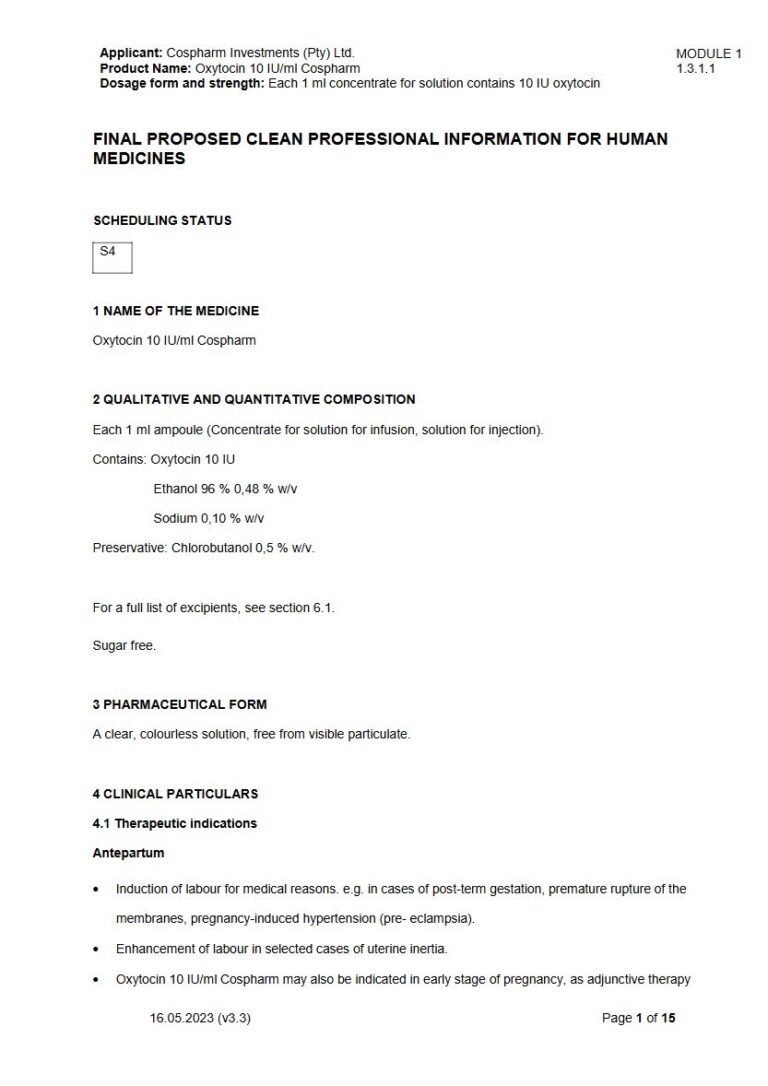
4.1 Therapeutic indications
Antepartum
- Induction of labour for medical reasons. e.g. in cases of post-term gestation, premature rupture of the membranes, pregnancy-induced hypertension (pre-eclampsia).
- Enhancement of labour in selected cases of uterine inertia.
- Oxytocin 10 IU/ml Cospharm may also be indicated in early stage of pregnancy, as adjunctive therapy for the management of incomplete, inevitable or missed abortion.
Postpartum:
- During caesarean section, after the delivery of the child.
- Prevention and treatment of postpartum haemorrhage and uterine atony.
4.2 Posology and method of administration
Posology
Induction or enhancement of labour
For drip infusion it is recommended that 5 IU of Oxytocin be added to 500 ml of a physiological electrolyte solution (such as sodium chloride 0,9 %). If a 5 IU ampoule is not available, it is recommended that 10 IU of Oxytocin be added to 1000 ml of physiological electrolyte solution (such as sodium chloride 0,9 %), to achieve the initial recommended dose of 5 IU/ml.
For patients in whom infusion of sodium chloride must be avoided; 5 % dextrose solution may be used as the diluent. To ensure even mixing, the bottle or bag must be turned upside-down several times before use. The initial infusion rate should be set at 1 to 4 milliunits/minute (0,1 to 0,4 ml/min or 2 to 8 drops/minute). It may be gradually increased at intervals not shorter than 20 minutes until a contraction pattern similar to that of normal labour is established. In pregnancy near term, this can often be achieved with an infusion of less than10 milliunits/minute (1 ml/minute or 20 drops/minute), and the recommended maximum rate is 20 milliunits/min (2 ml/minute or 40 drops/minute).
In the unusual event of higher rates being required, as may occur in the management of foetal death in utero or for induction of labour at an earlier stage of pregnancy, when the uterus is less sensitive to oxytocin, it is advisable to use a more concentrated Oxytocin 10 IU/ml Cospharm solution, e.g. 10 IU in 500 ml.
When using a motor-driven infusion pump which delivers smaller volumes than those given by drip infusion, the concentration suitable for infusion within the recommended dosage range must be calculated according to the specifications of the pump.
The frequency, strength and duration of contractions and also the foetal heart rate must be carefully monitored throughout the infusion. Once an adequate level of uterine activity is attained, the infusion rate can often be reduced. In the event of uterine hyperactivity and/or foetal distress, the Oxytocin 10 IU/ml Cospharm infusion must be discontinued immediately. If, in women who are at term or near term, regular contractions are not established after the infusion of a total amount of 5 IU Oxytocin 10 IU/ml Cospharm, it is recommended that the attempt to induce labour should be terminated; it may be repeated on the following day starting again from a rate of 1 to 4 milliunits /minute (0,1 to 0,4 ml/minute or 2 to 8 drops/ minute).
Note: Inadvertent paravenous infusion of Oxytocin 10 IU/ml Cospharm is not harmful.
Caesarian section
5 IU by i.v. infusion (5 IU diluted in physiological electrolyte solution and administered as an i.v drip infusion or, preferably, by means of a variable-speed infusion pump over 5 minutes) immediately after delivery of the foetus.
Prevention of postpartum uterine hemorrhage: The usual dose is 5 IU by intravenously infusion (5 IU diluted in physiological electrolyte solution and administered as an i.v. drip infusion or, preferably, by means of a variable-speed infusion pump over 5 minutes) or 5 to 10 IU intramuscular after delivery of the placenta. In women given Oxytocin 10 IU/ml Cospharm for induction or enhancement of labour, the infusion should be continued at an increased rate during the third stage of labour and for the next few hours thereafter.
Treatment of postpartum uterine haemorrhage: 5 IU by infusion (5 IU diluted in physiological electrolyte solution and administered as an i.v. drip infusion or, preferably, by means of a variable-speed infusion pump over 5 minutes) or 5 to 10 IU i.m., followed in severe cases by intravenous infusion of a solution containing 5 to 20 IU of Oxytocin 10 IU/ml Cospharm in 500 ml of an electrolyte-containing diluent, run at the rate necessary to control uterine atony.
Incomplete, inevitable, or missed abortion: 5 IU by intravenous infusion (5 IU diluted in physiological electrolyte solution and administered as an i.v drip infusion or, preferably, by means of a variable speed infusion pump over 5 minutes). If necessary, followed by intravenous infusion at a rate of 20 to 40 milliunits/minute or higher.
Method of administration
Oxytocin 10 IU/ml Cospharm should be administered as an intravenous drip infusion or, preferably, by means of a variable-speed infusion pump.
4.3 Contraindications
- Patients with a known hypersensitivity to oxytocin or to any of the excipients listed in section 6.1.
- Hypertonic uterine contractions, foetal distress when delivery is not imminent. Any conditions in which, for foetal or maternal reasons, spontaneous labour is unadvisable and/or vaginal delivery is contra-indicated: e.g. significant cephalopelvic disproportion, foetal malpresentation; placenta praevia and vasa praevia, placental abruption, cord presentation or prolapse; overdistension or impaired resistance of the uterus to rupture as in multiple pregnancy, polyhydramnios, grand multiparity and in the presence of a uterine scar resulting from major surgery, including classical caesarean section.
- Oxytocin 10 IU/ml Cospharm should not be used for prolonged periods in patients with oxytocin-resistant uterine inertia, severe pre-eclamptic toxaemia or severe cardiovascular disorders.
- Oxytocin 10 IU/ml Cospharm must not be administered within 6 hours after vaginal prostaglandins have been given.
4.4 Special warnings and precautions for use
The induction of labour by means of Oxytocin 10 IU/ml Cospharm should be attempted only when strictly indicated for medical reasons rather than for convenience. Administration should only be under hospital conditions and qualified medical supervision.
Oxytocin 10 IU/ml Cospharm should not be given as i.v. bolus injection as it may cause an acute short-lasting hypotension accompanied with flushing and reflex tachycardia.
Oxytocin 10 IU/ml Cospharm should be used with caution in patients who have a pre-disposition to myocardial ischaemia due to pre-existing cardiovascular disease (such as hypertrophic cardiomyopathy, valvular heart disease and/or ischemic heart disease including coronary artery vasospasm), to avoid significant changes in blood pressure and heart rate in these patients.
Oxytocin 10 IU/ml Cospharm should be given with caution to patients with known 'long QT syndrome' or related symptoms and to patients taking medicines that are known to prolong the QTc interval.
When Oxytocin 10 IU/ml Cospharm is given for induction and enhancement of labour:
- It must only be administered as an intravenous infusion, and never by subcutaneous, intramuscular or intravenous bolus injection.
- Administration of Oxytocin 10 IU/ml Cospharm at excessive doses results in uterine overstimulation which may cause foetal distress, asphyxia and death, or may lead to hypertonicity, tetanic contractions or rupture of the uterus. Careful monitoring of foetal heart rate and uterine motility (frequency, strength, and duration of contractions) is essential, so that the dosage may be adjusted to individual response.
- Particular caution is required in the presence of borderline cephalopelvic disproportion, secondary uterine inertia, mild or moderate degrees of pregnancy-induced hypertension or cardiac disease and in patients above 35 years of age or with a history of lower-uterine-segment caesarean section.
- The pharmacological induction of labour using Oxytocin 10 IU/ml Cospharm increases the risk of post-partum disseminated intravascular coagulation (DIC). The pharmacological induction itself and not a particular medicine is linked to such risk. This risk is increased in particular if the woman has additional risk factors for DIC such as being 35 years of age or over, complications during the pregnancy, and gestational age more than 40 weeks. In these women, Oxytocin 10 IU/ml Cospharm should be used with care, and the practitioner should be alerted by signs of DIC.
- In the case of foetal death in utero, and/or in the presence of meconium-stained amniotic fluid, tumultuous labour must be avoided, as it may cause amniotic fluid embolism.
Water intoxication
Because oxytocin possesses slight antidiuretic activity, its prolonged i.v. administration at high doses in conjunction with large volumes of fluid, as may be the case in the treatment of inevitable or missed abortion or in the management of postpartum haemorrhage, may cause water intoxication associated with hyponatraemia. The combined antidiuretic effect of oxytocin and the i.v. fluid administration may cause fluid overload leading to a haemodynamic form of acute pulmonary oedema without hyponatraemia.
To avoid these rare complications, the following precautions must be observed whenever high doses of oxytocin are administered over a long time: an electrolyte-containing diluent must be used (not dextrose); the volume of infused fluid should be kept low (by infusing Oxytocin 10 IU/ml Cospharm at a higher concentration than recommended for the induction or enhancement of labour at term); fluid intake by mouth must be restricted; a fluid balance chart should be kept, and serum electrolytes should be measured when electrolyte imbalance is suspected.
Renal Impairment
Caution should be exercised in patients with severe renal impairment because of possible water retention and possible accumulation of oxytocin.
Anaphylaxis in women with latex allergy
There have been reports of anaphylaxis following administration of oxytocin in women with a known latex allergy. Due to the existing structural homology between oxytocin and latex, latex allergy/intolerance may be an important predisposing risk factor for anaphylaxis following Oxytocin 10 IU/ml Cospharm administration.
This medicine contains 0,0061 ml of alcohol (ethanol) per ampoule, which is equivalent to 0,48 % w/v. The amount of alcohol in this medicine is not likely to have an effect in adults. The alcohol in this medicine may alter the effects of other medicines.
4.5 Interaction with other medicines and other forms of interaction
Interaction resulting in a concomitant use not recommended.
Prostaglandins and their analogues
Prostaglandins and its analogues facilitate contraction of the myometrium hence Oxytocin 10 IU/ml Cospharm can potentiate the uterine action of prostaglandins and analogues and vice versa.
Medicines prolonging the QT interval
Oxytocin 10 IU/ml Cospharm should be considered as potentially dysrhythmogenic, particularly in patients with other risk factors for Torsades de Pointes such as medicines which prolong the QT interval or in patients with history of long QT syndrome.
Interactions to be considered
Inhalation anaesthetics
Inhalation anaesthetics (e.g. cyclopropane, halothane, sevoflurane, desflurane) may enhance the hypotensive effects of Oxytocin 10 IU/ml Cospharm and reduce its oxytocic action. Inhalation, anaesthetics have a relaxing effect on the uterus and produce a notable inhibition of uterine tone and thereby, may diminish the uterotonic effect of Oxytocin 10 IU/ml Cospharm. Their concurrent use with Oxytocin 10 IU/ml Cospharm has also been reported to cause cardiac rhythm disturbances.
Vasoconstrictors / Sympathomimetics
Oxytocin 10 IU/ml Cospharm may enhance the vasopressor effects of vasoconstrictors and sympathomimetics, even those contained in local anaesthetics.
Caudal anaesthetics
When given during or after caudal block anaesthesia, Oxytocin 10 IU/ml Cospharm may potentiate the pressor effect of sympathomimetic vasoconstrictor medicines.
4.6 Fertility, pregnancy and lactation
Pregnancy
Based on extensive experience with oxytocinu2019s chemical structure and pharmacological properties, it is unlikely to present a risk of foetal abnormalities when used as indicated.
Breastfeeding
Oxytocin 10 IU/ml Cospharm may be found in small quantities in mothers breast milk. However, it is unlikely to cause harmful effects in the newborn because it is inactivated in the alimentary tract.
Fertility
Not applicable for Oxytocin 10 IU/ml Cospharm because of the targeted indications.
4.7 Effects on ability to drive and use machines
Oxytocin 10 IU/ml Cospharm can induce labour, therefore caution should be exercised when driving or operating machines. Women with uterine contractions should not drive or use machines.
4.8 Undesirable effects
As there is a wide variation in uterine sensitivity, uterine spasm may be caused in some instances by what are normally considered to be low doses. When Oxytocin 10 IU/ml Cospharm is used by i.v. infusion for the induction or enhancement of labour, administration at too high doses results in uterine overstimulation which may cause foetal distress, asphyxia, and death, or may lead to hypertonicity, tetanic contractions, soft tissue damage or rupture of the uterus.
Rapid i.v. bolus injection of Oxytocin 10 IU/ml Cospharm at doses amounting to several IU may result in acute short-lasting hypotension accompanied with flushing and reflex tachycardia (see section 4.4). These rapid haemodynamic changes may result in myocardial ischaemia, particularly in patients with pre-existing cardiovascular disease.
Rapid i.v. bolus injection of Oxytocin 10 IU/ml Cospharm at doses amounting to several IU may also lead to QTc prolongation. In circumstances the pharmacological induction of labour using uterotonic medicines, including Oxytocin 10 IU/ml Cospharm, increases the risk of postpartum disseminated intravascular coagulation.
Water intoxication
Water intoxication associated with maternal and neonatal hyponatraemia has been reported in cases where high doses of Oxytocin 10 IU/ml. Cospharm together with large amounts of electrolyte-free fluid have been administered over a prolonged period of time. The combined antidiuretic effect of Oxytocin 10 IU/ml Cospharm and the i.v. fluid administration may cause fluid overload leading to a haemodynamic form of acute pulmonary oedema without hyponatraemia.
Symptoms of water intoxication include:
- Headache, anorexia, nausea, vomiting and abdominal pain.
- Lethargy, drowsiness, unconsciousness and grand-mal type seizures.
- Low blood electrolyte concentration.
The ADRs tabulated below are based on clinical trial results as well as postmarketing reports. The adverse drug reactions derived from post-marketing experience with oxytocin as in Oxytocin 10 IU/ml Cospharm are via spontaneous case reports and literature cases. Because these reactions are reported voluntarily from a population of uncertain size, it is not possible to reliably estimate their frequency which is therefore categorised as not known. Adverse drug reactions are listed according to system organ classes in MedDRA. Within each system organ class, ADRs are presented in order of decreasing seriousness.
Immune system disorders
Less frequent: Anaphylactoid reactions
Nervous system disorders
Frequent: Headache
Cardiac disorders
Frequent: Tachycardia, bradycardia
Less frequent: Dysrhythmia
Not known: Myocardial ischaemia, electrocardiogram QTc prolongation
Vascular disorders
Hypotension, shock, flushing
Gastrointestinal disorders
Frequent: Nausea, vomiting
Skin and subcutaneous tissue disorders:
Less frequent: Rash
Not known: Angioedema
Pregnancy, puerperium and perinatal conditions
Not known: Hypertonicity, tetanic contractions or rupture of the uterus, foetal distress syndrome, asphyxia and death
Metabolism and nutrition disorders
Not known: Water intoxication, maternal hyponatraemia
Respiratory, thoracic and mediastinal disorders
Not known: Acute pulmonary oedema
General disorders and administration site conditions
Not known: Flushing
Blood and lymphatic system disorders
Not known: Disseminated intravascular coagulation
Adverse drug reactions in foetus/neonate
Not known: Foetal distress syndrome, asphyxia and death. Pelvic haematomas, neonatal jaundice and retinal haemorrhage have been associated with the use of oxytocin as in Oxytocin 10 IU/ml Cospharm. Maternal death from severe hypertension and subarachnoid haemorrhage has occurred. Pospartum haemorrhage and fatal afibrinogenaemia have been reported and may be due to obstetric complications.
Reporting of suspected adverse reactions
Reporting suspected adverse reactions after authorisation of the medicine is important. It allows continued monitoring of the benefit/risk balance of the medicine. Healthcare providers are asked to report any suspected adverse reactions to SAHPRA via the u201c6.04 Adverse Drug Reactions Reporting Formu201d, found online under SAHPRAu2019s publications: https://www.sahpra.org.za/Publications/Index/8 . Healthcare providers should also report adverse reactions to the Holder Of Certificate of Registration: Cospharm Investments (Pty) Ltd. The contact details for our national reporting system are: Email: [email protected] Tel: 078 774 5503 Emergency: 078 774 5503
4.9 Overdose
As a result of uterine overstimulation, placental abruption and/or amniotic fluid embolism has been reported. Overdosage following prolonged or too rapid infusion, may give rise to the following complications: foetal distress (bradycardia and dysrhythmias, meconium staining of amniotic fluid, foetal asphyxia). Uterine hypertonicity, tetanic contraction, uterine rupture, extensive laceration of soft tissue, subarachnoid haemorrhage, severe hypotension, water retention and intoxication with convulsions, coma and even foetal and maternal death.
Treatment: When signs or symptoms of overdosage occur during continuous i.v. administration of Oxytocin 10 IU/ml Cospharm, the infusion must be discontinued at once and oxygen should be given to the mother. In the event of water intoxication it is essential to restrict fluid intake, promote diuresis, correct electrolyte imbalance; and control possible convulsions by judicious use of diazepam.
