
Adco-Prednisolone Syrup
Clinical Summary
Quick overview from the medicine insert
Indication
Management of inflammatory and autoimmune conditions such as asthma, rheumatoid arthritis, and allergic reactions.
Dosage (summary)
The usual dose for adults is 5 to 60 mg per day, depending on the condition being treated. For children, the dose is typically 0.1 to 2 mg/kg/day.
Onset of Action / Duration
Effects may be observed within 1 to 2 hours after oral administration, with peak effects occurring within 4 to 8 hours.
Special Populations
- Elderly patients may require dose adjustments.
- Patients with hepatic impairment may require dose adjustments.
- Patients with renal impairment may require dose adjustments.
Pregnancy & Breastfeeding
Prednisolone is classified as Category C. Use during pregnancy only if the potential benefit justifies the potential risk to the fetus. Caution is advised during lactation as it may be excreted in breast milk.
Key Drug Interactions
- Nonsteroidal anti-inflammatory drugs (NSAIDs) may increase the risk of gastrointestinal side effects.
- Anticoagulants may have altered effects when used with prednisolone.
- Live vaccines may be less effective and should be avoided during treatment.
Contraindications
- Systemic fungal infections.
- Hypersensitivity to prednisolone or any component of the formulation.
- Active tuberculosis.
Common side effects
- Increased appetite.
- Weight gain.
- Mood changes.
- Insomnia.
- Gastrointestinal disturbances.
Counselling Points
- Take the medication as prescribed and do not discontinue abruptly without consulting a healthcare provider.
- Monitor for signs of infection, as prednisolone can suppress the immune system.
- Report any unusual mood changes or side effects to a healthcare provider.
Serious warnings
- Use with caution in patients with a history of peptic ulcer disease.
- Long-term use may lead to adrenal suppression.
- Monitor blood glucose levels in diabetic patients.
Important Disclaimer
The Adco-Prednisolone Syrup professional information leaflet below is the property of Adcock Ingram and is provided on Medinsert exactly as issued, with no.. alterations or editorial changes. We make every effort to keep content current by updating documents as soon as new versions become available. Medinsert serves as a trusted access point for healthcare professionals, but does not replace official sources or clinical judgement. For more details, please read our full disclaimer. read more>>
 Healthcare Professionals Only
This content is for registered healthcare professionals
Sign in or create a free account to read the full package insert.
Free for HPCSA-registered professionals. Powered by Medinsert.
Clinical Particulars
Section 4 of the official insert — extracted exactly as issued, no alterations
4.1 Therapeutic indications
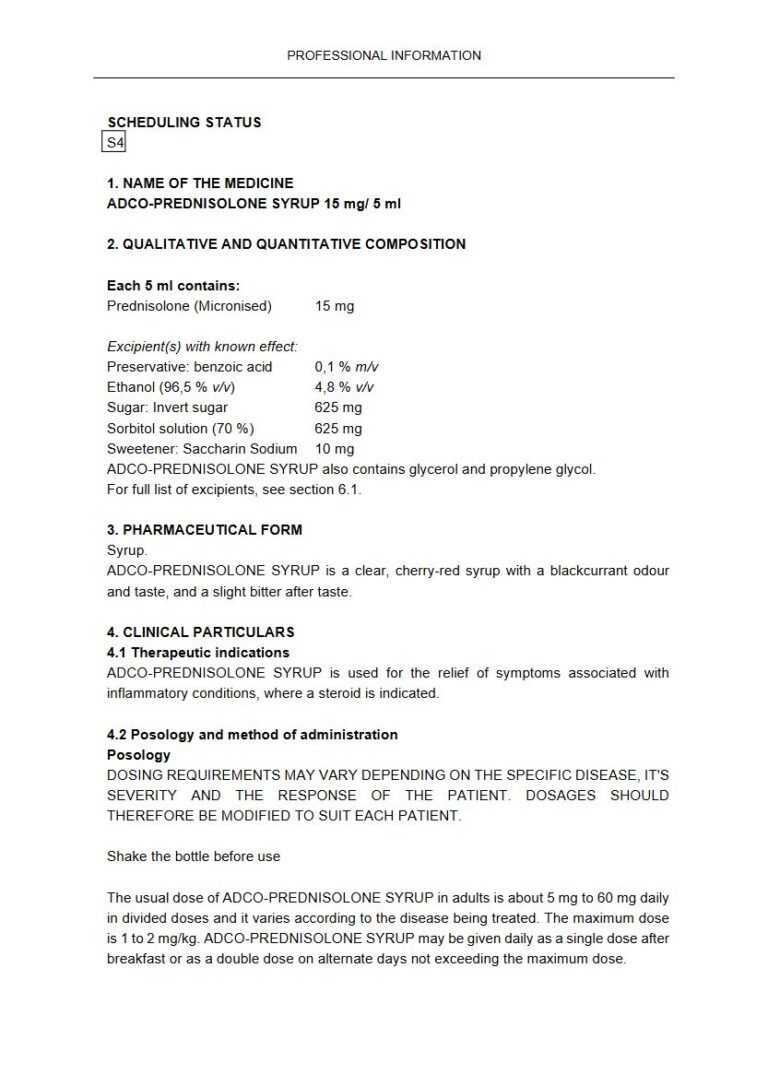
ADCO-PREDNISOLONE SYRUP is used for the relief of symptoms associated with inflammatory conditions, where a steroid is indicated.
4.2 Posology and method of administration
Posology
DOSING REQUIREMENTS MAY VARY DEPENDING ON THE SPECIFIC DISEASE, IT'S SEVERITY AND THE RESPONSE OF THE PATIENT. DOSAGES SHOULD THEREFORE BE MODIFIED TO SUIT EACH PATIENT.
Shake the bottle before use
The usual dose of ADCO-PREDNISOLONE SYRUP in adults is about 5 mg to 60 mg daily in divided doses and it varies according to the disease being treated. The maximum dose is 1 to 2 mg/kg. ADCO-PREDNISOLONE SYRUP may be given daily as a single dose after breakfast or as a double dose on alternate days not exceeding the maximum dose.
Some patients may require higher initial doses, whereas low doses should be sufficient in less severe situations. Careful adjustment of the initial dose may be required to obtain a satisfactory response and this dose should be maintained thereafter. Gradually discontinue the treatment if spontaneous remission occurs in a chronic condition.
Paediatric population
The usual paediatric daily dose of ADCO-PREDNISOLONE SYRUP is 0,5 mg to 2 mg per kg of body weight or 15 to 60 mg per square metre of body surface area in three divided doses.
Method of administration
For oral administration.
4.3 Contraindications
- Hypersensitivity to prednisolone, other corticosteroids or to any of the excipients of ADCO-PREDNISOLONE SYRUP (see section 6.1).
- ADCO-PREDNISOLONE SYRUP should not be used by pregnant or breastfeeding women (see section 4.6).
- ADCO-PREDNISOLONE SYRUP is contraindicated in patients with osteoporosis, oesophagitis, gastritis, peptic ulcer, acute psychosis or severe psychoneuroses.
- It should not be used in patients with systemic fungal infections, or in patients with uncontrolled, systemic, or local bacterial or viral infections.
- Patients with active or doubtfully latent tuberculosis should not be given ADCO-PREDNISOLONE SYRUP, except, very rarely, as adjuncts to anti-tubercular treatment.
- The presence of acute viral infections such as herpes zoster or ocular herpes simplex are contraindications to the use of ADCO-PREDNISOLONE SYRUP.
- Patients receiving high-dose ADCO-PREDNISOLONE SYRUP therapy should not be immunised with live vaccines for up to 3 months after steroid therapy.
4.4 Special warnings and precautions for use
Withdrawal
For patients who have received more than physiological doses of systemic corticosteroids, such as prednisolone as contained in ADCO-PREDNISOLONE SYRUP, (approximately 7,5 mg prednisolone or equivalent), for greater than three weeks, withdrawal should not be abrupt. How dose reduction should be carried out depends largely on whether the disease is likely to relapse as the dose of systemic corticosteroids, such as prednisolone as in ADCO-PREDNISOLONE SYRUP, is reduced. Clinical assessment of disease activity may be needed during withdrawal. If the disease is unlikely to relapse on withdrawal of systemic corticosteroids, such as prednisolone as in ADCO-PREDNISOLONE SYRUP, but there is uncertainty about HPA suppression, the dose of systemic corticosteroid, such as prednisolone as in ADCO-PREDNISOLONE SYRUP, may be reduced rapidly to physiological doses. Once a daily dose equivalent to 7,5 mg (2,5 ml) prednisolone, as contained in ADCO-PREDNISOLONE SYRUP, is reached, dose reduction should be slower to allow the HPA axis to recover.
Abrupt withdrawal of systemic corticosteroid treatment, such as prednisolone, as contained in ADCO-PREDNISOLONE SYRUP, which has continued up to three weeks, is appropriate if the disease is unlikely to relapse.
Abrupt withdrawal of doses of up to 40 mg daily of prednisolone, as contained in ADCO-PREDNISOLONE SYRUP, or equivalent for three weeks is unlikely to lead to clinically relevant HPA axis suppression, in the majority of patients.
In the following patient groups, gradual withdrawal of systemic corticosteroid therapy, such as ADCO-PREDNISOLONE SYRUP should be considered even after courses lasting three weeks or less:
- Patients who have had repeated courses of systemic corticosteroids, such as prednisolone as contained in ADCO-PREDNISOLONE SYRUP, particularly if taken for a duration greater than three weeks.
- When a short course has been prescribed within one year of cessation of long-term therapy (months or years).
- Patients who may have reasons for adrenocortical insufficiency other than exogenous corticosteroid therapy, been stopped following prolonged therapy they may need to be temporarily reintroduced.
- Patients receiving doses of systemic corticosteroids, greater than 40 mg daily of prednisolone, as contained in ADCO-PREDNISOLONE SYRUP (or equivalent).
- Patients repeatedly taking doses in the evening.
Adrenal cortical atrophy develops during prolonged therapy and may persist for years after stopping treatment. Withdrawal of corticosteroids, such as ADCO-PREDNISOLONE SYRUP, after prolonged therapy must therefore always be gradual to avoid acute adrenal insufficiency, being tapered off over weeks or months according to the dose and duration of treatment. During prolonged therapy any intercurrent illness, trauma or surgical procedure will require a temporary increase in dosage; if corticosteroids, such as ADCO-PREDNISOLONE SYRUP, have been stopped following prolonged therapy they may need to be temporarily re-introduced (see section 4.8).
Risk of bradycardia
Bradycardia is a rare but serious adverse effect of corticosteroids, such as prednisolone as contained in ADCO-PREDNISOLONE SYRUP, that may be both symptomatic and asymptomatic. It is most likely to occur with high doses of corticosteroids, such as prednisolone as contained in ADCO-PREDNISOLONE SYRUP; however, bradycardia can occur even with standard doses of oral corticosteroids, such as ADCO-PREDNISOLONE SYRUP. This is, however, reversible with dose reduction or discontinuation. Furthermore, patients with pre-existing cardiac or renal problems, or electrolyte imbalance, are at high risk of experiencing bradycardia (see section 4.8). The degree of risk may be increased by the concurrent use of other medicines that causes bradycardia as an adverse event.
Suppression of the HPA axis
Suppression of the HPA axis and other undesirable effects may be minimised by using the lowest effective dose for the minimum period and by administering the daily requirement as a single morning dose or whenever possible as a single morning dose on alternate days. Frequent patient review is required to appropriately titrate the dose against disease activity (see section 4.2).
Infections
Suppression of the inflammatory response and immune function increases the susceptibility to infections and the severity thereof. Patients treated with ADCO-PREDNISOLONE SYRUP may become more susceptible to all kinds of infections which include septicaemia, tuberculosis, fungal infections, and viral infections. The resultant opportunistic infections may be fatal. The clinical presentation may often be atypical: the anti-inflammatory, analgesic and antipyretic effects of ADCO-PREDNISOLONE SYRUP may mask the signs and symptoms of infection (see section 4.8) and serious infections may reach an advanced stage before being recognised.
Chickenpox
Chickenpox is of particular concern since this normally minor illness may be fatal in immunosuppressed patients. Patients without a definite history of chickenpox should be advised to avoid close personal contact with chickenpox or herpes zoster and if exposed they should seek urgent medical attention. If the patient is a child, parents must be given the above advice. Passive immunisation with varicella zoster immunoglobulin (VZIG) is needed by exposed non-immune patients who are receiving systemic corticosteroids, such as prednisolone as contained in ADCO-PREDNISOLONE SYRUP, or who have used them within the previous three months; this should be given within 10 days of exposure to chickenpox. If a diagnosis of chickenpox is confirmed, the illness warrants specialist care and urgent treatment. Corticosteroid treatment, such as prednisolone as contained in ADCO-PREDNISOLONE SYRUP, should not be stopped and the dose may need to be increased.
Measles exposure
Patients should be advised to take particular care to avoid exposure to measles and to seek immediate advice if exposure occurs. Prophylaxis with intramuscular normal immunoglobulin may be required.
Live vaccines
Live vaccines should not be given to individuals with impaired immune responsiveness caused by high doses of corticosteroids, such as prednisolone as contained in ADCO-PREDNISOLONE SYRUP. The antibody response to other vaccines may be diminished (see section 4.3).
4.5 Interactions with other medicines
High doses of corticosteroids, such as prednisolone as contained in ADCO-PREDNISOLONE SYRUP, impairs the immune response; therefore, live vaccines should be avoided (see also sections 4.3 and 4.4). Co-treatment with CYP3A inhibitors, including cobicistat-containing medicines, is expected to increase the risk of systemic side effects. The combination should be avoided unless the benefit outweighs the increased risk of systemic corticosteroid, such as prednisolone as contained in ADCO-PREDNISOLONE SYRUP, side effects, in which case patients should be monitored for systemic corticosteroid side effects.
Concurrent use of barbiturates, phenytoin, carbamazepine, primidone, rifampicin, rifabutin, phenobarbitone, immunosuppressants, ephedrine or aminoglutethimide may lead to an increased metabolism and reduced effect of corticosteroids, such as prednisolone as contained in ADCO-PREDNISOLONE SYRUP.
Mifepristone may reduce the effect of corticosteroids, such as prednisolone as contained in ADCO-PREDNISOLONE SYRUP, for 3 to 4 days.
Erythromycin and ketoconazole may inhibit the metabolism of some corticosteroids, such as prednisolone as contained in ADCO-PREDNISOLONE SYRUP.
Ciclosporin increases plasma concentration of prednisolone, as contained in ADCO-PREDNISOLONE SYRUP.
Plasma levels of corticosteroids may be elevated by ritonavir.
Estrogens and other oral contraceptives may potentiate the effects of glucocorticoids, such as prednisolone as contained in ADCO-PREDNISOLONE SYRUP, and dosage adjustments may be required if oral contraceptives are added to or withdrawn from a stable dosage regimen. Plasma levels of corticosteroids, such as prednisolone as contained in ADCO-PREDNISOLONE SYRUP, may be elevated by oral contraceptives.
Hypokalaemia may result from concurrent administration with potassium-depleting diuretics such as the thiazides or furosemide or bronchodilator therapy with xanthines or beta 2 agonists. The hypokalaemic effects of acetazolamide, loop diuretics and carbenoxolone are enhanced by corticosteroids, such as prednisolone as contained in ADCO-PREDNISOLONE SYRUP. The risk of hypokalaemia is increased with theophylline and amphotericin. Corticosteroids, such as ADCO-PREDNISOLONE SYRUP, should not be given concurrently with amphotericin, unless required to control reactions.
The risk of hypokalaemia also increases if high doses of corticosteroids, such as prednisolone as contained in ADCO-PREDNISOLONE SYRUP, are given with high doses of bambuterol, fenoterol, formoterol, ritodrine, salbutamol, salmeterol and terbutaline.
The toxicity of cardiac glycosides is increased if hypokalaemia occurs with corticosteroids, such as prednisolone as contained in ADCO-PREDNISOLONE SYRUP.
Concomitant use of aspirin and Non-Steroidal Anti-Inflammatory Drugs (NSAIDs) with corticosteroids, such as prednisolone as contained in ADCO-PREDNISOLONE SYRUP, may cause an increased incidence of gastrointestinal bleeding and ulceration. The renal clearance of salicylates is increased by corticosteroids, such as prednisolone as contained in ADCO-PREDNISOLONE SYRUP and treatment withdrawal may result in salicylate intoxication. Serum concentrations of salicylates may be reduced.
Corticosteroids, such as prednisolone as contained in ADCO-PREDNISOLONE, increases the requirements for antidiabetic or antihypertensive medicines (see section 4.4). The desired effects of hypoglycaemic medicines (including insulin), antihypertensives and diuretics are antagonised by corticosteroids, such as prednisolone as contained in ADCO-PREDNISOLONE SYRUP. The efficacy of coumarin anticoagulants and warfarin may be enhanced by concurrent corticosteroid therapy, such as prednisolone as contained in ADCO-PREDNISOLONE SYRUP, and close monitoring of the INR or prothrombin time is required to avoid spontaneous bleeding. The growth promoting effect of somatotropin may be inhibited by the concurrent use of corticosteroids, such as prednisolone as contained in ADCO-PREDNISOLONE SYRUP. Corticosteroids, such as prednisolone as contained in ADCO-PREDNISOLONE SYRUP, may lead to a reduced effect of anticholinesterases or antimuscarinics in the treatment of myasthenia gravis and cholecystographic x-ray media. Concurrent use with methotrexate may increase the risk of haematological toxicity.
4.6 Fertility, pregnancy and lactation
Pregnancy
The use of ADCO-PREDNISOLONE SYRUP is contraindicated in pregnancy (see section 4.3). The ability of corticosteroids to cross the placenta varies between individual medicines; however, 88 % of prednisolone, as contained in ADCO-PREDNISOLONE SYRUP, is inactivated as it crosses the placenta. Administration of corticosteroids, such as prednisolone as contained in ADCO-PREDNISOLONE SYRUP, to pregnant animals can cause abnormalities of foetal development including cleft palate, intra-uterine growth retardation and effects on brain growth and development. There is no evidence that corticosteroids, such as prednisolone as contained in ADCO-PREDNISOLONE SYRUP, result in an increased incidence of congenital abnormalities, such as cleft palate / lip. However, when administered for prolonged periods or repeatedly during pregnancy, corticosteroids, such as prednisolone as contained in ADCO-PREDNISOLONE SYRUP, may increase the risk of intrauterine growth retardation. Hypoadrenalism may, in theory, occur in the neonate following prenatal exposure to corticosteroids, such as prednisolone as contained in ADCO-PREDNISOLONE SYRUP, but usually resolves spontaneously following birth and is rarely clinically important. Depression of hormone levels has been described in pregnancy but the significance of this finding is not clear. Cataracts have been reported in infants born to mothers treated with long-term prednisolone, as contained in ADCO-PREDNISOLONE SYRUP, during pregnancy.
Breastfeeding
The use of ADCO - PREDNISOLONE SYRUP is contraindicated during lactation (see section 4.3). Corticosteroids, such as prednisolone as contained in ADCO-PREDNISOLONE SYRUP, are distributed into breast milk and may cause unwanted effects such as growth suppression and inhibition of endogenous steroid production in the infant.
Fertility
Corticosteroids, such as prednisolone as contained in ADCO-PREDNISOLONE SYRUP, may cause irregular menstruation or amenorrhoea.
4.7 Effects on ability to drive and use machines
ADCO-PREDNISOLONE SYRUP has no or negligible influence on the ability to drive or operate machinery. However, since adverse reactions such as dizziness, headache and blurred vision have been reported, patients should not drive, use machinery or perform any tasks that require concentration until they are certain that ADCO-PREDNISOLONE SYRUP does not adversely affect their ability to do so (see sections 4.4 and 4.8).
4.8 Undesirable effects
Summary of the safety profile
The incidence of predictable undesirable effects, including hypothalamo-pituitary-adrenal (HPA) suppression, correlates with the relative potency of the medicine, dosage, timing of administration and the duration of treatment (see section 4.4). The following side effects may be associated with the long-term systemic use of corticosteroids, such as prednisolone as contained in ADCO-PREDNISOLONE SYRUP:
Tabulated list of adverse reactions
System Organ Class
Frequent
Less frequent
Frequency not known
Infections and infestations
Septicaemia, tuberculosis, fungal infections, viral infections, increased susceptibility and severity of infections with suppression of clinical symptoms and signs, opportunistic infections, recurrence of dormant tuberculosis, may mask the signs and symptoms of infection (see section 4.4).
Neoplasms
Kaposi's sarcoma.
benign, malignant and unspecified (including cysts and polyps)
Blood and the lymphatic system disorders
Leukocytosis.
Immune system disorders
Hypersensitivity including anaphylaxis.
Endocrine disorders
Cushingoid manifestations, suppression of the HPA axis, impaired carbohydrate intolerance, manifestation of latent diabetes mellitus, acute adrenal insufficiency may result from rapid withdrawal after prolonged therapy.
Metabolism and nutrition disorders
Increased appetite. Hyperglycaemia with accentuation or precipitation of the diabetic state, diabetic patients may require more insulin. Sodium and water retention, with oedema, disturbances in electrolyte balance and hypokalaemic alkalosis resulting from increased excretion of potassium, negative protein and calcium balance.
Psychiatric disorders
Mental disturbances. Euphoric mood, psychological dependence, depressed mood, insomnia, aggravation of schizophrenia.
Nervous system disorders
Neurological disturbances, dizziness, headache, aggravation of epilepsy.
Eye disorders
Ocular changes involving glaucoma and cataracts, papilloedema, posterior subcapsular cataracts, central serous chorioretinopathy, exophthalmos, corneal or scleral thinning, exacerbation of ophthalmic viral or fungal diseases, blurred vision.
Ear and labyrinth disorders
Vertigo.
Cardiac disorders
Myocardial rupture following recent myocardial infarction, congestive cardiac failure (in susceptible patients), bradycardia (following high doses).
Vascular disorders
Thromboembolic complications, benign intra-cranial hypertension, hypertension, embolism.
Respiratory, thoracic and mediastinal disorders
Hiccups.
Gastrointestinal disorders
Acute pancreatitis, dyspepsia, nausea, vomiting, abdominal distension, abdominal pain, diarrhoea, oesophageal ulceration, candidiasis, peptic ulceration with perforation and haemorrhage.
Skin and subcutaneous tissue disorders
Hyperhidrosis. Skin thinning, skin atrophy, skin striae, acne, telangiectasia, rash, pruritus, urticaria, hirsutism.
Musculoskeletal and connective tissue disorders
Osteoporosis, spontaneous fractures. Aseptic necrosis of the bone. Myopathy, muscular weakness, vertebral and long bone fractures, myalgia, tendon rupture, contusion (bruising).
Renal and urinary disorders
Scleroderma renal crisis.
Reproductive system and breast disorders
Menstrual irregularities, amenorrhoea.
General disorders and administrative site conditions
Growth retardation in children, impaired healing, malaise, delayed wound healing.
Investigations
Nitrogen depletion, weight increased.
Description of selected adverse reactions
Neoplasms benign, malignant and unspecified (including cysts and polyps): Kaposi's sarcoma has been reported to occur in patients receiving corticosteroids, such as prednisolone as contained in ADCO-PREDNISOLONE SYRUP. Discontinuation of ADCO-PREDNISOLONE SYRUP may result in clinical remission.
Endocrine disorders: Large doses of prednisolone, as contained in ADCO-PREDNISOLONE SYRUP, may produce symptoms typical of hyperactivity of the adrenal cortex, with moon-face, sometimes hirsutism, buffalo hump, flushing, increased bruising, acne, striae, hypertension, hypokalaemia, glycosuria, gastric discomfort and mental disturbances, and sometimes leading to a fully developed Cushing's syndrome.
Metabolism and nutrition disorders: Hyperglycaemia may occur with accentuation or precipitation of the diabetic state. Diabetic patients may also require more insulin.
Psychiatric disorders: A wide range of psychiatric reactions including affective disorders (such as irritable, euphoric, depressed and labile mood and suicidal thoughts), psychotic reactions (including mania, delusions, hallucinations and aggravation of schizophrenia), behavioural disturbances, irritability, anxiety, sleep disturbances, and cognitive dysfunction including confusion and amnesia have been reported. Reactions are common and may occur in both adults and children. In adults, the frequency of severe reactions has been estimated to be 5 to 6 %. Psychological effects have been reported on withdrawal of corticosteroids, such as prednisolone as contained in ADCO-PREDNISOLONE SYRUP; however, the frequency is unknown.
Scleroderma renal crisis: Amongst the different sub-populations the occurrence of scleroderma renal crisis is variable. The highest risk has been reported in patients with diffuse systemic sclerosis. The lowest risk has been reported in patients with limited systemic sclerosis (2 %) and juvenile onset systemic sclerosis (1 %) (see section 4.4).
Withdrawal Symptoms
ADCO-PREDNISOLONE SYRUP should be gradually discontinued after prolonged therapy as rapid withdrawal may cause acute adrenal insufficiency. Too rapid a reduction of corticosteroid, such as prednisolone as contained in ADCO-PREDNISOLONE SYRUP, dosage following prolonged treatment can lead to acute adrenal insufficiency, hypotension and death (see section 4.4). A 'withdrawal syndrome' may also occur including fever, myalgia, arthralgia, rhinitis, conjunctivitis, painful itchy skin nodules and loss of weight. In some instances, withdrawal symptoms may involve or resemble a clinical relapse of the disease for which the patient has been undergoing treatment. Other effects that may occur during withdrawal or change of corticosteroid, such as prednisolone as contained in ADCO-PREDNISOLONE SYRUP, therapy include benign intracranial hypertension with headache, vomiting and papilloedema caused by cerebral oedema. Latent rhinitis or eczema may be unmasked.
Paediatric population
Increased intracranial pressure with papilloedema in children (pseudotumour cerebri) usually after treatment withdrawal, and growth retardation in infancy, childhood and adolescence have been reported (see section 4.4).
Reporting of suspected adverse reactions
Reporting suspected adverse reactions after authorisation of the medicine is important. It allows continued monitoring of the benefit/risk balance of the medicine. Health care providers are requested to report any suspected adverse drug reactions to SAHPRA via the Med Safety APP (Medsafety X SAHPRA) and eReporting platform (who-umc.org) found on SAHPRA website. Reporting can also be done directly to Adcock Ingram Limited at [email protected].
4.9 Overdose
Symptoms
For symptoms of overdosage please see section 4.8.
Treatment
Treatment is symptomatic and supportive. Treatment is unlikely to be needed in cases of acute overdosage. Serum electrolytes should be monitored. High systemic doses of corticosteroids, such as prednisolone as contained in ADCO-PREDNISOLONE SYRUP, caused by chronic use, have been associated with adverse events such as neuropsychiatric disorders (psychosis, depression, hallucinations), cardiac dysrhythmias and Cushing's syndrome.
