
Be-Tabs Prednisone 5mg Tablet
Clinical Summary
Quick overview from the medicine insert
Indication
Prednisone is indicated for the treatment of various inflammatory and autoimmune conditions, including but not limited to asthma, rheumatoid arthritis, and allergic reactions.
Dosage (summary)
The typical starting dose for adults is 5 to 60 mg per day, depending on the condition being treated. Dosage may be adjusted based on clinical response.
Onset of Action / Duration
Onset of action is usually within 1 to 2 hours, with peak effects occurring within 6 to 12 hours.
Special Populations
- Elderly patients may require dose adjustments due to increased sensitivity.
- Patients with hepatic impairment may require dose adjustments.
- Patients with renal impairment may require dose adjustments.
Pregnancy & Breastfeeding
Prednisone is classified as Category C. It should be used during pregnancy only if the potential benefit justifies the potential risk to the fetus. It is excreted in breast milk; caution is advised when administered to nursing mothers.
Key Drug Interactions
- Nonsteroidal anti-inflammatory drugs (NSAIDs) may increase the risk of gastrointestinal side effects.
- Anticoagulants may have altered effects when used with prednisone.
- Certain vaccines may be less effective when administered concurrently with prednisone.
Contraindications
- Systemic fungal infections.
- Hypersensitivity to prednisone or any component of the formulation.
- Live vaccines should not be administered to patients receiving immunosuppressive doses of prednisone.
Common side effects
- Increased appetite.
- Weight gain.
- Insomnia.
- Mood changes.
- Gastrointestinal disturbances.
- Increased risk of infections.
Counselling Points
- Take the medication exactly as prescribed and do not discontinue abruptly without consulting a healthcare provider.
- Monitor for signs of infection and report any unusual symptoms.
- Maintain a balanced diet to help manage weight gain.
- Discuss any other medications being taken to avoid potential interactions.
Serious warnings
- Long-term use may lead to adrenal suppression; tapering is recommended.
- Use with caution in patients with a history of peptic ulcer disease.
- Monitor blood glucose levels in diabetic patients, as prednisone can cause hyperglycemia.
Important Disclaimer
The Be-Tabs Prednisone 5mg Tablet professional information leaflet below is the property of Ranbaxy Pharmaceuticals and is provided on Medinsert exactly as issued, with no.. alterations or editorial changes. We make every effort to keep content current by updating documents as soon as new versions become available. Medinsert serves as a trusted access point for healthcare professionals, but does not replace official sources or clinical judgement. For more details, please read our full disclaimer. read more>>
 Healthcare Professionals Only
This content is for registered healthcare professionals
Sign in or create a free account to read the full package insert.
Free for HPCSA-registered professionals. Powered by Medinsert.
Clinical Particulars
Section 4 of the official insert — extracted exactly as issued, no alterations
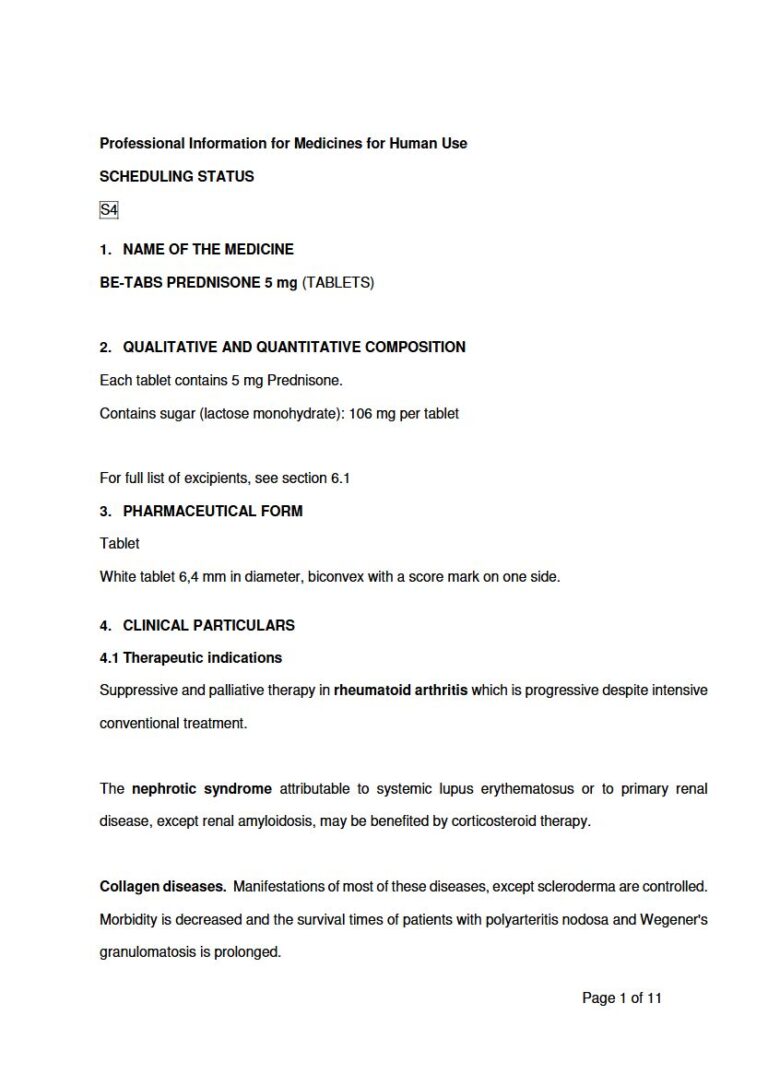
4.1 Therapeutic indications
Suppressive and palliative therapy in rheumatoid arthritis which is progressive despite intensive conventional treatment. The nephrotic syndrome attributable to systemic lupus erythematosus or to primary renal disease, except renal amyloidosis, may be benefited by corticosteroid therapy. Collagen diseases. Manifestations of most of these diseases, except scleroderma are controlled. Morbidity is decreased and the survival times of patients with polyarteritis nodosa and Wegener's granulomatosis is prolonged.
Fulminating systemic lupus erythematosus is a life-threatening condition the manifestations of which should be promptly suppressed with large doses. Manifestations of allergic conditions which do not react to anti-histaminic treatment may be suppressed by adequate doses or as a supplement to primary therapy. However, severe reactions such as anaphylaxis require immediate adrenalin subcutaneously. Bronchial asthma. Acute, or severe chronic asthma, uncontrolled by other measures. Acute skin diseases and exacerbations of chronic skin diseases. Severely ill patients with chronic ulcerative colitis. Thrombocytopenia: To decrease the bleeding tendency. Organ transplantations.
4.2 Posology and method of administration
1. The dose must be determined individually by the seriousness of the disease and the reaction of the patient.
2. Administration of large doses for short courses cause less side effects than long-term therapy with small doses. Long courses of therapy at high dosage should be reserved for life-threatening diseases.
3. In long-term therapy the dose must be the smallest one to achieve a desired effect. Complete relief is not sought.
Rheumatoid arthritis: The initial dose should be small, usually about 10 mg and increase slowly until the desired degree of control is attained.
Nephrotic syndrome: 60 mg Daily in divided doses (2 mg/kg oedema-free body mass in children) for 3 to 4 weeks. If a remission with a diuresis and decreased proteinuria occurs during this period, maintenance treatment is continued for as long as a year. For this the daily dose of prednisone is given only for the first 3 days of each week.
Collagen disease: 1 mg/kg daily until remission is induced. The dose is then reduced to the minimal effective level.
Fulminating systemic lupus erythematosus: 1 mg/kg daily which may be increased in 20 mg increment daily until a favourable response occurs. After control has been obtained, dosage should be reduced by small steps of 5 mg prednisone per week until further reductions elucidate symptoms.
Bronchial asthma: In status asthmaticus the attack is brought under control by intravenous cortisol whereafter 10 mg prednisone is given for 4 to 5 days. The dose is then reduced in steps to be withdrawn 10 days after initiation of prednisone therapy.
Severe chronic bronchial asthma: To reduce severity without eliminating the manifestations of the disease, 5 to 10 mg daily in divided doses in combination with the usual medication.
Skin diseases: 40 mg per day. Up to 120 mg per day may be life-saving in pemphigus.
Chronic ulcerative colitis: 60 to 120 mg per day.
Thrombocytopenia: 0,5 mg/kg.
Organ transplantation: 50 to 100 mg at the time of surgery. Maintenance doses of 10 to 20 mg per day are continued indefinitely and the dosage increased if rejection is threatened. The dosage should be reduced and therapy discontinued gradually if therapy is continued for more than a few days. Abrupt cessation of prolonged, high dosage therapy may produce adrenal insufficiency or sufficient severity to be threatening to life.
4.3 Contraindications
- Known hypersensitivity to prednisone or to any of the excipients of BE-TABS PREDNISONE 5 mg (see section 6.1)
- Liver disease
- Peptic ulcer
- Osteoporosis
- Phychosis or severe phychoneurosis
- Because of interference with antibody formation, systemic administration is usually contra- indicated in the presence of acute bacterial and viral infections.
4.4 Special warnings and precautions for use
Corticosteroids should be used only with great caution in the presence of congestive heart failure, in patients with diabetes mellitus, infectious diseases, chronic renal failure, and uraemia, and in elderly persons. Patients with active or doubtfully quiescent tuberculosis should not be given these hormones except as adjuncts to treatment with tuberculostatic drugs. Patients with quiescent tuberculosis should be observed closely and should receive chemoprophylaxis if corticosteroid therapy is prolonged.
Acute adrenal insufficiency may occur during prolonged treatment or on cessation of treatment and may be precipitated by an infection or stressful situation such as anaesthesia, surgery or trauma. Patients under stress should therefore receive supplementary corticosteroids if they were given corticosteroids in the previous 3 months or high prolonged doses in the previous year.
Infections may be masked. A reduction in the number of circulating lymphocytes may occur. Immunisation procedures should not be undertaken in patients receiving corticosteroids. Caution must be observed in ulcerative colitis if a possibility exists of intestinal perforation and peritonitis. Bradycardia has been reported following high doses. Pheochromocytoma-related crisis, which may be fatal, has been reported following systemic corticosteroid administration. Corticosteroids should only be administered to patients with suspected or identified pheochromocytoma following consideration of individual risk / benefit.
In post marketing experience tumour lysis syndrome (TLS) has been reported in patients with malignancies, including haematological malignancies and solid tumours, following the use of systemic corticosteroids alone, including BE-TABS PREDNISONE 5 mg, or in combination with other chemotherapeutic medicines. Patients at high risk of TLS, such as patients with tumours that have a high proliferative rate, high tumour burden and high sensitivity to cytotoxic medicines, should be monitored closely and appropriate precautions should be taken.
BE-TABS PREDNISONE 5 mg contains lactose monohydrate. Patients with rare hereditary problems of galactose intolerance, total lactase deficiency or glucose-galactose malabsorption should not take this medicine. BE-TABS PREDNISONE 5 mg contains less than 1 mmol sodium (23 mg) per tablet, that is to say essentially 'sodium-free'.
4.5 Interaction with other medicines and other forms of interaction
Concurrent administration of barbiturates, phenylbutazone, phenytoin, or rifampicin may enhance the metabolism and reduce the effects of corticosteroids. Response to anticoagulants may also be reduced by corticosteroids.
4.6 Fertility, pregnancy and lactation
Babies born of mothers who received large doses corticosteroids during pregnancy should be watched carefully for signs of hypoadrenalism. Corticosteroids appear in breast milk and mothers receiving corticosteroids should be advised not to breast feed.
4.7 Effects on ability to drive and use machines
The effect of prednisolone on the ability to drive or use machinery has not been evaluated. There is no evidence to suggest that prednisolone may affect these abilities.
4.8 Undesirable effects
System Organ Class Frequency Adverse Reaction
Blood and lymphatic system disorders Not known An increase in the coagulability of the blood may lead to thrombo-embolic complications.
Metabolism and nutrition disorders Not known Retention of sodium and water, with oedema and hypertension; increased excretion of potassium with the possibility of hyperkalaemic alkalosis, and in extreme cases cardiac failure may be induced. Patients receiving diuretics which cause potassium depletion should be watched carefully for signs of hypokalaemia. Excessive metabolic effects which lead to mobilisation of Calcium and phosphorous, with osteoporosis and spontaneous fractures, nitrogen depletion, and hyperglycaemia with accentuation or precipitation of the diabetic state. Insulin requirements of diabetic patients are increased. Increased appetite.
Nervous system disorders Not known Mental and neurological disturbances, Intracranial hypertension
Cardiac disorders Not known Bradycardia.
Gastrointestinal disorders Not known There may be peptic ulceration with haemorrhage and perforation.
Reproductive system and breast disorders Not known Amenorrhoea
General disorders and administration site conditions Not known An effect on tissue repair which is manifest in delayed wound healing and increased liability to infection.
Endocrine disorders Not known Pheochromocytoma-related crisis (see section 4.4)
Following high doses. On sudden reduction of dosage during the treatment of rheumatoid arthritis, fatalities have been attributed to lesions of small arterioles similar to polyarteritis.
Reporting of suspected adverse reactions: Reporting suspected adverse reactions after authorisation of the medicine is important. It allows continued monitoring of the benefit/risk balance of the medicine. Health care providers are asked to report any suspected adverse reactions to SAHPRA via the u201c6.04 Adverse Drug Reaction Reporting formu201d, found online under SAHPRAu2019s publications: https://www.sahpra.org.za/Publications/index/8
4.9 Overdose
Reports of acute toxicity and/or death following overdosage of glucocorticoids are rare. No specific antidote is available; treatment is supportive and symptomatic. Serum electrolytes should be monitored. High systemic doses of corticosteroids caused by chronic use have been associated with adverse effects such as neuropsychiatric disorders (psychosis, depression, and hallucinations), cardiac dysrhythmias and Cushing's syndrome.
