
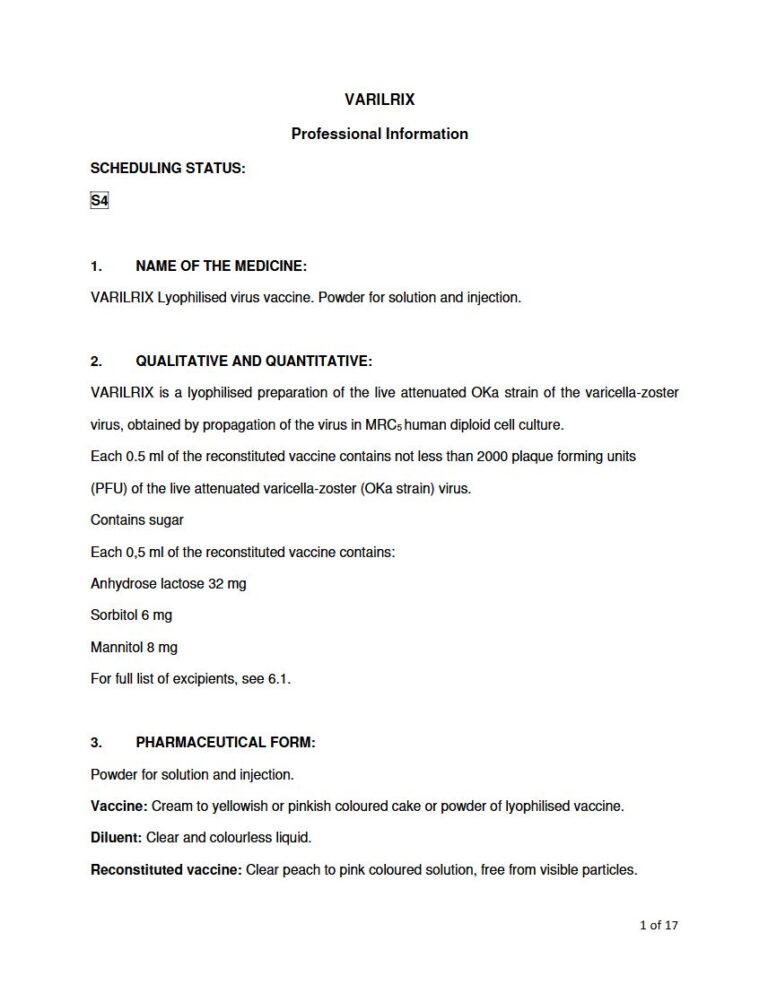
Varilrix 0.5 ml Powder for solution and injection.
PDF Leaflet Revision Date: 21 June 2021
Clinical Summary
Quick overview from the medicine insert
Indication
Active immunisation against varicella in healthy infants, children, adolescents, and high-risk patients.
Dosage (summary)
0.5 ml for healthy subjects; 2 doses for ages 9 months to 12 years and for 13 years and above, with a minimum interval of 4 weeks.
Special Populations
- Immunocompromised patients
- Patients with chronic diseases
- High-risk patients
Pregnancy & Breastfeeding
Contraindicated in pregnancy; avoid pregnancy for 1 month post-immunisation; not advised during breastfeeding.
Key Drug Interactions
- Avoid salicylates for 6 weeks post-vaccination
- Delay vaccination after immune globulin or blood transfusion for 3 months
Contraindications
- Severe immunodeficiency
- Hypersensitivity to neomycin or components
- Pregnancy
Common side effects
- Pain at injection site
- Fever
- Rash
- Lymphadenopathy
Counselling Points
- Inform about potential mild varicella breakthrough cases
- Advise on injection site care
- Discuss the importance of completing the vaccination schedule
Serious warnings
- Postpone in acute severe febrile illness
- Monitor for anaphylactic reactions
- Avoid contact with immunocompromised individuals for 14 days post-vaccination
Important Disclaimer
The Varilrix 0.5 ml Powder for solution and injection. professional information leaflet below is the property of Glaxosmithkline South Africa and is provided on Medinsert exactly as issued, with no.. alterations or editorial changes. We make every effort to keep content current by updating documents as soon as new versions become available. Medinsert serves as a trusted access point for healthcare professionals, but does not replace official sources or clinical judgement. For more details, please read our full disclaimer. read more>>
 Healthcare Professionals Only
This content is for registered healthcare professionals
Sign in or create a free account to read the full package insert.
Free for HPCSA-registered professionals. Powered by Medinsert.
Clinical Particulars
Section 4 of the official insert — extracted exactly as issued, no alterations
4.1 Therapeutic Indications
Healthy subjects: VARILRIX is indicated for active immunisation against varicella of healthy infants (from the age of 9 months), children and adolescents.
High-risk patients and healthy close contacts: VARILRIX is also indicated for active immunisation against varicella of susceptible high-risk patients and their susceptible healthy close contacts.
Patients with acute leukaemia: Patients suffering from leukaemia have been recognised to be at special risk when they develop varicella and should therefore receive the vaccine if they have no history of the disease or are found to be seronegative. When immunising patients in the acute phase of leukaemia: Maintenance chemotherapy should be withheld one week before and one week after immunisation. Patients under radiotherapy should normally not be immunised during the treatment phase.
Patients under immunosuppressive treatment: Patients under immunosuppressive treatment (including corticosteroid therapy) for malignant solid tumours or for serious chronic diseases (such as chronic renal failure, auto-immune diseases, collagen diseases, severe bronchial asthma) are predisposed to severe varicella. Generally, patients are immunised when they are in complete haematological remission from the disease. It is advised that the total lymphocyte count should be at least 1 200/mm 3 or no other evidence of lack of cellular immune competence exists.
Patients with planned organ transplantation: If organ transplantation (e.g. kidney transplant) is being considered, immunisation should be carried out a few weeks before the administration of the immunosuppressive treatment.
Patients with chronic diseases: Other chronic diseases, such as metabolic and endocrine disorders, chronic pulmonary and cardiovascular diseases, mucoviscidosis and neuromuscular abnormalities may also predispose to severe varicella.
Healthy close contacts: Susceptible healthy close contacts should be immunised in order to reduce the risk of transmission of the virus to high-risk patients. These include parents and siblings of high-risk patients and medical, paramedical personnel and other people who are in close contact with varicella patients or high-risk patients.
4.2 Posology and method of administration
Posology 0.5 ml of reconstituted vaccine contains one immunising dose.
Healthy Subjects:
- Children 9 months up to and including 12 years of age: Children from the age of 9 months up to and including 12 years of age should receive 2 doses of VARILRIX to ensure optimal protection against varicella. It is preferable to administer the second dose at least 6 weeks after the first dose but in no circumstances less than 4 weeks.
- Adolescents and adults from 13 years of age and above: From 13 years of age and above: 2 doses. It is preferable to administer the second dose at least 6 weeks after the first dose but in no circumstances less than 4 weeks.
- High risk patients: In high risk patients additional doses of vaccine might be required.
Interchangeability:
- A single dose of VARILRIX may be administered to those who have already received a single dose of another varicella-containing vaccine.
- A single dose of VARILRIX may be administered followed by a single dose of another varicella-containing vaccine.
Method of administration: VARILRIX is to be injected subcutaneously (SC) or intramuscularly (IM) in the deltoid region or in the anterolateral area of the thigh. VARILRIX should not be administered intradermally. VARILRIX should be administered subcutaneously in subjects with bleeding disorders (e.g. thrombocytopenia or any coagulation disorder). Note: VARILRIX must under no circumstances be administered intravenously.
Use and handling: The diluent and the reconstituted vaccine should be inspected visually for any foreign particulate matter and/or variation of physical aspect prior to reconstitution or administration. In the event of either being observed, do not use the diluent or the reconstituted vaccine. VARILRIX must be reconstituted by adding the contents of the supplied container of diluent to the vial containing the powder. The mixture should be well shaken until the powder is completely dissolved in the diluent. Due to minor variations of its pH, the colour of the reconstituted vaccine may vary from clear peach to pink coloured solution.
4.3 Contraindications
VARILRIX is contra-indicated in subjects with severe humoral or cellular immunodeficiency such as:
- subjects with primary or acquired immunodeficiency states, with a total lymphocyte count less than 1 200 per mm 3
- subjects presenting other evidence of lack of cellular immune competence (e.g. subjects with leukaemias, lymphomas, blood dyscrasias, clinically manifest HIV infection subjects receiving immunosuppressive therapy, including high dose corticosteroids (see section 4.4).
VARILRIX is contra-indicated in subjects with known hypersensitivity to neomycin, or to any component of the vaccine. A history of contact dermatitis to neomycin is not a contra-indication.
VARILRIX is contra-indicated in pregnant women. Pregnancy should be avoided for one month after immunisation (see section 4.6).
In high-risk patients, VARILRIX should not be administered at the same time as other live attenuated vaccines. Inactivated vaccines may be administered in any temporal relationship to VARILRIX, given that no specific contra-indication has been established.
4.4 Special warnings and precautions for use
The administration of VARILRIX should be postponed in patients suffering from acute severe febrile illness. In healthy subjects, the presence of minor infection, however, is not a contra-indication for immunisation.
Syncope (fainting) can occur following, or even before, any vaccination as a psychogenic response to the needle injection. It is important that procedures are in place to avoid injury from faints.
Alcohol and other disinfecting agents must be allowed to evaporate from the skin before injection of the vaccine since they can inactivate the attenuated viruses in the vaccine.
Limited protection against varicella may be obtained by vaccination up to 72 hours after exposure to natural disease.
As with any vaccine, a protective immune response may not be elicited in all vaccinees. As for other varicella vaccines, cases of varicella disease have been shown to occur in persons who have previously received VARILRIX. These breakthrough cases are usually mild, with a fewer number of lesions and less fever as compared to cases in unvaccinated individuals.
Transmission of the Oka vaccine virus has been shown to occur at a very low rate in seronegative contacts of vaccinees with rash. Transmission of the Oka vaccine from a vaccinee who does not develop a rash to seronegative contacts cannot be excluded.
It is advised that contact of vaccinees with persons who may be immunocompromised due to HIV infection or other immunodeficiency should be avoided for at least 14 days post immunisation.
There is limited data on the use of VARILRIX in immunocompromised subjects, therefore vaccination should be considered with caution and only when, in the opinion of the physician, the benefits outweigh the risks. Immunocompromised subjects who have no contra-indication for this vaccination (see section 4.3) may not respond as well as immunocompetent subjects, therefore some of these subjects may acquire varicella despite appropriate vaccine administration. Immunocompromised subjects should be monitored carefully for signs of varicella.
Very few reports exist on disseminated varicella with internal organ involvement following vaccination with Oka varicella vaccine strain mainly in immunocompromised subjects.
In high-risk patients VARILRIX should not be administered at the same time as other live attenuated vaccines. VARILRIX must not be administered intravascularly or intradermally.
Appropriate medical treatment should always be readily available including adrenaline in case of rare anaphylactic reactions following administration of the vaccine. For this reason, the vaccinee should remain under medical supervision for 30 minutes after immunisation.
It must be expected that the reactogenicity following co-administration of VARILRIX and more reactogenic vaccines will be determined by the reactions of the latter.
Excipient Warnings: VARILRIX contains lactose. Patients with rare hereditary problems of galactose intolerance, the Lapp lactase deficiency or glucose-galactose malabsorption should not be given VARILRIX (see section 6.1). VARILRIX contains traces of neomycin. VARILRIX should not be used in patients with a known hypersensitivity to this antibiotic.
4.5 Interactions with other medicines and other forms of interaction
If tuberculin testing has to be done it should be carried out before or simultaneously with vaccination since it has been reported that live viral vaccines may cause a temporary depression of tuberculin skin sensitivity. As this anergy may last up to a maximum of 6 weeks, tuberculin testing should not be performed within that period after vaccination to avoid false negative results.
In subjects who have received immune globulin or a blood transfusion, immunisation should be delayed for at least three months because of likelihood of vaccine failure to passively acquired varicella antibodies.
Salicylates should be avoided for 6 weeks after varicella vaccination, as Reyeu2019s syndrome has been reported following the use of salicylates during natural varicella infection.
Healthy subjects: VARILRIX can be administered at the same time as any other vaccines. Different injectable vaccines should always be administered at different injection sites.
Should a measles containing vaccine not be given at the same time as VARILRIX, it is recommended that an interval of at least one month should be respected, since it is recognised that measles vaccination may lead to short lived suppression of the cell-mediated immune response.
High-risk patients: VARILRIX should not be administered at the same time as other live attenuated vaccines. Inactivated vaccines may be administered in any temporal relationship to VARILRIX, given that no specific contra-indication has been established. However, different injectable vaccines should always be administered at different injection sites (see section 4.3).
4.6 Fertility, pregnancy and lactation
Pregnancy: VARILRIX is contra-indicated during pregnancy. Pregnant women must not be vaccinated with VARILRIX. Pregnancy should be avoided for one month after immunisation (see section 4.3). Women who intend to become pregnant should be advised to delay pregnancy. Adequate human data on the use of VARILRIX during pregnancy are not available and animal studies on reproductive toxicity have not been conducted.
Breastfeeding: Administration of VARILRIX is not advised during breastfeeding.
Fertility: No data available.
4.7 Effects on ability to drive and use machines
It would not be expected that vaccination would affect the ability to drive or operate machinery.
4.8 Undesirable effects
Clinical trial data: Healthy subjects: More than 7900 individuals have participated in clinical trials evaluating the reactogenicity profile of the vaccine administered subcutaneously either alone or concomitantly with other vaccines. The safety profile presented below is based on a total of 5 369 doses of VARILRIX administered alone to children, adolescents and adults. Frequencies are reported as follows:
Very common: u2265 1/10 Common: u2265 1/100 to < 1/10 Uncommon: u2265 1/1 000 to < 1/100 Rare: u2265 1/10 000 to < 1/1 000 Very rare: < 1/10 000, including isolated reports.
System organ class Frequency Adverse reactions Infections and infestations Uncommon upper respiratory tract infection, pharyngitis Blood and lymphatic system disorders Uncommon lymphadenopathy Psychiatric disorders Uncommon irritability Nervous system disorders Uncommon headache, somnolence Eye disorders Rare conjunctivitis Respiratory, thoracic and mediastinal disorders Uncommon cough, rhinitis Gastrointestinal disorders Uncommon nausea, vomiting Rare abdominal pain, diarrhoea Skin and subcutaneous tissue disorders Common rash Uncommon varicella-like rash, pruritus Rare urticaria Musculoskeletal and connective tissue disorders Uncommon arthralgia, myalgia General disorders and administration site conditions Very common pain, redness Common swelling at the injection site*, fever (oral/axillary temperature u2265 37,5 C or rectal temperature u2265 38,0 C)* Uncommon fever (oral/axillary temperature > 39,0u00b0C or rectal temperature > 39,5u00b0C), fatigue, malaise * Swelling at the injection site and fever were reported very commonly in studies conducted in adolescents and adults. Swelling was also reported very commonly after the second dose in children under 13 years of age. A trend for higher incidence of pain, redness and swelling after the second dose was observed as compared to after the first dose. No differences were seen in the reactogenicity profile between initially seropositive and initially seronegative subjects. In a clinical trial, 328 children aged 11 to 21 months received GSKu2019s combined measles, mumps, rubella and varicella vaccine (containing the same varicella strain as VARILRIX) either by subcutaneous or intramuscular route. A comparable safety profile was observed for both administration routes.
High-risk patients: There are only very limited data from clinical trials available in patients at high risk of severe varicella. However, vaccine-associated reactions (principally papulo-vesicular eruptions and fever) are usually mild. As in healthy subjects, redness, swelling and pain at the site of injection are mild and transient.
Post-marketing data: During post-marketing surveillance, the following additional reactions have been reported after varicella vaccination: Infections and infestations: herpes zoster Blood and lymphatic disorders: thrombocytopenia Immune system disorders: hypersensitivity, anaphylactic reactions Nervous system disorders: encephalitis, cerebrovascular accident, cerebellitis, cerebellitis like symptoms (including transient gait disturbance and transient ataxia), convulsions Vascular disorders: vasculitis (including Henoch Schonlein purpura and Kawasaki syndrome) Skin and subcutaneous tissue disorders: erythema multiforme.
Reporting of suspected adverse events: Reporting suspected adverse reactions after authorisation of the medicine is important. It allows continued monitoring of the benefit/risk balance of the medicine. Health care providers are asked to report any suspected adverse reactions to SAHPRA via the u201c6.04 Adverse Drug Reactions Reporting Formu201d, found online under SAHPRAu2019s publications: https://www.sahpra.org.za/Publications/Index/8
4.9 Overdose
Cases of accidental administration of more than the recommended dose of VARILRIX have been reported. Amongst these cases, the following adverse events were reported: lethargy and convulsions. In the other cases reported as overdose there were no associated adverse events. See section 4.8. Treatment is symptomatic and supportive.
