
Quifol 10 mg/ 20 ml Injection
PDF Leaflet Revision Date: 22-July-2025
Clinical Summary
Quick overview from the medicine insert
Indication
Induction and maintenance of general anaesthesia, sedation in ICU, and conscious sedation for procedures.
Dosage (summary)
Induction: 1.5-2.5 mg/kg; Maintenance: 4-12 mg/kg/hr; ICU sedation: 0.3-4 mg/kg/hr.
Onset of Action / Duration
Onset: 30 secs, Duration: varies with administration.
Special Populations
- Elderly
- Renal impairment
- Hepatic impairment
Pregnancy & Breastfeeding
Not recommended in pregnancy; safety in breastfeeding not established.
Key Drug Interactions
- Narcotics
- Benzodiazepines
- Neuromuscular blockers
Contraindications
- Hypersensitivity to propofol
- Children under 3 years
- Fat metabolism disorders
Common side effects
- Hypotension
- Apnoea
- Nausea
- Vomiting
- Bradycardia
Counselling Points
- Monitor for respiratory depression
- Avoid driving post-anesthesia
- Report any adverse reactions
Serious warnings
- Respiratory depression
- Anaphylactic reactions
- Cardiac arrhythmias
Important Disclaimer
The Quifol 10 mg/ 20 ml Injection professional information leaflet below is the property of Qhayisa 2014 Trading And Projects Pty Ltd T/A and is provided on Medinsert exactly as issued, with no.. alterations or editorial changes. We make every effort to keep content current by updating documents as soon as new versions become available. Medinsert serves as a trusted access point for healthcare professionals, but does not replace official sources or clinical judgement. For more details, please read our full disclaimer. read more>>
 Healthcare Professionals Only
This content is for registered healthcare professionals
Sign in or create a free account to read the full package insert.
Free for HPCSA-registered professionals. Powered by Medinsert.
Clinical Particulars
Section 4 of the official insert — extracted exactly as issued, no alterations
4.1 Therapeutic indication
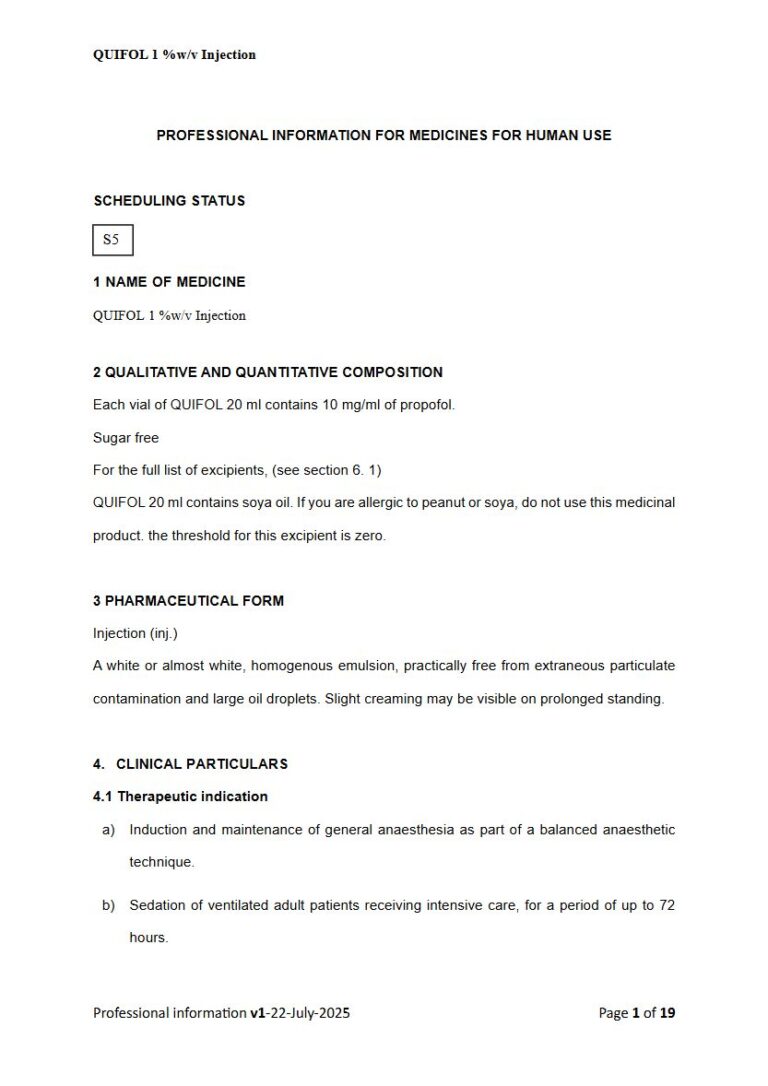
a) Induction and maintenance of general anaesthesia as part of a balanced anaesthetic technique.
b) Sedation of ventilated adult patients receiving intensive care, for a period of up to 72 hours.
c) Conscious sedation for surgical and diagnostic procedures in adults provided that there are adequate facilities for monitoring of haemodynamic and oxygenation parameters and if administered by a qualified anaesthetist.
4.2 Posology and method of administration
Posology
Supplementary analgesic medicines are required in addition to QUIFOL, where analgesia is required. QUIFOL has been used in association with spinal and epidural anaesthesia and with commonly used premedication, neuromuscular blocking medicines, inhalation and analgesic medicines; no pharmacological incompatibility has been encountered. Dosage adjustment may be necessary when used together with the above medicines, particularly the narcotics (e.g. morphine, meperidine and fentanyl), combinations of opioids and sedatives (e.g. benzodiazepines, barbiturates, droperidol etc.), supplementary analgesic medicines (e.g nitrous oxide or opioids) and the potent inhalation medicines (e.g. isoflurane, enflurane and halothane). Where general anaesthesia with QUIFOL is used simultaneously with a regional anaesthetic technique, lower doses of QUIFOL may be required.
When QUIFOL is used undiluted to maintain anaesthesia, it is recommended that equipment such as drop counters, syringe pumps or volumetric infusion pumps should always be used to control infusion rates. QUIFOL can be used for infusion undiluted from glass infusion bottles, or plastic syringes. QUIFOL can be diluted with 5 % dextrose intravenous infusion only, in PVC infusion bags or glass infusion bottles. Dilutions, which must not exceed 1 in 5 (2 mg propofol per ml) should be prepared aseptically immediately before administration and must be used within 6 hours of preparation. The dilution may be used with a variety of infusion control techniques but a giving set used alone will not avoid the risk of accidental, uncontrolled infusion of large volumes of diluted QUIFOL. A burette, drop counter or volumetric pump must be included in the infusion line. The risk of uncontrolled infusion must be taken into account when deciding the maximum amount of QUIFOL in the burette. It is recommended that, when using diluted QUIFOL, the volume of 5 % dextrose removed from the infusion bag during the dilution process is totally replaced in volume by QUIFOL emulsion. QUIFOL may be administered via a Y-piece close to the injection site, into intravenous infusions of dextrose 5 % or sodium chloride 0.9 %. QUIFOL may be premixed with alfentanil injection. In order to reduce pain on initial injection, that part of the QUIFOL used for induction may be mixed with lignocaine injection in the ratio of 20 parts QUIFOL with up to 1 part of 1 % lignocaine injection immediately prior to administration. It is recommended that blood lipid levels be monitored routinely should QUIFOL be administered to patients thought to be at particular risk of fat overload. Administration of QUIFOL should be adjusted appropriately if the monitoring indicates that fat is being inadequately cleared from the body. If the patient is receiving other intravenous lipid concurrently, a reduction in quantity should be made in order to take account of the amount of lipid infused as part of the QUIFOL formulation; 1.0 ml of QUIFOL contains 0.1 g of fat. Patients with hypovolaemia should have fluid-volume deficits corrected prior to administration of QUIFOL.
Method of Administration
For intravenous administration
ADULTS
Induction of general anaesthesia: QUIFOL may be used to induce anaesthesia by slow bolus injection or infusion. In unpremedicated and premedicated patients: Most adult patients aged less than 55 years are likely to require 1.5 to 2.5 mg/kg (0.15 to 0.25 ml/kg) of QUIFOL, (approximately 4 ml every 10 seconds in an average healthy adult) by slow bolus injection or infusion titrated against the response of the patient until clinical signs show onset of anaesthesia. The total dose required can be reduced by lower rates of administration (20 to 50 mg/min [2 to 5 ml/min]). Over the age of 55 years the requirement will generally be less. In patients of ASA Grades 3 and 4, lower rates of administration should be used (approximately 20 mg [2 ml] every 10 seconds).
Maintenance of general anaesthesia: Anaesthesia can be maintained by administering QUIFOL either by continuous infusion or by repeat bolus injections to prevent the clinical signs of light anaesthesia. Infusion: The average rate of administration varies between patients, but rates in the region of 4 to 12 mg/kg/hr (0.4 to 1.2 ml/kg/hr) usually maintain satisfactory anaesthesia. Slightly higher rates of administration may be required for 10 to 20 minutes after induction of anaesthesia. Repeat bolus injections: As a guide, increments of 25 mg (2.5 ml) to 50 mg (5.0 ml) may be used.
Sedation during intensive care: To provide sedation for ventilated adult patients undergoing intensive care, it is recommended that QUIFOL be given by continuous infusion, for up to 72 hours. Adjust infusion rate according to the depth of sedation required. Rates of 0.3 mg/kg/hr to 4.0 mg/kg/hr should achieve satisfactory sedation. Rates above 4.0 mg/kg/hr are not recommended.
Conscious sedation for surgical and diagnostic procedures (section 4.4): To provide sedation for surgical and diagnostic procedures rates of administration should be individualised and titrated to clinical response. Most patients will require 0.5 mg/kg to 1 mg/kg over 1 to 5 minutes to initiate sedation. Maintenance of sedation may be accomplished by titrating QUIFOL infusion to the desired level of sedation - most patients will require 1.5 mg/kg/hr to 4.5 mg/kg/hr. In addition to the infusion, bolus administration of 10 mg to 20 mg may be used if a rapid increase in the depth of sedation is required. In patients in ASA Grades 3 and 4 the rate of administration and dosage may need to be reduced.
ELDERLY PATIENTS
In elderly patients the dose requirement for induction of anaesthesia with QUIFOL is reduced. The reduction should take account of the physical status and age of the patient. The reduced dose should be given at a slower rate and titrated against the response. Where QUIFOL is used for maintenance of anaesthesia or sedation the rate of infusion or u201ctarget concentrationu201d should also be reduced. Patients of ASA Grades 3 and 4 will require further reductions in dose and dose rate. Rapid bolus administration (single or repeated) should not be used in the elderly as this may lead to cardio respiratory depression.
CHILDREN
Induction of general anaesthesia: QUIFOL is not recommended for use in children less than 3 years of age (see section 4.3). It is recommended that QUIFOL be given slowly until the clinical signs show the onset of anaesthesia. Adjust dose for age and/or mass. Most patients over 8 years of age are likely to require approximately 2.5 mg/kg (0.25 ml/kg) of QUIFOL for induction. Under this age the requirement may be more. Lower dosage is recommended for children of ASA Grades 3 and 4. Maintenance of general anaesthesia: QUIFOL is not recommended for use in children less than 3 years of age. Administer QUIFOL by infusion or repeat bolus injection to maintain the depth of anaesthesia required. The required rate of administration varies considerably between patients. 9 mg/kg/hr to 15 mg/kg/hr (0.9 ml/kg/hr to 1.5 ml/kg/hr) usually achieves satisfactory anaesthesia. Conscious sedation for surgical and diagnostic procedures: QUIFOL is not recommended for conscious sedation in children as safety and efficacy have not been demonstrated. Sedation during intensive care: QUIFOL is not recommended for sedation in children as safety and efficacy have not been demonstrated. Although no causal relationship has been established, serious adverse events (including fatalities) have been observed from spontaneous reports of unlicensed use and these events were seen most often in children with respiratory tract infections, given doses in excess of those recommended for adults.
4.3 Contraindications
QUIFOL is contraindicated in:
- Known hypersensitivity to the active substance propofol or to any of the excipients listed in section 6.1.
- QUIFOL is not recommended in children under the age of 3 years.
- Sedation of children of all ages with croup or epiglottitis receiving intensive care (see Section 4.4).
- Appropriate care should be applied in patients with disorders of fat metabolism, patients predisposed to fat embolism and in other conditions where lipid emulsions must be used cautiously.
- Fat metabolism may be disturbed in conditions such as renal insufficiency, uncompensated diabetes mellitus, certain forms of liver insufficiency, metabolic disorders, severe trauma including long-bone and multiple fractures, and sepsis.
4.4 Special warnings and precautions for use
u2022 Respiration will be depressed and must be monitored to ensure adequate gas exchange. Special care should be exercised when used with other respiratory depressants. Patients should be constantly monitored and facilities for maintenance of a patent airway, artificial ventilation and oxygen enrichment and other resuscitative facilities should be readily available at all times. QUIFOL should not be administered by the person conducting the diagnostic or surgical procedure.
u2022 A generalised systemic reaction which may be anaphylactic in nature (including angioedema, bronchospasm, erythema and hypotension) may occur following QUIFOL administration - estimated as 1 in 15 000.
u2022 When QUIFOL is administered to an epileptic patient, there may be a risk of convulsion.
u2022 In the elderly, debilitated or ASA Grades 3 or 4 patients, rapid single or repeated bolus administration should not be used in order to minimise undesirable cardiorespiratory side effects.
u2022 QUIFOL should be given by those trained in anaesthesia (or where appropriate, doctors trained in the care of patients in intensive care). When QUIFOL is administered for conscious sedation, for surgical and diagnostic procedures, patients should be continually monitored for early signs of hypotension, airway obstruction and oxygen desaturation. An adequate period is needed prior to discharge of the patient to ensure full recovery after general anaesthesia. Very rarely the use of QUIFOL may be associated with the development of a period of post-operative unconsciousness, which may be accompanied by an increase in muscle tone. This may or may not be preceded by a period of wakefulness. Although recovery is spontaneous, appropriate care of an unconscious patient should be administered.
Caution should be applied in patients with cardiac, respiratory, renal or hepatic impairment or in hypovolaemic or debilitated patients. The pharmacokinetics of propofol may be prolonged in people with chronic hepatic cirrhosis or chronic renal impairment. Recovery times may double as a result. The effects of acute hepatic or renal failure on the pharmacokinetics of propofol have not been studied.
EDTA is a chelator of metal ions, including zinc. The need for supplemental zinc should be considered during prolonged administration of QUIFOL, particularly in patients who are predisposed to zinc deficiency, such as those with burns, diarrhoea and/or major sepsis.
QUIFOL lacks vagolytic activity and has been associated with reports of bradycardia, occasionally profound and also asystole. The intravenous administration of an anticholinergic medicine before induction, or during maintenance of anaesthesia should be considered, especially in situations where vagal tone is likely to predominate or when QUIFOL is used in conjunction with other medicines likely to cause a bradycardia.
4.5 Interaction with other medicines and other forms of interaction
The neuromuscular blocking medicines, atracurium and mivacurium should not be given through the same intravenous line as QUIFOL without prior flushing. QUIFOL has been used in association with spinal and epidural anaesthesia and with commonly used premedication, neuromuscular blocking medicines, inhalation and analgesic medicines; no pharmacological incompatibility has been encountered. Dosage adjustment may be necessary when used together with the above medicines, particularly the narcotics (e.g. morphine, meperidine and fentanyl), combinations of opioids and sedatives (e.g. benzodiazepines, barbiturates, droperidol etc.), supplementary analgesic medicines (e.g. nitrous oxide or opioids) and the potent inhalation medicines (e.g. isoflurane, enflurane and halothane). Where general anaesthesia with QUIFOL is used simultaneously with a regional anaesthetic technique, lower doses of QUIFOL may be required.
4.6 Fertility, pregnancy and lactation
Women of childbearing potential
Pregnancy: QUIFOL should not be used in pregnancy. QUIFOL crosses the placenta and may be associated with neonatal depression. It should not be used for obstetric anaesthesia. QUIFOL has been used, however, during termination of pregnancy in the first trimester.
Breastfeeding: In mothers who are breastfeeding, safety to the neonate has not been established.
Fertility: No data available.
4.7 Effects on ability to drive and use machines
Patients should be advised that performance at skilled tasks, such as driving and operating machinery, may be impaired for some time after general anaesthesia.
4.8 Undesirable effects
a) Tabulated list of adverse reactions
System organ class
Frequent
Less frequent
Frequency unknown
- Immune system disorders: Anaphylaxis - may include angioedema, bronchospasm, erythema, hypotension
- Metabolism and nutrition disorders: Metabolic acidosis, hyperkalaemia, hyperlipidaemia
- Psychiatric disorders: Euphoric moods, drug abuse and drug dependence
- Nervous system disorders: Headache during recovery, Epileptiform movements, Involuntary movement phase, including convulsions and opisthotonus during induction, maintenance and recovery, postoperative unconsciousness
- Cardiac disorders: Bradycardia, Cardiac arrhythmia, cardiac failure
- Vascular disorders: Flushing in children, hypotension
- Respiratory, thoracic and mediastinal disorders: Transient apnoea during induction, Pulmonary oedema, Respiratory depression (dose dependent)
- Gastrointestinal disorders: Nausea and vomiting during recovery phase, Pancreatitis
- Hepatobiliary disorders: Hepatomegaly
- Musculoskeletal, connective tissue and bone disorder: Dystonia/dyskinesia, Rhabdomyolysis
- Renal and urinary disorders: Urine discolouration following prolonged administration, Renal failure
- Reproductive system and breast disorders: Sexual disinhibition, Priapism
- General disorders and administration site conditions: Local pain on induction, Withdrawal symptoms in children, Tissue necrosis following accidental extravascular administration, Local pain, swelling following accidental extravascular administration
- Investigations: Brugada type ECG
- Injury and poisoning: Postoperative fever
1. Serious bradycardias are rare. There have been isolated reports of progression to asystole.
2. Occasionally, hypotension may require use of intravenous fluids and reduction of the administration rate of QUIFOL.
3. Very rare reports of rhabdomyolysis have been received where QUIFOL has been given at doses greater than 4 mg/kg/hr for ICU sedation.
4. May be minimised by using the larger veins of the forearm and antecubital fossa.
5. Combinations of these events, reported as u201cPropofol Infusion Syndromeu201d, may be seen in seriously ill patients who often have multiple risk factors for the development of the events.
6. Brugada-type ECG - elevated ST-segment and coved T-wave in ECG.
7. Rapidly progressive cardiac failure (in some cases with fatal outcome) in adults. The cardiac failure in such cases was usually unresponsive to inotropic supportive treatment.
8. Abuse of and drug dependence on propofol, predominantly by healthcare professionals.
9. Not known as it cannot be estimated from the available clinical trial data.
10. Necrosis has been reported where tissue viability has been impaired.
11. Following abrupt discontinuation of QUIFOL during intensive care.
General: Side effects include excitation, involuntary movement, hiccup, flushing and hypertension. During induction and maintenance of anaesthesia, hypotension and apnoea may occur. Hypotension may require use of intravenous fluids and reduction of the rate of administration of QUIFOL during the period of anaesthetic maintenance. Less frequently, tachycardia, premature ventricular contractions, premature atrial contractions, syncope, abnormal ECG, and ST segment depression may occur. Epileptiform movements, including convulsions and opisthotonos have been reported in 0.5 % at induction of anaesthesia, during maintenance of anaesthesia and during recovery. During the recovery phase nausea, vomiting and headache may occur. There have been reports of rhabdomyolysis when QUIFOL has been administered at doses greater than 4 mg/kg/hr for ICU sedation. Sexual disinhibition has been reported during recovery. Pulmonary oedema. Discolouration of urine has been reported following prolonged administration of QUIFOL. There have been reports of post-operative fever. Pancreatitis has been observed following the use of QUIFOL; a causal relationship has not been clearly established.
Local: The local pain which may occur during the induction phase of QUIFOL anaesthesia can be minimised by the co-administration of lignocaine (see section 4.2) and by the use of the larger veins of the forearm and antecubital fossa. Thrombosis and phlebitis may occur less frequently. Accidental clinical extravasation and animal studies showed minimal tissue reaction.
Reporting of suspected adverse reactions: Reporting suspected adverse reactions after authorisation of the medicine is important. It allows continued monitoring of the benefit/risk balance of the medicine. Healthcare professionals are asked to report any suspected adverse reactions to SAHPRA via Med Safety APP (Medsafety X SAHPRA) and eReporting platform (who-umc.org) found on SAHPRA website.
4.9 Overdose
Symptoms
Accidental overdosage is likely to cause cardio respiratory depression.
Treatment
Respiratory depression should be treated by artificial ventilation with oxygen. Cardiovascular depression would require lowering of the patientu2019s head, and, if severe, use of plasma expanders and pressor medicines.
