
Prydostrin 60 60 mg tablets
PDF Leaflet Revision Date: 22 July 2025
Clinical Summary
Quick overview from the medicine insert
Indication
Treatment of myasthenia gravis.
Dosage (summary)
Adults: 1-3 tablets (60 mg) 2-4 times daily; Children: 7 mg/kg daily.
Special Populations
- Renal impairment
- Elderly patients
- Obstructive respiratory diseases
Pregnancy & Breastfeeding
Safety in pregnancy and lactation not established.
Key Drug Interactions
- Corticosteroids may decrease requirement
- Antimuscarinics antagonize effects
- Aminoglycoside antibiotics may interact
Contraindications
- Hypersensitivity to pyridostigmine
- Mechanical intestinal or urinary obstruction
Common side effects
- Muscle cramps
- Fasciculation
- Weakness
- Nausea
- Diarrhoea
Counselling Points
- Monitor for signs of overdose
- Titrate dosage based on response
- Avoid abrupt discontinuation
Serious warnings
- Risk of cholinergic crisis
- Care in patients with bradycardia or AV block
Important Disclaimer
The Prydostrin 60 60 mg tablets professional information leaflet below is the property of Juno Pharma Sa and is provided on Medinsert exactly as issued, with no.. alterations or editorial changes. We make every effort to keep content current by updating documents as soon as new versions become available. Medinsert serves as a trusted access point for healthcare professionals, but does not replace official sources or clinical judgement. For more details, please read our full disclaimer. read more>>
 Healthcare Professionals Only
This content is for registered healthcare professionals
Sign in or create a free account to read the full package insert.
Free for HPCSA-registered professionals. Powered by Medinsert.
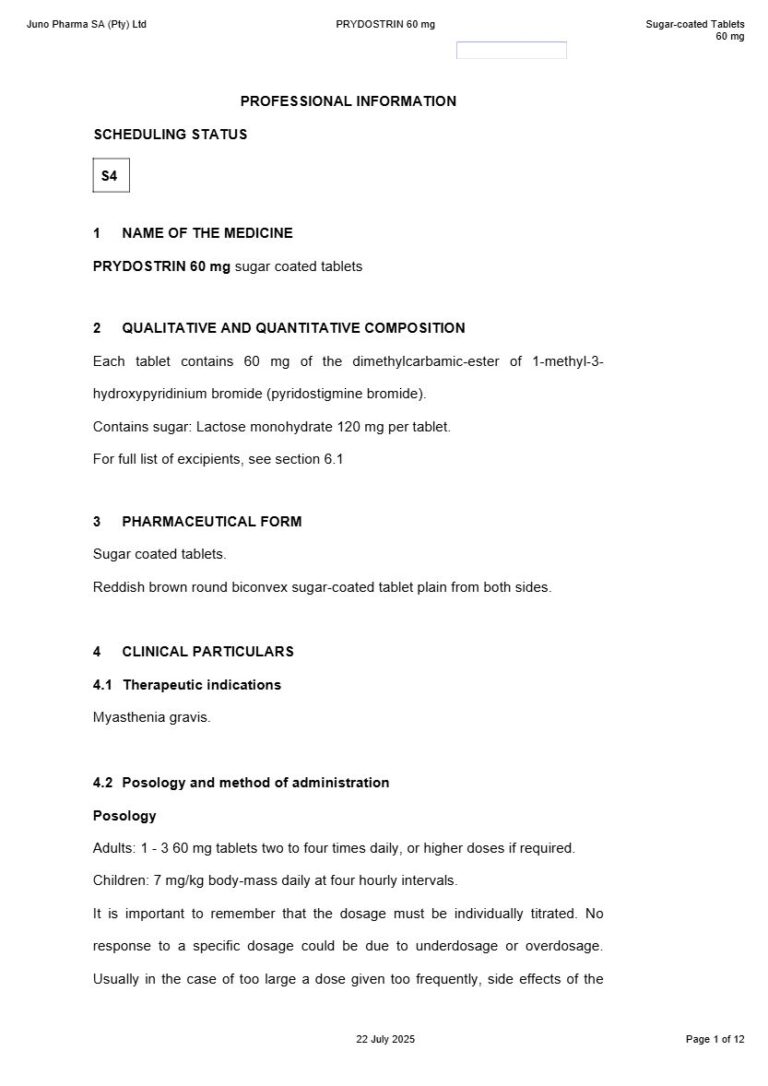
Clinical Particulars
Section 4 of the official insert — extracted exactly as issued, no alterations
4.1 Therapeutic indications
Myasthenia gravis.
4.2 Posology and method of administration
Posology
Adults: 1 - 3 60 mg tablets two to four times daily, or higher doses if required.
Children: 7 mg/kg body-mass daily at four hourly intervals.
It is important to remember that the dosage must be individually titrated. No response to a specific dosage could be due to underdosage or overdosage. Usually in the case of too large a dose given too frequently, side effects of the muscarinic and/or nicotinic type will manifest (see section 4.8).
Method of administration
For oral use.
4.3 Contraindications
- Hypersensitivity to pyridostigmine or to any of the excipients of PRYDOSTRIN (see section 6.1).
- Mechanical intestinal or urinary obstruction.
4.4 Special warnings and precautions for use
Although failure of patients to show clinical improvement may reflect underdosage, it can also be indicative of overdosage. Overdosage may result in cholinergic crisis, a state characterised by increasing muscle weakness which, through involvement of the muscles of respiration, may lead to death. Myasthenic crisis due to an increase in the severity of the disease is also accompanied by extreme muscle weakness, and thus may be difficult to distinguish from cholinergic crisis on a symptomatic basis.
Differential diagnosis can be aided by the Tensilonu00ae (edrophonium chloride) test. If 0,1 ml (1 mg) or at most 0,2 ml (2 mg) of Tensilonu00ae (edrophonium chloride) is given intravenously, a marked improvement indicates myasthenic crisis. Any other response, whether equivocal or exacerbation of symptoms, must be considered to be cholinergic.
The treatment of the two conditions obviously differs radically. Whereas the presence of myasthenic crisis suggests the need for more intensive anticholinesterase therapy, the diagnosis of cholinergic crisis calls for the prompt withdrawal of all medicines of this type and institution of appropriate supportive measures, including respiratory assistance. The immediate use of atropine in cholinergic crisis is also recommended. Atropine may also be used to abolish or obtund gastrointestinal side effects or other muscarinic reactions. Care should be observed in the use of atropine for counteracting side effects; such use, by masking signs of overdosage, can lead to inadvertent induction of cholinergic crisis.
Differentiation of myasthenic and cholinergic crisis
The patient with myasthenic crisis will often have a history of intervening infection, emotional trauma, perhaps a relationship to the menstrual cycle or cessation of medication. The usual dose of the medicine becomes ineffective and increased weakness or side reactions do not occur after taking medication.
A cholinergic crisis may begin in a similar manner but the patient keeps increasing the amount and frequency of medication, with less effect and more side reactions, especially increased secretions with gastrointestinal activity. The patient in cholinergic crisis is weak, as in myasthenic crisis, but there is usually pallor, a cold clammy skin, often accompanied by hypertension, bradycardia, miosis, excessive salivation and perspiration and muscular fasciculation.
PRYDOSTRIN is mainly excreted unchanged by the kidney. Therefore lower doses may be required in patients with renal disease and treatment should be based on titration of medicine dosage effect.
Extreme caution is required when administering PRYDOSTRIN to patients with obstructive respiratory diseases like bronchial asthma and chronic obstructive pulmonal diseases (COPD).
Care should be taken in patients with:
- Dysrhythmias such as bradycardia and AV block (elderly patients may be more susceptible to dysrhythmias than the young adult)
- Recent coronary occlusion
- Hypotension
- Vagotonia
- Peptic ulcer
- Epilepsy
- Parkinsonism
- Hyperthyroidism
- Renal impairment
When relatively large doses of pyridostigmine bromide are taken by myasthenic patients it may be necessary to give atropine or other anti-cholinergic medicines to specifically counteract the muscarinic effects of pyridostigmine while maintaining its nicotinergic effect.
PRYDOSTRIN should be given with caution to elderly patients and to patients with pre-existing conduction disturbances.
Note: certain antibiotics, especially neomycin, streptomycin and kanamycin have a mild definite non-depolarizing blocking action which may accentuate neuromuscular block. These antibiotics should only be used in the myasthenic patient when definitely indicated and then with careful observation to adjust anticholinesterase dosage.
PRYDOSTRIN contains lactose monohydrate. Patients with the rare hereditary conditions of galactose intolerance e.g. galactosaemia, the Lapp lactase deficiency or glucose-galactose malabsorption should not take PRYDOSTRIN.
4.5 Interaction with other medicines and other forms of interaction
lmmunosuppressant medicines
The requirement for pyridostigmine bromide may be decreased by concomitant use when additional therapy (corticosteroids or immune-suppressant medicines) is given. Nevertheless, a new addition of corticosteroids may initially aggravate the symptoms of myasthenia gravis.
Thymectomy
The need for PRYDOSTRIN dosing may be decreased after thymectomy.
Methylcellulose
Methylcellulose and medicines containing methylcellulose as excipients can completely inhibit absorption of pyridostigmine bromide.
Antimuscarinics
Atropine and Hyoscine antagonise the muscarinic effects of pyridostigmine bromide. It should be noted that the slower gastro-intestinal motility caused by these medicines may affect the absorption of pyridostigmine bromide.
Muscle relaxants
Pyridostigmine bromide antagonises the effect of non-polarising muscle relaxants (e.g. pancuronium and vecuronium). Pyridostigmine bromide may prolong the effect of depolarising muscle relaxants (e.g. suxamethonium).
Others
Aminoglycoside antibiotics, local and some general anaesthetics, antidysrhythmic medicines, and other medicines that interfere with neuromuscular transmission may interact with pyridostigmine bromide.
4.6 Fertility, pregnancy and lactation
Pregnancy
Safety in pregnancy has not been established.
Breastfeeding
Safety in lactation has not been established.
Fertility
No data is available.
4.7 Effects on ability to drive and use machines
Due to miosis and accommodation disorders caused by pyridostigmine bromide or an inadequate treatment of Myasthenia gravis, PRYDOSTRIN may impair visual acuity and consequently the ability to react as well as the ability to drive and use machines.
4.8 Undesirable effects
a. Summary of the safety profile
Nicotinic side effects are comprised chiefly of muscle cramps, fasciculation and weakness. Skin rash may occur. As with all cholinergic medicines, PRYDOSTRIN may have unwanted functional effects on the autonomic nervous system. Muscarinic-like adverse effects may be exhibited as nausea, vomiting, diarrhoea, abdominal cramps, increased peristaltic and increased bronchial secretion, salivation, bradycardia and miosis and diaphoresis.
The primary nicotinic effects are muscle spasms, fasciculation and muscular weakness.
b. Tabulated summary of adverse reactions
Within the system organ classes, adverse reactions are listed under headings of frequency (number of patients expected to experience the reaction), using the following categories: frequent, less frequent and frequency unknown.
System organ class Frequency Adverse reactions
Immune system disorders Frequency unknown Medicine hypersensitivity
Nervous system disorders Frequency unknown Syncope
Eye disorders Frequency unknown Miosis, increased lacrimation, accommodation disorders (e.g. blurred vision)
Cardiac disorders Frequency unknown Dysrhythmia (incl. bradycardia, tachycardia, AV Block) as well as syncope and hypotension, Prinz metal angina
Vascular disorders Frequency unknown Flushing, hypotension
Respiratory, thoracic and mediastinal disorders Frequency unknown Increased bronchial secretion combined with bronchoconstriction
Gastrointestinal disorders Frequency unknown Nausea, vomiting, diarrhoea, abdominal cramps, gastrointestinal hypermotility, salivary hypersecretion, abdominal symptoms (e.g. discomfort pain, cramps)
Skin and subcutaneous Less frequent Rash (disappears usually soon after ceasing of medication. Bromide containing medicines should no longer be used) Frequency unknown Hyperhidrosis, urticarial
Musculoskeletal and connective tissue disorders Frequency unknown Increased muscle weakness, fasciculation (muscle twitching), tremors, and muscle cramps or muscle hypotonia.
Renal and urinary disorders Frequency unknown Urinary urgency
Because these symptoms may be an indication of cholinergic crisis, the medical practitioner should be notified immediately to clarify the diagnosis.
Reporting of suspected adverse reactions
Reporting suspected adverse reactions after authorisation of the medicine is important. It allows continued monitoring of the benefit/risk balance of the medicine. Health care providers are asked to report any suspected adverse reactions to SAHPRA via the Med Safety APP (Medsafety X SAHPRA) and eReporting platform (who-umc.org) found on SAHPRA website.
4.9 Overdose
In the event of an overdose, side effects can be precipitated and/or be of increased severity (see section 4.8).
As PRYDOSTRIN is excreted mainly by the kidneys, caution is advised in cases of renal function impairment. The signs and symptoms of overdosage are due to muscarinic and nicotinic actions. Its muscarinic effects consist of abdominal cramps, increased peristalsis, diarrhoea, nausea and vomiting, increased bronchial secretions, salivation, diaphoresis and miosis. The nicotinic effects are muscular cramps, fasciculations and general weakness. Bradycardia and hypotension may occur if overdosage is excessive. Skin rashes due to sensitivity to bromide ion have been reported. Overdosage with decreased therapeutic effect must be differentiated from myasthenia gravis.
Suggested treatment of overdosage: PRYDOSTRIN treatment must be stopped immediately. Artificial ventilation should be instituted if respiration is severely depressed. The muscarinic effects are the most serious and may be controlled by atropine. Nicotinic effects may be treated symptomatically.
