
Ramiwin
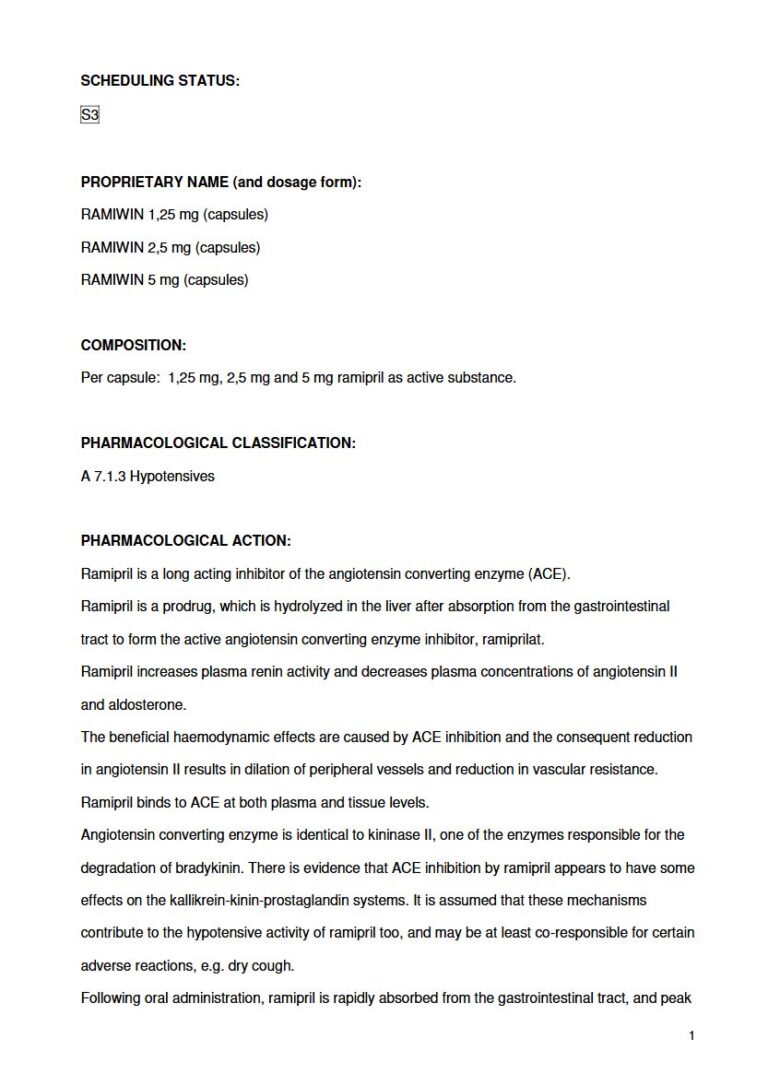
PDF Leaflet Revision Date: 11 August 1994
Clinical Summary
Quick overview from the medicine insert
Indication
Mild to moderate hypertension, cardiac failure post-myocardial infarction, diabetic nephropathy.
Dosage (summary)
Initial: 2.5 mg once daily, max 10 mg. Post-MI: 2.5 mg twice daily.
Onset of Action / Duration
Onset: 1-2 hours, Duration: 24 hours
Special Populations
- Renal impairment
- Hepatic impairment
Pregnancy & Breastfeeding
Not recommended; teratogenic effects observed.
Key Drug Interactions
- Fluoroquinolones
- Potassium-sparing diuretics
- Lithium
Contraindications
- Hypersensitivity to ramipril
- History of angioneurotic oedema
- Children
Common side effects
- Nausea
- Dizziness
- Headache
- Dry cough
Counselling Points
- Take with half a glass of liquid
- Monitor blood pressure regularly
- Avoid potassium supplements
Serious warnings
- Pregnancy: discontinue immediately
- Monitor renal function
- May impair ability to drive
Important Disclaimer
The Ramiwin professional information leaflet below is the property of Zentiva South Africa and is provided on Medinsert exactly as issued, with no.. alterations or editorial changes. We make every effort to keep content current by updating documents as soon as new versions become available. Medinsert serves as a trusted access point for healthcare professionals, but does not replace official sources or clinical judgement. For more details, please read our full disclaimer. read more>>
 Healthcare Professionals Only
This content is for registered healthcare professionals
Sign in or create a free account to read the full package insert.
Free for HPCSA-registered professionals. Powered by Medinsert.
Clinical Particulars
Section 4 of the official insert — extracted exactly as issued, no alterations
4.1 Therapeutic indications
Mild to moderate hypertension.
Cardiac failure following myocardial infarction.
To reduce proteinuria and the decline in glomerular filtration rate in patients with diabetic nephropathy and hypertension.
4.2 Posology and method of administration
RAMIWIN should be taken with half a glass of liquid during or after meals. Hypertension: Administration of RAMIWIN to hypertensive patients results in a reduction of both supine and erect blood pressure. The antihypertensive effect is evident within one to two hours after intake of the medicine, peak effect occurs three to six hours after intake, and has been shown to be maintained for at least 24 hours at recommended doses. The dose range is 2,5 mg to 10 mg RAMIWIN in a single daily dose. The recommended initial dosage in patients not on diuretics is 2,5 mg RAMIWIN once a day. Dosage should be increased to 5 mg RAMIWIN and up to a maximum of 10 mg RAMIWIN once a day at intervals of one to two weeks based on patient response. A maximum dose of 10 mg should not be exceeded. In patients who are currently being treated with a diuretic, symptomatic hypotension occasionally may occur following the initial dose of RAMIWIN. The diuretic should, if possible, be discontinued for two to three days before beginning therapy with RAMIWIN to reduce the likelihood of hypotension. In case the diuretic therapy cannot be discontinued, the initial dose of RAMIWIN should be 1,25 mg.
Post-myocardial infarction: The treatment with RAMIWIN should be initiated in hospital 3 to 10 days after an acute myocardial infarction if the patient manifests with evidence of heart failure and is haemodynamically stable. The recommended dosage is 2,5 mg RAMIWIN twice daily for two days. If well tolerated, increase the dose to 5 mg RAMIWIN twice daily. If patients are unable to tolerate 2,5 mg initially, 1,25 mg RAMIWIN twice daily may be given initially and later increased to 2,5 mg twice daily.
Non-diabetic and diabetic nephropathy: Recommended initial dose: 1,25 mg RAMIWIN once daily. Depending on how the patient tolerates the medicine, the dose should be increased. It is recommended that the dose, if increased, be doubled at intervals of 2 to 3 weeks. Maximum permitted daily dose: 10 mg RAMIWIN. IN PATIENTS PRE-TREATED WITH A DIURETIC, consideration must be given to discontinuing the diuretic for at least 2 to 3 days or depending on the duration of action of the diuretic, longer, before starting treatment with RAMIWIN, or at least, to reducing the diuretic dose. Dosage adjustment in renal impairment: Ramipril is not recommended for use in dialysis patients.
4.3 Contraindications
Hypersensitivity to ramipril and starch. History of angioneurotic oedema. Ramipril is not recommended for use in children. Pregnancy and lactation: Teratogenicity has been shown in animals. Hypertensive women receiving ACE-inhibitors should take care to ensure that they do not become pregnant while taking an ACE-inhibitor. ACE-inhibitors pass through the placenta and can be presumed to cause disturbances in foetal blood pressure regulatory mechanisms. Oligohydramnios as well as hypotension, oliguria and anuria in newborns have been reported after administration of ACE-inhibitors in the second and third trimester. Cases of defective skull ossification have been observed. Prematurity and low birth mass can occur. Concomitant use of ACE inhibitors with fluoroquinolones is contraindicated in patients with moderate to severe renal impairment.
4.4 Special warnings and precautions for use
Should a woman become pregnant while receiving an ACE-inhibitor, the treatment should be stopped promptly and switched to a different medicine. Should a woman contemplate pregnancy, the doctor should consider alternative medication. The treatment of hypertension with this preparation must be carried out under regular medical supervision. Treatment with RAMIWIN may impair the ability to drive or operate machinery, particularly at the start of treatment, when changing over from other preparations and during concomitant use of alcohol. In patients with impaired liver function, the metabolism of the parent compound ramipril and therefore the formation of the bioactive metabolite ramiprilat is decelerated resulting in markedly elevated plasma ramipril levels due to a diminished activity of esterases in the liver. Use of ramipril in patients with impaired liver function is not recommended. Concomitant use of fluoroquinolones and ACE inhibitors may precipitate acute kidney injury in patients, especially those with moderate to severe renal impairment and elderly patients (see CONTRA-INDICATIONS). Renal function should be assessed before initiating treatment and monitored during treatment with fluoroquinolones or ACE inhibitors whether used separately and/or concomitantly.
4.8 Undesirable effects
The most frequently reported side-effects are nausea, dizziness and headache. A dry cough has been reported. Cardiovascular system: Hypotension may occur after the initial dose of RAMIWIN, as well as after increasing the dose of RAMIWIN. Symptomatic hypotension (i.e. headache, tiredness, palpitations, tinnitus) accompanied by dizziness, nausea and a feeling of weakness can be observed in salt/volume depleted patients such as those treated with diuretics or patients on dialysis, as well as in patients with severe congestive heart failure. Syncope has been observed. In patients with concomitant congestive heart failure with or without renal insufficiency, excessive hypotension has been observed and may be associated with oliguria or azotemia. In these patients therapy should be started under close medical supervision, and at a reduced starting dose. If hypotension occurs, the patient should be placed in a supine position and, if necessary, receive an intravenous infusion of physiological saline. Renal function: Treatment with RAMIWIN may impair renal function. Patients with renal insufficiency may require reduced initial doses of RAMIWIN and their renal function should be closely monitored. There is a risk of impairment of renal function particularly in patients with congestive heart failure or renovascular disease (bilateral renal artery stenosis or unilateral renal artery stenosis in the single kidney), in patients with pre-existing impairment of renal function, as well as in kidney transplant patients. Some patients with no apparent pre-existing renal disease may develop increases in blood urea, proteinuria and serum creatinine when RAMIWIN is given. In patients with renal insufficiency there is a risk of hyperkalaemia. Decrease in serum sodium can also occur. Liver function: As RAMIWIN is a prodrug metabolised in the liver to its active moiety, particular caution and close monitoring should be applied in patients with liver impairment. The metabolism of the parent compound and therefore the formation of the bioactive metabolite ramiprilat may be decelerated, resulting in markedly elevated plasma levels of the parent-compound due to the diminished activity of esterases in the liver. Surgery/Anaesthesia: In patients undergoing surgery or during anaesthesia with agents producing hypotension, RAMIWIN may block angiotensin II formation secondary to compensatory renin release. If hypotension occurs and is considered to be due to this mechanism it can be corrected by volume expansion. Neutropenia and proteinuria: Regular monitoring of white blood cell counts and protein levels in urine should be performed in patients with collagen vascular disease, such as lupus erythematosus and systemic sclerosis, in particular where associated with impaired renal function and concomitant therapy with drugs like corticosteroids and antimetabolites. Hyperkalaemia: Elevated serum potassium may occur in hypertensive patients. Risk factors for the development of hyperkalaemia include renal insufficiency and the concomitant use of agents to treat hypokalaemia as well as potassium sparing diuretics. Gastrointestinal tract: Gastrointestinal disorders, e.g. nausea, diarrhoea or gastric pain may occur but these reactions are often transient. Taste disturbances may occur. Angioneurotic oedema: Angioneurotic oedema may occur during therapy with ACE-inhibitors including RAMIWIN. If laryngeal stridor or angio-oedema of the face, tongue or glottis occurs, treatment with RAMIWIN must be discontinued and appropriate therapy instituted immediately. Allergic reactions: Hypersensitivity reactions accompanied by pruritus, rash and sometimes fever may occur, but may resolve spontaneously after withdrawal of RAMIWIN. Laboratory values: Increases in blood urea and serum creatinine may occur, particularly in patients with renal insufficiency or in patients pre-treated with a diuretic. Elevation of serum potassium may occur, since RAMIWIN decreases aldosterone secretion. Potassium sparing diuretics such as spironolactone, amiloride, triamterene or potassium supplements should therefore be avoided. Increases in liver enzymes and/or bilirubin. Changes in blood picture: decrease in haemoglobin; leukopenia and thrombocytopenia.
4.9 Overdose
In case of overdosage, excessive hypotension is to be expected. Treatment should include volume expanders.
