
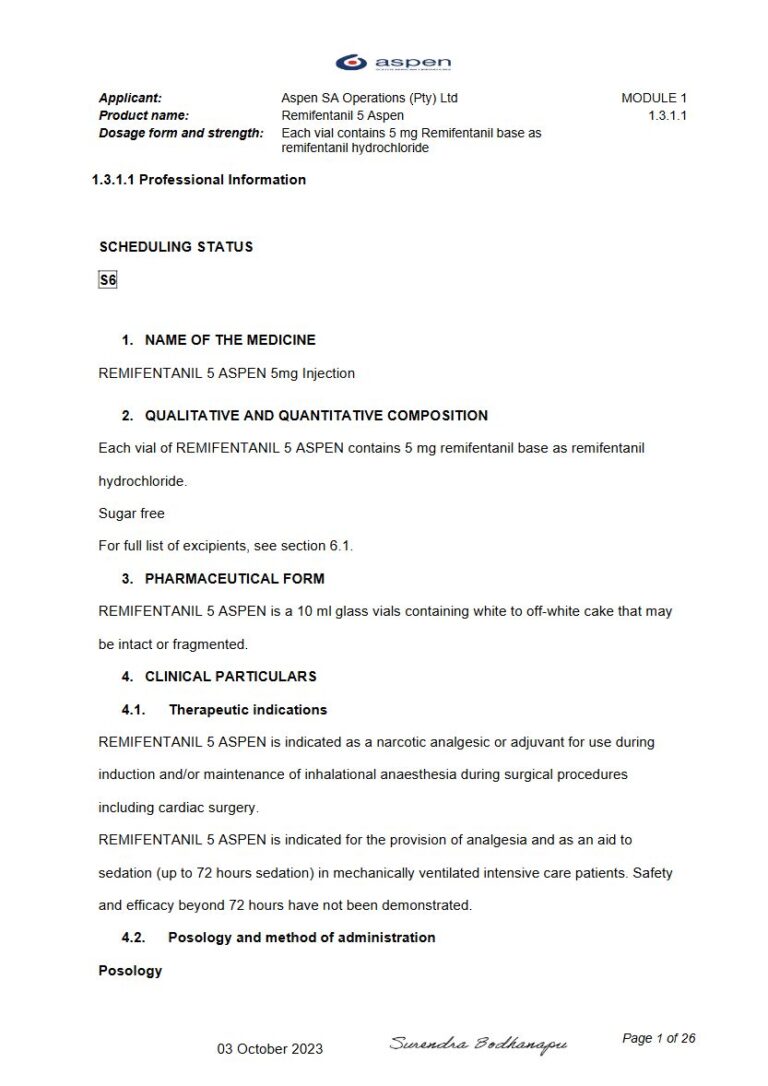
Remifentanil 5 Aspen 5 mg Injection
PDF Leaflet Revision Date: 03 October 2023
Clinical Summary
Quick overview from the medicine insert
Indication
Narcotic analgesic for induction and maintenance of anaesthesia.
Dosage (summary)
Adults: 0.5-1.0 u03bcg/kg/min continuous infusion; initial bolus 1 u03bcg/kg over 30 seconds.
Onset of Action / Duration
Onset: 1-2 mins, Duration: 5-10 mins
Special Populations
- Elderly: reduce initial dose by 50%
- Renal impairment: no dosage adjustment needed
- Hepatic impairment: monitor closely
Pregnancy & Breastfeeding
Safety in pregnancy and lactation not established; crosses placenta and appears in breast milk.
Key Drug Interactions
- Increased risk of respiratory depression with benzodiazepines
- Decreased requirement for inhaled and IV anaesthetics
Contraindications
- Hypersensitivity to excipients
- Not for use without planned artificial ventilation
- Not recommended for epidural or intrathecal use
Common side effects
- Respiratory depression
- Bradycardia
- Hypotension
- Skeletal muscle rigidity
Counselling Points
- Monitor for signs of respiratory depression
- Avoid driving or operating machinery post-treatment
- Ensure alternative analgesia is in place before discontinuation
Serious warnings
- Risk of sedation and respiratory depression with concomitant sedatives
- Potential for withdrawal syndrome after prolonged use
Important Disclaimer
The Remifentanil 5 Aspen 5 mg Injection professional information leaflet below is the property of Aspen Sa Operations and is provided on Medinsert exactly as issued, with no.. alterations or editorial changes. We make every effort to keep content current by updating documents as soon as new versions become available. Medinsert serves as a trusted access point for healthcare professionals, but does not replace official sources or clinical judgement. For more details, please read our full disclaimer. read more>>
 Healthcare Professionals Only
This content is for registered healthcare professionals
Sign in or create a free account to read the full package insert.
Free for HPCSA-registered professionals. Powered by Medinsert.
Clinical Particulars
Section 4 of the official insert — extracted exactly as issued, no alterations
4.1. Therapeutic indications
REMIFENTANIL 5 ASPEN is indicated as a narcotic analgesic or adjuvant for use during induction and/or maintenance of inhalational anaesthesia during surgical procedures including cardiac surgery. REMIFENTANIL 5 ASPEN is indicated for the provision of analgesia and as an aid to sedation (up to 72 hours sedation) in mechanically ventilated intensive care patients. Safety and efficacy beyond 72 hours have not been demonstrated.
4.2. Posology and method of administration
Continuous infusion of REMIFENTANIL 5 ASPEN must be administered by a calibrated infusion device into a fast-flowing IV line or via a dedicated IV line. This infusion line should be connected at, or close to, the venous cannula and primed, to minimise the potential dead space. Care should be taken to avoid obstruction or disconnection of infusion lines and to adequately clear the lines to remove residual REMIFENTANIL 5 ASPEN after use (see section 4.4).
General anaesthesia
The administration of REMIFENTANIL 5 ASPEN must be individualised based on the patientu2019s response.
Adults: The following table summarises the starting infusion rates and dosage range:
Dosing Guidelines for Adults:
- INDICATION BOLUS INFUSION OF REMIFENTANIL 5 ASPEN (u03bcg/kg) CONTINUOUS INFUSION OF REMIFENTANIL 5 ASPEN (u03bcg/kg/min) Starting Rate Range
- With Induction of anaesthesia in ventilated patients 1 (Given over not less than 30 seconds) 0,5 to 1,0
- Maintenance of anaesthesia in ventilated patients u2022 Isoflurane (starting dose 0,5 MAC) 0,5 to 1,0 0,25 0,05 to 0,5
At the doses recommended, REMIFENTANIL 5 ASPEN significantly reduces the amount of hypnotic medicine required to maintain anaesthesia. Therefore, isoflurane should be administered as recommended above to avoid excessive depth of anaesthesia (see section 4.5)
Induction of anaesthesia: REMIFENTANIL 5 ASPEN should be administered with a hypnotic medicine, such as isoflurane, for the induction of anaesthesia. REMIFENTANIL 5 ASPEN can be administered at an infusion rate of 0,5 u03bcg/kg/min to 1,0 u03bcg/kg/min with or without an initial bolus infusion of 1 u03bcg/kg over not less than 30 seconds. If endotracheal intubation is to occur more than 8 to 10 minutes after the start of the REMIFENTANIL 5 ASPEN infusion, then a bolus infusion is not necessary.
Maintenance of anaesthesia: After endotracheal intubation, the infusion rate of REMIFENTANIL 5 ASPEN should be decreased, according to the anaesthetic technique, as indicated in the above table. Due to the fast onset and short duration of action of REMIFENTANIL 5 ASPEN, the rate of administration during anaesthesia can be titrated upward in 25 % to 100 % increments or downward in 25 % to 50 % decrements, every 2 to 5 minutes to attain the desired level of u03bc-opioid response. In response to light anaesthesia, supplemental bolus infusions may be administered every 2 to 5 minutes.
Guidelines for discontinuation: Due to the very rapid offset of action of REMIFENTANIL 5 ASPEN, residual opioid activity will be reduced within 5 to 10 minutes after discontinuation. For those patients undergoing surgical procedures where post-operative pain is anticipated, analgesics should be administered prior to, or immediately following discontinuation of REMIFENTANIL 5 ASPEN. Sufficient time must be allowed to reach the maximum effect of the longer acting analgesic. The choice of analgesic should be appropriate for the patientu2019s surgical procedure and the level of post-operative care.
Paediatric patients (1 to 12 years of age): Induction of anaesthesia: REMIFENTANIL 5 ASPEN is not recommended for the induction of anaesthesia, as insufficient data are available. Maintenance of anaesthesia: CONCOMITANT ANAESTHETIC MEDICINE BOLUS INFUSION OF REMIFENTANIL 5 ASPEN (u03bcg/kg) CONTINUOUS INFUSION OF REMIFENTANIL 5 ASPEN (u03bcg/kg/min) Starting Rate Typical Maintenance Rates Halothane (starting dose 0,3 MAC) 1 0,25 0,05 to 1,3 Sevoflurane (starting dose 0,3 MAC) 1 0,25 0,05 to 0,9 Isoflurane (starting dose 0,5 MAC) 1 0,25 0,06 to 0,9 When given by bolus infusion, REMIFENTANIL 5 ASPEN should be administered over not less than 30 seconds. Surgery should not commence until at least 5 minutes after the start of the REMIFENTANIL 5 ASPEN infusion if a simultaneous bolus dose has not been given. Paediatric patients should be monitored, and the dose titrated to the depth of analgesia appropriate for the surgical procedure.
Concomitant medication: At the doses recommended above, REMIFENTANIL 5 ASPEN significantly reduces the amount of hypnotic medicine required to maintain anaesthesia. Therefore, isoflurane, halothane and sevoflurane should be administered as recommended above to avoid excessive depth of anaesthesia. No data are available for dosage recommendations for simultaneous use of other hypnotics with remifentanil.
Guidelines for discontinuation: Following discontinuation of the infusion, the offset of analgesic effect of REMIFENTANIL 5 ASPEN is rapid and like that seen in adult patients. Appropriate post-operative analgesic requirements should be anticipated and implemented (see Adults - Guidelines for discontinuation).
Neonates/infants (aged less than 1 year): The pharmacokinetic profile of remifentanil, as contained in REMIFENTANIL 5 ASPEN, in neonates/infants (aged less than 1 year) is comparable to that seen in adults after correction of body weight differences. However, there are insufficient clinical data to make dosage recommendations for this age group.
Cardiac anaesthesia
Adults: Dosing Guidelines for Cardiac Anaesthesia INDICATION BOLUS INFUSION OF REMIFENTANIL 5 ASPEN (u03bcg/kg) CONTINUOUS INFUSION OF REMIFENTANIL 5 ASPEN (u03bcg/kg/min) Starting Rate Typical Infusion Rates Intubation Not recommended 1 - Maintenance of anaesthesia u2022 Isoflurane (starting dose 0,4 MAC) 0,5 to 1 1 0,003 to 4 u2022 Propofol (starting dose 50 u03bcg/kg/min) 0,5 to 1 1 0,01 to 4,3 Continuation of post-operative analgesia, prior to extubation Not recommended 1 0 to 1 Induction period of anaesthesia: After administration of hypnotic to achieve loss of consciousness, REMIFENTANIL 5 ASPEN should be administered at an initial infusion rate of 1 u03bcg/kg/min. The use of bolus infusions of REMIFENTANIL 5 ASPEN during induction in cardiac surgical patients is not recommended. Endotracheal intubation should not occur until at least 5 minutes after the start of the infusion.
Maintenance period of anaesthesia: After endotracheal intubation the infusion rate of REMIFENTANIL 5 ASPEN should be titrated according to patient need. Supplemental bolus doses may also be given as required. High risk cardiac patients, such as those with poor ventricular function, should be administered a maximum bolus dose of 0,5 u03bcg/kg. These dosing recommendations also apply during hypothermic cardiopulmonary bypass (see section 5.2).
Concomitant medication: At the doses recommended above, REMIFENTANIL 5 ASPEN significantly reduces the amount of hypnotic medicine required to maintain anaesthesia. Therefore, isoflurane and propofol should be administered as recommended above to avoid excessive depth of anaesthesia. No data are available for dosage recommendations for simultaneous use of other hypnotics with REMIFENTANIL 5 ASPEN.
Continuation of post-operative analgesia prior to extubation: It is recommended that the infusion of REMIFENTANIL 5 ASPEN should be maintained at the final intra-operative rate during transfer of patients to the post-operative care area. Upon arrival into this area, the infusion should be maintained initially at a rate of 1 u03bcg/kg/min until the patient is ready to be weaned from the ventilator.
Guidelines for discontinuation: Prior to discontinuation of REMIFENTANIL 5 ASPEN patients must be given alternative analgesic and sedative medicine at a sufficient time in advance. The choice and dose of medicine(s) should be appropriate for the patientu2019s level of post-operative care. It is recommended that the REMIFENTANIL 5 ASPEN infusion is discontinued by reducing the infusion rate in three or four steps of 50% at 10-minute intervals. During weaning from the ventilator, the REMIFENTANIL 5 ASPEN infusion should not be increased, and only down titration should occur, supplemented as required with alternative analgesics. It is recommended that haemodynamic changes such as hypertension and tachycardia should be treated with alternative medicines as appropriate.
USE IN INTENSIVE CARE
REMIFENTANIL 5 ASPEN can be used for the provision of analgesia for up to 72 hours and short-term sedation in mechanically ventilated intensive care patients. It is recommended that REMIFENTANIL 5 ASPEN is initiated at an infusion rate of 0,1 u03bcg/kg/min (6 u03bcg/kg/h) to 0,15 u03bcg/kg/min (9 u03bcg/kg/h). The infusion rate should be titrated in increments of 0,025 u03bcg/kg/min (1,5 u03bcg/kg/h) to achieve the desired level of analgesia and sedation. A period of at least 5 minutes should be allowed between dose adjustments. The level of analgesia and sedation should be carefully monitored, regularly reassessed and the REMIFENTANIL 5 ASPEN infusion rate adjusted accordingly. If an infusion rate of 0,2 u03bcg/kg/min (12 u03bcg/kg/h) is reached and the desired level of sedation is not achieved, it is recommended that dosing with an appropriate sedative medicine is initiated (see below). The dose of sedative medicine should be titrated to obtain the desired level of sedation. Further increases to the REMIFENTANIL 5 ASPEN infusion rate in increments of 0,025 u03bcg/kg/min (1,5 u03bcg/kg/h) may be made if additional analgesia is required.
The following table summarises the starting infusion rates and typical dose range for provision of analgesia and sedation in individual patients: Dosing Guidelines for Use of REMIFENTANIL 5 ASPEN within the Intensive Care setting CONTINUOUS INFUSION u03bcg/kg/min (u03bcg/kg/h) Starting Rate Range 0,1(6) to 0,15 (9) 0,006 (0,36) to 0,74 (44,4) Bolus doses of REMIFENTANIL 5 ASPEN are not recommended in the intensive care setting. The use of REMIFENTANIL 5 ASPEN will reduce the dosage requirement of any concomitant sedative medicines by approximately 50%. Typical starting doses for sedative medicines, if required, are given below. Recommended starting dose of sedative medicines, if required: Sedative medicine Bolus (mg/kg) Infusion (mg/kg/h) Propofol Up to 0,5 0,5 Midazolam Up to 0,03 0,03 To allow separate titration of the respective medicines, sedative medicines should not be administered as an admixture via the same infusion set.
Additional analgesia for ventilated patients undergoing stimulating procedures: An increase in the existing REMIFENTANIL 5 ASPEN infusion rate may be required to provide additional analgesic cover for ventilated patients undergoing stimulating and/or painful procedures such as endotracheal suctioning, wound dressing, and physiotherapy. It is recommended that an REMIFENTANIL 5 ASPEN infusion rate of at least 0,1 u03bcg/kg/min (6 u03bcg/kg/h) should be maintained for at least 5 minutes prior to the start of the stimulating procedure. Further dose adjustments may be made every 2 to 5 minutes in increments of 25 % to 50 % in anticipation of, or in response to, additional requirement for analgesia. A mean infusion rate of 0,25 u03bcg/kg/min (15 u03bcg/kg/h), maximum 0,75 u03bcg/kg/min (45 u03bcg/kg/h), has been administered for provision of additional anaesthesia during stimulating procedures.
Establishment of alternative analgesia prior to discontinuation of REMIFENTANIL 5 ASPEN: Due to the very rapid offset of action of REMIFENTANIL 5 ASPEN, no residual opioid activity will be present within 5 to 10 minutes after discontinuation regardless of the duration of infusion. Prior to discontinuation of REMIFENTANIL 5 ASPEN, patients must be given alternative analgesic and sedative medicines at a sufficient time in advance, to allow the therapeutic effects of these medicines to become established. It is therefore recommended that the choice of medicine(s), the dose and the time of administration are planned prior to discontinuation of REMIFENTANIL 5 ASPEN.
Guidelines for extubation and discontinuation of REMIFENTANIL 5 ASPEN: In order to ensure a smooth emergence from a REMIFENTANIL 5 ASPEN-based regimen it is recommended that the infusion rate of REMIFENTANIL 5 ASPEN is titrated in stages to 0,1 u03bcg/kg/min (6 u03bcg/kg/h) over a period up to 1 hour prior to extubation. Following extubation, the infusion rate should be reduced by 25 % decrements in at least 10-minute intervals until the infusion is discontinued. During weaning from the ventilator, the REMIFENTANIL 5 ASPEN infusion should not be increased, and only down titration should occur, supplemented as required with alternative analgesics. Upon discontinuation of REMIFENTANIL 5 ASPEN, the IV cannula should be cleared or removed to prevent subsequent inadvertent administration. When other opioid medicines are administered as part of the regimen for transition to alternative analgesia, the patient must be carefully monitored. The benefit of providing adequate analgesia must always be balanced against the potential risk of respiratory depression with these medicines.
Renally-impaired intensive care patients: No adjustments to the doses recommended above are necessary in renally-impaired patients including those undergoing renal replacement therapy.
Special populations
Elderly population General anaesthesia: The initial starting dose of remifentanil, as contained in REMIFENTANIL 5 ASPEN, should be half the recommended adult dose and then titrated to individual patient need, as an increased sensitivity to the pharmacological effects of remifentanil has been seen in this patient population. This dose adjustment applies to use in all phases of anaesthesia including induction, maintenance, and immediate post-operative analgesia. Cardiac anaesthesia: No initial dose reduction is required (see Cardiac Anaesthesia - Dosing guidelines). Intensive care: No initial dose reduction is required (see Use in Intensive Care).
Obese patients For obese patients (greater than 30 % over their ideal body weight) the dosage of REMIFENTANIL 5 ASPEN should be reduced and based upon ideal body weight as the clearance and volume of distribution of remifentanil, as contained in REMIFENTANIL 5 ASPEN, are better correlated with ideal body weight than actual body weight in this population.
Renal impairment No dosage adjustment is necessary in patients with impaired renal function, including intensive care patients.
Hepatic impairment No dosage adjustment is necessary. However, patients with severe hepatic impairment may be more sensitive to the respiratory depressant effects of remifentanil. These patients should be closely monitored, and the dose of remifentanil, as contained in REMIFENTANIL 5 ASPEN, titrated to individual patient need.
ASA III/IV patients: General anaesthesia: As the haemodynamic effects of potent opioids can be expected to be more pronounced in ASA III/IV patients, caution should be exercised in the administration of REMIFENTANIL 5 ASPEN in this population. Initial dosage reduction and subsequent titration to effect is therefore recommended. Cardiac anaesthesia: No initial dose reduction is required (see Cardiac Anaesthesia - Dosing guidelines). Long-term use in the ICU: No data are available on the long-term (longer than 24 hours) use of REMIFENTANIL 5 ASPEN in ICU patients.
Paediatric population There are insufficient data to make a dosage recommendation for use during cardiac surgery. Paediatric intensive care patients: There are no data available on use in paediatric patients.
Method of administration REMIFENTANIL 5 ASPEN should not be mixed with other medicines prior to administration.
REMIFENTANIL 5 ASPEN is for intravenous use only and must not be administered by epidural or intrathecal injection.
4.3. Contraindications
REMIFENTANIL 5 ASPEN is contraindicated in:
- Patients with hypersensitivity to any excipients in REMIFENTANIL 5 ASPEN (see section 6.1).
- Safety in pregnancy and lactation has not been established.
- REMIFENTANIL 5 ASPEN should not be used with nitrous oxide and oxygen alone at altitudes above sea level.
- REMIFENTANIL 5 ASPEN should not be used unless artificial ventilation is planned.
4.4. Special warnings and precautions for use
REMIFENTANIL 5 ASPEN is not recommended for use as the sole medicine in general anaesthesia. As glycine is present in the formulation REMIFENTANIL 5 ASPEN is contraindicated for epidural and intrathecal use. REMIFENTANIL 5 ASPEN should be administered only by persons specifically trained in the use of anaesthetics and the recognition and management of the expected adverse effects of potent opioids, including respiratory and cardiac resuscitation such as the establishment and maintenance of a patent airway and assisted ventilation.
Risk from concomitant use of sedative medicines such as benzodiazepines or related drugs
Concomitant use of remifentanil and sedative medicines such as benzodiazepines or related drugs may result in sedation, respiratory depression, coma and death. Because of these risks, concomitant prescribing with these sedative medicines should be reserved for patients for whom alternative treatment options are not possible. If a decision is made to prescribe remifentanil concomitantly with sedative medicines, the lowest effective dose should be used, and the duration of treatment should be as short as possible. The patients should be followed closely for signs and symptoms of respiratory depression and sedation. In this respect, it is strongly recommended to inform patients and their caregivers to be aware of these symptoms (see section 4.5).
Discontinuation of Treatment and withdrawal syndrome
Repeated administration at short term intervals for prolonged periods may result in the development of withdrawal syndrome after cessation of therapy. Symptoms following withdrawal of remifentanil including tachycardia, hypertension and agitation have been reported infrequently upon abrupt cessation, particularly after prolonged administration of more than 3 days. Where reported, re-introduction and tapering of the infusion has been beneficial. The use of remifentanil in mechanically ventilated intensive care patients is not recommended for duration of treatment greater than 3 days.
Inadvertent administration
A sufficient amount of REMIFENTANIL 5 ASPEN may be present in the dead space of the IV line and/or cannula to cause respiratory depression, apnoea and/or muscle rigidity if the line is flushed with IV fluids or other medicines. This may be avoided by administering REMIFENTANIL 5 ASPEN into a fast-flowing IV line or via a dedicated IV line, which is adequately cleared of residual medicine, or which is removed upon discontinuation of REMIFENTANIL 5 ASPEN. REMIFENTANIL 5 ASPEN may produce dependency. The safety profile of REMIFENTANIL 5 ASPEN during labour or delivery has not been demonstrated. There are insufficient data to recommend REMIFENTANIL 5 ASPEN for use during labour and caesarean section. Remifentanil, as contained in REMIFENTANIL 5 ASPEN, crosses the placental barrier and fentanyl analogues can cause respiratory depression in the baby (see section 4.2).
Rapid offset of action
Due to the very rapid offset of action of REMIFENTANIL 5 ASPEN no residual opioid activity will be present within 5 to 10 minutes after discontinuation of REMIFENTANIL 5 ASPEN. For those patients undergoing surgical procedures where post-operative pain is anticipated, analgesics should be administered prior to or immediately following discontinuation of REMIFENTANIL 5 ASPEN. Sufficient time must be allowed to reach the maximum effect of the longer-acting analgesic. The choice of analgesic should be appropriate for the patientu2019s surgical procedure and the level of post-operative care.
Muscle rigidity prevention and management
At the doses recommended muscle rigidity may occur. The incidence is related to the dose and rate of administration. Therefore, bolus infusions should be administered over not less than 30 seconds. Muscle rigidity induced by REMIFENTANIL 5 ASPEN must be treated in the context of the patientu2019s clinical condition with appropriate supporting measures.
Excessive muscle rigidity occurring during the induction of anaesthesia should be treated by the administration of a neuromuscular blocking medicine and/or additional hypnotic medicines. Muscle rigidity seen during the use of REMIFENTANIL 5 ASPEN as an analgesic may be treated by stopping or decreasing the rate of administration of REMIFENTANIL 5 ASPEN. Resolution of muscle rigidity after discontinuing the infusion of REMIFENTANIL 5 ASPEN occurs within minutes.
Respiratory depression management
Analgesia is accompanied by marked respiratory depression. Therefore, REMIFENTANIL 5 ASPEN should only be used in areas where facilities for monitoring and dealing with respiratory depression are available. The appearance of respiratory depression should be managed appropriately, including decreasing the rate of infusion by 50% or a discontinuation of the infusion. Remifentanil, as contained in REMIFENTANIL 5 ASPEN, has not been shown to cause recurrent respiratory depression even after prolonged administration. However, as many factors may affect post-operative recovery it is important to ensure that full consciousness and adequate spontaneous ventilation are achieved before the patient is discharged from the recovery area.
Cardiovascular effects
Hypotension and bradycardia may be managed by reducing the rate of infusion of REMIFENTANIL 5 ASPEN or the dose of concurrent anaesthetics or by using IV fluids, vasopressor, or anticholinergic medicines as appropriate. Debilitated, hypovolaemic and elderly patients are more sensitive to the cardiovascular effects of remifentanil, as contained in REMIFENTANIL 5 ASPEN.
4.5. Interactions with other medicines
Remifentanil, as contained in REMIFENTANIL 5 ASPEN, is not metabolised by plasma cholinesterase and therefore interactions with medication metabolised by this enzyme are not anticipated. If doses of concomitantly administered CNS depressant medicines are not reduced, patients may experience an increased incidence of adverse effects associated with these medicines. REMIFENTANIL 5 ASPEN decreases the amounts or doses of inhaled and IV anaesthetics, and benzodiazepines required for anaesthesia. The cardiovascular effects of REMIFENTANIL 5 ASPEN (hypotension and bradycardia) may be exacerbated in patients receiving concomitant cardiac depressant medicines, such as beta-blockers and calcium channel blocking medicines. The concomitant use of opioids with sedative medicines such as benzodiazepines or related drugs increases the risk of sedation, respiratory depression, coma and death because of additive CNS depressant effect. The dose and duration of concomitant use should be limited (see section 4.4). The concomitant use of opioids and gabapentinoids (gabapentin and pregabalin) increases the risk of opioid overdose, respiratory depression and death. Co-administration of remifentanil with a serotonergic agent, such as Selective Serotonin Reuptake Inhibitors (SSRIs), Serotonin Norepinephrine Reuptake Inhibitors (SNRIs) or Monoamine Oxidase Inhibitors (MAOIs) may increase the risk of serotonin syndrome, a potentially life-threatening condition. Caution should be exercised with concomitant use of MAOIs. Irreversible MAOIs should be discontinued at least 2 weeks prior to remifentanil use.
4.6. Fertility, pregnancy and lactation
The safety profile of REMIFENTANIL 5 ASPEN during labour or delivery has not been demonstrated. There are insufficient data to recommend REMIFENTANIL 5 ASPEN for use during labour and caesarean section. Remifentanil crosses the placental barrier and fentanyl analogues can cause respiratory depression in the baby.
Breastfeeding
Safety in pregnancy and lactation has not been established. Remifentanil, as contained in REMIFENTANIL 5 ASPEN, crosses the placenta, and appears in breast milk.
Fertility
No data available
4.7. Effects on ability to drive and use machines
If an early discharge is envisaged following treatment using anaesthetic medicines, patients should be advised not to drive or operate machinery.
4.8. Undesirable effects
a) Summary of the safety profile
The most frequent undesirable effects associated with remifentanil are direct extensions of u03bc-opioid agonist pharmacology. These adverse events resolve within minutes of discontinuing or decreasing the rate of remifentanil administration.
b) Tabulated list of adverse reactions
System organ class Frequency Adverse reactions
- Immune system disorders Less frequent Allergic reactions including anaphylaxis have been reported in patients receiving remifentanil in conjunction with one or more anaesthetic agents
- Psychiatric disorders Frequency unknown Drug dependence, withdrawal syndrome
- Nervous System Disorders Frequent Skeletal muscle rigidity
- Less Frequent Sedation (during recovery from general anaesthesia)
- Frequency unknown Convulsions
- Cardiac Disorders Frequent Bradycardia
- Less Frequent Asystole/cardiac arrest, usually preceded by bradycardia, has been reported in patients receiving remifentanil in conjunction with other anaesthetic agents
- Frequency unknown Atrioventricular block, arrhythmia
- Vascular Disorders Frequent Hypotension, Post-operative hypertension
- Respiratory, Thoracic and Mediastinal Disorders Frequent Acute respiratory depression, apnoea, cough
- Less frequent Hypoxia
- Gastrointestinal Disorders Frequent Nausea, vomiting, Constipation
- Skin and Subcutaneous Tissue Disorders Frequent Pruritus
- General Disorders and Administration Site Conditions Frequent Post-operative shivering
- Less frequent Post-operative aches
- Frequency unknown Drug tolerance
Reporting of suspected adverse reactions
Reporting suspected adverse reactions after authorisation of the medicine is important. It allows continued monitoring of the benefit/risk balance of the medicine. Healthcare providers are asked to report any suspected adverse reactions to SAHPRA via the u201c6.04 Adverse Drug Reactions Reporting Formu201d, found online under SAHPRAu2019s publications: https://www.sahpra.org.za/Publications/Index/8
4.9. Overdose
Symptoms
Overdose would be manifested by an extension of the pharmacological actions of REMIFENTANIL 5 ASPEN i.e., respiratory depression, bradycardia, hypotension, and skeletal muscle rigidity. Due to the very short duration of action of REMIFENTANIL 5 ASPEN, the potential for overdose is limited to the immediate time period following administration. Response to discontinuation is rapid with return to baseline within ten minutes.
Treatment
In the event of overdosage, the following actions are to be taken:
- discontinue administration of REMIFENTANIL 5 ASPEN,
- maintain a patent airway,
- initiate assisted or controlled ventilation with oxygen,
- maintain adequate cardiovascular function.
If depressed respiration is associated with muscle rigidity, a neuromuscular blocking medicine may be required to facilitate assisted or controlled respiration. Intravenous fluids and vasopressor medicines for the treatment of hypotension and other supportive measures may be employed. Intravenous administration of an opioid antagonist such as naloxone may be given to manage severe respiratory depression and muscle rigidity. The duration of respiratory depression following overdose with REMIFENTANIL 5 ASPEN is unlikely to exceed the duration of action of the opioid antagonist.
