
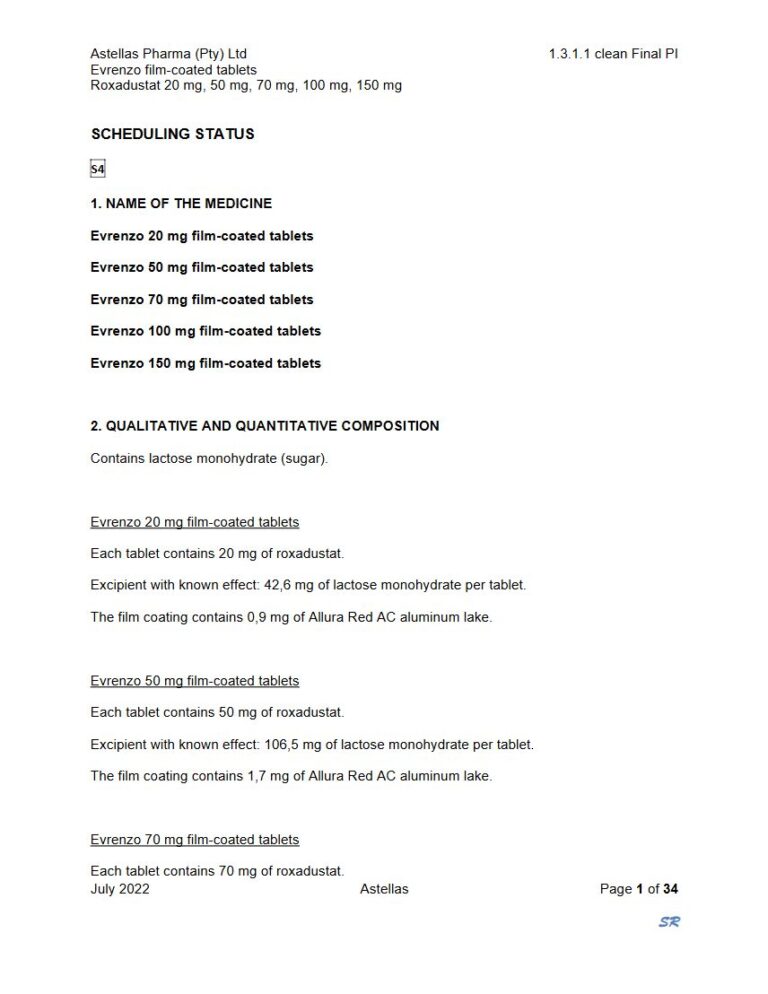
Evrenzo 20 Mg/50 Mg/70 Mg/100 Mg/150 Mg Tablets
PDF Leaflet Revision Date: July 2022
Clinical Summary
Quick overview from the medicine insert
Indication
Treatment of anaemia in adult patients with chronic kidney disease (CKD).
Dosage (summary)
Oral, three times per week; starting dose 70 mg (under 100 kg) or 100 mg (100 kg and over).
Special Populations
- Elderly
- Hepatic impairment
- Paediatric population
Pregnancy & Breastfeeding
Contraindicated in pregnancy and breastfeeding.
Key Drug Interactions
- CYP2C8 inhibitors (e.g., gemfibrozil)
- Phosphate binders
Contraindications
- Hypersensitivity to roxadustat
- Pregnancy
- Breastfeeding
- Children under 18 years
Common side effects
- Seizures
- Nausea
- Vascular Access Thrombosis (VAT)
- Deep Vein Thrombosis (DVT)
Counselling Points
- Take orally with or without food.
- Do not chew or crush tablets.
- Monitor for signs of infection.
Serious warnings
- Monitor haemoglobin levels to avoid excessive increases.
- Risk of seizures in predisposed patients.
Important Disclaimer
The Evrenzo 20 Mg/50 Mg/70 Mg/100 Mg/150 Mg Tablets professional information leaflet below is the property of Astellas Pharma and is provided on Medinsert exactly as issued, with no.. alterations or editorial changes. We make every effort to keep content current by updating documents as soon as new versions become available. Medinsert serves as a trusted access point for healthcare professionals, but does not replace official sources or clinical judgement. For more details, please read our full disclaimer. read more>>
 Healthcare Professionals Only
This content is for registered healthcare professionals
Sign in or create a free account to read the full package insert.
Free for HPCSA-registered professionals. Powered by Medinsert.
Clinical Particulars
Section 4 of the official insert — extracted exactly as issued, no alterations
4.1 Therapeutic indications
Evrenzo is indicated for treatment of anaemia in adult patients with chronic kidney disease (CKD).
4.2 Posology and method of administration
Leave the blisters in the carton until required for use. Treatment with Evrenzo should be initiated by a medical practitioner experienced in the management of anaemia.
Posology
The appropriate dose of Evrenzo must be taken orally three times per week and not on consecutive days. The dose of Evrenzo should be individualised to achieve and maintain target haemoglobin levels of 10 to 12 g/dL as described below.
Starting dose at treatment initiation
Adequate iron stores should be ensured prior to initiating treatment with Evrenzo.
Patients not currently treated with an Erythropoiesis Stimulating Agent (ESA)
For patients initiating anaemia treatment not previously treated with ESA the recommended starting dose of Evrenzo is 70 mg three times per week in patients weighing less than 100 kg and 100 mg three times per week in patients weighing 100 kg and over.
Patients converting from an Erythropoiesis Stimulating Agent (ESA)
For patients converting anaemia therapy from ESA to roxadustat, the recommended starting dose of Evrenzo is based on the average prescribed ESA dose in the 4 weeks before conversion (see Table 1). The first roxadustat dose should replace the next scheduled dose of the current ESA.
Table 1: Starting doses of Evrenzo to be taken three times per week in patients converting from an ESA
Darbepoetin alfa Epoetin Methoxy polyethylene glycol-epoetin beta Roxadustat dose (milligrams three times per week)
- Less than 25 Less than 5,000 Less than 80 70
- 25 to less than 40 5,000 up to 8,000 80 up to and including 120 100
- 40 up to and > 8,000 up to and More than 120 up to 150
- including 80 including 16,000 and including 200
- More than 80 More than 16,000 More than 200 200
Dose adjustment and haemoglobin monitoring
The individualised maintenance dose ranges from 20 mg to 400 mg three times per week (see section maximum recommended dose). Haemoglobin levels should be monitored every two weeks until the desired haemoglobin level of 10-12 g/dL is achieved and stabilised, and every 4 weeks thereafter, or as clinically indicated. The dose of Evrenzo can be adjusted stepwise up or down from the starting dose 4 weeks after treatment start, and every 4 weeks thereafter. When adjusting the dose of Evrenzo, consider the current haemoglobin level and the recent rate of change in haemoglobin level over the past 4 weeks, and follow the dose adjustment steps according to the dose adjustment algorithm described in Table 2.
Table 2: Dose adjustment rules
Change in Current haemoglobin (Hb) level (g/dL): Hb over the Lower than 10,5 to 11,9 12,0 to 12,9 13,0 or higher previous 4 10,5 weeks*
- Change is No change Reduce dose Reduce dose Withhold dosing, monitor Hb value of by one step by one step level and resume dosing when more than Hb is less than 12,0 g/dL, at a +1,0 g/dL dose that is reduced by two steps
- Change is Increase dose No change Reduce dose value by one step by one step between -1,0 and +1,0 g/dL
- Change is Increase dose Increase dose No change value of by one step by one step less than -1,0 g/dL
The dose of Evrenzo should not be adjusted more frequently than once every 4 weeks, except if haemoglobin (Hb) increases by more than 2 g/dL at any time within a 4-week period, in which case the dose should be reduced by one step immediately.
*Change in Hb over the previous 4 weeks = (present Hb value) u2013 (previous Hb value drawn 4 weeks ago). If additional dose reduction is required for a patient already on the lowest dose (20 mg three times per week), do not reduce the 20 mg dose by breaking the tablet, but reduce the dose frequency to twice per week. If further dose reduction is needed, the dose frequency may be further reduced to once weekly.
Maintenance Dose: After stabilisation to target haemoglobin levels between 10 to 12 g/dL, the haemoglobin levels should continue to be monitored regularly and the dose adjustment rules must be followed (see Table 2).
Patients starting dialysis while on roxadustat treatment: No specific dose adjustment is required for CKD patients who start dialysis while on treatment with roxadustat. Normal dose adjustment rules (see Table 2) should be followed.
Concomitant roxadustat treatment with inducers or inhibitors: When initiating or discontinuing concomitant treatment with strong inhibitors (e.g. gemfibrozil) or inducers (e.g. rifampicin) of CYP2C8, or inhibitors (e.g. probenecid) of UGT1A9: the haemoglobin levels should be monitored and the dose adjustment rules must be followed (see Table 2; see also section 4.5 and 5.2).
Maximum recommended dose
Patients not on dialysis: do not exceed a roxadustat dose of 3 mg/kg body weight or 300 mg three times per week, whichever is lower. Patients on dialysis: do not exceed a roxadustat dose of 3 mg/kg body weight or 400 mg three times per week, whichever is lower.
Missed dose
If an Evrenzo dose is missed, and there is more than 1 day until the next scheduled dose, the missed dose must be taken as soon as possible. If one day or less remains before the next scheduled Evrenzo dose, the missed dose must be skipped and the next Evrenzo dose must be taken on the next scheduled day. In each case, the regular dosing schedule should be resumed thereafter.
Special populations
Paediatric population: Safety and efficacy of roxadustat in paediatric patients under 18 years of age have not been established. Evrenzo should therefore not be used in children (see section 4.3).
Elderly: No adjustment of the starting dose is required in elderly patients (see section 5.2).
Patients with hepatic impairment: No adjustment of the starting dose level is required in patients with mild hepatic impairment (Child-Pugh class A) (see section 4.4 and 5.2). The safety and efficacy of roxadustat have not been studied in CKD patients with concurrent moderate or severe hepatic impairment (Child-Pugh class B and C). Caution is recommended when prescribing roxadustat to CKD patients with concurrent moderate or severe hepatic impairment. Consider using a lower starting dose in these patients (see sections 4.4 and 5.2).
Method of administration: Evrenzo tablets are taken orally with or without food. The tablets must be swallowed whole and not chewed, broken or crushed. The tablets should be taken at least 1 hour before or 1 hour after administration of phosphate binders (except lanthanum) or other (medicinal) products containing multivalent cations such as calcium, iron, magnesium or aluminium) (see sections 4.5 and 5.2). The tablets can be taken before or after dialysis (see section 5.2).
4.3 Contraindications
Evrenzo is contraindicated in the following conditions:
- Hypersensitivity to roxadustat or to any of the excipients (see section 6.1).
- Breastfeeding (see sections 4.6 and 5.3).
- Pregnancy (see sections 4.6 and 5.3).
- Children under 18 years (see section 4.2).
4.4 Special warnings and precautions for use
Vascular Access Thrombosis (VAT)
Vascular access thrombosis was reported as very common amongst the patients on dialysis in clinical trials (see section 4.8). In patients on dialysis rates of VAT in Evrenzo-treated patients were highest in the first 12 weeks following initiation of Evrenzo, at haemoglobin values more than 12 g/dL and in the setting of haemoglobin rise of more than 2 g/dL over 4 weeks. Closely monitor haemoglobin levels and adjust the dose of Evrenzo using the dose adjustment rules (see Table 2) to avoid haemoglobin levels of more than 12 g/dL and haemoglobin rise of more than 2 g/dL over 4 weeks. Patients with VAT should be evaluated and treated according to standard of care. The effect of interrupting or discontinuing roxadustat in this setting is unknown.
Seizures
Seizures were reported as common amongst the patients in clinical trials receiving Evrenzo (see section 4.8). Evrenzo should be used with caution in patients with a history of seizures (convulsions or fits), epilepsy or medical conditions associated with a predisposition to seizure activity such as CNS infections. The effect of interrupting or discontinuing roxadustat in this setting is unknown.
Serious infections
Patients with signs and symptoms of an infection should be promptly evaluated and treated according to standard of care. In patients not on dialysis serious infections occurred in 18,9 % (12,4 patients with events per 100 patient years of exposure) in the Evrenzo group and 12,9 % (10,6 patients with events per 100 patient years of exposure) in the placebo group. Fatal infections occurred in 3,0 % (1,8 patients with events per 100 patient years of exposure) in the Evrenzo group vs 1,0 % (0,7 patients with events per 100 patient years of exposure) in the placebo group. The most commonly reported serious infections were pneumonia, sepsis and urinary tract infections. In patients on dialysis the numerical imbalance of serious and fatal infections was not observed between patients treated with Evrenzo and patients treated with ESAs. A causal relationship between Evrenzo and serious infections has not been established.
Deep Vein Thrombosis (DVT)
Deep vein thrombosis was reported as common amongst the patients in clinical trials (see section 4.8). The majority of DVT events were serious. Patients with signs and symptoms of DVT should be promptly evaluated and treated according to standard of care. The effect of interrupting or discontinuing Evrenzo in this setting is unknown.
Hepatic impairment
The safety and efficacy of Evrenzo have not been confirmed in patients with CKD and moderate or severe hepatic impairment (Child-Pugh class B and C) (see section 4.2).
Excipients
Evrenzo contains lactose monohydrate (sugar). Patients with rare hereditary problems of galactose intolerance, total lactase deficiency or glucose-galactose malabsorption should not take this medicine. Evrenzo contains Allura Red AC aluminium lake (see section 6.1) which may cause allergic reactions.
4.5 Interaction with other medicines and other forms of interaction
Effect of other medicines on Evrenzo
Phosphate binders and other products containing multivalent cations
Co-administration of Evrenzo with sevelamer carbonate or calcium acetate decreased the plasma exposure of Evrenzo (see section 5.2). Evrenzo should be taken at least 1 hour before or after administration of phosphate binders or other medicines or supplements containing multivalent cations such as calcium, iron, magnesium or aluminium (see section 4.2). This restriction does not apply to lanthanum carbonate, as the co-administration of Evrenzo with lanthanum carbonate did not result in a clinically meaningful change in the plasma exposure of roxadustat.
Modifiers of CYP2C8 activity
Co-administration of Evrenzo with gemfibrozil, an inhibitor of CYP2C8 and OATP1B1, increased the plasma exposure of roxadustat (see section 5.2). Monitor haemoglobin levels when initiating or discontinuing concomitant treatment with gemfibrozil or other strong inhibitors or inducers of CYP2C8. Adjust the dose of Evrenzo following dose adjustment rules (see Table 2) based on haemoglobin monitoring.
Modifiers of UGT1A9 activity
Roxadustat is a substrate of UGT1A9. Co-administration of Evrenzo with probenecid, an inhibitor of UGT and OAT1/OAT3, increased the plasma exposure of roxadustat (see section 5.2). Monitor haemoglobin levels when initiating or discontinuing concomitant treatment with probenecid or other inhibitors of UGT1A9. Adjust the dose of Evrenzo following dose adjustment rules (see Table 2) based on haemoglobin monitoring.
Effects of Evrenzo on other medicines
OATP1B1 or BCRP Substrates
Roxadustat is an inhibitor of BCRP and OATP1B1. These transporters play an important role in the intestinal and hepatic uptake and efflux of statins. Co-administration of 200 mg of Evrenzo with simvastatin, rosuvastatin or atorvastatin increased the plasma exposure of each of the statins by 2- to 3-fold (see section 5.2). Interactions are also expected with other statins. When co-administered with Evrenzo, consider this interaction, monitor for adverse reactions associated with statins and for the need of statin dose reduction. Refer to statin prescribing information when deciding on the appropriate statin dose for individual patients. Evrenzo may increase the plasma exposure of other medicines that are substrates of BCRP or OATP1B1. Monitor for possible adverse reactions of co-administered medicines and adjust dose accordingly.
Evrenzo and ESAs
Evrenzo has not been studied in combination with ESAs.
4.6 Fertility, pregnancy and lactation
Pregnancy, women of childbearing potential and contraception
Evrenzo is contraindicated for use in pregnant women and females of reproductive potential not using effective contraception because of the potential for foetal harm based on animal data (see section 4.3 and section 5.3). There are currently no human data to establish the presence or absence of drug-associated risk with the use of Evrenzo during pregnancy.
Breastfeeding
Women must not breastfeed during treatment with Evrenzo (see section 5.3), because of the potential for adverse reactions from Evrenzo in a breastfed infant.
Fertility
Women of reproductive potential should use effective contraception for at least one week prior to start with Evrenzo and until after the last dose of Evrenzo is taken. At a maternally toxic dose, increased embryonic loss was observed (see section 5.3).
4.7 Effects on ability to drive and use machines
Evrenzo has negligible influence on the ability to drive and use machines. However, it can cause seizures and dizziness. Therefore, patients should not drive or operate machinery when using Evrenzo (see section 4.8).
4.8 Undesirable effects
Summary of the safety profile
The total safety database from clinical trials comprised 13 063 subjects (CKD patients and healthy volunteers), including 7 821 subjects treated with Evrenzo, 3 129 with ESAs and 2 113 with placebo. In the non-dialysis controlled Phase 3 studies 3 154 CKD patients were treated with Evrenzo (4 641 PEY) versus 1 935 with placebo and 423 with ESAs. In dialysis phase 3 studies 3 004 CKD patients were treated with Evrenzo (4 341 PEY) versus 2 612 with ESAs.
Identified adverse reactions associated with Evrenzo are vascular access thrombosis (VAT), seizures, deep vein thrombosis (DVT) and nausea.
Tabulated list of adverse drug reactions
Adverse drug reactions in Table 3 are listed according to MedDRA system organ class and frequency category. Frequency categories are defined using the following convention: very common ( u2265 1/10); common (u22651/100 to <1/10); uncommon (u22651/1,000 to <1/100); rare (u22651/10,000 to <1/1,000); very rare (<1/10,000).
Table 3: Adverse drug reactions following treatment with Evrenzo
System Organ Class Frequency category Adverse drug reaction (MedDRA)
- Nervous System Disorders Common Seizures
- Gastrointestinal Disorders Common Nausea
- Vascular Disorders Very Common Vascular Access Thrombosis (VAT)
- Common Deep Vein Thrombosis (DVT)
Description of selected adverse reactions
Vascular Access Thrombosis (VAT)
Vascular access thrombosis was reported as very common amongst the patients on dialysis in clinical trials. Haemoglobin levels must be monitored closely (see section 4.4). In patients on dialysis, vascular access thrombosis was observed in 12,8 % (7,6 patients with events per 100 patient years of exposure) in the Evrenzo group, compared to 10,2 % (5,4 patients with events per 100 patient years of exposure) in the ESA group.
Seizures
Seizures were reported as common amongst the patients in clinical trials receiving Evrenzo (see section 4.4). In patients not on dialysis, seizures occurred in 1,1 % (0,6 patients with events per 100 patient years of exposure) in the Evrenzo group, and 0,2 % (0,2 patients with events per 100 patient years of exposure) in the placebo group. In patients on dialysis, seizures occurred in 2,0 % (1,2 patients with events per 100 patient years of exposure) in the Evrenzo group, and 1,6 % (0,8 patients with events per 100 patient years of exposure) in the ESA group.
Deep vein thrombosis (DVT)
Deep vein thrombosis was reported as common amongst the patients in clinical trials. The majority of DVT events were serious. In patients not on dialysis, DVT events were uncommon, occurring in 1,0 % (0,6 patients with events per 100 patient years of exposure) in the Evrenzo group, and 0,2 % (0,2 patients with events per 100 patient years of exposure) in the placebo group. In patients on dialysis, DVT events occurred in 1,3 % (0,8 patients with events per 100 patient years of exposure) in the Evrenzo group and 0,3 % (0,1 patients with events per 100 patient years of exposure) in the ESA group.
Reporting suspected adverse reactions after authorisation of the medicine is important. It allows continued monitoring of the benefit/risk balance of the medicine. Health care providers are asked to report any suspected adverse reactions to SAHPRA via the u201c6.04 Adverse Drug Reactions Reporting Formu201d, found online on SAHPRAu2019s website: https://primaryreporting.who-umc.org/Reporting/Reporter?OrganizationID=ZA or Astellas Pharma (Pty) Ltd., 7 Mirage Road, Bedfordview, 2007, South Africa Tel: +27 11 615 9433 Mobile: +27 82 410 8864 Email: [email protected]
4.9 Overdose
Single supratherapeutic doses of Evrenzo 5 mg/kg (up to 510 mg) in healthy subjects were associated with a transient increase in heart rate, an increased frequency of mild to moderate musculoskeletal pain, headaches, sinus tachycardia, and less commonly, low blood pressure, all these findings were non-serious. Evrenzo overdose can elevate haemoglobin levels above the desired level (10-12 g/dL), which should be managed with discontinuation or reduction of Evrenzo dosage (see section 4.2) and careful monitoring and treatment as clinically indicated.
