
Flomax 0.4mg Sustained Release Capsule
PDF Leaflet Revision Date: 2 June 2020
Clinical Summary
Quick overview from the medicine insert
Indication
Treatment of functional symptoms of benign prostatic hyperplasia (BPH) in adult males.
Dosage (summary)
One capsule daily after breakfast.
Onset of Action / Duration
Onset: 6 hours, Duration: 13 hours
Special Populations
- Renal impairment
- Hepatic insufficiency
Pregnancy & Breastfeeding
Not indicated for use in women; safety in pregnancy and lactation not established.
Key Drug Interactions
- Strong CYP3A4 inhibitors
- Cimetidine
- Furosemide
Contraindications
- Hypersensitivity to tamsulosin
- Orthostatic hypotension
- Hepatic insufficiency
Common side effects
- Dizziness
- Ejaculation disorders
- Orthostatic hypotension
Counselling Points
- Take after the same meal daily
- Monitor for dizziness
- Inform surgeon if scheduled for eye surgery
Serious warnings
- Risk of orthostatic hypotension
- Intraoperative Floppy Iris Syndrome (IFIS)
Important Disclaimer
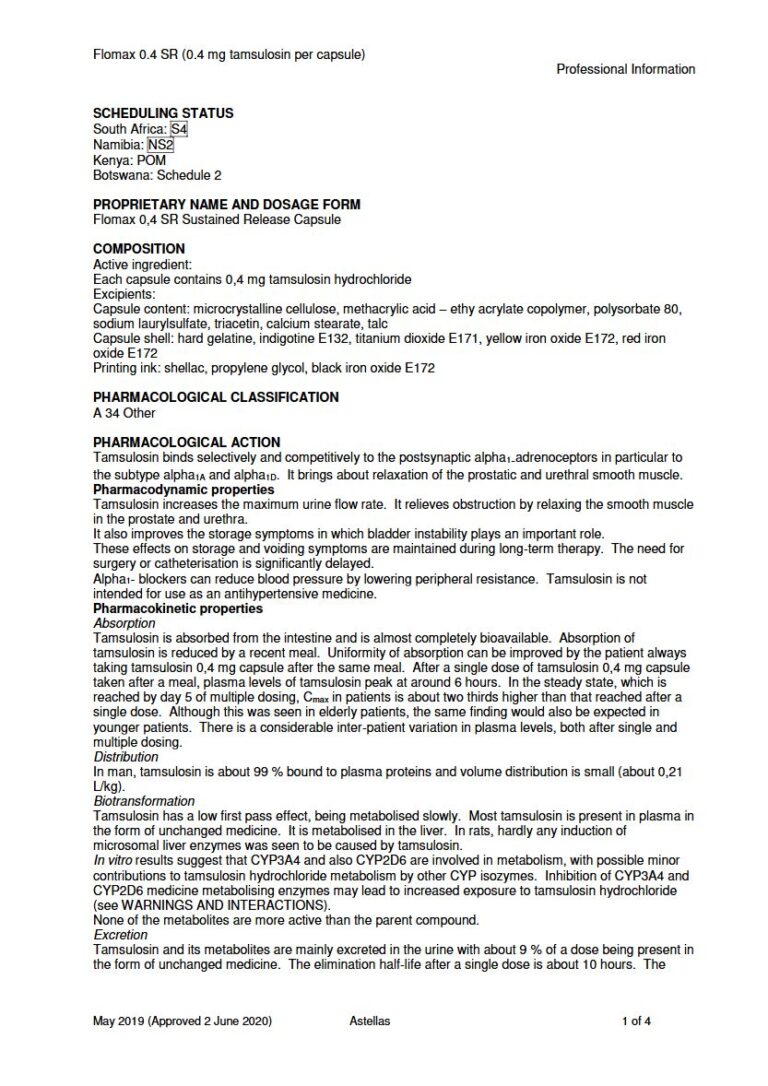
The Flomax 0.4mg Sustained Release Capsule professional information leaflet below is the property of Astellas Pharma and is provided on Medinsert exactly as issued, with no.. alterations or editorial changes. We make every effort to keep content current by updating documents as soon as new versions become available. Medinsert serves as a trusted access point for healthcare professionals, but does not replace official sources or clinical judgement. For more details, please read our full disclaimer. read more>>
 Healthcare Professionals Only
This content is for registered healthcare professionals
Sign in or create a free account to read the full package insert.
Free for HPCSA-registered professionals. Powered by Medinsert.
Clinical Particulars
Section 4 of the official insert — extracted exactly as issued, no alterations
4.1 Therapeutic indications
Flomax 0, 4 SR is indicated for the treatment of functional symptoms of benign prostatic hyperplasia (BPH) in adult males. Efficacy in children with neurogenic bladder has not been demonstrated.
4.2 Posology and method of administration
One capsule daily to be taken after breakfast or the first meal of the day. The capsule should be swallowed whole and must not be crunched or chewed, as this will interfere with the sustained release property of the active ingredient. No dose adjustment is warranted in renal impairment. No dose adjustment is warranted in patients with mild to moderate hepatic insufficiency (see Contraindications). Paediatric population: There is no indication for use of Flomax 0,4 SR in children. The safety and efficacy of tamsulosin in children <18 years have not been established.
4.3 Contraindications
Hypersensitivity to tamsulosin hydrochloride, or any other components of Flomax 0.4 SR. A history of orthostatic hypotension. Hepatic insufficiency. Flomax 0,4 SR should not be used in combination with strong inhibitors of CYP3A4, e.g. ketoconazole (see INTERACTIONS).
4.4 Special warnings and precautions for use
A decrease in blood pressure can take place during therapy with Flomax 0,4 SR, as a result of which orthostatic hypotension and syncope can occur. At the first signs of orthostatic hypotension (dizziness, weakness), the patient should sit or lie down until the symptoms have disappeared. Before therapy with Flomax 0,4 SR is initiated, the patient should be examined in order to exclude the presence of other conditions which can cause the same symptoms as benign prostatic hyperplasia. Digital rectal examination, and when necessary, determination of prostate specific antigen (PSA) should be performed before treatment and at regular intervals afterwards. The treatment of patients with severe renal impairment (creatinine clearance of <10 ml/min) should be approached with caution, as these patients have not been studied. The u201cIntraoperative Floppy Iris Syndromeu201d (IFIS, a variant of small pupil syndrome) has been observed during cataract and glaucoma surgery in some patients previously treated with Flomax 0,4 SR. IFIS may increase the risk of eye complications during and after the operation. Discontinuing Flomax 0,4 SR 1 to 2 weeks prior to cataract or glaucoma surgery is anecdotally considered helpful, but the benefit of treatment discontinuation has not yet been established. IFIS has also been reported in patients who had discontinued Flomax 0,4 SR for a longer period prior to eye surgery. The initiation of therapy with Flomax 0,4 SR in patients for whom cataract or glaucoma surgery is scheduled is not recommended. During pre-operative assessment, surgeons and ophthalmic teams should consider whether patients scheduled for cataract or glaucoma surgery are being or have been treated with Flomax 0,4 SR in order to ensure that appropriate measures will be in place to manage the IFIS during surgery. Flomax 0,4 SR should not be given in combination with strong inhibitors of CYP3A4 in patients with poor metaboliser CYP2D6 phenotype. Flomax 0,4 SR should be used with caution in combination with strong and moderate inhibitors of CYP3A4 (see Interactions). Flomax 0,4 SR is intended for adult male patients only.
4.5 Interactions with other medicines
No interactions have been seen when Flomax 0,4 SR was given concomitantly with either atenolol, enalapril, or theophylline. Concomitant cimetidine brings about a rise in plasma levels of tamsulosin and concomitant furosemide brings about a fall, but as levels remain within the normal range dosages need not be changed. Diazepam, propanolol, trichlormethazide, chlormadinone, amitriptyline, diclofenac, glibenclamide, simvastatin and warfarin do not change the free fraction of tamsulosin in human plasma, in vitro. Neither does tamsulosin change the free fractions of diazepam, propanolol, trichlormethiazide and chlormadinone. Diclofenac and warfarin, may increase the elimination rate of tamsulosin. Concomitant administration of Flomax 0,4 SR with strong inhibitors of CYP3A4 may lead to increased exposure to tamsulosin hydrochloride. Concomitant administration with ketoconazole (a known strong CYP3A4 inhibitor) resulted in an increase in AUC and C max of tamsulosin hydrochloride by a factor of 2.8 and 2.2, respectively. Since CYP2D6 poor metabolisers cannot be readily identified and the potential for significant increase in tamsulosin hydrochloride exposure exists when Flomax 0,4 SR is co-administered with strong CYP3A4 inhibitors in CYP2D6 poor metabolisers, Flomax 0,4 SR should not be given in combination with strong inhibitors of CYP3A4 (see Contraindications). Flomax 0,4 SR should be given with caution in combination with moderate inhibitors of CYP3A4. Concomitant administration of Flomax 0,4 SR with paroxetine, a strong inhibitor of CYP2D6, resulted in a C max and AUC of tamsulosin that increased by a factor of 1.3 and 1.6, respectively, but these increases are not considered clinically relevant. Concurrent administration of other alpha 1 -adrenoceptor antagonists could lead to hypotensive effects.
4.6 Fertility, pregnancy and lactation
Flomax 0,4 SR is not indicated for use in women. Fertility: Ejaculation disorders have been observed in short and longterm clinical studies with tamsulosin. Events of ejaculation disorder, retrograde ejaculation and ejaculation failure have been reported post-marketing.
4.7 Effects on ability to drive and use machines
No data is available on whether Flomax 0,4 SR adversely affects the ability to drive or operate machinery. However, in this respect, patients should be aware of the fact that dizziness may occur.
4.8 Undesirable effects
The following medicine related side-effects have been reported during the use of Flomax 0,4 SR: Common: >1/100, 1/1000, 1/10 000,<1/1000 Very rare: <1/10,000 Nervous system disorders Common: Dizziness Uncommon: Headache Rare: Syncope Cardiac disorders Uncommon: Palpitations Vascular disorders Uncommon: Orthostatic hypotension Respiratory, thoracic and mediastinal disorders Uncommon: Rhinitis Gastrointestinal disorders Uncommon: Constipation, diarrhoea, nausea, vomiting Skin and subcutaneous tissue disorders Uncommon: Rash, pruritus, urticaria Rare: Angioedema Very rare: Stevens-Johnson Syndrome Reproductive system disorders Common: Ejaculation disorders including retrograde ejaculation and ejaculation failure Very Rare: Priapism General disorders and administrative site conditions Uncommon: Aesthenia Post-marketing experience (Frequency unknown): Eye Disorders: Blurred vision, visual impairment Respiratory, thoracic and mediastinal disorders: Epistaxis Skin and subcutaneous tissue disorders Erythema multiforme, exfoliative dermatitis In addition to the adverse events listed above, atrial fibrillation, dysrhythmia, tachycardia and dyspnoea have been reported in association with Flomax 0,4 SR use.
4.9 Overdose
Symptoms: Overdosage with Flomax 0,4 SR may result in severe hypotensive effects. Severe hypotensive effects have been observed at different levels of overdosing. The highest dose of Flomax 0,4 SR accidentally given to a single patient was 12 mg, resulting in headache but not requiring hospitalization. Treatment: In case of acute hypotension occurring after overdosage, cardiovascular support should be given. Blood pressure can be restored and heart rate brought back to normal, by lying the patient down. If this does not help then volume expanders, and when necessary, vasopressors could be employed. Renal function should be monitored and general supportive measures applied. Dialysis is unlikely to be of help as tamsulosin is very highly bound to plasma proteins. Measures such as emesis can be taken to impede absorption. When large quantities are involved, activated charcoal and an osmotic laxative, such as sodium sulphate, can be administered.
