
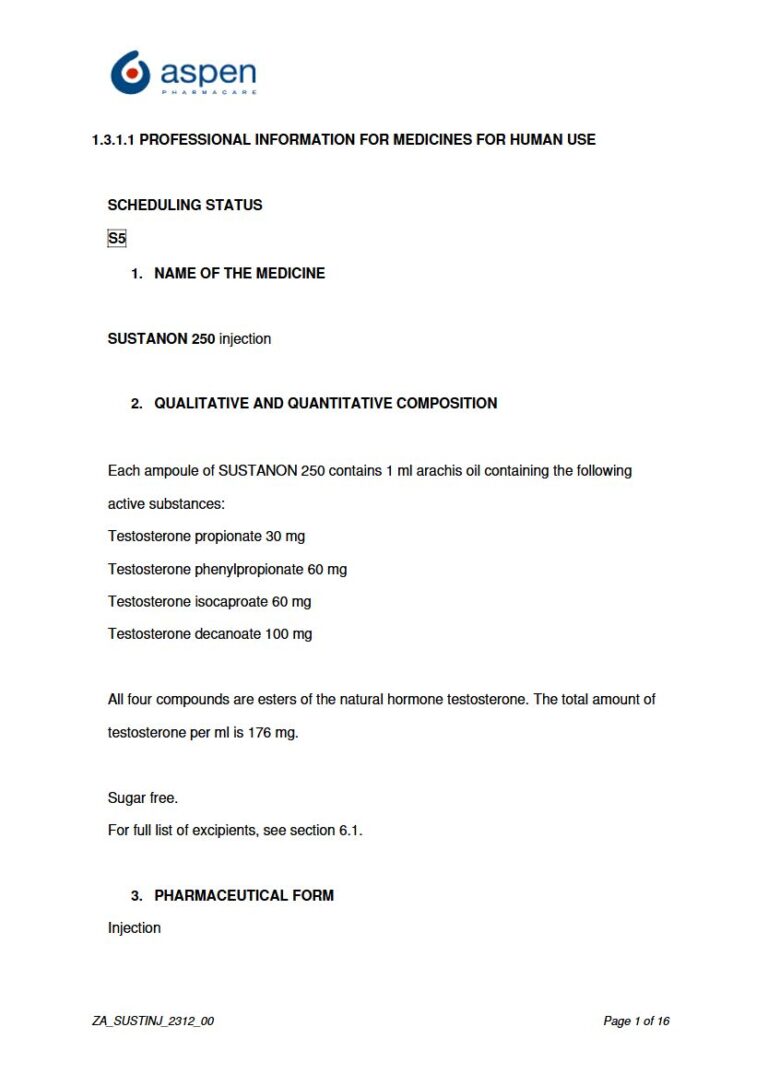
Sustanon 1 ml Injections
PDF Leaflet Revision Date: 21 December 2023
Clinical Summary
Quick overview from the medicine insert
Indication
Testosterone replacement therapy in males with confirmed hypogonadism.
Dosage (summary)
1 ml injection every three weeks for adults.
Special Populations
- Elderly
- Renal impairment
- Hepatic impairment
Pregnancy & Breastfeeding
Contraindicated in pregnancy and lactation due to risk of virilisation.
Key Drug Interactions
- Warfarin
- Insulin
- Corticosteroids
Contraindications
- Hypersensitivity to testosterone
- Prostatic carcinoma
- Breast carcinoma
Common side effects
- Polycythaemia
- Fluid retention
- Mood disturbances
- Hypertension
- Gynaecomastia
Counselling Points
- Monitor testosterone levels regularly
- Avoid use in sports without consulting WADA
- Discuss risks of discontinuation with healthcare provider
Serious warnings
- Risk of heart attack and stroke
- Potential for virilisation
- Thrombotic events
Important Disclaimer
The Sustanon 1 ml Injections professional information leaflet below is the property of Pharmacare and is provided on Medinsert exactly as issued, with no.. alterations or editorial changes. We make every effort to keep content current by updating documents as soon as new versions become available. Medinsert serves as a trusted access point for healthcare professionals, but does not replace official sources or clinical judgement. For more details, please read our full disclaimer. read more>>
 Healthcare Professionals Only
This content is for registered healthcare professionals
Sign in or create a free account to read the full package insert.
Free for HPCSA-registered professionals. Powered by Medinsert.
Clinical Particulars
Section 4 of the official insert — extracted exactly as issued, no alterations
4.1 Therapeutic indications
SUSTANON 250 is indicated in adults for:
- Testosterone replacement therapy in males for conditions associated with primary and secondary hypogonadism (either congenital or acquired), only when testosterone deficiency has been confirmed by clinical features and biochemical tests.
4.2 Posology and method of administration
Posology
In general, the dosage should be adjusted according to the response of the individual patient. Safety and efficacy have not been determined in children.
Adults
Usually, one injection of 1 ml every three weeks is adequate.
Paediatric population
Safety and efficacy have not been determined in children and adolescents. Pre-pubertal children treated with SUSTANON 250 should be treated with caution (see section 4.4).
Method of administration
SUSTANON 250 should be administered by deep intramuscular injection.
4.3 Contraindications
SUSTANON 250 is contraindicated in:
- Patients with hypersensitivity to testosterone or any of the excipients of SUSTANON 250, including arachis oil, is therefore contraindicated in patients allergic to peanuts or soya (see section 4.4 and section 6.1).
- Patients with known or suspected prostatic carcinoma or breast carcinoma.
- Pregnancy and lactation (see section 4.6).
4.4 Special warnings and precautions for use
Medical examination
Testosterone level should be monitored at baseline and at regular intervals during treatment. Medical practitioners should adjust the dosage individually to ensure maintenance of eugonadal testosterone levels.
Medical practitioners should consider monitoring patients receiving SUSTANON 250 before the start of treatment, at quarterly intervals for the first 12 months and yearly thereafter for the following parameters:
- digital rectal examination (DRE) of the prostate and PSA to exclude benign prostate hyperplasia or a sub-clinical prostate cancer.
- haematocrit and haemoglobin to exclude polycythemia.
Conditions that need supervision:
Patients, especially the elderly, with the following conditions should be monitored for:
- Tumours
Patients especially the elderly should be monitored for mammary carcinoma, hypernephroma, bronchial carcinoma and skeletal metastases. In these patients hypercalcaemia may develop spontaneously, also during SUSTANON 250 therapy. The latter can be indicative of a positive tumour response to the hormonal treatment. Nevertheless, the hypercalcemia should first be treated appropriately and after restoration of normal calcium levels, hormone therapy can be resumed.
SUSTANON 250 should be used with caution in men suffering from benign prostatic hypertrophy.
Pre-existing conditions
Middle aged and elderly males on treatment for angina pectoris or other circulatory disease should receive SUSTANON 250 only under very careful supervision. Patients on treatment for latent or overt cardiac failure, renal dysfunction, hypertension, epilepsy or migraine (or a history of these conditions) should be kept under close medical supervision, since aggravation or recurrence may be induced by treatment with SUSTANON 250. In such cases treatment must be stopped immediately.
In patients with pre-existing cardiac, renal or hepatic insufficiency/disease, androgen treatment with SUSTANON 250 may cause complications characterised by oedema with or without congestive heart failure. In such cases treatment must be stopped immediately.
Approved testosterone treatment, such as SUSTANON 250 possibly may increase risk of heart attack and strokes. Patients should not stop taking SUSTANON 250 without first discussing any questions or concerns with their health care professionals. Health care professionals should consider whether the benefits of treatment are likely to exceed the potential risks of treatment.
Diabetes mellitus
SUSTANON 250 can improve glucose tolerance and blood glucose control in diabetic patients (see section 4.5).
Anti-coagulant therapy
SUSTANON 250 can enhance the anti-coagulant action of warfarin (see section 4.5).
Sleep apnoea
There is insufficient evidence for a recommendation regarding the safety of treatment with testosterone esters in men with sleep apnoea. Good clinical judgment and caution should be employed in patients with risk factors such as adiposity or chronic lung diseases. SUSTANON 250 in obese males with chronic obstructive pulmonary disease (COPD) may cause sleep apnoea.
Adverse events
If androgen associated adverse reactions occur (see section 4.8), treatment with SUSTANON 250 should be discontinued, and, upon resolution of complaints, and after disappearance of the symptoms, be resumed at a lower dosage. A decrease in protein bound iodine (PBI) may occur, but this has no clinical significance.
Clotting disorders
Testosterone should be used with caution in patients with thrombophilia or risk factors for venous thromboembolism (VTE), as there have been post-marketing studies and reports of thrombotic events (e.g. deep-vein thrombosis, pulmonary embolism, ocular thrombosis) in these patients during testosterone therapy. In thrombophilic patients, VTE cases have been reported even under anticoagulation treatment, therefore continuing testosterone treatment after first thrombotic event should be carefully evaluated. In case of treatment continuation, further measures should be taken to minimise the individual VTE risk.
(Mis)use in sports
The misuse of SUSTANON 250 to enhance ability in sports carries serious health risk. Patients who participate in competitions governed by the World Anti-Doping Agency (WADA) should consult the WADA-code before using this SUSTANON 250, as SUSTANON 250 can interfere with anti-doping testing. The misuse of androgens to enhance ability in sports carries serious health risks and is to be discouraged.
Polycythaemia
Treatment with testosterone, as in SUSTANON 250 decreases serum LDL-C, HDL-C and triglycerides and increases haemoglobin and haematocrit, which may lead to polycythaemia.
Virilisation
Patients should be informed about the potential occurrence of signs of virilisation. In particular, singers and women with speech professions should be informed about the risk of deepening of the voice. The voice changes may be irreversible. If signs of virilisation develop, the risk/benefit ratio has to be newly assessed with the individual patient.
Drug abuse and dependence
Testosterone has been subject to abuse, typically at doses higher than recommended for the approved indications and in combination with other anabolic androgenic steroids. Abuse of testosterone and other anabolic androgenic steroids can lead to serious adverse reactions including: cardiovascular (with fatal outcomes in some cases), hepatic and/or psychiatric events. Testosterone abuse may result in dependence and withdrawal symptoms upon significant dose reduction or abrupt discontinuation of use. The abuse of testosterone and other anabolic androgenic steroids carries serious health risks and is to be discouraged (see section 4.8).
Elderly people
There is limited experience on the safety and efficacy of the use of SUSTANON 250 in patients over 65 years of age. Currently, there is no consensus about age specific testosterone reference values. It should be taken into account that physiologically testosterone serum levels are lower with increasing age.
Paediatric population
SUSTANON 250 should not be used in pre-pubertal boys as premature epiphyseal closure or precocious sexual development may occur. In pre-pubertal children statural growth and sexual development should be monitored since SUSTANON 250 in high dosages may accelerate epiphyseal closure and sexual maturation.
Excipients
SUSTANON 250 contains arachis oil (peanut oil) and should not be administered to patients known to be allergic to peanuts. As there is a possible relationship between allergy to peanut and allergy to soya, patients with soya allergy should also avoid SUSTANON 250 (see section 4.3). SUSTANON 250 contains 100 mg benzyl alcohol per ml solution and must not be given to premature babies or neonates. Benzyl alcohol may cause toxic reactions and anaphylactoid reactions in infants and children up to 3 years old.
4.5 Interaction with other medicines and other forms of interaction
Enzyme-inducing medicines may decrease, and enzyme-inhibiting medicines may increase testosterone levels. Therefore, adjustment of the dose of SUSTANON 250, and/or intervals between injections may be required.
Insulin and other anti-diabetic medicines
SUSTANON 250 may improve glucose tolerance and decrease the need for insulin or other anti-diabetic medicines in diabetic patients, with hypogonadism (see section 4.4). Patients with diabetes mellitus should therefore be monitored especially at the beginning or end of treatment and at periodic intervals during SUSTANON 250 treatment.
Anti-coagulant therapy
High doses of SUSTANON 250 may enhance the anticoagulant action of warfarin and other anti-coagulants (see section 4.4). Therefore, close monitoring of prothrombin time and if necessary, a dose reduction of the warfarin is required during therapy.
ACTH or corticosteroids
The concurrent administration of SUSTANON 250 with ACTH or corticosteroids may enhance oedema formation; thus, these active substances should be administered cautiously, particularly in patients with cardiac or hepatic disease or in patients predisposed to oedema (see section 4.4).
Laboratory test interactions
SUSTANON 250 may decrease levels of thyroxine-binding globulin resulting in decreased total T4 serum levels and increased resin uptake of T3 and T4. Free thyroid hormone levels remain unchanged, however, and there is non-clinical evidence of thyroid dysfunction.
4.6 Fertility, pregnancy, lactation
SUSTANON 250 is contraindicated in pregnancy and lactation.
Pregnancy
SUSTANON 250 is not indicated for treatment in women and therefore must not be used by pregnant or breastfeeding women. If used during pregnancy SUSTANON 250 poses a risk of virilisation of the foetus (see section 4.3).
Breastfeeding
There are no adequate data for the use of SUSTANON 250 during lactation. Therefore, SUSTANON 250 should not be used during lactation.
Fertility
In men, treatment with SUSTANON 250 can lead to fertility disorders by repressing sperm-formation (see section 4.8).
4.7 Effects on ability to drive and use machines
SUSTANON 250 can cause mood disturbances, paranoia and delusion which may influence the ability to drive and operate machines. Patients should not drive, use machinery or perform any tasks that require concentration until they are certain that SUSTANON 250 does not adversely affect their ability to do so safely (see section 4.8).
4.8 Undesirable effects
a) Summary of the safety profile
Due to the nature of SUSTANON 250, side effects cannot be quickly reversed by discontinuing SUSTANON 250. SUSTANON 250 may cause a local reaction at the injection site. The following adverse reactions have been associated with SUSTANON 250. Frequencies are unknown.
b) Tabulated list of adverse reactions
System Organ Class Frequency unknown (cannot be estimated from the available data)
- Neoplasms benign and malignant (including cysts and polyps) Prostatic cancer
- Blood and the lymphatic system disorders Polycythaemia
- Metabolism and nutrition disorders Fluid retention
- Psychiatric disorders Depression, nervousness, mood disturbances, increased libido, decreased libido, aggression
- Vascular disorders Hypertension
- Gastrointestinal disorders Nausea
- Skin and subcutaneous tissue disorders Pruritus, acne
- Musculoskeletal, connective tissue and bone disorders Myalgia
- Reproductive system and breast disorders Gynaecomastia, oligozoospermia, decreased ejaculatory volume, priapism, benign prostatic disorder
- In pre-pubertal boys: precocious sexual development, an increased frequency of erections, priapism, phallic enlargement and premature epiphyseal closure
- Investigations Hepatic function abnormal, abnormal lipids
c) Description of selected adverse reactions
Drug abuse and dependence: Testosterone, often in combination with other anabolic androgenic steroids (AAS), has been subject to abuse at doses higher than recommended for the approved indication (see section 4.4). The following additional adverse reactions have been reported in the context of testosterone/AAS abuse:
- Endocrine disorders: Secondary hypogonadism
- Psychiatric disorders: Hostility, aggression, psychotic disorder, mania, paranoia and delusion.
- Cardiovascular disorders: Myocardial infarction, cardiac failure, cardiac failure chronic, cardiac arrest, sudden cardiac death, cardiac hypertrophy, cardiomyopathy, ventricular dysrhythmia, ventricular tachycardia, venous/arterial thrombotic and embolic events (including deep venous thrombosis, pulmonary embolism, coronary artery thrombosis, carotid artery occlusion, intracranial venous sinus thrombosis), cerebrovascular accident and ischaemic stroke.
- Hepatobiliary disorders: Peliosis hepatis, cholestasis, liver injury, jaundice, hepatic failure.
- Skin and subcutaneous tissue disorders: Alopecia.
- Reproductive system and breast disorders: Testicular atrophy, azoospermia, infertility (in males), enlarged clitoris and breast atrophy (in females).
d) Paediatric population
The following undesirable effects have been reported in pre-pubertal children using androgens (see section 4.4): precocious sexual development, an increased frequency of erections, phallic enlargement and premature epiphyseal closure.
Reporting of suspected adverse reactions
Reporting suspected adverse reactions after authorisation of the medicine is important. It allows continued monitoring of the benefit/risk balance of the medicine. Healthcare providers are asked to report any suspected adverse reactions to to SAHPRA via the u201c6.04 Adverse Drug Reactions Reporting Formu201d, found online under SAHPRAu2019s publications: https://www.sahpra.org.za/Publications/Index/8 Aspen Pharmacare: E-mail: [email protected] Tel: 0800 118 088
4.9 Overdose
Symptoms
The acute toxicity of testosterone is low. If symptoms of chronic overdose occur (e.g. polycythaemia, priapism) treatment should be discontinued and after disappearance of the symptoms, be resumed at a lower dosage (see section 4.8).
Treatment
Treat symptomatically.
