
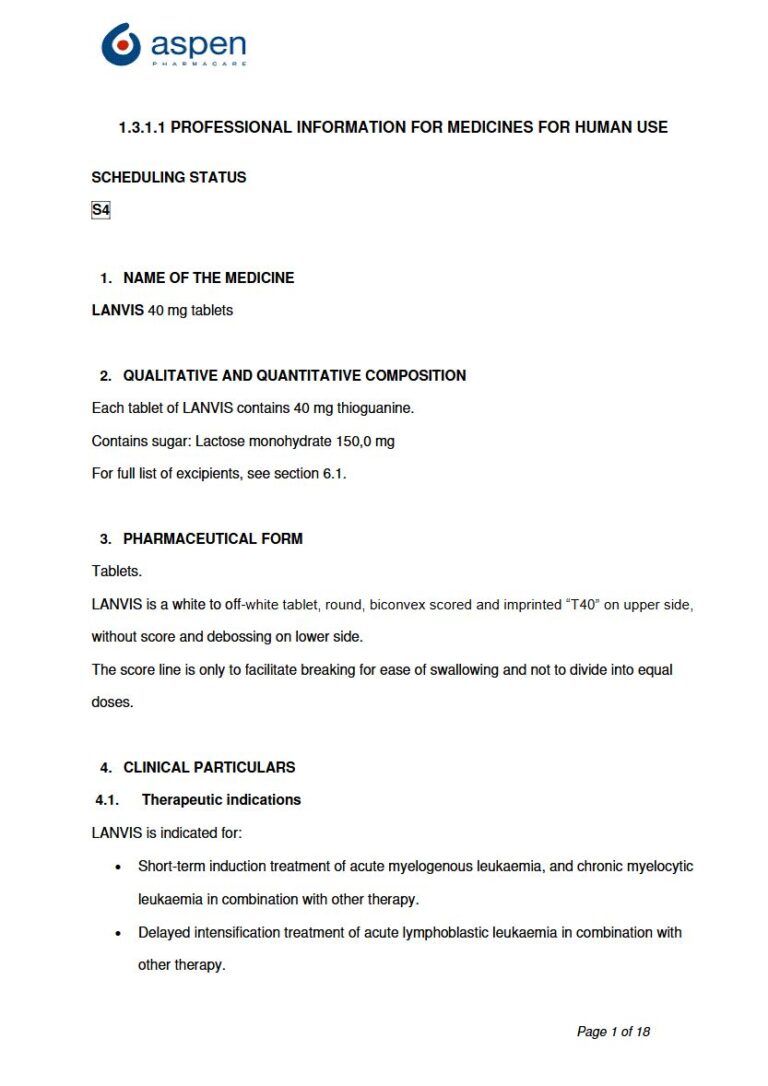
Lanvis 40 mg Tablets.
PDF Leaflet Revision Date: 19 January 2022
Clinical Summary
Quick overview from the medicine insert
Indication
Indicated for acute myelogenous leukaemia and chronic myelocytic leukaemia.
Dosage (summary)
Adults: 60-200 mg/mu00b2/day; adjust for children based on body surface area.
Special Populations
- Elderly population
- Renal impairment
- Hepatic impairment
- TPMT-deficient patients
- NUDT15 variant patients
Pregnancy & Breastfeeding
Avoid in pregnancy; contraindicated in breastfeeding.
Key Drug Interactions
- Live vaccines
- Aminosalicylate derivatives
- Other myelotoxic substances
Contraindications
- Hypersensitivity to thioguanine
- Live vaccines
Common side effects
- Bone marrow suppression
- Hyperuricaemia
- Gastrointestinal intolerance
- Skin rash
- Photosensitivity
Counselling Points
- Avoid sun exposure; use sunscreen.
- Monitor for signs of infection.
- Report unusual bleeding or bruising.
Serious warnings
- High risk of liver toxicity
- Myelosuppression
- Potentially mutagenic and carcinogenic
Important Disclaimer
The Lanvis 40 mg Tablets. professional information leaflet below is the property of Pharmacare and is provided on Medinsert exactly as issued, with no.. alterations or editorial changes. We make every effort to keep content current by updating documents as soon as new versions become available. Medinsert serves as a trusted access point for healthcare professionals, but does not replace official sources or clinical judgement. For more details, please read our full disclaimer. read more>>
 Healthcare Professionals Only
This content is for registered healthcare professionals
Sign in or create a free account to read the full package insert.
Free for HPCSA-registered professionals. Powered by Medinsert.
Clinical Particulars
Section 4 of the official insert — extracted exactly as issued, no alterations
4.1. Therapeutic indications
LANVIS is indicated for:
- Short-term induction treatment of acute myelogenous leukaemia, and chronic myelocytic leukaemia in combination with other therapy.
- Delayed intensification treatment of acute lymphoblastic leukaemia in combination with other therapy.
Cross-resistance exists between LANVIS and mercaptopurine, and generally it is not expected that patients who no longer respond to mercaptopurine will respond to LANVIS or vice versa.
4.2. Posology and method of administration
Posology
The dosage of LANVIS and duration of administration must be carefully adjusted for each patient to obtain optimum benefit without toxic effects. Therapy should be initiated in a specialised unit with full facilities for supportive therapy. The exact dose and duration of administration will depend on the nature and dosage of other cytotoxic medicines given in conjunction with LANVIS. LANVIS is variably absorbed following oral administration and plasma levels may be reduced following emesis or intake of food. LANVIS can be used at any stage prior to maintenance therapy in short-term cycles e.g. induction, consolidation, intensification. However, it is not recommended for use during maintenance therapy or similar long-term continuous treatments due to the high risk of liver toxicity (see section 4.4).
Adults
For adults, the usual dosage of LANVIS is between 60 and 200 mg/m2 body surface area per day.
Paediatric population
For children, similar dosages to those used in adults, with appropriate correction for body surface area, have been used.
Special populations
Elderly population
There are no specific dosage recommendations in elderly patients (see Renal or hepatic impairment below). LANVIS has been used in various combination chemotherapy schedules in elderly patients with acute leukaemia at equivalent doses to those used in younger patients.
Renal or hepatic impairment
Consideration should be given to reducing the dosage in patients with impaired hepatic or renal function, since these will result in slower elimination of the medicine and a greater cumulative effect.
TPMT-deficient patients
Patients with inherited little or no thiopurine S-methyltransferase (TPMT) activity are at increased risk for severe thioguanine toxicity from conventional doses of LANVIS and generally require substantial dose reduction. The optimal starting dose for homozygous deficient patients has not been established (see section 4.4). Most patients with heterozygous TPMT deficiency can tolerate recommended LANVIS doses, but some may require dose reduction. Genotypic and phenotypic tests of TPMT are available (see section 4.4). Consideration should be given to reducing the dosage in patients with impaired hepatic function.
Patients with NUDT15 variant
Patients with inherited mutated NUDT15 gene are at increased risk for severe thiopurine toxicity, such as early leukopenia and alopecia, from conventional doses of LANVIS and generally require substantial dose reduction. Patients of Asian ethnicity are particularly at risk, due to the increased frequency of the mutation in this population. The optimal starting dose for heterozygous or homozygous deficient patients has not been established. Genotypic and phenotypic testing of NUDT15 variants should be considered before initiating LANVIS therapy in all patients (including paediatric patients) to reduce the risk of thiopurine-related severe leukocytopenia and alopecia, especially in Asian populations (see section 5.2). Close monitoring of blood counts is necessary.
Method of administration
For oral administration. If halving a tablet is required, care should be taken not to contaminate the hands or inhale the medicine (see section 6.6).
4.3. Contraindications
LANVIS is contraindicated in:
- Patients with hypersensitivity to thioguanine or to any of the excipients in LANVIS (see section 6.1).
- Live vaccines must not be used on patients receiving LANVIS (see section 4.4).
4.4. Special warnings and precautions for use
LANVIS IS AN ACTIVE CYTOTOXIC MEDICINE FOR USE ONLY UNDER THE DIRECTION OF MEDICAL PRACTITIONERS EXPERIENCED IN THE ADMINISTRATION OF SUCH MEDICINES.
Immunisation
Immunisation using a live organism vaccine has the potential to cause infection in immunocompromised hosts. Therefore, immunisations with live organism vaccines are contraindicated. In all cases, patients in remission should not receive live organism vaccines until at least 3 months after their chemotherapy treatment has been completed (see section 4.3).
Hepatic effects
LANVIS SHOULD NOT BE USED FOR MAINTENANCE THERAPY OR SIMILAR LONG TERM CONTINUOUS TREATMENTS DUE TO THE HIGH RISK OF LIVER TOXICITY ASSOCIATED WITH VASCULAR ENDOTHELIAL DAMAGE (see section 4.2 and section 4.8). This liver toxicity has been observed in a high proportion of children receiving LANVIS as part of maintenance therapy for acute lymphoblastic leukaemia and in other conditions associated with continuous use of LANVIS. This liver toxicity is particularly prevalent in males. Liver toxicity usually presents as the clinical syndrome of hepatic veno-occlusive disease (hyperbilirubinaemia, tender hepatomegaly, weight gain due to fluid retention and ascites) or with signs of portal hypertension (splenomegaly, thrombocytopaenia and oesophageal varices). Histopathological features associated with this toxicity include hepatoportal sclerosis, nodular regenerative hyperplasia, peliosis hepatis and periportal fibrosis. LANVIS therapy should be discontinued in patients with evidence of liver toxicity, as reversal of signs and symptoms of liver toxicity have been reported upon withdrawal.
Monitoring
Patients must be carefully monitored during therapy, including blood cell counts and weekly liver function tests. Early indications of liver toxicity are signs associated with portal hypertension such as thrombocytopaenia out of proportion with neutropenia and splenomegaly. Elevations of liver enzymes have also been reported in association with liver toxicity but do not always occur.
Haematological effects
Treatment with LANVIS causes bone marrow suppression leading to leukopaenia and thrombocytopaenia (see Hepatic effects). Anaemia has been reported less frequently. Bone marrow suppression is usually reversible if LANVIS is withdrawn early enough.
Thiopurine S-methyltransferase (TPMT) deficiency
There are individuals with an inherited deficiency of the enzyme thiopurine methyltransferase (TPMT) who may be unusually sensitive to the myelosuppressive effect of LANVIS and prone to developing rapid bone marrow depression following the initiation of treatment with LANVIS. This problem could be exacerbated by co-administration with medicines that inhibit TPMT, such as olsalazine, mesalazine or sulphasalazine. Some laboratories offer testing for TPMT deficiency, although these tests have not been shown to identify all patients at risk of severe toxicity. Therefore, close monitoring of blood counts is still necessary.
NUDT15 mutation
Patients with inherited mutated NUDT15 gene are at increased risk for severe thiopurine toxicity, such as early leukopenia and alopecia, from conventional doses of LANVIS therapy and generally require substantial dose reduction. Patients of Asian ethnicity are particularly at risk, due to the increased frequency of the mutation in this population. The optimal starting dose for heterozygous or homozygous deficient patients has not been established. Genotypic and phenotypic testing of NUDT15 variants should be considered before initiating LANVIS therapy in all patients (including paediatric patients) to reduce the risk of thiopurine-related severe leukocytopenia and alopecia, especially in Asian populations (see section 5.2).
During remission induction in acute myelogenous leukaemia the patient may frequently have to survive a period of relative bone marrow aplasia and it is important that adequate supportive facilities are available. Patients on myelosuppressive chemotherapy are particularly susceptible to a variety of infections. During remission induction, particularly when rapid cell lysis is occurring, adequate precautions should be taken to avoid hyperuricaemia and/or hyperuricosuria and the risk of uric acid nephropathy (see section 4.8).
Monitoring
SINCE LANVIS IS STRONGLY MYELOSUPPRESIVE FULL BLOOD COUNTS MUST BE CARRIED OUT FREQUENTLY DURING REMISSION INDUCTION. PATIENTS MUST BE CAREFULLY MONITORED DURING THERAPY. The leucocyte and platelet counts continue to fall after treatment is stopped, so at the first sign of an abnormally large fall in these counts, treatment should be temporarily discontinued.
Lesch-Nyhan Syndrome
Since the enzyme hypoxanthine guanine phosphoribosyl transferase is responsible for the conversion of LANVIS to its active metabolite, it is possible that patients deficient in this enzyme, such as those suffering from Lesch-Nyhan syndrome, may be resistant to the medicine. Resistance to azathioprine, which has one of the same active metabolites as LANVIS, has been demonstrated in children with Lesch-Nyhan syndrome.
Exposure to ultraviolet light
Patients treated with LANVIS are more sensitive to the sun. Exposure to sunlight and UV light should be limited, and patients should be recommended to wear protective clothing and to use a sunscreen with a high protection factor.
Bone marrow depression
If bone marrow depression occurs, the following precautions should be exercised: 1) avoiding exposure of patient to persons with bacterial infections. 2) consult a medical practitioner immediately if there is unusual bleeding or bruising. 3) care must be taken to avoid accidental cuts with sharp objects. 4) avoiding contact sports or any other situations where bruising or injury may occur.
Risk benefit
Risk-benefit should be considered when the following pre-existing medical problems are present: 1) bone marrow depression 2) chickenpox 3) herpes zoster 4) gout 5) renal stones 6) hepatic function impairment 7) infection and 8) renal function impairment. Caution must be exercised in patients who have had therapy with cytotoxic medicines and radiation during the last 4 to 6 weeks prior to treatment with LANVIS.
Mutagenicity and carcinogenicity
In view of its action on DNA, LANVIS is potentially mutagenic and carcinogenic.
Excipients
Patients with rare hereditary problems of galactose intolerance, total lactase deficiency or glucosegalactose malabsorption should not take LANVIS.
4.5. Interaction with other medicines and other forms of interaction
Serious Medicine Interactions
- Potential of serious infection after vaccinations with live organism vaccines (see below).
- Increased risk of myelosuppression during concomitant administration with other cytotoxic medicines or radiation therapy (see below).
- Increased toxicities when LANVIS is concomitantly used with aminosalicylate derivatives (e.g. olsalazine, mesalazine or sulphasalazine, see below).
Other myelotoxic substances or radiation therapy
During concomitant administration of other myelotoxic substances or radiation therapy, the risk of myelosuppression is increased.
Busulphan
The combination of busulphan and LANVIS has resulted in the development of nodular regenerative hyperplasia, portal hypertension and oesophageal varices.
Allopurinol
The concomitant use of allopurinol to inhibit uric acid formation does not necessitate reduction of dosage of LANVIS.
Aminosalicylate derivatives
As there is in vitro evidence that aminosalicylate derivatives (e.g. olsalazine, mesalazine or sulphasalazine) inhibit the TPMT enzyme, they should be administered with caution to patients receiving concurrent LANVIS therapy (see section 4.4).
Blood dyscrasia-causing medicines
e.g. ACE-inhibitors, anticonvulsants, antidepressants, NSAIDs, chloramphenicol: leukopenic and/or thrombocytopenic effects of LANVIS may be increased by concurrent or recent use of such medicines.
Killed virus vaccines
Normal defence mechanisms may be suppressed by LANVIS therapy; the patient's antibody response to the vaccine may be decreased.
Live virus vaccines
Normal defence mechanisms may be suppressed by LANVIS therapy; concurrent use with a live virus vaccine may potentiate the replication of the vaccine virus; may increase the adverse effects of the vaccine virus and/or may decrease the patient's antibody response to the vaccine (see section 4.3).
4.6. Fertility, pregnancy and lactation
LANVIS, like other cytotoxic medicines, is potentially teratogenic.
Pregnancy
LANVIS should be avoided whenever possible during pregnancy, particularly during the first trimester.
Contraception in males and females
As with all cytotoxic chemotherapy, adequate contraceptive precautions must be advised when either partner is receiving LANVIS.
Fertility
There have been reports of men who have received combinations of cytotoxic medicines, including thioguanine, as in LANVIS, and have fathered children with congenital abnormalities.
Breastfeeding
Mothers receiving LANVIS should not breastfeed (see section 4.3).
4.7. Effects on ability to drive and use machines
LANVIS has no or negligible influence on the ability to drive and operate machinery. Patients should not drive, use machinery or perform any tasks that require concentration until they are certain that LANVIS does not adversely affect their ability to do so safely (see section 4.8).
4.8. Undesirable effects
a) Tabulated list of adverse reactions
System organ class
- Frequent
- Less frequent
- Frequency unknown
Blood and the lymphatic system disorders
- Bone marrow suppression, bone marrow failure
Metabolism and nutrition disorders
- Hyperuricaemia, loss of appetite
Gastrointestinal disorders
- Stomatitis, gastrointestinal intolerance, diarrhoea, intestinal necrosis, perforation, necrotizing colitis, nausea, vomiting, gastrointestinal disorder
Hepato-biliary disorders
- Veno-occlusive liver disease
- Centrilobular hepatic necrosis
Skin and subcutaneous tissue disorders
- Skin rash or itching
- Photosensitivity
Renal and urinary disorders
- Hyperuricosuria, urate nephropathy
b) Description of selected adverse reactions
Hepato-biliary disorders
Liver toxicity associated with vascular endothelial damage when LANVIS is used in maintenance or similar long-term continuous therapy, which is not recommended (see section 4.2 and section 4.4). Usually presenting as the clinical syndrome of hepatic veno-occlusive disease (hyperbilirubinaemia, tender hepatomegaly, weight gain due to fluid retention and ascites) or signs and symptoms of portal hypertension (splenomegaly, thrombocytopaenia and oesophageal varices). Elevation of liver transaminases, alkaline phosphatase and gamma glutamyl transferase and jaundice may also occur. Histopathological features associated with this toxicity include hepatoportal sclerosis, nodular regenerative hyperplasia, peliosis hepatis and periportal fibrosis. Liver toxicity during short-term cyclical therapy presenting as veno-occlusive disease. Reversal of signs and symptoms of this liver toxicity has been reported upon withdrawal of short-term or long-term continuous therapy, but reversal may not be seen and patients may still develop portal hypertension. Centrilobular hepatic necrosis has been reported in a few cases including patients receiving combination chemotherapy, oral contraceptives, high-dose thioguanine and alcohol.
4.9. Overdose
Symptoms
Signs and symptoms of overdosage may be immediate, such as nausea, vomiting, anorexia, malaise, stomatitis, hypotension and diaphoresis; or delayed, such as myelosuppression and azotaemia. It is not known whether thioguanine is dialysable.
Treatment
There is no known antagonist to LANVIS and therefore prompt discontinuation of LANVIS is essential when toxicity develops, so as to avoid irreversible depression of the bone marrow. Haematology should be closely monitored and blood and transfusion (platelets, granylocytes), instituted if necessary.
