
Zolasol 4 mg Powder for concentrate for solution for infusion
PDF Leaflet Revision Date: 31 May 2024
Clinical Summary
Quick overview from the medicine insert
Indication
Treatment of metastatic ovarian carcinoma and small cell lung carcinoma.
Dosage (summary)
1.5 mg/mu00b2 IV daily for 5 days, repeat every 3 weeks; adjust for neutropenia.
Onset of Action / Duration
Onset: 8-11.7 weeks for ovarian cancer; 6.1 weeks for small cell lung cancer.
Special Populations
- Renal impairment
- Hepatic impairment
Pregnancy & Breastfeeding
Contraindicated in pregnancy and breastfeeding; may cause fetal harm.
Key Drug Interactions
- Increased myelosuppression with other cytotoxic agents.
Contraindications
- Severe hypersensitivity to topotecan
- Severe bone marrow depression
- Pregnancy
- Breastfeeding
Common side effects
- Neutropenia
- Thrombocytopenia
- Nausea
- Vomiting
- Diarrhea
Counselling Points
- Use effective contraception during and after treatment.
- Report signs of infection or bleeding.
- Avoid pregnancy during treatment.
Serious warnings
- Severe myelosuppression
- Risk of interstitial lung disease
- Monitor for neutropenic colitis
Important Disclaimer
The Zolasol 4 mg Powder for concentrate for solution for infusion professional information leaflet below is the property of Ando Pharma and is provided on Medinsert exactly as issued, with no.. alterations or editorial changes. We make every effort to keep content current by updating documents as soon as new versions become available. Medinsert serves as a trusted access point for healthcare professionals, but does not replace official sources or clinical judgement. For more details, please read our full disclaimer. read more>>
 Healthcare Professionals Only
This content is for registered healthcare professionals
Sign in or create a free account to read the full package insert.
Free for HPCSA-registered professionals. Powered by Medinsert.
Clinical Particulars
Section 4 of the official insert — extracted exactly as issued, no alterations
4.1 Therapeutic indications
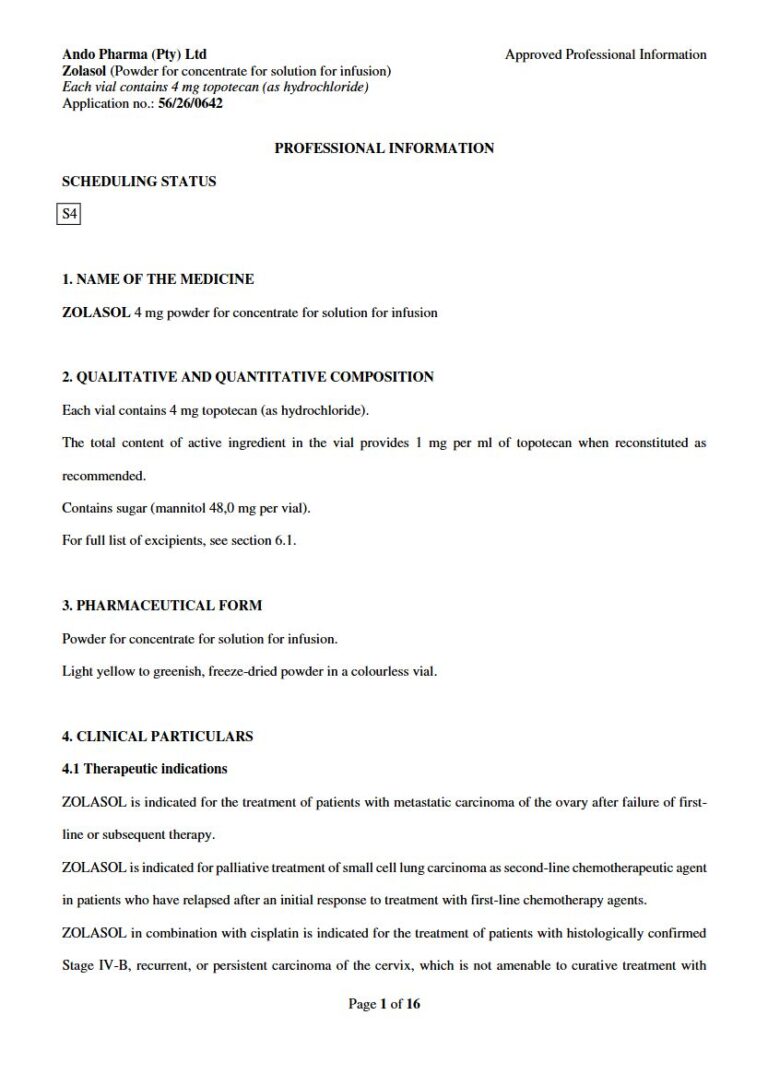
ZOLASOL is indicated for the treatment of patients with metastatic carcinoma of the ovary after failure of first-line or subsequent therapy. ZOLASOL is indicated for palliative treatment of small cell lung carcinoma as second-line chemotherapeutic agent in patients who have relapsed after an initial response to treatment with first-line chemotherapy agents. ZOLASOL in combination with cisplatin is indicated for the treatment of patients with histologically confirmed Stage IV-B, recurrent, or persistent carcinoma of the cervix, which is not amenable to curative treatment with surgery and/or radiation therapy.
4.2 Posology and method of administration
ZOLASOL should be administered under the direction of a medical practitioner experienced in the use of cytotoxic medicines (see section 6.6). Appropriate management of complications is possible only when adequate diagnostic and treatment facilities are readily available.
Posology
Prior to administration of the first course of ZOLASOL patients must have a baseline neutrophil count of more than or equal to 1,5 x 10⁹/l, a platelet count of more than or equal to 100 x 109/l and a haemoglobin level of more than or equal to 9 g/dl (after transfusion if necessary).
Ovarian and small cell lung carcinoma
Initial dose: The recommended dose of ZOLASOL is 1,5 mg/m2 per day administered by intravenous infusion over 30 minutes daily for 5 consecutive days with a 3 week interval between the start of each course. A minimum of 4 courses is recommended unless patient progresses since median time to response in clinical trials was 8 - 11,7 weeks in ovarian cancer and 6,1 weeks in small cell lung cancer.
Subsequent doses: ZOLASOL should not be re-administered unless the neutrophil count is u2265 1 x 10⁹/l, the platelet count is u2265 100 x 109/l, and the haemoglobin level is u2265 9 g/dl (after transfusion if necessary). If dose reduction is chosen for patients who experience severe neutropenia (neutrophil count u2264 0,5 x 10⁹/l) for 7 days or more, or severe neutropenia associated with fever or infection, or who have had treatment delayed due to neutropenia, the dose should be reduced by 0,25 mg/m2/day to 1,25 mg/m2/day (or subsequently down to 1,0 mg/m2/day if necessary). Doses should be similarly reduced if the platelet count falls below 25 x 109/l. In clinical trials, topotecan was discontinued if the dose had been reduced to 1,0 mg/m2 and a further dose reduction was required to manage adverse effects.
Dosage in combination: Dose adjustment may be necessary if ZOLASOL is administered in combination with other cytotoxic medicines.
Cervical cancer
Initial dose: The recommended dose of ZOLASOL is 0,75 mg/m2 administered as a 30 minute intravenous infusion daily on days 1, 2 and 3. Cisplatin is administered as an intravenous infusion on day 1 at a dose of 50 mg/m2 and following the ZOLASOL dose. This treatment schedule is repeated every 21 days for 6 courses or until progressive disease.
Subsequent doses: ZOLASOL should not be re-administered unless the neutrophil count is u2265 1,5 x 10⁹/l, the platelet count is u2265 100 x 109/l, and the haemoglobin level is u2265 9 g/dl (after transfusion if necessary). Patients who experience severe neutropenia (neutrophil count less than 0,5 x 10⁹/u2113) for seven days or more, or severe neutropenia associated with fever or infection or who have had treatment delayed due to neutropenia should have the dose of ZOLASOL reduced by 20 % to 0,60 mg/m2/day for subsequent courses (or subsequently down 0,45 mg/m2/day). Doses of ZOLASOL should be similarly reduced if the platelet count falls below 25 x 109/l.
Special populations
Patients with renal impairment
Monotherapy: The recommended dose in patients with creatinine clearance between 20 and 39 ml/min is 0,75 mg/m2/day. No dosage adjustment is required in patients with a creatinine clearance u2265 40 ml/min. Insufficient data is available to make a recommendation for patients with a creatinine clearance < 20 ml/min. Advice on dosing of ZOLASOL for patients with moderate renal impairment (20 to 39 ml/min) is based on studies involving patients with advanced ovarian and small cell lung cancer.
Combination therapy: It is recommended that ZOLASOL in combination with cisplatin for the treatment of cervical cancer only be initiated in patients with serum creatinine less than or equal to 1,5 mg/dl. If, during ZOLASOL/cisplatin combination therapy serum creatinine exceeds 1,5 mg/dl, it is recommended that the full prescribing information be consulted for any advice on cisplatin dose reduction/continuation. If cisplatin is discontinued, there are insufficient data regarding continuing monotherapy with ZOLASOL in patients with cervical cancer.
Patients with hepatic impairment: No dosage adjustment is required in patients with hepatic impairment (serum bilirubin u2265 1,5 to u2264 10 mg/dl). Hepatically impaired patients were able to tolerate 1,5 mg/m2 for five days every three weeks although a small reduction in topotecan clearance was observed.
Paediatric population: Use in children is not recommended as only limited data are available.
Method of administration
For intravenous use. ZOLASOL must be reconstituted and further diluted before use (see section 6.6).
4.3 Contraindications
- History of severe hypersensitivity reactions to topotecan or any of the excipients listed in 6.1.
- Pregnancy or breastfeeding (see section 4.6).
- Severe bone marrow depression prior to starting first course, as evidenced by baseline neutrophils <1,5 x 10⁹l L and/or a platelet count of u2264100 x 109/l.
4.4 Special warnings and precautions for use
Haematological toxicity is dose-related and full blood count including platelets should be determined regularly (see section 4.2). ZOLASOL can cause severe myelosuppression. Myelosuppression leading to sepsis and fatalities due to sepsis have been reported in patients treated with topotecan (see section 4.8). Topotecan-induced neutropenia can cause neutropenic colitis. Fatalities due to neutropenic colitis have been reported in clinical studies with topotecan, as contained in ZOLASOL. In patients presenting with fever, neutropenia and a compatible pattern of abdominal pain, the possibility of neutropenic colitis should be considered. Topotecan, as in ZOLASOL, has been associated with reports of interstitial lung disease (ILD), some of which have been fatal (see section 4.8). Underlying risk factors include history of ILD, pulmonary fibrosis, lung cancer, thoracic exposure to radiation and use of pneumotoxic medicines and/or colony stimulating factors. Patients should be monitored for pulmonary symptoms indicative of ILD (e.g., cough, fever, dyspnoea and/or hypoxia), and ZOLASOL should be discontinued if a new diagnosis of ILD is confirmed. It is recommended that ZOLASOL is not used as a single medicine therapy in first-line patients. ZOLASOL monotherapy and in combination with cisplatin are commonly associated with clinically relevant thrombocytopenia. This should be taken into account when prescribing ZOLASOL, e.g., if patients at increased risk of tumour bleeds are considered for therapy. As would be expected, patients with poor performance status (PS > 1) have a lower response rate and an increased incidence of complications such as fever, infection, and sepsis (see section 4.8). Accurate assessment of performance status at the time therapy is given is important, to ensure that patients have not deteriorated to PS 3. There is insufficient experience of the use of ZOLASOL in patients with severely impaired renal function (creatinine clearance <20 ml/min) or severely impaired hepatic function (serum bilirubin u2265 10 mg/dl) due to cirrhosis. Use of ZOLASOL in these patient groups is not recommended (see section 4.2). ZOLASOL contains less than 1 mmol sodium (23 mg) per dose, that is to say essentially u201csodium freeu201d. However, if 0,9 % sodium chloride BP intravenous infusion is used for the dilution of ZOLASOL prior to administration then the dose of sodium received would be higher.
4.5 Interaction with other medicines and other forms of interaction
No in vivo human pharmacokinetic interaction studies have been performed. Topotecan does not inhibit human P450 enzymes (see section 5.2). It has been reported in population studies using the intravenous route, that the co-administration of granisetron, ondansetron, morphine or corticosteroids did not appear to have a significant effect on the pharmacokinetics of total topotecan (active and inactive form). There is an increased risk of myelosuppression when ZOLASOL is used in combination with other cytotoxic medicines, (e.g. paclitaxel or etoposide) thereby necessitating dose reduction. When combining ZOLASOL with other chemotherapy agents, reduction of the doses of each medicine may be required to improve tolerability. However, when combining with platinum agents, there is a distinct sequence-dependent interaction depending on whether the platinum agent is given on day 1 or 5 of the ZOLASOL dosing. If either cisplatin or carboplatin is given on day 1 of ZOLASOL dosing, a lower dose of each medicine must be given to improve tolerability compared to the dose of each medicine which can be given if the platinum agent is given on day 5 of ZOLASOL dosing. It has been reported when topotecan (0,75 mg/m2/day for 5 consecutive days) and cisplatin (60 mg/m2/day on day 1) were administered in 13 patients with ovarian cancer, a slight increase in AUC (12 %) and C max (23 %) was noted on day 5. This increase is considered unlikely to be of clinical relevance.
4.6 Fertility, pregnancy and lactation
Women of child-bearing potential / Contraception in males and females
ZOLASOL may cause foetal harm and therefore women of childbearing potential should be advised to avoid becoming pregnant during therapy with ZOLASOL. Patients being treated with ZOLASOL must be advised that they or their partner must use an effective method of contraception. Women of childbearing potential should be instructed to use effective contraceptive measures while on treatment with ZOLASOL and for 6 months following completion of treatment. Men with female partners of childbearing potential are recommended to use effective contraceptive measures and to not father a child while receiving ZOLASOL and for 3 months following completion of treatment.
Pregnancy
Topotecan has been shown to cause embryo-foetal lethality and malformations in preclinical studies. ZOLASOL may cause foetal harm when administered to pregnant women and therefore is contraindicated during pregnancy (see section 4.3).
Breastfeeding
ZOLASOL is contraindicated during breastfeeding (see section 4.3). Although it is not known whether topotecan is excreted in human breast milk, it is recommended that breastfeeding be discontinued when receiving ZOLASOL.
Fertility
No effects on male or female fertility have been observed in reproductive toxicity studies in rats. However, ZOLASOL is genotoxic and effects on fertility, including male fertility, cannot be excluded.
4.7 Effects on ability to drive and use machines
Caution should be exercised when driving or operating machines if fatigue and asthenia persist.
4.8 Undesirable effects
Summary of the safety profile
It has been reported in dose-finding studies, that the dose-limiting toxicity was found to be haematological. Toxicity was predictable and reversible. No evidence of cumulative haematological or non-haematological toxicity was seen in patients. In patients with small cell lung or ovarian carcinoma, the onset of neutropenia and thrombocytopenia was generally within 2 weeks of treatment and in the majority of cases lasted no more than 7 days. In 11 % of courses severe neutropenia lasted more than 7 days. The most frequently reported treatment-related or possibly related non-haematological effects were gastrointestinal such as nausea, vomiting and diarrhoea, constipation, and mucositis. These were usually mild at the recommended dose level. No evidence of significant cardiotoxicity, neurotoxicity or major organ toxicity was observed with topotecan. The safety profile of ZOLASOL when given in combination with cisplatin in cervical cancer is consistent with that seen with ZOLASOL monotherapy. The overall haematological toxicity is lower in patients treated with ZOLASOL in combination with cisplatin compared to ZOLASOL monotherapy, but higher than with cisplatin alone. Additional adverse events were reported when topotecan was given in combination with cisplatin; however, these events were seen with cisplatin monotherapy and were not attributable to ZOLASOL. The prescribing information for cisplatin should be consulted for a full list of adverse events associated with cisplatin use.
Tabulated list of adverse reactions
System organ class
Frequent
Less frequent
Frequency not known
Infections and infestations
Infection, sepsis
Blood and lymphatic system disorders
Febrile neutropenia, neutropenia (see u201cGastrointestinal disordersu201d), thrombocytopenia, anaemia, leukopenia, pancytopenia
Severe bleeding (associated with thrombocytopenia)
Immune system disorders
Hypersensitivity reaction
Anaphylactic reaction, including rash
angioedema, urticaria
Metabolism and nutrition disorders
Anorexia (which may be severe)
Respiratory, thoracic, and mediastinal disorders
Interstitial lung disease (some cases have been fatal)
Gastrointestinal disorders
Nausea, vomiting and diarrhoea (all of which may be severe), constipation, abdominal pain, mucositis
Gastrointestinal perforation
Hepatobiliary disorders
Hyperbilirubinaemia
Skin and subcutaneous tissue disorders
Alopecia, pruritus
General disorders and administration site conditions
Pyrexia, asthenia, fatigue, malaise
Extravasation
Mucosal inflammation
1 Fatalities due to sepsis have been reported in patients treated with topotecan (see section 4.4).
2 Neutropenic colitis, including fatal neutropenic colitis, has been reported to occur as a complication of topotecan-induced neutropenia (see section 4.4).
3 Reactions have been mild and have not generally required specific therapy.
The adverse events listed in the table above have the potential to occur with a higher frequency in patients who have a poor performance status (see section 4.4).
Description of selected adverse reactions
The frequencies associated with the haematological and non-haematological adverse events listed below represent the adverse event reports considered to be related/possibly related to topotecan therapy such as ZOLASOL.
Haematological
Neutropenia: Severe (neutrophil count < 0,5 x 10⁹/l) during course 1 in 55 % of patients, with duration u2265 seven days in 20 %, and overall, in 77 % of patients (39 % of courses). In association with severe neutropenia, fever or infection occurred in 16 % of patients during course 1 and overall, in 23 % of patients (6 % of courses). Median time to onset of severe neutropenia was nine days and the median duration was seven days. Severe neutropenia lasted beyond seven days in 11 % of courses overall. Among all patients treated in clinical studies (including both those with severe neutropenia and those who did not develop severe neutropenia), 11 % (4 % of courses) developed fever and 26 % (9 % of courses) developed infection. In addition, 5 % of all patients treated (1 % of courses) developed sepsis (see section 4.4).
Thrombocytopenia: Severe (platelets < 25 x 109/l) in 25 % of patients (8 % of courses); moderate (platelets between 25,0 and 50,0 x 10⁹/l) in 25 % of patients (15 % of courses). Median time to onset of severe thrombocytopenia was day 15 and the median duration was five days. Platelet transfusions were given in 4 % of courses. Reports of significant sequelae associated with thrombocytopenia, including fatalities due to tumour bleeds, have been infrequent.
Anaemia: Moderate to severe (Hb u2264 8,0 g/dl) in 37 % of patients (14 % of courses). Red cell transfusions were given in 52 % of patients (21 % of courses).
Non-haematological
Frequently reported non-haematological effects were gastrointestinal, such as nausea (52 %), vomiting (32 %), diarrhoea (18 %), constipation (9 %) and mucositis (14 %). The incidence of severe (Grade 3 or 4) nausea, vomiting, diarrhoea, and mucositis was 4, 3, 2 and 1 %, respectively. Mild abdominal pain was reported in 4 % of patients. Fatigue was observed in approximately 25 % and asthenia in 16 % of patients receiving topotecan. Severe (Grade 3 or 4) fatigue and asthenia both occurred with an incidence of 3 %. Total or pronounced alopecia was observed in 30 % of patients and partial alopecia in 15 % of patients. Other severe events that were recorded as related or possibly related to topotecan treatment were anorexia (12 %), malaise (3 %) and hyperbilirubinaemia (1 %). Hypersensitivity reactions including rash, urticaria, angioedema and anaphylactic reactions have been reported less frequently. Rash was reported in 4 % of patients and pruritus in 1,5 % of patients.
Reporting of suspected adverse reactions
Reporting suspected adverse reactions after authorisation of the medicine is important. It allows continued monitoring of the benefit/risk balance of the medicine. Healthcare providers are asked to report any suspected adverse reactions to SAHPRA via the u201c6.04 Adverse Drug Reactions Reporting Formu201d, found online under SAHPRAu2019s publications: https://www.sahpra.org.za/Publications/Index/8.
4.9 Overdose
There is no known antidote for topotecan overdose. The primary complications of overdosage are anticipated to be bone marrow suppression and mucositis.
