
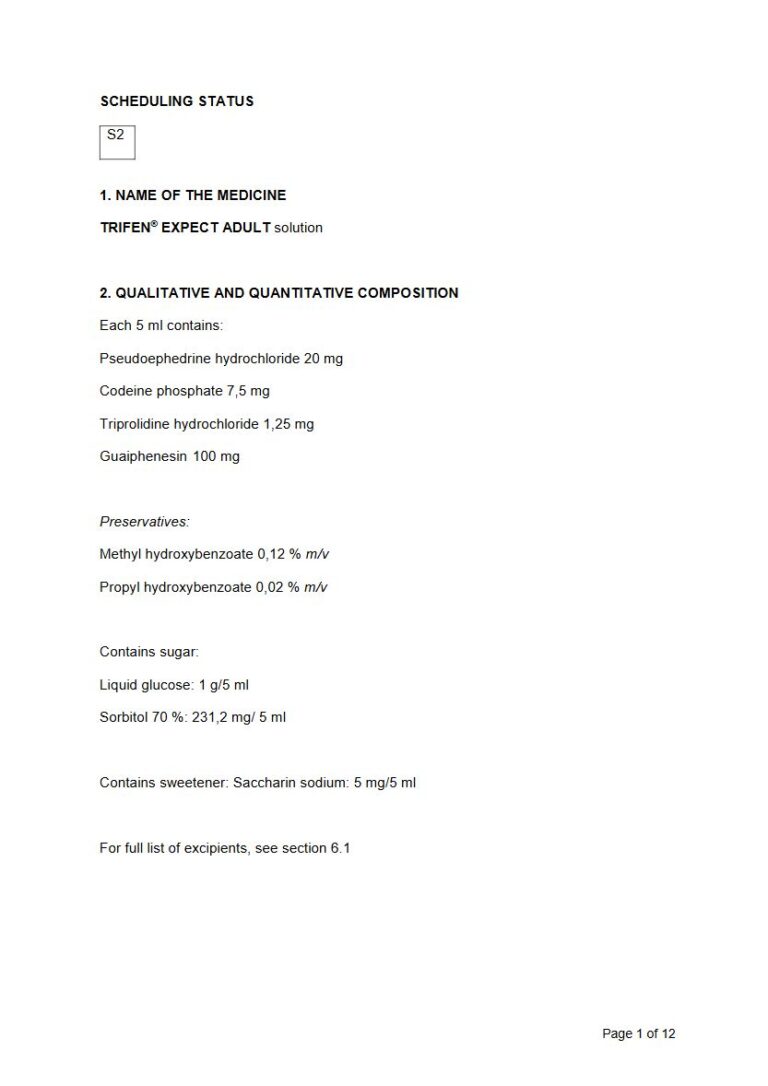
Trifen Expect Adult 5 ml Solution
PDF Leaflet Revision Date: 13 March 2023
Clinical Summary
Quick overview from the medicine insert
Indication
Alleviation of cough.
Dosage (summary)
5 ml to 10 ml three times a day for adults and children over 12 years.
Special Populations
- Elderly
- Debilitated patients
- Patients with renal impairment
- Patients with liver impairment
Pregnancy & Breastfeeding
Safety during pregnancy and lactation not established.
Key Drug Interactions
- Sympathomimetics
- Monoamine oxidase inhibitors
- Alcohol
- Tricyclic antidepressants
Contraindications
- Hypersensitivity to components
- Cardiovascular disease
- Hypertension
- Thyrotoxicosis
- Prostatism
- Narrow angle glaucoma
- Acute alcoholism
- Bronchial asthma attack
Common side effects
- Drowsiness
- Dry mouth
- Nausea
- Constipation
- Dizziness
Counselling Points
- Avoid alcohol while taking this medication.
- Do not exceed prescribed dose.
- Report any unusual side effects.
Serious warnings
- Risk of dependency and addiction
- Caution in patients with heart disease
- May impair ability to drive or operate machinery
Important Disclaimer
The Trifen Expect Adult 5 ml Solution professional information leaflet below is the property of Ranbaxy Pharmaceuticals and is provided on Medinsert exactly as issued, with no.. alterations or editorial changes. We make every effort to keep content current by updating documents as soon as new versions become available. Medinsert serves as a trusted access point for healthcare professionals, but does not replace official sources or clinical judgement. For more details, please read our full disclaimer. read more>>
 Healthcare Professionals Only
This content is for registered healthcare professionals
Sign in or create a free account to read the full package insert.
Free for HPCSA-registered professionals. Powered by Medinsert.
Clinical Particulars
Section 4 of the official insert — extracted exactly as issued, no alterations
4.1 Therapeutic indications
TRIFEN u00ae EXPECT ADULT is indicated for the alleviation of cough.
4.2 Posology and method of administration
Adults and children over 12 years: 5 ml to 10 ml three times a day.
4.3 Contraindications
- Hypersensitivity to pseudoephedrine hydrochloride, codeine phosphate, triprolidine hydrochloride, guaiphenesin or to any of the excipients listed in section 6.1.
- Cardiovascular disease (especially coronary insufficiency),
- Hypertension.
- Thyrotoxicosis.
- Prostatism.
- Bladder dysfunction.
- Narrow angle glaucoma.
- Phaeochromocytoma.
- Patients being treated with monoamine oxidase inhibitors and within two weeks of stopping such treatment.
- Ephedrine and other sympathomimetic medicines as a hypertensive response may result.
- Acute alcoholism.
- During the acute attack of bronchial asthma.
- Head injuries and where the intracranial pressure is raised.
- Heart failure secondary to chronic lung disease.
- Respiratory depression, especially in the presence of cyanosis and excessive bronchial secretion.
4.4 Special warnings and precautions for use
Exceeding the prescribed dose, together with prolonged and continuous use of this medication, may lead to dependency and addiction. Pseudoephedrine HCl should be given with caution to patients with organic heart disease, cardiac decompensation or angina of effort. In patients with prostatic enlargement, it may cause difficulty with micturition. TRIFEN u00ae EXPECT ADULT should be used with caution in patients with aneurisms, cardiac arrhythmias (e.g. tachycardia), diabetes mellitus and occlusive vascular disorders (arteriosclerosis). It should be used carefully in elderly and debilitated patients. Tolerance may develop when given to asthmatics for their asthmatic effects. Large doses may precipitate fits in epileptics. Codeine should be used with caution in patients with obstructive bowel disorders, liver impairment, myasthenia gravis, prostatic hypertrophy, impaired renal function or shock. It should be used with caution or in reduced doses in patients with adrenocortical insufficiency and hypothyroidism. Dosages should be reduced in debilitated and elderly patients.
TRIFEN u00ae EXPECT ADULT may interfere with diagnostic measurements of 5 - hydroxy - indoleacetic acid and vanillylmandelic acid. Excipients TRIFEN u00ae EXPECT ADULT contains glucose which may have an effect on the glycaemic control of patients with diabetes mellitus. Patients with rare glucose-galactose malabsorption should not take/be given TRIFEN u00ae EXPECT ADULT. TRIFEN u00ae EXPECT ADULT contains sorbitol 70 % solution and may cause gastrointestinal discomfort and have a mild laxative effect. Patients with hereditary fructose intolerance (HFI) should not take/be given TRIFEN u00ae EXPECT ADULT.
4.5 Interaction with other medicines and other forms of interaction
TRIFEN u00ae EXPECT ADULT should be used with caution in patients taking other sympathomimetic medicines, such as decongestants, appetite suppressants and amphetamine-like psycho-stimulants, or antihypertensive medicines, as this may cause a rise in blood pressure largely, because of interaction with pseudoephedrine HCl. The effect of a single dose of TRIFEN u00ae EXPECT ADULT on the blood pressure of these patients should be observed before recommending repeated or unsupervised treatment. The antibacterial medicine, furazolidone, is known to cause a dose related inhibition of monoamine oxidase. TRIFEN u00ae EXPECT ADULT and furazolidone should not be taken together. The effects of TRIFEN u00ae EXPECT ADULT due to pseudoephedrine HCl, are diminished by guanethidine, reserpine, methyldopa and may be diminished by tricyclic antidepressants.
Codeine may affect the activity of other medicines by delaying their absorption. The depressant effects of codeine are aggravated by alcohol, anaesthetics, hypnotics and sedatives, tricyclic antidepressants and phenothiazines. Triprolidine may enhance the central nervous system sedative effects of alcohol, barbiturates, hypnotics, narcotic analgesics, sedatives and tranquillisers. The effects of atropine and tricyclic antidepressants may be enhanced by triprolidine HCl. Triprolidine HCl may mask the warning symptoms of damage caused by ototoxic medicines and may affect the metabolism of medicines in the liver. Long term use of anti-convulsants and oral steroid contraceptives cause an increase in the first pass metabolism or clearance rate and may prevent attainment of therapeutic levels.
4.6 Fertility, pregnancy and lactation
The safety of TRIFEN u00ae EXPECT ADULT during pregnancy and lactation has not been established.
4.7 Effects on the ability to drive and use machines
The use of TRIFEN u00ae EXPECT ADULT may lead to drowsiness and impaired concentration which may be aggravated by the simultaneous intake of alcohol or other central nervous system depressants. Patients should be warned against taking charge of vehicles, or operating machinery where loss of concentration may lead to accidents.
4.8 Undesirable effects
Trifen Expect Adult Pseudoephedrine hydrochloride Codeine phosphate Triprolidine hydrochloride Guaiphenesin Blood and the lymphatic system disorders: Frequency unknown Blood dyscrasias, agranulocytosis, haemolytic anaemia Immune system disorders: Frequency unknown Allergy, anaphylaxis Metabolism and nutrition disorders: Frequency unknown Thirst, loss of appetite, disturbance of glucose metabolism, dry mouth Dry mouth Anorexia, dry mouth Psychiatric disorders: Frequency unknown Anxiety, insomnia, confusion, fear, psychotic states, irritability, restlessness, agitation Confusion, drowsiness, euphoria, mood changes, restlessness Elation or depression, irritability, nightmares Nervous system disorders: Frequent Sedation varying from slight drowsiness to deep sleep Frequency unknown Giddiness, headache, pre-cordial pain, tremors, dizziness, cerebral haemorrhage Deepening coma, increased intracranial pressure Inability to concentrate, lassitude, dizziness, incoordination, headache, tingling, heaviness and weakness of the hands Eye disorders: Frequency unknown Miosis Ear and labyrinth disorders: Frequency unknown Vertigo Tinnitus Cardiac disorders: Frequency unknown Palpitation, tachycardia, hypertension, ventricular arrhythmias, reflex bradycardia, cardiac arrest, dyspnoea, vasoconstriction which may result in hypertension, pulmonary oedema Bradycardia, circulatory failure, hypotension, orthostatic hypotension, palpitations Hypotension, tightness of the chest Vascular disorders: Frequency unknown Weakness Flushing Respiratory, thoracic and mediastinal disorders: Frequency unknown Respiratory depression Gastrointestinal disorders: Less Frequent Increased risk of abdominal pain, including pancreatitis Frequency unknown Nausea, vomiting Nausea, vomiting, constipation Nausea, vomiting, diarrhoea, constipation, epigastric pain Gastrointestinal discomfort, nausea, vomiting Skin and subcutaneous tissue disorders: Frequency unknown Fixed drug eruption, taking the form of erythematous nummular patches Pruritus, urticaria Lichenoid skin eruption Musculoskeletal, connective tissue and bone disorders: Frequency unknown Muscular weakness Muscle rigidity Muscular weakness Renal and urinary disorders: Frequency unknown Difficulty with micturition Urinary retention, ureteric and biliary spasm, antidiuretic effect Difficulty with micturition General disorders and administrative site conditions: Frequency unknown Sweating, fainting, blushing Sweating, hypothermia
Reporting of suspected adverse reactions Reporting suspected adverse reactions after authorisation of the medicine is important. It allows continued monitoring of the benefit/risk balance of the medicine. Healthcare providers are asked to report any suspected adverse reactions to SAHPRA via the u20186.04 Adverse Drug Reaction Reporting Formu2019, found online under SAHPRAu2019s publications: https://www.sahpra.org.za/Publications/index/8
4.9 Overdose
Symptoms of overdosage with codeine phosphate include the following: nausea, vomiting, restlessness, sensory disturbances, muscle tremor, diuresis, palpitations, stupor, shock, central stimulation with exhilaration, convulsions, drowsiness, respiratory depression, hypotension with circulatory failure, respiratory collapse, cyanosis and coma. In acute poisoning the stomach should be emptied by aspiration and lavage. Intensive supportive therapy may be necessary to correct respiratory failure and shock. The specific antagonist naloxone may be used to counteract severe respiratory depression. Symptoms of pseudoephedrine HCl overdosage may include paranoid psychosis, delusions and hallucinations. Further treatment is symptomatic and supportive.
