
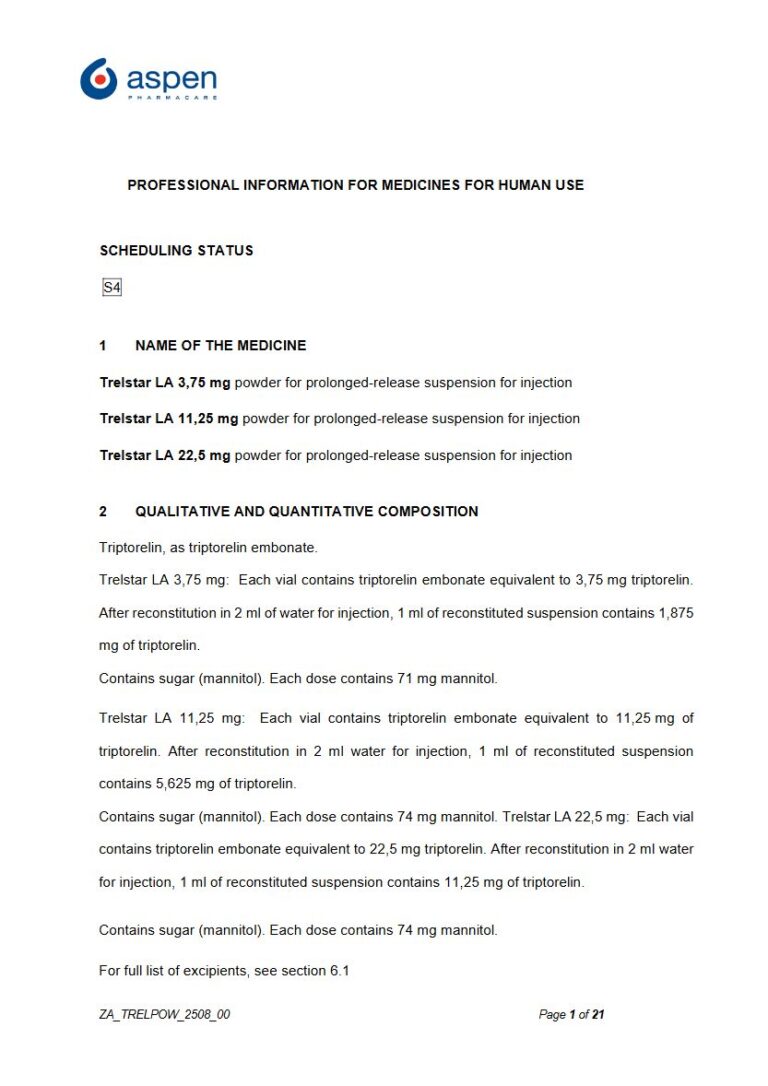
Trelstar La 3,75 mg/11,25 mg/22,5 mg Suspension
PDF Leaflet Revision Date: 25 August 2025
Clinical Summary
Quick overview from the medicine insert
Indication
Treatment of locally advanced or metastatic hormone-dependent prostate cancer.
Dosage (summary)
3.75 mg monthly, 11.25 mg every 3 months, or 22.5 mg every 6 months as IM injection.
Onset of Action / Duration
Onset: 2-4 weeks, Duration: up to 6 months
Special Populations
- Renal impairment
- Hepatic impairment
Pregnancy & Breastfeeding
Not indicated for females; potential reproductive effects noted in animal studies.
Key Drug Interactions
- QT prolonging agents
- Hormonal therapies
Contraindications
- Hypersensitivity to GnRH or its analogues
- Spinal cord compression
- Hormone independent prostate carcinoma
- Post-orchidectomy
Common side effects
- Hot flushes
- Erectile dysfunction
- Decreased libido
Counselling Points
- Monitor testosterone and PSA levels
- Inform about potential initial symptom worsening
- Advise on injection site rotation
Serious warnings
- Risk of osteoporosis
- Potential for pituitary adenoma
- Increased risk of depression
Important Disclaimer
The Trelstar La 3,75 mg/11,25 mg/22,5 mg Suspension professional information leaflet below is the property of Pharmacare and is provided on Medinsert exactly as issued, with no.. alterations or editorial changes. We make every effort to keep content current by updating documents as soon as new versions become available. Medinsert serves as a trusted access point for healthcare professionals, but does not replace official sources or clinical judgement. For more details, please read our full disclaimer. read more>>
 Healthcare Professionals Only
This content is for registered healthcare professionals
Sign in or create a free account to read the full package insert.
Free for HPCSA-registered professionals. Powered by Medinsert.
Clinical Particulars
Section 4 of the official insert — extracted exactly as issued, no alterations
4.1 Therapeutic indications
Trelstar LA is indicated for the treatment of locally advanced or metastatic, hormone-dependent prostate cancer. As an alternative treatment if orchiectomy or the administration of oestrogens are not indicated or are unacceptable to the patient.
4.2 Posology and method of administration
Posology
Trelstar LA must be administered under the supervision of a medical practitioner. The injection site should be varied periodically. Since Trelstar LA is a suspension of microgranules, inadvertent intravascular injection must be strictly avoided. The recommended dose of Trelstar LA 3,75 mg is 3,75 mg triptorelin (1 vial) administered once a month (four weeks) as a single subcutaneous or intramuscular injection. The recommended dose of Trelstar LA 11,25 mg is 11,25 mg of triptorelin (1 vial) administered every three months (twelve weeks) as a single intramuscular injection. The recommended dose of Trelstar LA 22,5 mg is 22,5 mg triptorelin (1 vial) administered every six months (twenty four weeks) as a single intramuscular injection. Due to different release characteristics, the dosage strengths are not additive and must be selected based upon the desired dosing schedule.
All three dose regimens provide 3,75 mg triptorelin per month. Existing evidence does not support superiority of one dose regimen over the others. Therefore, patientsu2019 preference for treatment modality and clinical consideration of patientsu2019 age and mobility should be considered when determining the treatment of choice in patients with prostate cancer. Sustained-release formulations have been developed to reduce the number of injections, improve convenience and increase adherence. Depot formulations may particularly be advantageous for patients preferring improved flexibility with scheduling, less frequent injections, improved comfort, fewer doctor visits, decreased exposure to possible site reactions, decreased cost and fewer missed visits.
Special populations
No dosage adjustment is necessary for patients with renal or hepatic impairment. Safety and efficacy of Trelstar LA has not been established in neonates, infants, children and adolescents, therefore Trelstar LA is not indicated for the use in these populations.
Method of administration
Refer to section 6.6 for preparation and handling instructions. The prepared injection is a milky, homogeneous suspension without aggregates and the total volume passes through an injection needle. Following reconstitution, the suspension has to be injected immediately.
4.3 Contraindications
- Hypersensitivity to GnRH (gonadotropin releasing hormone), its analogues or any other component of Trelstar LA (see section 4.8).
- Patients presenting with spinal cord compression. Care should be taken in patients with metastases in the spinal column, in whom compression may occur.
- Patients in whom hormonal therapy has failed.
- Hormone independent prostate carcinoma.
- After orchidectomy (in case of surgical castration triptorelin does not cause further decrease of serum testosterone).
- Trelstar LA is not to be used in women.
4.4 Special warnings and precautions for use
Trelstar, may cause reduction in bone mineral density. In men, preliminary data suggest that the use of a bisphosphonate in combination with an GnRH agonist may reduce bone mineral loss. Particular caution is necessary in patients with additional risk factors for osteoporosis (e.g. chronic alcohol abuse, smokers, long-term therapy with medicines that reduce bone mineral density, e.g. anticonvulsants or corticoids, family history of osteoporosis, malnutrition). Treatment with GnRH agonists may reveal the presence of a previously unknown gonadotroph cell pituitary adenoma. These patients may present a pituitary apoplexy characterised by sudden headache, vomiting, visual impairment and ophthalmoplegia. There is an increased risk of incident depression (which may be severe) in patients undergoing treatment with Trelstar LA. Patients should be informed accordingly and treated appropriate if symptoms occur. Patients with known depression should be monitored closely during therapy. Initially Trelstar LA causes a one to two week increase in serum testosterone levels. As a consequence, cases of short-term worsening of signs and symptoms of prostate cancer may develop during the first weeks of treatment. During the initial phase of treatment, consideration should be given to the additional administration of a suitable anti-androgen to counteract the initial rise in serum testosterone levels and the worsening of clinical symptoms. The prostate specific antigen (PSA) and the testosterone plasma levels should be regularly monitored during treatment. Testosterone levels should not exceed 1 ng/ml (1 nmol/l).
A small number of patients may experience a temporary worsening of signs and symptoms of their prostate cancer (tumour flare) and a temporary increase in cancer related pain (metastatic pain), which can be managed symptomatically. Cases of spinal cord compression or urethral obstruction have been observed. If spinal cord compression or renal impairment develops, standard treatment of these complications should be instituted, and in extreme cases an immediate orchiectomy (surgical castration) should be considered. Careful monitoring is indicated during the first weeks of treatment, particularly in patients suffering from vertebral metastases, at the risk of spinal cord compression, and in patients with urinary tract obstruction. After surgical castration Trelstar LA does not induce any further decrease in serum testosterone levels. Once the castration levels of testosterone have been achieved by the end of the first month, serum testosterone levels are maintained for as long as the patients receive their:
- monthly injection of Trelstar LA 3,75 (4 weekly) or
- three monthly injection of Trelstar LA 11,25 every 3 months (12 weekly) or
- six monthly injection of Trelstar LA 22,5 every 6 months (24 weekly). The effectiveness of treatment can be monitored by measuring serum levels of testosterone and PSA. Long-term androgen deprivation either by bilateral orchiectomy or administration of GnRH analogues is associated with increased risk of bone loss and may lead to osteoporosis and increased risk of bone fracture. Androgen deprivation therapy may prolong the QT interval. In patients with a history of or risk factors for QT prolongation and in patients receiving concomitant medicines that might prolong the QT interval (see section 4.5) medical practitioners should assess the benefit risk ratio including the potential for Torsade de pointes prior to initiating Trelstar LA. In addition, from epidemiological data, it has been observed that patients may experience metabolic changes (e.g. glucose intolerance), or an increased risk of cardiovascular disease during androgen deprivation therapy, such as with the Trelstar LA formulations. However, prospective data did not confirm the link between treatment with GnRH analogues (including Trelstar LA) and an increase in cardiovascular mortality. Patients at high risk for metabolic or cardiovascular diseases should be carefully assessed before commencing treatment and adequately monitored during androgen deprivation therapy. Caution is required with intramuscular injection in patients treated with anticoagulants, due to the potential risk of haematomas at the site of injection. Administration of Trelstar LA in therapeutic doses results in suppression of the pituitary gonadal system. Normal function is usually restored after treatment is discontinued. Diagnostic tests of pituitary gonadal function conducted during treatment and after discontinuation of therapy with GnRH analogues may therefore be misleading.
Porphyria
Trelstar has been reported to be porphyrinogenic.
4.5 Interaction with other medicines and other forms of interaction
When Trelstar LA is co-administered with medicines affecting pituitary secretion of gonadotrophins, caution should be exercised and it is recommended that the patientu2019s hormonal status should be supervised. Cytochromes P450 (CYP) are unlikely to be involved in the metabolism or clearance of triptorelin. In addition, in vitro data showed that triptorelin was not a significant CYP inhibitor, CYP inducer, P-glycoprotein (P-gP) substrate or inhibitor. Therefore, medicine interactions with Trelstar LA are unlikely. Since androgen deprivation treatment may prolong the QT interval, the concomitant use of Trelstar LA with medicines known to prolong the QT interval or medicines able to induce Torsade de pointes such as class IA (e.g. quinidine, disopyramide) or class III (e.g. amiodarone, sotalol, dofetilide, ibutilide) antidysrhythmic medicines, methadone, moxifloxacin, antipsychotics, etc. should be carefully evaluated (see section 4.4). Spironolactone and levodopa can stimulate gonadotrophins (including Trelstar LA) while phenothiazines, dopamine antagonists, digoxin and sex hormones can inhibit gonadotrophin secretion.
4.6 Fertility, pregnancy and lactation
Trelstar LA is not indicated for use in females (see 4.3). Animal studies have shown effects on reproductive parameters. In chronic toxicity studies at clinically relevant doses, triptorelin induced macro- and microscopic changes in the reproductive organs of male rats, dogs and monkeys. These were considered as a reaction to suppressed gonadal function.
4.7 Effects on ability to drive and use machines
The ability to drive and use machines may be impaired if the patient experiences dizziness, somnolence and visual disturbances. These are possible side effects of treatment (see section 4.8) or may result from the underlying disease.
4.8 Undesirable effects
Since patients suffering from locally advanced or metastatic, hormone-dependent prostate cancer are generally elderly men and have other diseases frequently encountered in this aged population, more than 90 % of the patients included in clinical trials reported adverse events, and often the causality is difficult to assess. The most commonly observed adverse events related to Trelstar LA treatment were due to its expected pharmacological effects. These effects included hot flushes, erectile dysfunction and decreased libido. With the exception of immuno-allergic (rare) and injection site (< 5 %) reactions, all side effects are known to be related to testosterone changes. The following side effects considered as at least possibly related to Trelstar LA treatment were reported. Most of these events are known to be related to biochemical or surgical castration. The frequency of the side effects is classified as follows: very common (u2265 1/10); common (u2265 1/100 to < 1/10); uncommon (u2265 1/1 000 to < 1/100); rare (u2265 1/10000 to < 1/1 000)
System Organ Class
Very Common AEs
Common AEs
Uncommon AEs
Rare AEs
Additional post-marketing AEs Frequency not known
Infections and infestations
Nasopharyngitis
Blood and lymphatic system disorders
Thrombophlebitis
Purpura
Immune system disorders
Anaphylactic reaction
Hypersensitivity
Endocrine disorders
Diabetes mellitus
Metabolism and nutrition disorders
Anorexia, Gout, Increased appetite, Elevated enzyme levels (LDH, SGT, AST, ALT)
Psychiatric disorders
Depression*
Mood changes*
Insomnia
Irritability
Confusional state
Decreased activity
Euphoric mood
Anxiety
Nervous system disorders
Paraesthesia in lower limbs
Dizziness
Headache
Paraesthesia
Memory impairment
Convulsions
Eye disorders
Abnormal sensation in eye
Visual disturbance
Vision blurred
Ear and labyrinth disorders
Tinnitus
Vertigo
Cardiac disorders
QT prolongation* (see 4.4 and 4.5)
Vascular disorders
Hot flushes
Hypertension
Hypotension
Respiratory, thoracic and mediastinal disorders
Dyspnoea
Orthopnoea
Epistaxis
Gastro-intestinal disorders
Nausea
Abdominal pain
Constipation
Diarrhoea
Vomiting
Abdominal distension
Dry mouth
Dysgeusia
Flatulence
Skin and subcutaneous tissue disorders
Hyperhidrosis
Acne
Alopecia
Pruritus
Rash
Blisters
Angioneurotic oedema
Urticaria
Musculoskeletal, connective tissue and bone disorders
Back pain
Musculoskeletal pain
Pain in extremity
Arthralgia
Muscle cramp
Muscular weakness
Myalgia
Joint stiffness
Joint swelling
Musculoskeletal stiffness
Osteoarthritis
Bone pain
Reproductive system and breast disorders
Erectile dysfunction
Loss of libido, impotence
Gynaecomastia
Breast pain
Testicular atrophy
Testicular pain
Ejaculation failure
General disorders and administration site conditions
Asthenia
Fatigue
Injection site erythema
Injection site inflammation
Injection site pain
Injection site reaction
Oedema
Lethargy
Pain
Rigors
Somnolence
Chest pain
Dysstasia
Influenza like illness
Pyrexia
Malaise
Investigations
Increased alanine aminotransferase
Increased aspartate aminotransferase, Increased blood creatinine, Increased blood urea, Increased weight, Increased blood alkaline phosphatase
Increased body temperature
Decreased weight
*This frequency is based on class-effect frequencies common for all GnRH agonists. Trelstar LA causes an increase in circulating testosterone levels within the first week after the initial injection of the sustained release formulation. With this initial increase in circulating testosterone levels, a small percentage of patients (u2264 5 %) may experience a temporary worsening of signs and symptoms of their prostate cancer (tumour flare), usually manifested by an increase in urinary symptoms (< 2 %) and metastatic pain (5 %) which can be managed symptomatically. These symptoms usually disappear in one to two weeks. Isolated cases of exacerbation of disease symptoms, either urethral obstruction or spinal cord compression by metastasis have occurred. Therefore, patients with metastatic vertebral lesions and/or with upper or lower urinary tract obstruction should be closely observed during the first few weeks of therapy (see section 4.4). The use of Trelstar LA to treat prostate cancer may be associated with increased bone loss and may lead to osteoporosis and increases the risk of bone fracture. This may also lead to an incorrect diagnosis of bone metastases. Reporting of suspected adverse reactions
Reporting suspected adverse reactions after authorisation of the medicine is important. It allows continued monitoring of the benefit/risk balance of the medicine. Healthcare providers are asked to report any suspected adverse reactions to SAHPRA via the SAHPRA website.
4.9 Overdose
The pharmaceutical properties of Trelstar LA and its mode of administration make accidental or intentional overdosage unlikely. There is no human experience of overdosage. Animal tests suggest that the intended therapeutic effects on sex hormone concentration and on the reproductive tract will be evident with higher doses of Trelstar LA. If overdose occurs, symptomatic management is indicated.
