
Ella 30 mg Tablet
PDF Leaflet Revision Date: 24 January 2023
Clinical Summary
Quick overview from the medicine insert
Indication
Emergency contraception within 120 hours of unprotected intercourse.
Dosage (summary)
One tablet orally as soon as possible, within 120 hours after intercourse.
Special Populations
- Renal impairment
- Hepatic impairment
- Adolescents
Pregnancy & Breastfeeding
Not for use in pregnancy; excreted in breast milk; avoid breastfeeding for one week post-dose.
Key Drug Interactions
- CYP3A4 inducers
- CYP3A4 inhibitors
- Hormonal contraceptives
Contraindications
- Hypersensitivity to ulipristal acetate
Common side effects
- Headache
- Nausea
- Abdominal pain
- Dysmenorrhoea
Counselling Points
- Take as soon as possible after unprotected intercourse
- Use barrier contraception until next period
- Pregnancy test if period is late
Serious warnings
- Not for regular contraceptive use
- Pregnancy must be excluded before use
Important Disclaimer
The Ella 30 mg Tablet professional information leaflet below is the property of Actor Pharma and is provided on Medinsert exactly as issued, with no.. alterations or editorial changes. We make every effort to keep content current by updating documents as soon as new versions become available. Medinsert serves as a trusted access point for healthcare professionals, but does not replace official sources or clinical judgement. For more details, please read our full disclaimer. read more>>
 Healthcare Professionals Only
This content is for registered healthcare professionals
Sign in or create a free account to read the full package insert.
Free for HPCSA-registered professionals. Powered by Medinsert.
Clinical Particulars
Section 4 of the official insert — extracted exactly as issued, no alterations
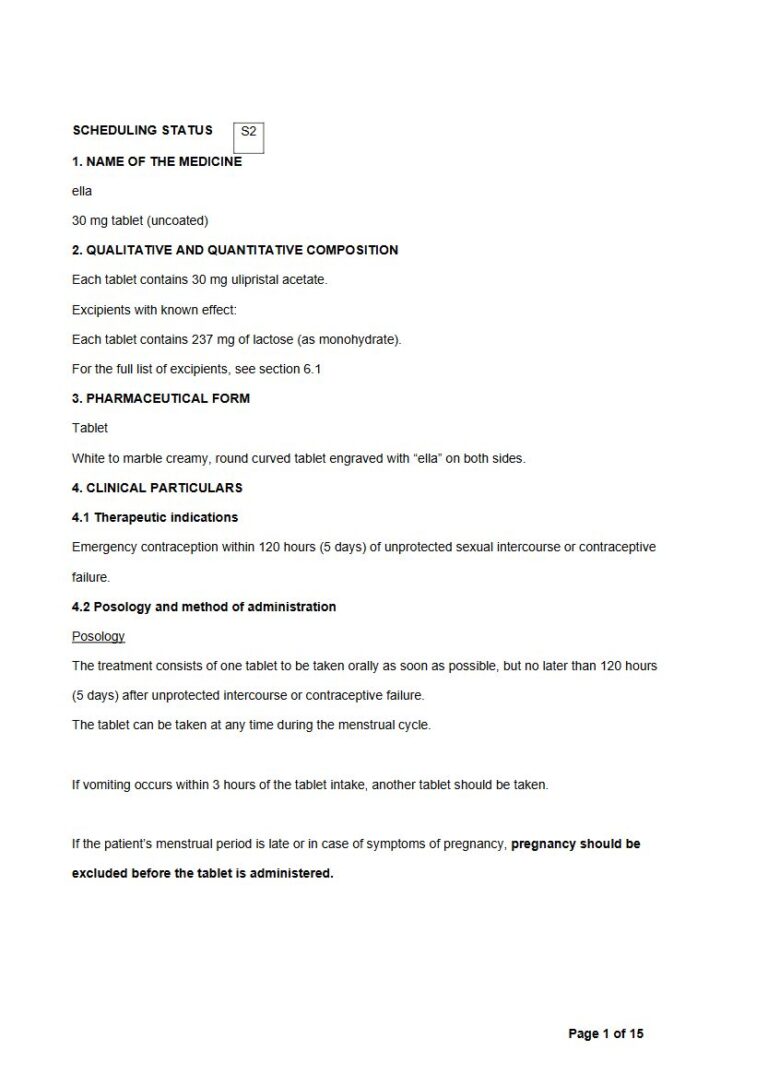
4.1 Therapeutic indications
Emergency contraception within 120 hours (5 days) of unprotected sexual intercourse or contraceptive failure.
4.2 Posology and method of administration
Posology
The treatment consists of one tablet to be taken orally as soon as possible, but no later than 120 hours (5 days) after unprotected intercourse or contraceptive failure. The tablet can be taken at any time during the menstrual cycle. If vomiting occurs within 3 hours of the tablet intake, another tablet should be taken. If the patientu2019s menstrual period is late or in case of symptoms of pregnancy, pregnancy should be excluded before the tablet is administered.
Special populations
Renal impairment
No dose adjustment is necessary.
Hepatic impairment
In the absence of specific studies, no alternate dose recommendations for ELLA can be made.
Severe hepatic impairment
In the absence of specific studies, ELLA is not recommended.
Paediatric population
There is no relevant use of ELLA for children of prepubertal age in the indication emergency contraception. Adolescents: ELLA for emergency contraception is suitable for any woman of child bearing age, including adolescents. No differences in safety or efficacy have been shown compared to adult women aged 18 and older (see section 5.1).
Method of administration
Oral use. The tablet can be taken with or without food.
4.3 Contraindications
Hypersensitivity to ulipristal acetate or to any of the excipients listed in section 6.1
4.4 Special warnings and precautions for use
Before ELLA is taken pregnancy should be excluded. ELLA is for occasional use only. It should in no instance replace a regular contraceptive method. In any case, women should be advised to adopt a regular method of contraception. ELLA is not intended for use during pregnancy and should not be taken by any woman suspected or known to be pregnant. However, it does not interrupt an existing pregnancy (see section 4.6). ELLA does not prevent pregnancy in every case. In case the next menstrual period is more than 7 days late, if the menstrual period is abnormal in character or if there are symptoms suggestive of pregnancy or in case of doubt, a pregnancy test should be performed. The possibility of an ectopic pregnancy should be considered. It is important to know that the occurrence of uterine bleeding does not rule out ectopic pregnancy. Women who become pregnant after taking ELLA should contact their doctor (see section 4.6). ELLA inhibits or postpones ovulation (see section 5.1). If ovulation has already occurred, it is no longer effective. The timing of ovulation cannot be predicted and therefore the tablet should be taken as soon as possible after unprotected intercourse. No data are available on the efficacy of ELLA when taken more than 120 hours (5 days) after unprotected intercourse. Limited and inconclusive data suggest that there may be reduced efficacy of ELLA with increasing body weight or body mass index (BMI) (see section 5.1). In all women, emergency contraception should be taken as soon as possible after unprotected intercourse, regardless of the womanu2019s body weight or BMI. After the tablet intake menstrual periods can sometimes occur a few days earlier or later than expected. In approximately 7 % of the women, menstrual periods occurred more than 7 days earlier than expected. In 18,5 % of the women a delay of more than 7 days occurred, and in 4 % the delay was greater than 20 days. Concomitant use of ELLA and emergency contraception containing levonorgestrel is not recommended (see section 4.5).
Contraception after ELLA intake
ELLA is an emergency contraceptive that decreases pregnancy risk after unprotected intercourse but does not confer contraceptive protection for subsequent acts of intercourse. Therefore, after using emergency contraception, women should be advised to use a reliable barrier method until her next menstrual period. Although the use of ELLA for emergency contraception does not contraindicate the continued use of regular hormonal contraception, ELLA may reduce its contraceptive action (see section 4.5). Therefore, if a woman wishes to start or continue using hormonal contraception, she can do so after using ELLA, however, she should be advised to use a reliable barrier method until the next menstrual period.
Specific populations
Concomitant use of ELLA with CYP3A4 inducers is not recommended due to interaction (e.g. barbiturates (including primidone and phenobarbital), phenytoin, fosphenytoin, carbamazepine, oxcarbazepine, herbal medicines containing Hypericum perforatum (St. Johnu2019s wort), rifampicin, rifabutin, griseofulvin, efavirenz, nevirapine and long-term use of ritonavir). Use in women with severe asthma treated by oral glucocorticoid is not recommended. This medicine contains lactose. Patients with rare hereditary problems of galactose intolerance, total lactase deficiency or glucose-galactose malabsorption should not take this medicine. This medicine contains less than 1 mmol sodium (23 mg) per tablet, that is to say essentially u2018sodium-freeu2019.
4.5 Interaction with other medicines and other forms of interaction
Potential for other medicines to affect ELLA
Ulipristal acetate is metabolised by CYP3A4 in vitro.
- CYP3A4 inducers
In vivo results show that the administration of ulipristal acetate with a strong CYP3A4 inducer such as rifampicin markedly decreases C max and AUC of ulipristal acetate by 90 % or more and decreases ulipristal acetate half-life by 2,2-fold corresponding to an approximately 10-fold decrease of ulipristal acetate exposure. Concomitant use of ELLA with CYP3A4 inducers (e.g. barbiturates (including primidone and phenobarbital), phenytoin, fosphenytoin, carbamazepine, oxcarbazepine, herbal medicines containing Hypericum perforatum (St. Johnu2019s wort), rifampicin, rifabutin, griseofulvin, efavirenz and nevirapine) therefore reduces plasma concentrations of ulipristal acetate and may result in a decreased efficacy of ELLA. For women who have used enzyme-inducing drugs in the past 4 weeks, ELLA is not recommended (see section 4.4) and non-hormonal emergency contraception (i.e. a copper intrauterine device (Cu-IUD)) should be considered.
- CYP3A4 inhibitors
In vivo results show that administration of ulipristal acetate with a potent and a moderate CYP3A4 inhibitor increased C max and AUC of ulipristal acetate with a maximum of 2- and 5,9-fold, respectively. The effects of CYP3A4 inhibitors are unlikely to have any clinical consequences. The CYP3A4 inhibitor ritonavir can also have an inducing effect on CYP3A4 when ritonavir is used for a longer period. In such cases ritonavir might reduce plasma concentrations of ulipristal acetate. Concomitant use is therefore not recommended (see section 4.4). Enzyme induction wears off slowly and effects on the plasma concentrations of ulipristal acetate may occur even if a woman has stopped taking an enzyme inducer in the past 4 weeks.
Medicines affecting gastric pH
Administration of ulipristal acetate (10 mg tablet) together with the proton pump inhibitor esomeprazole (20 mg daily for 6 days) resulted in approximately 65 % lower mean C max, a delayed T max (from a median of 0,75 hours to 1,0 hours) and 13 % higher mean AUC. The clinical relevance of this interaction for single dose administration of ELLA as emergency contraception is not known.
Potential for ELLA to affect other medicines
Hormonal contraceptives
Because ulipristal acetate binds to the progesterone receptor with high affinity, it may interfere with the action of progestogen-containing medicines:
- Contraceptive action of combined hormonal contraceptives and progestogen-only contraception may be reduced
- Concomitant use of ELLA and emergency contraception containing levonorgestrel is not recommended (see section 4.4).
4.6 Fertility, pregnancy and lactation
Pregnancy
ELLA is not intended for use during pregnancy and should not be taken by any woman suspected or known to be pregnant (see section 4.2). ELLA does not interrupt an existing pregnancy. Pregnancy may occasionally occur after ELLA intake. Limited human data regarding pregnancy exposure to ELLA do not suggest any safety concern. Nevertheless, it is important that any pregnancy in a woman who has taken ELLA be reported to Actor Pharma (Pty) Ltd via email: [email protected] or telephonically on 011 312 3812 or to SAHPRA via the u201c6.04 Adverse Drug Reaction Reporting Formu201d, found online under SAHPRAu2019s publications: https://www.sahpra.org.za/Publications/Index/8.
Breastfeeding
ELLA is excreted in breast milk (see section 5.2). The effect on newborn/infants has not been studied. A risk to the breastfed child cannot be excluded. After intake of ELLA for emergency contraception, breastfeeding is not recommended for one week. During this time it is recommended to express and discard the breast milk in order to stimulate lactation.
Fertility
A rapid return of fertility is likely following treatment with ELLA for emergency contraception. Women should be advised to use a reliable barrier method for all subsequent acts of intercourse until the next menstrual period.
4.7 Effects on ability to drive and use machines
ELLA has minor or moderate influence on the ability to drive or use machines: mild to moderate dizziness is common after ELLA intake, somnolence and blurred vision are uncommon; disturbance in attention has been rarely reported. The patient should be informed not to drive or use machines if they are experiencing such symptoms (see section 4.8).
4.8 Undesirable effects
Summary of the safety profile
Safety of ELLA has been evaluated in 4 718 women during the clinical development program. The most commonly reported adverse reactions were headache, nausea, abdominal pain and dysmenorrhoea.
Tabulated list of adverse reactions
The adverse reactions reported in the phase III program of 2,637 women are provided in the table below.
Body System Frequency of adverse reactions Common ( u2265 1/100 to 1/10) Uncommon ( u2265 1/1,000 to <1/100) Rare ( u2265 1/10,000 to <1/1,000) Infections and Infestations Influenza
Immune system disorders Hypersensitivity reactions including rash, urticaria, angioedema**
Metabolism and nutrition disorders Appetite disorders
Psychiatric disorders Mood disorders Emotional disorder Anxiety Insomnia Hyperactivity disorder Libido changes Disorientation
Nervous system disorders Headache Dizziness Somnolence Migraine Tremor Disturbance in attention Dysgeusia Syncope
Eye disorders Visual disturbance Abnormal sensation in eye Ocular hyperaemia Photophobia
Ear and labyrinth disorders Vertigo
Respiratory, thoracic and mediastinal disorders Dry throat
Gastrointestinal disorders Nausea* Abdominal pain* Abdominal discomfort Vomiting* Diarrhoea Dry mouth Dyspepsia Flatulence
Skin and subcutaneous tissue disorders Acne Skin lesion Pruritus
Musculoskeletal and connective tissue disorders Myalgia Back pain
Reproductive system and Breast disorders Dysmenorrhoea Pelvic pain Breast tenderness Menorrhagia Vaginal discharge Menstrual disorder Metrorrhagia Vaginitis Hot flush Premenstrual syndrome Genital pruritus Dyspareunia Ruptured ovarian cyst Vulvovaginal pain Hypomenorrhoea*
General disorders and administration site conditions Fatigue Chills Malaise Pyrexia Thirst
*Symptom which could also be related to an undiagnosed pregnancy (or related complications). **Adverse reaction from spontaneous reporting
Adolescents: the safety profile observed in women less than 18 years old in studies and post-marketing is similar to the safety profile in adults during the phase III program (see section 4.2). Post-marketing experience: the adverse reactions spontaneously reported in post-marketing experience were similar in nature and frequency to the safety profile described during the phase III program.
Description of selected adverse reactions
The majority of women (74,6 %) in the phase III studies had their next menstrual period at the expected time or within u00b1 7 days, while 6,8 % experienced menses more than 7 days earlier than expected and 18,5 % had a delay of more than 7 days beyond the anticipated onset of menses. The delay was greater than 20 days in 4 % of the women. A minority (8,7 %) of women reported intermenstrual bleeding lasting an average of 2,4 days. In a majority of cases (88,2 %), this bleeding was reported as spotting. Among the women who received ELLA in the phase III studies, only 0,4 % reported heavy intermenstrual bleeding.
In the phase III studies, 82 women entered a study more than once and therefore received more than one dose of ELLA (73 women enrolled twice and 9 enrolled three times). There were no safety differences in these subjects in terms of incidence and severity of adverse reactions, change in duration or volume of menses or incidence of intermenstrual bleeding.
Reporting of suspected adverse reactions
Reporting of suspected adverse reactions after authorisation of the medicine is important. It allows continued monitoring of the benefit/risk balance of the medicine. Healthcare professionals are asked to report any suspected adverse reactions. Suspected adverse reactions can be reported to Actor Pharma (Pty) Ltd via email: [email protected] or telephonically on 011 312 3812. Suspected adverse reactions can also be reported to SAHPRA via the u201c6.04 Adverse Drug Reaction Reporting Formu201d, found online under SAHPRAu2019s publications: https://www.sahpra.org.za/Publications/Index/8.
4.9 Overdose
Experience with ulipristal acetate overdose is limited. Treatment is supportive and symptomatic.
