
Valacyclovir 500 mg Film-Coated Tablets
PDF Leaflet Revision Date: 27 August 2025
Clinical Summary
Quick overview from the medicine insert
Indication
Treatment of herpes zoster and recurrent genital herpes.
Dosage (summary)
Herpes zoster: 1g TID for 7 days; Genital herpes: 500mg BID for 5 days.
Special Populations
- Renal impairment
- Elderly
Pregnancy & Breastfeeding
Not established; crosses placenta and may enter breast milk.
Key Drug Interactions
- Cimetidine
- Probenecid
- Tacrolimus
- Ciclosporin
Contraindications
- Hypersensitivity to acyclovir or valacyclovir
- Pregnancy
- Lactation
Common side effects
- Nausea
- Headaches
- Dizziness
- Rashes
Counselling Points
- Maintain hydration
- Avoid intercourse during outbreaks
- Monitor for severe skin reactions
Serious warnings
- Risk of TTP/HUS in immunocompromised patients
- Severe skin reactions
Important Disclaimer
The Valacyclovir 500 mg Film-Coated Tablets professional information leaflet below is the property of Biotech Laboratories and is provided on Medinsert exactly as issued, with no.. alterations or editorial changes. We make every effort to keep content current by updating documents as soon as new versions become available. Medinsert serves as a trusted access point for healthcare professionals, but does not replace official sources or clinical judgement. For more details, please read our full disclaimer. read more>>
 Healthcare Professionals Only
This content is for registered healthcare professionals
Sign in or create a free account to read the full package insert.
Free for HPCSA-registered professionals. Powered by Medinsert.
Clinical Particulars
Section 4 of the official insert — extracted exactly as issued, no alterations
4.1 Therapeutic indications
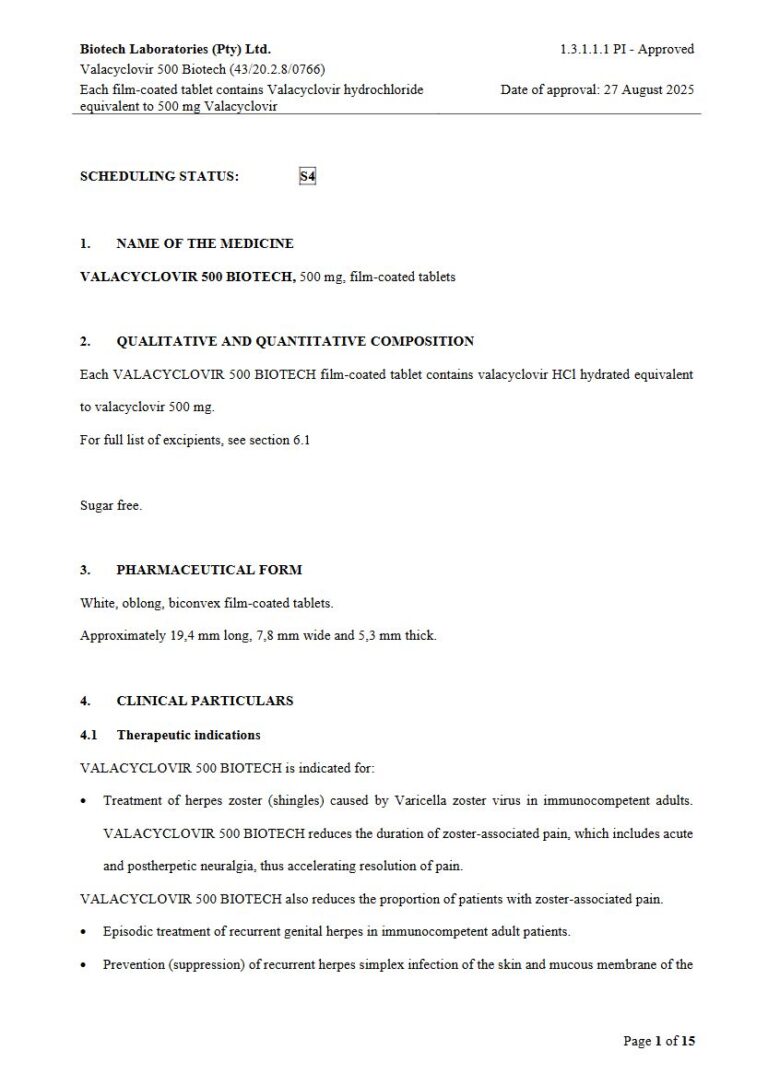
VALACYCLOVIR 500 BIOTECH is indicated for:
- Treatment of herpes zoster (shingles) caused by Varicella zoster virus in immunocompetent adults. VALACYCLOVIR 500 BIOTECH reduces the duration of zoster-associated pain, which includes acute and postherpetic neuralgia, thus accelerating resolution of pain. VALACYCLOVIR 500 BIOTECH also reduces the proportion of patients with zoster-associated pain.
- Episodic treatment of recurrent genital herpes in immunocompetent adult patients.
- Prevention (suppression) of recurrent herpes simplex infection of the skin and mucous membrane of the ano-genital area.
- Prophylaxis of cytomegalovirus (CMV) infection and CMV disease and other herpes virus infections following organ transplantation, where a special risk exists.
4.2 Posology and method of administration
Posology
VALACYCLOVIR 500 BIOTECH may be taken with or without meals.
Usual adult dose
Treatment of Herpes zoster:
- Therapy should be initiated as soon as possible following the onset of signs and symptoms.
- Two tablets (1 gram) three times a day for 7 days.
Treatment of Recurrent genital herpes:
- Therapy should be initiated as soon as possible following the onset of signs and symptoms.
- One tablet (500 mg) twice daily for 5 days.
Prevention (suppression) of recurrences of herpes simplex infection
- Dosing should begin as early as possible. For recurrent episodes of herpes simplex, this should ideally be during the prodromal period or immediately the first signs or symptoms appear. There is no data on the effectiveness of VALACYCLOVIR 500 BIOTECH when initiated more than 24 hours after the onset of signs and symptoms.
- Immunocompromised patients: One tablet (500 mg) twice daily.
- Immunocompetent patients: One tablet (500 mg) to be taken once daily.
- Some patients with very frequent recurrences (e.g. 10 or more per year) may gain additional benefit from the daily dose of 500 mg being taken as a divided dose (250 mg) twice daily.
Prophylaxis of CMV infection and CMV disease in organ transplantation:
- Adults and adolescents (from 12 years of age): A dose of 2000 mg (4 tablets) four times daily is recommended.
- Prophylaxis should begin as early as possible post-transplant and is usually continued for 90 days, but may need to be extended in high risk patients.
- This dose should be reduced according to creatinine clearance (see Administration in renal impairment).
Dosage in the elderly:
Dosage modification is not required unless renal function is impaired (see Dosage in renal impairment). Adequate hydration should be maintained.
Dosage in renal impairment:
Doses of VALACYCLOVIR 500 BIOTECH may need to be reduced in patients with renal impairment. The following dosage reductions are suggested according to the creatinine clearance (CrCl)
HERPES ZOSTER
Creatinine Clearance VALACYCLOVIR 500 BIOTECH Dose
- 15 - 30 ml/minute 1 000 mg twice daily
- < 15 ml/minute 1 000 mg once daily
RECURRENT GENITAL HERPES
Creatinine Clearance VALACYCLOVIR 500 BIOTECH Dose
- > 15 ml/minute 500 mg twice daily
- 0 - 15 ml/minute 500 mg once daily
PREVENTION OF RECURRENCES (Herpes simplex)
Creatinine Clearance Dose
- Immunocompetent Immunocompromised
- 15 - 30 ml/minute No dosage adjustment required No dosage adjustment required
- < 15 ml/minute 250 mg once daily 500 mg once daily
In patients on haemodialysis, the VALACYCLOVIR 500 BIOTECH dose recommended for patients with a creatinine clearance of less than 15 ml/min should be used, but the dose should be administered after the haemodialysis has been performed.
CMV prophylaxis:
The dosage of VALACYCLOVIR 500 BIOTECH should be adjusted in patients with impaired renal function as shown in the table below:
CMV PROPHYLAXIS
Creatinine Clearance VALACYCLOVIR 500 BIOTECH Dose
- u2265 75 ml/minute 2000 mg four times daily
- 50 to < 75 ml/minute 1500 mg four times daily
- 25 to < 50 ml/minute 1500 mg three times daily
- 10 to < 25 ml/minute 1500 mg twice daily
- < 10 ml/minute or dialysis (**) 1500 mg once daily (**) In patients on haemodialysis, the VALACYCLOVIR 500 BIOTECH dosage should be administered after the haemodialysis has been performed. The creatinine clearance should be monitored frequently, especially during periods when renal function is changing rapidly e.g. immediately after transplantation or engraftment. The VALACYCLOVIR 500 BIOTECH dosage should be adjusted accordingly.
Dosage in hepatic impairment:
Dose modification is not required in patients with mild or moderate cirrhosis (hepatic synthetic function maintained). Pharmacokinetic data in patients with advanced cirrhosis (impaired hepatic synthetic function and evidence of portal-systemic shunting) do not indicate the need for dosage adjustment; however, clinical experience is limited. For higher doses recommended for CMV prophylaxis (see section 4.4).
Method of administration
For oral use.
4.3 Contraindications
Hypersensitivity to acyclovir, valacyclovir or to any or to any of the excipients lists in section 6.1. Pregnancy and lactation.
4.4 Special warnings and precautions for use
Severe renal impairment - a dose reduction is required in patients with a creatinine clearance of < 30 ml/minute. Bone marrow transplantation; Advanced Human Immunodeficiency Virus (HIV) infection and renal transplantation: Thrombotic thrombocytopenic purpura/ haemolytic uraemic syndrome (TTP/HUS) has been reported in patients with these conditions who were taking high doses of valacyclovir as in VALACYCLOVIR 500 BIOTECH for prolonged periods of time. In some cases death has occurred. VALACYCLOVIR 500 BIOTECH is therefore not indicated in immunocompromised patients. TTP/HUS has not been seen in immunocompetent patients treated with valacyclovir.
Severe cutaneous adverse reactions (SCARs) Drug reaction with eosinophilia and systemic symptoms (DRESS). DRESS, which can be life-threatening or fatal, has been reported in associate with valacyclovir treatment. At the time of prescription, patients should be advised of the signs and symptoms and monitored closely for skin reactions. If signs and symptoms suggestive of DRESS appear, valacyclovir should be withdrawn immediately and an alternative treatment considered (as appropriate). If the patient has developed DRESS with the use of valacyclovir, treatment with valacyclovir must not be restarted in this patient at any time.
Acute generalised exanthematous pustulosis (AGEP) has been reported in relation to acyclovir and valacyclovir-containing medicines. VALACYCLOVIR 500 BIOTECH should be discontinued, at the first appearance of signs and symptoms of severe skin reactions, such as skin rash, mucosal lesions, or any other sign of hypersensitivity.
Hydration status Care should be taken to ensure adequate fluid intake in patients who are at risk of dehydration, particularly the elderly.
Use in patients with renal impairment and in elderly patients: Care should be taken to maintain adequate hydration in patients receiving high doses of VALACYCLOVIR 500 BIOTECH. Acyclovir is eliminated by renal clearance, therefore the VALACYCLOVIR 500 BIOTECH dose should be adjusted in patients with renal impairment (see section 4.2). Elderly patients are likely to have reduced renal function and therefore the need for dose reduction must be considered in this group of patients. Both elderly patients and patients with renal impairment are at increased risk of developing neurological side effects and should be closely monitored for evidence of these effects. In the reported cases, these reactions were generally reversible on discontinuation of treatment (see section 4.8).
Hepatic impairment and liver transplantation: The rate, but not the extent, of conversion of valacyclovir to acyclovir is reduced in patients with moderate to severe liver disease. The half-life of acyclovir is not affected and dosage modification is not recommended for patients with cirrhosis. There are no data on the use of high doses of VALACYCLOVIR 500 BIOTECH (8 g/day) in patients with liver disease. Caution should therefore be exercised when administering high doses of VALACYCLOVIR 500 BIOTECH to these patients. Studies of VALACYCLOVIR 500 BIOTECH have not been conducted in liver transplantation.
Use for zoster treatment Clinical response should be closely monitored, particularly in immunocompromised patients. Consideration should be given to intravenous antiviral therapy when response to oral therapy is considered insufficient. Patients with complicated herpes zoster, i.e. those with visceral involvement, disseminated zoster, motor neuropathies, encephalitis and cerebrovascular complications should be treated with intravenous antiviral therapy. Moreover, immunocompromised patients with ophthalmic zoster or those with a high risk for disease dissemination and visceral organ involvement should be treated with intravenous antiviral therapy.
Transmission of genital herpes Patients should be advised to avoid intercourse when symptoms are present even if treatment with an antiviral has been initiated. During suppressive treatment with antiviral agents, the frequency of viral shedding is significantly reduced. However, the risk of transmission is still possible. Therefore, in addition to therapy with VALACYCLOVIR 500 BIOTECH, it is recommended that patients use safer sex practices.
Use in CMV infections Data on the efficacy of valacyclovir from transplant patients (~200) at high risk of CMV disease (e.g. donor CMV-positive/recipient CMV negative or use of anti-thymocyte globulin induction therapy) indicate that VALACYCLOVIR 500 BIOTECH should only be used in these patients when safety concerns preclude the use of valgancyclovir or gancyclovir. High dose valacyclovir as required for CMV prophylaxis may result in more frequent adverse events, including CNS abnormalities, than observed with lower doses administered for other indications (see section 4.8). Patients should be closely monitored for changes in renal function, and doses adjusted accordingly (see section 4.2).
4.5 Interaction with other medicines and other forms of interaction
Care is required when administering high doses of VALACYCLOVIR 500 BIOTECH with medicines which affect other aspects of renal physiology, e.g. tacrolimus and ciclosporin. Other medicinal products (including e.g. tenofovir) administered concurrently that compete with or inhibit active tubular secretion may increase acyclovir concentrations by this mechanism. Similarly, valacyclovir administration may increase plasma concentrations of the concurrently administered medicine.
Cimetidine and probenecid Cimetidine and probenecid have been found to decrease the rate, but not the extent, of conversion of valacyclovir to acyclovir. The renal clearance of acyclovir is decreased by cimetidine and probenecid resulting in an increase of the peak plasma concentration of acyclovir. In patients receiving high-dose VALACYCLOVIR 500 BIOTECH (8 g/day) for CMV prophylaxis, caution is required during concurrent administration with medicines which compete with acyclovir for elimination, because of the potential for increased plasma levels of one or both substances or their metabolites.
Mycophenolate mofetil Increase in the AUC of acyclovir and the inactive metabolite of mycophenolate mofetil have been shown when both medicines were co-administered. No changes in peak concentrations or AUCs are observed with co-administration of valacyclovir and mycophenolate mofetil in healthy volunteers. There is limited clinical experience with the use of this combination.
4.6 Fertility, pregnancy and lactation
Safety and efficacy in pregnancy and lactation have not been established. (See section 4.3.)
Pregnancy The active metabolite of VALACYCLOVIR 500 BIOTECH, acyclovir, crosses the placenta. There are no adequate or well-controlled studies in pregnant women with the active metabolite, acyclovir, or valacyclovir. Teratogenicity: Foetal abnormalities were observed in rats.
Breastfeeding It is not known if valacyclovir is distributed into breast milk. The active metabolite, acyclovir, has been found to pass into breast milk.
4.7 Effects on the ability to drive and use machines:
VALACYCLOVIR 500 BIOTECH is unlikely to impair the ability of patients to drive or operate machinery, but may cause nervous system disorders e.g. dizziness. Do not drive or operate machinery if you are affected by VALACYCLOVIR 500 BIOTECH.
4.8 Undesirable effects
List of adverse reactions
Blood and lymphatic system disorders Less frequent: Anaemia, leucopenia, thrombocytopenia, neutropenia. Thrombotic thrombocytopenic purpura and haemolytic uraemic syndrome, sometimes resulting in death, have occurred in immunocompromised patients.
Immune system disorders Less frequent: Anaphylaxis.
Psychiatric disorders Frequent: Somnolence Less frequent: Confusional states, hallucination, psychosis, agitation, convulsion, delirium, coma (especially in patients with renal impairment in whom the dosage was in excess of that recommended).
Nervous system disorders Frequent: Headaches, dizziness Less frequent: Fatigue, decreased consciousness, ataxia, dyasthria Neurological disorders, sometimes severe, may be linked to encephalopathy and include confusion, agitation, convulsions, hallucinations, coma. These events are generally reversible and usually seen in patients with renal impairment or with other predisposing factors (see section 4.4). In organ transplant patients receiving high doses (8000mg daily) of VALACYCLOVIR 500 BIOTECH for CMV prophylaxis, neurological reactions occurred more frequently compared with lower doses used for other indications.
Respiratory, thoracic and mediastinal disorders Less frequent: Dyspnoea
Gastrointestinal disorders Frequent: Nausea, vomiting, diarrhoea, abdominal pains. Less frequent: Gastrointestinal discomfort.
Hepato - biliary disorders Less frequent: Reversible increases in bilirubin and liver enzymes, hepatitis, jaundice.
Skin and subcutaneous tissue disorders Frequent: Rashes including photosensitivity, pruritus Less frequent: Diffuse hair loss, urticaria, angioedema, skin rash (including erythema multiforme, Stevens-Johnson syndrome and toxic epidermal necrolysis). Frequency unknown: Drug reaction with eosinophilia and systemic symptoms (DRESS) (see section 4.4). Acute generalised exanthematous pustulosis (AGEP).
Renal and urinary disorders Less frequent: Increases in blood urea and creatinine, renal pain, haematuria (often associated with other renal events), renal impairment, acute renal failure (especially in elderly patients or in patients with renal impairment receiving higher than the recommended doses). Frequency unknown: Tubulointerstitial nephritis. Renal pain may be associated with renal failure. Intratubular precipitation of acyclovir crystals in the kidney has also been reported. Adequate fluid intake should be ensured during treatment (see section 4.4).
General disorders and administrative site conditions Less frequent: Fever
Other: There have been reports of renal insufficiency, microangiopathic haemolytic anaemia and thrombocytopenia (sometimes in combination) in severely immunocompromised adult patients, particularly those with advanced HIV disease, and also in bone marrow transplant and renal transplant recipients receiving high doses of valacyclovir for prolonged periods in clinical trials. These findings have also been observed in patients not treated with valacyclovir who have the same underlying or concurrent conditions.
Reporting of suspecting adverse reactions Reporting suspected adverse reactions after authorisation of the medicine is important. It allows continued monitoring of the benefit/risk balance of the medicine. Healthcare providers are asked to report any suspected adverse reactions via the u201c6.04 Adverse Drug Reaction Reporting Formu201d, found online under SAHPRAu2019s publications: https://www.sahpra.org.za/Publications/Index/8.
4.9 Overdose
(See section 4.4)
Symptoms of overdose VALACYCLOVIR 500 BIOTECH has a wide therapeutic window therefore excessive doses of VALACYCLOVIR 500 BIOTECH are generally well tolerated. Repeated overdoses of oral VALACYCLOVIR 500 BIOTECH have been associated with gastrointestinal effects (such as nausea and vomiting) and neurological effects (such as headache and confusion).
Treatment of overdose Treatment is symptomatic and supportive. Haemodialysis, if required, significantly enhances the removal of acyclovir from the blood.
