
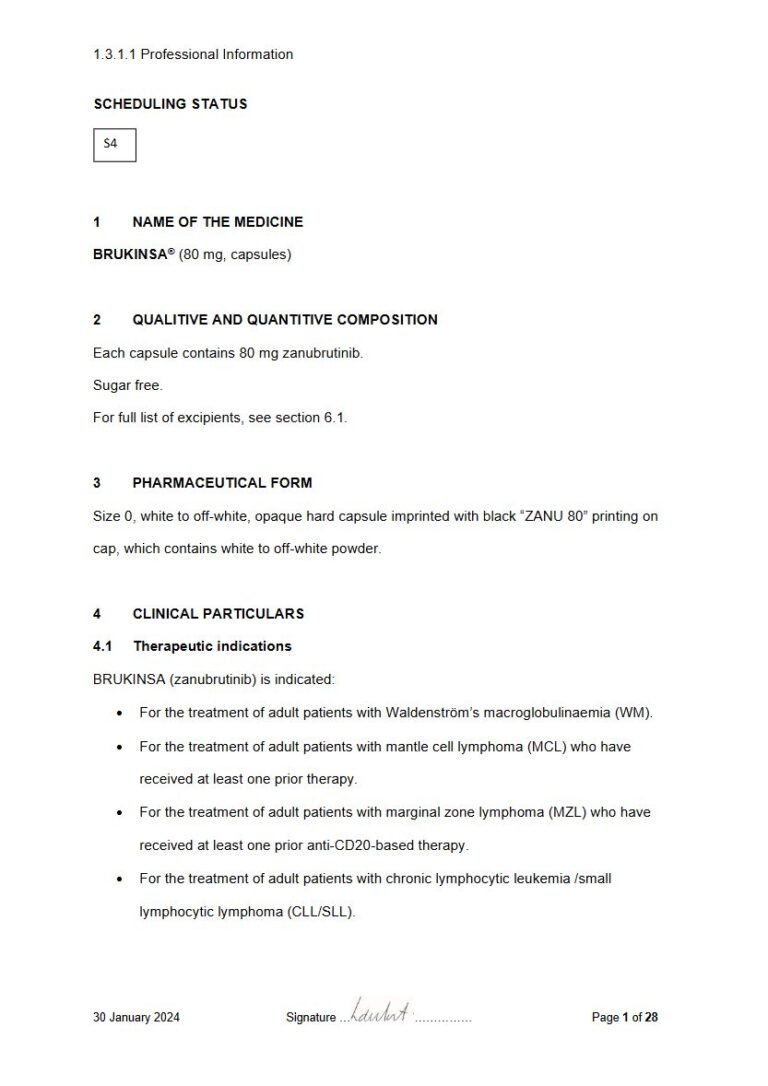
Brukinsa 80 mg Capsules
PDF Leaflet Revision Date: 30 January 2024
Clinical Summary
Quick overview from the medicine insert
Indication
Treatment of adult patients with WM, MCL, MZL, and CLL/SLL.
Dosage (summary)
320 mg daily (4 capsules) or 160 mg twice daily (2 capsules).
Special Populations
- Elderly
- Renal impairment
- Hepatic impairment
Pregnancy & Breastfeeding
May cause fetal harm; avoid breastfeeding during treatment.
Key Drug Interactions
- Strong CYP3A inhibitors
- Moderate CYP3A inhibitors
- Strong CYP3A inducers
Contraindications
- Hypersensitivity to zanubrutinib
Common side effects
- Neutropenia
- Pneumonia
- Fatigue
- Diarrhea
- Rash
Counselling Points
- Take with water, do not chew capsules.
- Avoid grapefruit and Seville oranges.
- Use effective contraception during treatment.
Serious warnings
- Risk of second primary malignancies
- Monitor for atrial fibrillation
- Serious infections
Important Disclaimer
The Brukinsa 80 mg Capsules professional information leaflet below is the property of Beigene South Africa and is provided on Medinsert exactly as issued, with no.. alterations or editorial changes. We make every effort to keep content current by updating documents as soon as new versions become available. Medinsert serves as a trusted access point for healthcare professionals, but does not replace official sources or clinical judgement. For more details, please read our full disclaimer. read more>>
 Healthcare Professionals Only
This content is for registered healthcare professionals
Sign in or create a free account to read the full package insert.
Free for HPCSA-registered professionals. Powered by Medinsert.
Clinical Particulars
Section 4 of the official insert — extracted exactly as issued, no alterations
4.1 Therapeutic indications
BRUKINSA (zanubrutinib) is indicated:
- For the treatment of adult patients with Waldenstru00f6mu2019s macroglobulinaemia (WM).
- For the treatment of adult patients with mantle cell lymphoma (MCL) who have received at least one prior therapy.
- For the treatment of adult patients with marginal zone lymphoma (MZL) who have received at least one prior anti-CD20-based therapy.
- For the treatment of adult patients with chronic lymphocytic leukemia / small lymphocytic lymphoma (CLL/SLL).
4.2 Posology and method of administration
Posology
The recommended total daily oral dose of BRUKINSA is 320 mg. BRUKINSA may be taken as either 320 mg (four 80 mg capsules) once daily or 160 mg (two 80 mg capsules) twice daily. Treatment with BRUKINSA should continue until disease progression or unacceptable toxicity.
Dosage Adjustment
Recommended dose modifications of BRUKINSA for Grade u2265 3 adverse reactions are provided in Table 1.
Table 1: Recommended Dose Modification for Adverse Reaction
| Event | Adverse Reaction Occurrence | Dose Modification (Starting Dose: 160 mg twice daily) |
|---|---|---|
| u2265 Grade 3 non-haematological toxicities | Grade 3 febrile neutropenia | First Interrupt BRUKINSA. Once toxicity has resolved to u2264 Grade 1 or baseline: Resume at 160 mg twice daily or 320 mg once daily |
| Grade 3 thrombocytopenia with significant bleeding | Second Interrupt BRUKINSA. Once toxicity has resolved to u2264 Grade 1 or baseline: Resume at 80 mg twice daily or 160 mg once daily | |
| Grade 4 neutropenia (lasting > 10 consecutive days) | Third Interrupt BRUKINSA. Once toxicity has resolved to u2264 Grade 1 or baseline: Resume at 80 mg once daily | |
| Grade 4 thrombocytopenia (lasting > 10 consecutive days) | Fourth Discontinue BRUKINSA |
Asymptomatic lymphocytosis should not be regarded as an adverse reaction, and these patients should continue taking zanubrutinib.
Recommended dose modification for use with CYP3A inhibitors or inducers are provided in Table 2.
Table 2: Use with CYP3A Inhibitors or Inducers
| CYP3A | Co-administered Drug | Recommended Dose |
|---|---|---|
| Inhibition | Strong CYP3A inhibitor | 80 mg once daily. Interrupt dose as recommended for adverse reactions |
| Moderate CYP3A inhibitor | 80 mg twice daily. Modify dose as recommended for adverse reactions | |
| Induction | Strong CYP3A inducer | Avoid concomitant use; Consider alternative agents with less CYP3A induction |
| Moderate CYP3A inducer | Use with caution. After discontinuation of a CYP3A inhibitor, resume previous dose of BRUKINSA. |
Special populations
Elderly population: Of the 847 patients in clinical trials of BRUKINSA, 53 % were 65 years of age or older, and 20 % were 75 years of age or older. No clinically relevant differences in safety or efficacy were observed between patients u2265 65 years and those younger than 65 years. No dose modification is necessary based on age.
Renal impairment: No dosage modification is recommended in patients with mild to moderate renal impairment (CrCl u2265 30 mL/min, estimated by Cockcroft -Gault). Monitor for BRUKINSA adverse reactions in patients with severe renal impairment (CrCl < 30 mL/min) or on dialysis.
Hepatic impairment: No dose modification is recommended in patients with mild or moderate hepatic impairment. The recommended dose of BRUKINSA for patients with severe hepatic impairment is 80 mg orally twice daily. The safety of BRUKINSA has not been evaluated in patients with severe hepatic impairment. Monitor closely for adverse reactions of BRUKINSA in patients with hepatic impairment.
Paediatric population: The safety and efficacy of BRUKINSA in children and adolescents aged less than 18 years have not been established, therefore BRUKINSA is not recommended for use in children under the age of 18 years.
Method of administration
For oral use. BRUKINSA capsules should be swallowed whole with water, BRUKINSA can be taken with or without food. The capsule should not be chewed, dissolved, or opened. BRUKINSA must not be taken with grapefruit juice, grapefruit and /or Seville oranges.
4.3 Contraindications
Hypersensitivity to the active substance, zanubrutinib or to any of the excipients.
4.4 Special warnings and precautions for use
Treatment with BRUKINSA should be initiated and supervised by a qualified doctor experienced in the use of anticancer therapies.
Carcinogenesis and Mutagenesis
Second Primary Malignancies: Second primary malignancies, including non-skin carcinoma have occurred in 12,4 % patients with hematological malignancies treated with BRUKINSA monotherapy. The most frequent second primary malignancy was skin cancer (basal cell carcinoma, squamous cell carcinoma of skin), reported in 7,4 % of patients. Monitor patients for skin cancer and advise patients to use sun protection.
Cardiovascular: Patients with active, clinically significant cardiovascular disease, such as uncontrolled arrhythmia, class 3 or 4 congestive heart failure or recent myocardial infarction, were excluded from clinical trials of BRUKINSA.
Atrial Fibrillation and Flutter: Atrial fibrillation and atrial flutter have occurred in 3,2 % of patients with haematological malignancies treated with BRUKINSA monotherapy. This risk may be increased in patients with cardiac risk factors, hypertension, and acute infections. Grade 3 and above events were reported in 1,4 % of patients. Monitor for signs and symptoms of atrial fibrillation and atrial flutter and manage as appropriate.
Haematologic: Cytopenias: Grade 3 or 4 neutropenia (18,5 %, including febrile neutropenia), thrombocytopenia (5,7 %) and anaemia (5,2 %) based on laboratory measurements were reported in patients with hematologic malignancies treated with BRUKINSA monotherapy (see section 4.8). Monitor complete blood counts regularly during treatment (see Monitoring and Laboratory Tests). Reduce dose, interrupt or discontinue treatment as necessary (See section 4.2) and treat using growth factors or transfusion as necessary.
Immune: Infections: Serious and fatal infections (including bacterial, viral, or fungal) and opportunistic infections have occurred in patients with haematological malignancies treated with BRUKINSA monotherapy. Grade 3 or higher infections occurred 21,8 % of patients treated with BRUKINSA monotherapy. The most common Grade 3 or higher infection was pneumonia. Infections due to hepatitis B virus (HBV) or varicella zoster reactivation (herpes zoster) have occurred. Monitor patients for signs and symptoms of infection and treat appropriately. Consider prophylaxis according to standard of care in patients who are at increased risk for infections.
Endocrine and Metabolism: Tumour Lysis Syndrome: Tumour lysis syndrome has been infrequently reported with BRUKINSA therapy, particularly in patients who were treated for CLL/SLL. Assess the baseline risk (e.g., high tumour burden) and take appropriate precautions. Monitor patients closely and treat as appropriate.
Monitoring and Laboratory Tests:
- Monitor complete blood counts as per routine clinical practice.
- Monitor for symptoms (e.g., palpitations, dizziness, syncope, chest pain, dyspnoea) of atrial fibrillation and atrial flutter and obtain an echocardiogram (ECG) as appropriate.
- Monitor patients for the appearance of skin cancers.
- Monitor patients for signs and symptoms of infection and treat as medically appropriate.
- Monitor patients for signs of bleeding.
Peri-Operative Considerations: Patients with major surgery within 4 weeks of the first dose of study drug were excluded from clinical trials with BRUKINSA. Consider the benefit-risk of withholding BRUKINSA for 3 to 7 days pre- and post-surgery depending upon the type of surgery and the risk of bleeding.
Respiratory: Interstitial Lung Disease (ILD): Cases of suspected ILD have occurred in 0,6 % of patients with haematological malignancies treated with BRUKINSA monotherapy. However, none were confirmed by biopsy. Monitor patients for signs and symptoms of ILD. Advise patients to report promptly any new or worsening respiratory symptoms. If ILD is suspected, interrupt BRUKINSA and treat promptly and appropriately. If ILD is confirmed, discontinue BRUKINSA.
Vascular: Haemorrhage: Serious and fatal haemorrhagic events have occurred in patients with haematological malignancies treated with BRUKINSA monotherapy. Grade 3 or higher bleeding events including intracranial and gastrointestinal haemorrhage, haematuria and hemothorax have been reported in 3,84 % of patients treated with BRUKINSA monotherapy. Bleeding events of any grade, including purpura and petechiae, occurred in 48,1 % of patients with haematological malignancies treated with BRUKINSA monotherapy. BRUKINSA may increase the risk of haemorrhage in patients receiving antiplatelet or anticoagulant therapies. Patients were excluded from BRUKINSA studies if they had recent history of stroke or intracranial haemorrhage, or if they required warfarin or other vitamin K antagonists. Patients should be monitored for signs of bleeding. Bleeding events should be managed with supportive measures, including transfusions, and specialized care as needed. Reduce dose, interrupt or discontinue treatment as necessary (See section 4.2). For any intracranial haemorrhage, treatment should be discontinued.
4.5 Interactions with other medicines
Zanubrutinib is primarily metabolized by CYP3A. Concomitant use of BRUKINSA with medicinal products that strongly or moderately inhibit CYP3A can increase zanubrutinib plasma concentrations, which may increase the risk of BRUKINSA toxicities. Concomitant use of BRUKINSA with moderate or strong CYP3A inducers can decrease zanubrutinib plasma concentrations, which may reduce BRUKINSA efficacy.
Medicine Interactions
The medicines listed in Table 3 are based on either medicine interaction studies, or potential interactions due to the expected magnitude and seriousness of the interaction.
Table 3: Medicine Interactions
| Common Name | Source of Evidence | Effect | Clinical Comment |
|---|---|---|---|
| Active substances that may increase zanubrutinib plasma concentrations | Strong CYP3A inhibitors (e.g., posaconazole, voriconazole, ketoconazole, itraconazole, clarithromycin, indinavir, lopinavir, ritonavir, telaprevir) | CT | Coadministration of itraconazole (200 mg once daily) increased zanubrutinib C max by 157 % and AUC by 278 %. Reduce BRUKINSA dosage to 80 mg once daily when co-administered with strong CYP3A inhibitors (see section 4.2) |
| Moderate CYP3A inhibitors (e.g., erythromycin, ciprofloxacin, diltiazem, dronedarone, fluconazole, verapamil, aprepitant) | P | Coadministration of erythromycin (500 mg four time daily) was predicted to increase zanubrutinib C max by 284 % and AUC by 317 %; Coadministration of fluconazole (200 mg once daily) was predicted to increase zanubrutinib C max by 179 % and AUC by 177 %; Coadministration of fluconazole (400 mg once daily) was predicted to increase zanubrutinib C max by 270 % and AUC by 284 %; Coadministration of diltiazem (200 mg once daily) was predicted to increase zanubrutinib C max by 151 % and AUC by 157 %; Reduce BRUKINSA dosage to 80 mg twice daily when co-administered with moderate CYP3A inhibitors (see section 4.2) | |
| Active substances that may decrease zanubrutinib plasma concentrations | Strong CYP3A inducers (e.g., carbamazepine, phenytoin, rifampin) | CT | Co-administration of rifampin (600 mg once a day for 8 days) decreased zanubrutinib C max by 92 % and AUC by 93 %. Avoid concomitant use of BRUKINSA with strong CYP3A inducers. |
| Moderate CYP3A inducers (e.g., bosentan, efavirenz, etravirine, modafinil, nafcillin) | CT | Co-administration of rifabutin (300 mg once a day for 9 days) decreased zanubrutinib C max by 48% and AUC by 44%. Use with caution |
Ref: BGB-3111-112 CT = Clinical Trial; P = Predicted
Clinical Studies
Effects of Gastric Acid Reducing Agents on zanubrutinib: No clinically significant differences in zanubrutinib pharmacokinetics were observed when co-administered with gastric acid reducing agents (proton pump inhibitors, H2-receptor antagonists).
Effects of zanubrutinib on CYP3A Substrates: Co-administration of multiple doses of zanubrutinib decreased midazolam (CYP3A substrate) C max by 30 % and AUC by 47 %.
Effects of zanubrutinib on CYP2C19 Substrates: Co-administration of multiple doses of zanubrutinib decreased omeprazole (CYP2C19 substrate) C max by 20 % and AUC by 36 %.
Effects of zanubrutinib on Other CYP Substrates: No clinically significant differences were observed with warfarin (CYP2C9 substrate) pharmacokinetics or predicted with rosiglitazone (CYP2C8 substrate) pharmacokinetics when co-administered with zanubrutinib.
Effects of zanubrutinib on Transporter Systems: Co-administration of multiple doses of zanubrutinib increased digoxin (P-gp substrate) C max by 34 % and AUC by 11 %. No clinically significant differences in the pharmacokinetics of rosuvastatin (BCRP substrate) were observed when co-administered with zanubrutinib.
In Vitro Studies
Effects of zanubrutinib on CYP2B6 Substrates: In vitro, zanubrutinib is a weak inducer of CYP2B6.
Effects of Transporters on zanubrutinib: In vitro, zanubrutinib is likely to be a substrate of P-gp. Zanubrutinib is not a substrate or inhibitor of OAT1, OAT3, OCT2, OATP1B1, or OATP1B3.
Medicine-Food Interactions: Avoid concomitant use with grapefruit, grapefruit juice and Seville oranges, as they contain inhibitors of CYP3A and may increase zanubrutinib plasma concentrations.
No clinically significant differences in zanubrutinib AUC or C max were observed following administration of a high-fat meal (approximately 1 000 calories with 50 % of total caloric content from fat) in healthy subjects.
Medicine-Herb Interactions: Avoid St. Johnu2019s wort which may unpredictably decrease zanubrutinib plasma concentrations.
4.6 Fertility, pregnancy and lactation
Women of childbearing potential/ Contraception in males and females: Women of child-bearing potential must use highly effective contraceptive measures while taking BRUKINSA and at least for one week after stopping treatment. Women who use hormonal methods of birth control must add a barrier method.
Pregnancy: There are no adequate and well-controlled studies of BRUKINSA in pregnant women. Based on findings in animals, zanubrutinib may cause foetal harm when administered to pregnant women (see section 5.3). If BRUKINSA is used during pregnancy or if the patient becomes pregnant while taking BRUKINSA, the patient should be apprised of the potential hazard to the fetus.
Breastfeeding: It is unknown if BRUKINSA is excreted in human milk. Because many medicines are excreted in human milk and because of the potential for serious adverse reactions from BRUKINSA in a breastfed child, advise lactating women not to breastfeed during treatment with BRUKINSA and for at least two weeks following the last dose.
Fertility: No effect on male or female fertility was noted in rats but morphological abnormalities in sperm and increased post-implantation loss were noted at 300 mg/kg/day (see section 5.3).
4.7 Effects on ability to drive and use machines
No specific studies have been conducted to evaluate the influence of BRUKINSA treatment on the ability to drive or operate heavy machinery. Fatigue, dizziness, and asthenia have been reported in some patients taking BRUKINSA and should be considered when assessing a patientu2019s ability to drive or operate machines.
4.8 Undesirable effects
Summary of the safety profile: The safety profile is based on pooled data from 1550 patients with B-cell malignancies treated with BRUKINSA monotherapy in 9 clinical trials, including one Phase 1 clinical study (BGB-3111-1002), one Phase 1/2 clinical study (BGB-3111-AU-003), four Phase 2 studies (BGB-3111-205, BGB-3111-206, and BGB-3111-210, BGB-3111-214), and three Phase 3 clinical studies (BGB-3111-302, BGB -3111-304, BGB-3111-305). Among 1550 patients receiving zanubrutinib, the median duration of exposure was 22,95 months. Among the patients, 73,6 % patients were exposed to zanubrutinib for at least 1 year, 48 % were exposed for at least 2 years, 23,5 % were exposed for at least 3 years and 6,7 % were exposed for at least 4 years.
The most common adverse reactions (u2265 10 % grouped terms) were upper respiratory tract infection, neutropenia, haemorrhage/haematoma, bruising, rash, musculoskeletal pain, diarrhoea, cough, pneumonia, fatigue, thrombocytopenia, anaemia, constipation, and dizziness.
Overall, 17,7 % of patients experienced serious adverse reactions. The most frequently reported serious adverse reactions (u2265 1 %, grouped terms) were pneumonia (9,2 %), haemorrhage /hematoma (2,5 %), neutropenia (1,9 %), and anaemia (1,4 %). Deaths due to adverse events within 30 days were reported in 1,4 % of patients. The most common treatment-emergent adverse event leading to death (u2265 1 %, grouped term) was pneumonia (1,2 %).
Of the 1550 patients treated with BRUKINSA, 41 (2,6 %) patients discontinued treatment due to adverse reactions. The most frequent adverse reaction leading to treatment discontinuation (u2265 1 %, grouped term) was pneumonia (1,4 %). Adverse reactions leading to dose reduction occurred in 4,6 % of patients. The most frequent adverse reactions leading to dose reduction were neutropenia (0,9 %) and pneumonia (0,8 %).
Tabulated list of adverse reactions: Adverse reactions in patients treated with BRUKINSA for B-cell malignancies are listed below by system organ class and frequency grouping. Frequencies are defined as follows: very common (u2265 1/10), common (u2265 1/100 to < 1/10), uncommon (u2265 1/1 000 to < 1/100), rare (u2265 1/10 000 to <1/1 000), very rare (< 1/10 000), not known (cannot be estimated from the available data).
Table 4: Adverse reactions reported in clinical studies in patients with B-cell malignancies
| MedDRA SOC | MedDRA Terms | All Grades* (%) | Grade 3 or higher (%) |
|---|---|---|---|
| Infections and infestations | Upper respiratory tract infection u00a7 | Very common (33) | 2 |
| Pneumonia u00a7# | Very common (18) | 9 | |
| Pneumonia | Very common (12) | 7 | |
| Lower respiratory tract infection | Common (5) | <1 | |
| Urinary tract infection | Very common (12) | 2 | |
| Bronchitis | Common (4) | <1 | |
| Hepatitis B reactivation | Uncommon (<1) | <1 | |
| Blood and lymphatic system disorders | Neutropenia u00a7 | Very common (28) | 19 |
| Febrile neutropenia | Common (1) | 1 | |
| Thrombocytopenia u00a7 | Very common (16) | 6 | |
| Anaemia u00a7 | Very common (14) | 5 | |
| Nervous system disorder | Dizziness u00a7 | Very common (11) | <1 |
| Cardiac disorders | Atrial fibrillation and flutter | Common (3) | 1 |
| Vascular disorders | Bruising u00a7 | Very common (30) | <1 |
| Contusion | Very common (18) | 0 | |
| Petechiae | Common (7) | <1 | |
| Purpura | Common (5) | <1 | |
| Ecchymosis | Common (2) | <1 | |
| Haemorrhage/Haematoma u00a7# | Very common (27) | 3 | |
| Haematuria | Very common (10) | <1 | |
| Epistaxis | Common (7) | <1 | |
| Gastrointestinal haemorrhage | Uncommon (<1) | <1 | |
| Hypertension u00a7 | Very common (13) | 7 | |
| Respiratory, thoracic and mediastinal disorders | Cough | Very common (19) | <1 |
| Gastrointestinal disorders | Diarrhoea | Very common (19) | 2 |
| Constipation | Very common (12) | <1 | |
| Nausea u03bc | Very common (11) | <1 | |
| Vomiting u03bc | Common (6) | <1 | |
| Skin and subcutaneous tissue disorders | Rash u00a7 | Very common (23) | <1 |
| Pruritus | Common (7) | <1 | |
| Dermatitis exfoliative general | Unknown | Unknown | |
| Musculoskeletal and connective tissue disorders | Musculoskeletal pain u00a7 | Very common (23) | 2 |
| Arthralgia | Very common (13) | <1 | |
| Back pain | Very common (10) | <1 | |
| General disorders and administration site conditions | Fatigue u00a7 | Very common (16) | 1 |
| Fatigue | Very common (12) | 1 | |
| Asthenia | Common (4) | <1 | |
| Oedema peripheral | Common (7) | <1 | |
| Metabolism and nutrition disorders | Tumour lysis syndrome u00a7# | Uncommon (<1) | <1 |
| Investigations u2020 | Absolute neutrophil count decreased u2020 u00b1 | Very common (49) | 21 |
| Platelets decreased u2020 u00b1 | Very common (36) | 7 | |
| Haemoglobin decreased u2020 u00b1 | Very common (23) | 4 |
* Grades were evaluated based on the National Cancer Institute Common Terminology Criteria for Adverse Events (NCI-CTCAE) version 4.03.
u2020 Based on laboratory measurements.
u00b1 Percentages are based on number of patients with both baseline and at least one postbaseline assessment available.
u00a7 Includes multiple adverse reaction terms
# Includes events with fatal outcome.
u03bc Treatment-emergent Adverse Events with no established causal relationship with the medicine
Reporting of suspected adverse reactions: Reporting suspected adverse reactions after authorisation of the medicine is important. It allows continued monitoring of the benefit/risk balance of the medicine. Health care providers are asked to report any suspected adverse reactions to SAHPRA on the SAHPRA website at the following link: https://medsafety.sahpra.org.za/#download1, via email at: [email protected] or via telephone at: 0125010311.
4.9 Overdose
There is no specific treatment for BRUKINSA overdose. For patients who experience overdose closely monitor and provide appropriate supportive treatment.
