
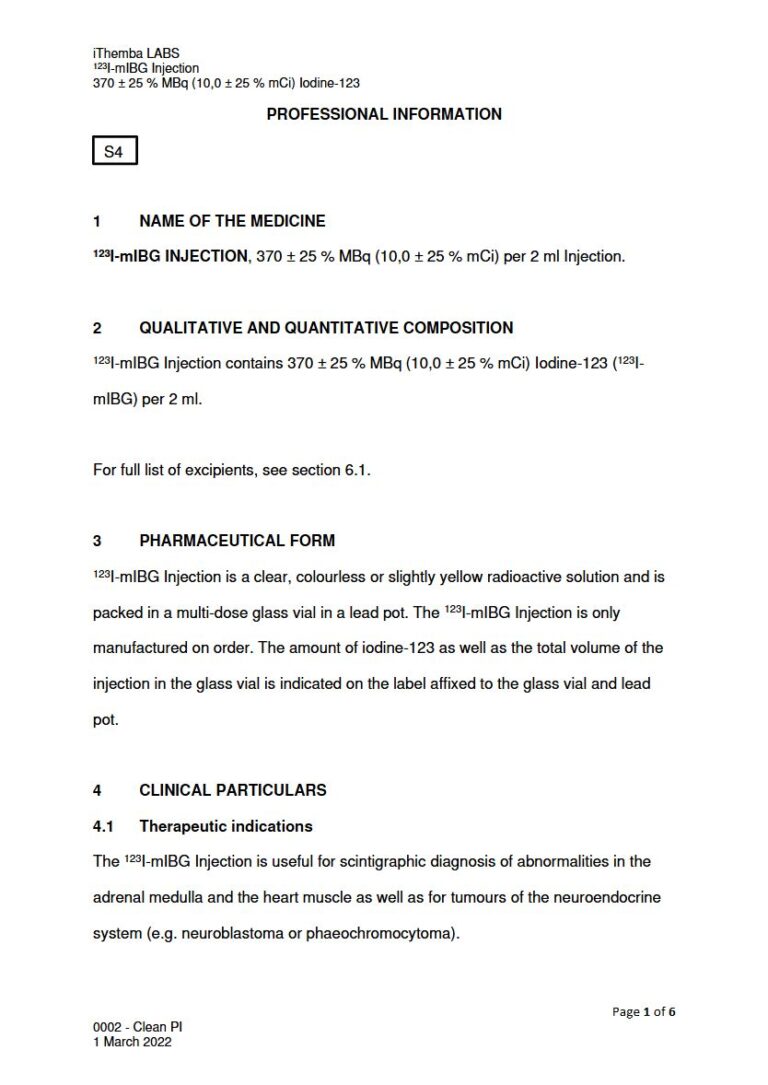
123I-Mibg Injection
Clinical Summary
Quick overview from the medicine insert
Indication
Used for diagnostic imaging in patients with neuroblastoma and other neuroendocrine tumors.
Dosage (summary)
Administered as a single intravenous injection of 370 MBq per 2 ml.
Onset of Action / Duration
Imaging results can typically be obtained within 24 hours post-injection.
Special Populations
- Elderly patients
- Patients with renal impairment
- Pediatric patients
Pregnancy & Breastfeeding
Use during pregnancy only if the potential benefit justifies the potential risk to the fetus. Caution is advised during lactation.
Key Drug Interactions
- May interact with other radiopharmaceuticals.
- Potential interactions with iodine-containing medications.
Contraindications
- Hypersensitivity to iodine or any component of the formulation.
- Severe renal impairment.
Common side effects
- Nausea
- Vomiting
- Allergic reactions
- Transient changes in thyroid function
Counselling Points
- Inform patients about the purpose of the injection and the imaging process.
- Advise patients to stay hydrated before and after the procedure.
- Discuss potential side effects and the importance of reporting any unusual symptoms.
Serious warnings
- Caution in patients with a history of thyroid disease.
- Monitor renal function in patients with pre-existing renal conditions.
Important Disclaimer
The 123I-Mibg Injection professional information leaflet below is the property of Ithemba Labs and is provided on Medinsert exactly as issued, with no.. alterations or editorial changes. We make every effort to keep content current by updating documents as soon as new versions become available. Medinsert serves as a trusted access point for healthcare professionals, but does not replace official sources or clinical judgement. For more details, please read our full disclaimer. read more>>
 Healthcare Professionals Only
This content is for registered healthcare professionals
Sign in or create a free account to read the full package insert.
Free for HPCSA-registered professionals. Powered by Medinsert.
Clinical Particulars
Section 4 of the official insert — extracted exactly as issued, no alterations
4.1 Therapeutic indications
The 123 I-mIBG Injection is useful for scintigraphic diagnosis of abnormalities in the adrenal medulla and the heart muscle as well as for tumours of the neuroendocrine system (e.g. neuroblastoma or phaeochromocytoma).
4.2 Posology and method of administration
The dose for administration to adults is between 74 and 370 MBq or as prescribed for a specific diagnosis. The injection must be administered intravenously.
4.3 Contraindications
Sensitivity to iodine.
4.4 Special warnings and precautions for use
123 I-mIBG Injection is radioactive and should only be handled and administered by legally authorised personnel. The 123 I-mIBG Injection is not recommended for pregnant patients. Since iodine-123 is excreted in human milk, formula feeding should be substituted for breastfeeding if 123 I-mIBG Injection must be administered to the mother during lactation.
4.5 Interaction with other medicines and other forms of interaction
No interaction studies have been performed.
4.6 Fertility, pregnancy and lactation
The safety of this preparation in pregnancy has not been established. Since iodine-123 is excreted in human milk, formula feeding should be substituted for breastfeeding if 123 I-mIBG Injection must be administered to the mother during lactation (see section 4.4. Special warnings and precautions for use).
4.7 Effects on ability to drive and use machines
No studies on the effects on the ability to drive and use machines have been performed.
4.8 Undesirable effects
No side-effects are known at normal levels of the diagnostic agent. The absorbed radiation dose per unit activity (mGy/MBq) in different organs is as follows:
Organ mGy/MBq Organ mGy/MBq
Adrenals 1.1E-02 Liver 7.1E-02
Bladder wall 7.0E-02 Ovaries 8.0E-03
Heart 1.1E-02 Testes 5.4E-03
Kidneys 1.4E-02 (Annals of the ICRP Volume 18 No. 1-4 P330 1987). ]
Reporting of suspected adverse reactions: Reporting suspected adverse reactions after authorisation of the medicine is important. It allows continued monitoring of the benefit/risk balance of the medicine. Healthcare providers are asked to report any suspected adverse reactions to SAHPRA via the u201c6.04 Adverse Drug Reactions Reporting Formu201d found online under SAHPRAu2019s publications: https://www.sahpra.org.za/Publications/Index/8.
4.9 Overdose
No symptoms of overdosage are known.
