
Adacel Injection
Clinical Summary
Quick overview from the medicine insert
Indication
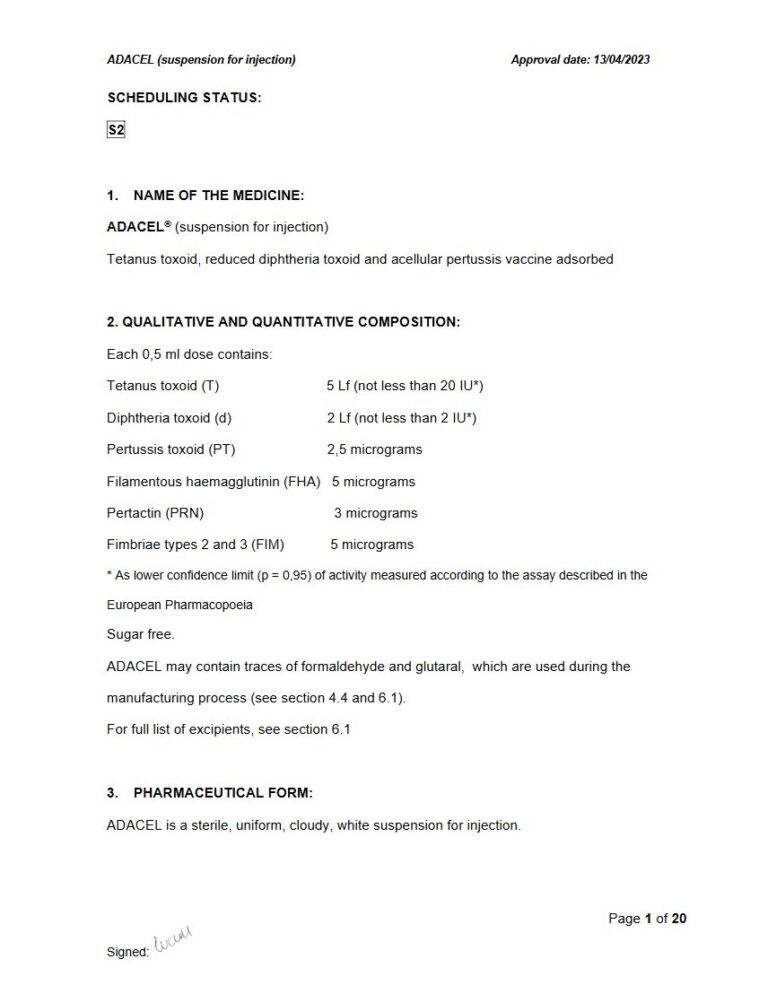
Active immunization against diphtheria, tetanus, and pertussis in individuals aged 10 years and older.
Dosage (summary)
Administer a single dose of 0.5 ml intramuscularly.
Onset of Action / Duration
Immunity develops within 2 to 4 weeks after vaccination.
Special Populations
- Individuals with a history of severe allergic reactions to vaccine components
- Individuals with moderate to severe acute illness
- Pregnant women should consult healthcare providers
Pregnancy & Breastfeeding
Adacel can be administered during pregnancy, particularly in the third trimester, to protect newborns from pertussis. Consult a healthcare provider before use during lactation.
Key Drug Interactions
- Immunosuppressive therapies may reduce vaccine efficacy
- Concurrent administration with other vaccines is generally safe but should be done under medical supervision
Contraindications
- Severe allergic reaction (e.g., anaphylaxis) to any component of the vaccine
- History of encephalopathy within 7 days of a previous pertussis vaccine
Common side effects
- Local reactions at the injection site (pain, swelling, redness)
- Fever
- Fatigue
- Headache
- Nausea
Counselling Points
- Inform patients about the importance of completing the vaccination series
- Advise patients to report any severe or unusual side effects
- Encourage patients to maintain a record of vaccinations
Serious warnings
- Monitor for allergic reactions post-vaccination
- Use caution in individuals with a history of Guillain-Barré syndrome
- Do not administer to individuals with moderate to severe acute illness until recovery
Important Disclaimer
The Adacel Injection professional information leaflet below is the property of Sanofi Pasteur and is provided on Medinsert exactly as issued, with no.. alterations or editorial changes. We make every effort to keep content current by updating documents as soon as new versions become available. Medinsert serves as a trusted access point for healthcare professionals, but does not replace official sources or clinical judgement. For more details, please read our full disclaimer. read more>>
 Healthcare Professionals Only
This content is for registered healthcare professionals
Sign in or create a free account to read the full package insert.
Free for HPCSA-registered professionals. Powered by Medinsert.
Clinical Particulars
Section 4 of the official insert — extracted exactly as issued, no alterations
4.1 Therapeutic indications:
ADACEL (Tdap) is indicated for active booster immunization for the prevention of tetanus, diphtheria and pertussis (whooping cough) in persons 4 years of age and older, according to local immunisation recommendations. Passive immunisation against pertussis in early infancy following maternal immunization during pregnancy (see sections 4.2, 4.6, and 5.1). Persons who have had pertussis, tetanus or diphtheria, should still be immunised since these clinical infections do not always confer immunity. ADACEL can be used in the management of tetanus prone injuries with or without concomitant administration of Tetanus immunoglobulin in accordance with official recommendations.
4.2 Posology and method of administration:
ADACEL (0,5 ml) should be administered as a booster injection by the intramuscular route. Re-dosing with ADACEL can be used to boost immunity to diphtheria, tetanus and pertussis at 5- to 10-year intervals. ADACEL may be administered to pregnant women during the second and third trimester to provide passive immunity to infants against pertussis (see sections 4.1, 4.6 and 5.1). The use of ADACEL in management of tetanus-prone wounds should follow local recommendations. A thorough attempt must be made to determine whether a patient has completed primary immunisation. Persons who have completed primary immunisation against tetanus and who sustain wounds that are minor and uncontaminated, should receive a booster dose of a tetanus toxoid-containing preparation if they have not received tetanus toxoid within the preceding 10 years. For tetanus-prone wounds (e.g., wounds contaminated with dirt, faeces, soil and saliva, puncture wounds, avulsions and wounds resulting from measles, crushing, burns or frostbite), a booster is appropriate if the patient has not received a tetanus toxoid-containing preparation within the preceding 5 years. Method of administration: Administer the total volume of 0,5 ml intramuscularly (IM). The preferred site of injection is the deltoid muscle. Fractional doses (doses < 0,5 ml) should not be given. Do not administer ADACEL intravenously. ADACEL should not be administered into the gluteal area; intradermal or subcutaneous routes should not be used (for exception see section 4.4). For instructions on handling of ADACEL before administration see section 6.6. Separate syringes, separate injection sites and preferably separate limbs must be used in case of concomitant administration (see section 4.5).
4.3 Contraindications:
Hypersensitivity: ADACEL should not be administered to anyone with a history of severe allergic reaction to any component of the vaccine (sections 2 and 6.1) or after a previous administration of the vaccine or a vaccine containing the same components or constituents.
Febrile or Acute Disease: Generally, vaccination must be postponed in cases of moderate or severe febrile and/or acute disease. Low-grade fever does not constitute a contraindication.
Neurological Disorders: Encephalopathy within 7 days of a previous dose of pertussis containing vaccine not attributable to another identifiable cause is a contraindication to vaccination with ADACEL.
4.4 Special warnings and precautions for use:
General: Before immunisation, healthcare providers should inform the recipient or their parent/guardian of the benefits and risks of immunisation, inquire about the recent health status of the recipient, review the recipientu2019s immunisation history including possible hypersensitivity to ADACEL or a similar vaccine, presence of contraindications to immunisation and comply with local requirements regarding information to be provided to the recipient or parent/guardian before immunisation. It is extremely important that the recipient or parent/guardian be questioned concerning any signs or symptoms of an adverse reaction after a previous dose of vaccine.
As with all injectable vaccines, appropriate medical treatment and supervision should always be readily available in case of a rare anaphylactic event following administration of the vaccine. The rates and severity of adverse events in recipients of tetanus toxoid are influenced by the number or prior doses and level of pre-existing antitoxins.
Hypersensitivity: Formaldehyde and glutaraldehyde have been used in the manufacturing process of ADACEL and trace residual amounts may be present in the final product. Therefore, a hypersensitivity reaction may occur.
Neurological Disorders: If Guillain-Barru00e9 syndrome or brachial neuritis has occurred following receipt of prior vaccine containing tetanus toxoid, the decision to give any vaccine containing tetanus toxoid should be based on careful consideration of the potential benefits and possible risks. ADACEL should not be administered to individuals with progressive or unstable neurological disorders, uncontrolled epilepsy or progressive encephalopathy until a treatment regimen has been established, the condition has stabilised and the benefit clearly outweighs the risk.
Protection: As with any vaccine, vaccination with ADACEL may not protect 100 % of susceptible individuals.
Special Patient Groups: Immunocompromised persons (whether from disease or treatment) may not obtain the expected immune response. If possible, consideration should be given to delaying vaccination until after the completion of any immunosuppressive treatment. Nevertheless, vaccination of subjects with chronic immunodeficiency such as HIV infection is recommended even if the immune response might be limited.
Administration Route Related Precautions: Do not administer by intravascular injection: ensure that the needle does not penetrate a blood vessel. As with all injectable vaccines, the vaccine must be administered with caution to subjects with thrombocytopaenia or a bleeding disorder since bleeding may occur following an intramuscular administration to these subjects. Syncope: Syncope (fainting) can occur following, or even before, administration of injectable vaccines, including ADACEL. Procedures should be in place to prevent falling injury and manage syncopal reactions.
4.5 Interactions with other medicines and other forms of interaction:
Concomitant Administration with Other Vaccines: ADACEL may be administered concurrently with influenza vaccine, hepatitis B vaccine, inactivated or oral poliomyelitis vaccine and human papillomavirus vaccine (see section 4.8). In accordance with national recommendations, other live or inactivated parenteral vaccines may be administered simultaneously, as appropriate for the recipientu2019s age and previous vaccination status. Separate injection sites and separate syringes must be used in case of concomitant administration. ADACEL must not be mixed with other vaccines or medicinal products.
Vaccine-Medicine Interaction: Immunosuppressive treatment may interfere with the development of the expected immune response to ADACEL.
4.6 Fertility, pregnancy and lactation:
Pregnancy: ADACEL can be used during the second or third trimester of pregnancy in accordance with official recommendations (see section 4.2). Safety data from 4 randomized controlled trials (310 pregnancy outcomes), 1 prospective observational studies (546 pregnancy outcomes), 5 retrospective observational studies (124 810 pregnancy outcomes), and from passive surveillance of women who received ADACEL or ADACEL QUADRA (Tdap-IPV; containing the same amounts of tetanus, diphtheria and pertussis antigens as ADACEL) during the second or third trimester have shown no vaccine-related adverse effect on pregnancy or on the health of the foetus / new born child. As with other inactivated vaccines, it is not expected that vaccination with ADACEL during any trimester would harm the foetus. Animal studies do not indicate direct or indirect harmful effects with respect to pregnancy, embryonal/foetal development, parturition or postnatal development. For information on immune responses to vaccination during pregnancy and its effectiveness at preventing pertussis in infants, see section 5.1.
Breastfeeding: It is not known whether the active substances included in ADACEL are excreted in human milk, but antibodies to the vaccine antigens have been found to be transferred to the suckling offspring of rabbits. Two animal developmental studies conducted in rabbits have not shown any harmful effects of maternal antibodies induced by the vaccine on offspring postnatal development. The effect of administration of ADACEL during lactation has not been assessed. As ADACEL is inactivated, any risk to the mother or the infant is improbable. The risks and benefits of vaccination should be assessed before making the [to] decision to immunise a nursing woman.
Fertility: ADACEL has not been evaluated in fertility studies.
4.7 Effects on the ability to drive and use machines:
No studies on the effects on the ability to drive and use machines have been performed.
4.8 Undesirable effects:
Data from Clinical Studies: In clinical studies of ADACEL conducted on individuals u2265 4 years of age, pain at the injection site was the most common solicited injection site reaction. Most injection site reactions occurred within 3 days following vaccination and their mean duration was less than 3 days.
The most frequent systemic reaction was tiredness in children and headache in adolescents and adults (18 - 64 years). Myalgia was the most frequently reported systemic reaction among older adults u2265 65 years of age. Fever was reported in less than 10 % of vaccinees. These reactions were usually transient and of mild to moderate intensity. The frequency of the solicited injection site and systemic reactions reported in 3 clinical studies following a single dose of ADACEL are shown in Table 1.
Table 1. Frequency (%) of solicited reactions observed within 0 to 14 days in clinical trials in children, adolescents and adults, following a single dose with ADACEL
Solicited reactions
- Children (4 - 6 years) (N = 298)
- Adolescents (11 - 17 years) (N = 1,184)
- Adults (18 - 64 years) (N = 1,752)
- Adults (u2265 65 years) (N = 1,153)
Injection site reactions:
- Pain 39,6 77,8 65,7 43,0
- Swelling 24,2 20,9 21,0 18,1
- Erythema 34,6 20,8 24,7 24,3
Systemic reactions:
- Fever (u2265 38,0 u00b0 C) 8,7 5,0 1,4 0,5
- Headache 16,4 43,7 33,9 18,2
- Nausea 9,4 13,3 9,2 N.S.*
- Diarrhea 14,4 10,3 10,3 N.S.*
- Vomiting 8,1 4,6 3,0 N.S.*
- Anorexia 21,5 N.S.* N.S.* N.S.*
- Rash 8,4 2,7 2,0 N.S.*
Solicited reactions
- Children (4 - 6 years) (N = 298)
- Adolescents (11 - 17 years) (N = 1,184)
- Adults (18 - 64 years) (N = 1,752)
- Adults (u2265 65 years) (N = 1,153)
Body ache or muscle weaknessu2020 / myalgiau2021 6,4 30,4 21,9 28.4*
Sore or swollen joints 4,0 11,3 9,1 N.S.*
Tirednessu00a7 / malaise** 31,5 30,2 24,3 17.2
Chills 7,1 15,1 8,1 N.S.*
Axillary lymph node swelling 5,4 6,6 6,5 N.S.*
* Not Solicited
u2020 Body ache or muscle weakness was the solicited term in the trials in children, adolescents and adults 18 - 64 years of age
u2021 Myalgia was the solicited term in the trial in adults u226565 years of age.
u00a7 Tiredness was the solicited term in the trials in children, adolescents and adults 18 - 64 years of age.
** Malaise was the solicited term in the trial in adults u2265 65 years of age.
The safety and tolerability of revaccination with ADACEL at 5 and 10 years after a previous dose of the vaccine was evaluated in 2 clinical studies. In adolescents and adults, pain at the injection site was the most common solicited injection site reaction, while myalgia was the most frequently reported systemic reaction. Fever was reported in less than 7 % of vaccinees. The frequency of the solicited injection site and systemic reactions observed in adolescents and adults following re-administration of ADACEL at 5 and 10 years are shown in Table 2.
Table 2. Frequency of solicited reactions observed in adolescents and adults following re-administration of ADACEL at 5 and 10 years, respectively
Solicited reactions
- Re-administration of ADACEL After 5 years*
- After 10 yearsu2020
- Adolescents and adults 16 u2013 69 years (N = 544)
- Adults 20 u2013 72 years (N = 361)
Injection site reactions:
- Pain 87,6 87,8
- Erythema/ Redness 28,6 23,1
- Swelling 25,6 20,5
Systemic reactions:
- Fever 6,5 4,2
- Headache 53,2 40,6
- Myalgia 61,0 60,1
- Malaise 38,2 29,4
* Adverse reactions observed within 0 to 14 days after vaccination
u2020 Adverse reactions observed within 0 to 7 days after vaccination
Safety analysis was conducted in 1,042 healthy adolescent males and females aged 10 to 17 years during a clinical trial. They received recombinant HPV vaccine concurrently with a dose of ADACEL and a dose of quadrivalent meningococcal conjugate vaccine serogroup A, C, Y and W135. The safety profiles were similar in both concomitant and non-concomitant groups. Higher frequencies of swelling at the recombinant HPV vaccine injection site, bruising and pain at ADACEL injection site were observed in the concomitant administration group. The differences observed between concomitant and non-concomitant groups were less than 7 % and in a majority of subjects the adverse events were reported as mild to moderate in intensity.
Data from post-marketing experience The following additional adverse events have been spontaneously reported during the post-marketing use of ADACEL worldwide. Because these events are reported voluntarily from a population of uncertain size, it is not always possible to reliably estimate their frequency or establish a causal relationship to vaccine exposure. Decisions to include these events in labelling were based on one or more of the following factors: 1) severity of the event, 2) frequency of reporting, or 3) strength of causal connection to ADACEL.
Immune System Disorders: Hypersensitivity (anaphylactic) reaction (angioedema, edema, rash, hypotension)
Nervous System Disorders: Paraesthesia, hypoesthesia, Guillain-Barru00e9 syndrome, brachial neuritis, facial palsy, convulsion, syncope, myelitis
Cardiac Disorders: Myocarditis
Skin and Subcutaneous Tissue Disorders: Pruritus, urticaria
Musculoskeletal and Connective Tissue Disorders: Myositis
General Disorders and Administration Site Conditions: Large injection site reactions (> 50 mm) and extensive limb swelling from the injection site beyond one or both joints occur after administration of ADACEL in adolescents and adults. These reactions usually start within 24 - 72 hours after vaccination, may be associated with erythema, warmth, tenderness or pain at the injection site and resolve spontaneously within 3 - 5 days. Injection site bruising, sterile abscess.
Reporting of suspected adverse reactions: Reporting suspected adverse reactions after authorisation of the medicine is important. It allows continued monitoring of the benefit/risk balance of the medicine. Health care providers are asked to report any suspected adverse reactions to: u2022 The Pharmacovigilance Unit at Sanofi: Email: [email protected] or Tel: 011 256- 3700, or u2022 SAHPRA via the u201c6.04 Adverse Drug Reactions Reporting Formu201d found online under SAHPRAu2019s publications: https://www.sahpra.org.za/Publications/Index/8.
4.9 Overdose:
None known.
