
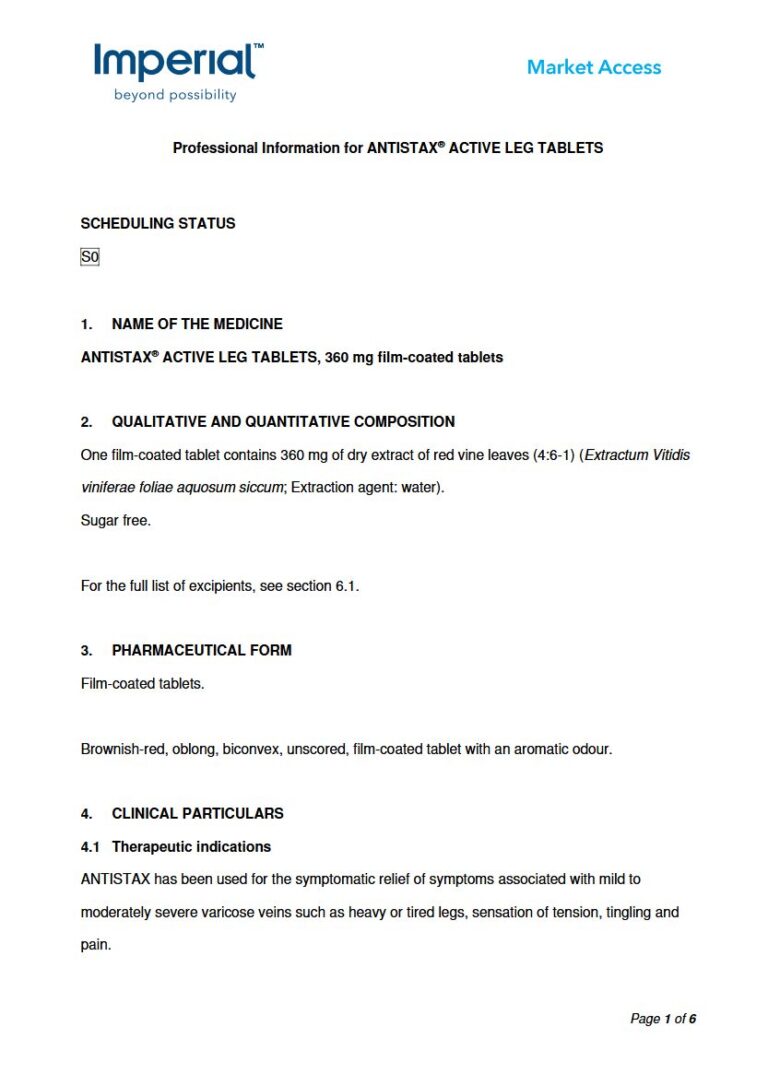
Antistax Active Leg 360 mg FC tablets
PDF Leaflet Revision Date: 15 December 2022
Clinical Summary
Quick overview from the medicine insert
Indication
Symptomatic relief of mild to moderately severe varicose veins.
Dosage (summary)
1 tablet (360 mg) daily, may increase to 2 tablets (720 mg) in the morning.
Pregnancy & Breastfeeding
Not recommended during pregnancy or breastfeeding.
Key Drug Interactions
- Caution with CYP450 metabolized drugs
Contraindications
- Hypersensitivity to red vine leaf extracts
Common side effects
- Hypersensitivity
- Nausea
- Stomach discomfort
- Generalized pruritic rash
- Urticaria
Counselling Points
- Swallow tablets whole with water before meals.
- Re-evaluate if symptoms persist after 6 weeks.
Serious warnings
- Consult doctor if sudden swelling or pain occurs; may indicate thrombophlebitis.
Important Disclaimer
The Antistax Active Leg 360 mg FC tablets professional information leaflet below is the property of Imperial Market Access Healthcare Sa and is provided on Medinsert exactly as issued, with no.. alterations or editorial changes. We make every effort to keep content current by updating documents as soon as new versions become available. Medinsert serves as a trusted access point for healthcare professionals, but does not replace official sources or clinical judgement. For more details, please read our full disclaimer. read more>>
 Healthcare Professionals Only
This content is for registered healthcare professionals
Sign in or create a free account to read the full package insert.
Free for HPCSA-registered professionals. Powered by Medinsert.
Clinical Particulars
Section 4 of the official insert — extracted exactly as issued, no alterations
4.1 Therapeutic indications
ANTISTAX has been used for the symptomatic relief of symptoms associated with mild to moderately severe varicose veins such as heavy or tired legs, sensation of tension, tingling and pain.
4.2 Posology and method of administration
Posology
The recommended dose for adults is 1 film-coated tablet (360 mg daily). The dose may be increased to 2 film-coated tablets (720 mg) daily to be taken in the morning. The film-coated tablets are to be swallowed whole with water before meals. Efficacy beyond 12 weeks was not studied.
Paediatric population
No data are available.
4.3 Contraindications
ANTISTAX should not be used in patients known to be hypersensitive to red vine leaf extracts or any other of the components of the product (see section 6.1).
4.4 Special warnings and precautions for use
If a sudden swelling, reddening of the skin, feeling of tension or heat and pain appear, especially in one leg, a doctor should be consulted. These symptoms may be due to thrombophlebitis. In the event of inadequate or unsatisfactory symptomatic response within six weeks, re-evaluate the patient as the symptoms may have alternative causes.
4.5 Interaction with other medicines and other forms of interaction
Caution is advised when ANTISTAX are used concomitantly with other medicines that are metabolised by CYP450 enzymes. No formal interactions studies have been conducted.
4.6 Fertility, pregnancy and lactation
ANTISTAX are not recommended during pregnancy or in nursing mothers. There are no studies in pregnant women or nursing mothers. There are no studies on the effects of ANTISTAX on fertility.
4.7 Effects on ability to drive and use machines
No studies on the effects on the ability to drive and use machines have been performed.
4.8 Undesirable effects
Frequency classes: Very common ( u2265 1/10); common ( u2265 1/100, < 1/10); uncommon ( u2265 1/1 000, < 1/100); rare ( u2265 1/10 000, < 1/1 000); very rare (< 1/10 000); Not known (cannot be estimated from the available data).
Immune system disorders:
Uncommon: Hypersensitivity.
Gastrointestinal disorders:
Uncommon: Nausea, stomach discomfort and other symptoms involving the digestive system.
Skin and subcutaneous tissue disorders:
Uncommon: Generalized pruritic rash and urticaria.
Reporting of suspected adverse reactions
Reporting suspected adverse reactions after authorisation of ANTISTAX is important. It allows continued monitoring of the benefit/risk balance of ANTISTAX. Health care providers are asked to report any suspected adverse reactions to SAHPRA via the u201c6.04 Adverse Drug Reactions Reporting Formu201d, found online under SAHPRAu2019s publications: https://www.sahpra.org.za/Publications/Index/8.
4.9 Overdose
In case of overdosage, treatment should be symptomatic and supportive.
