
Aptika Tablets
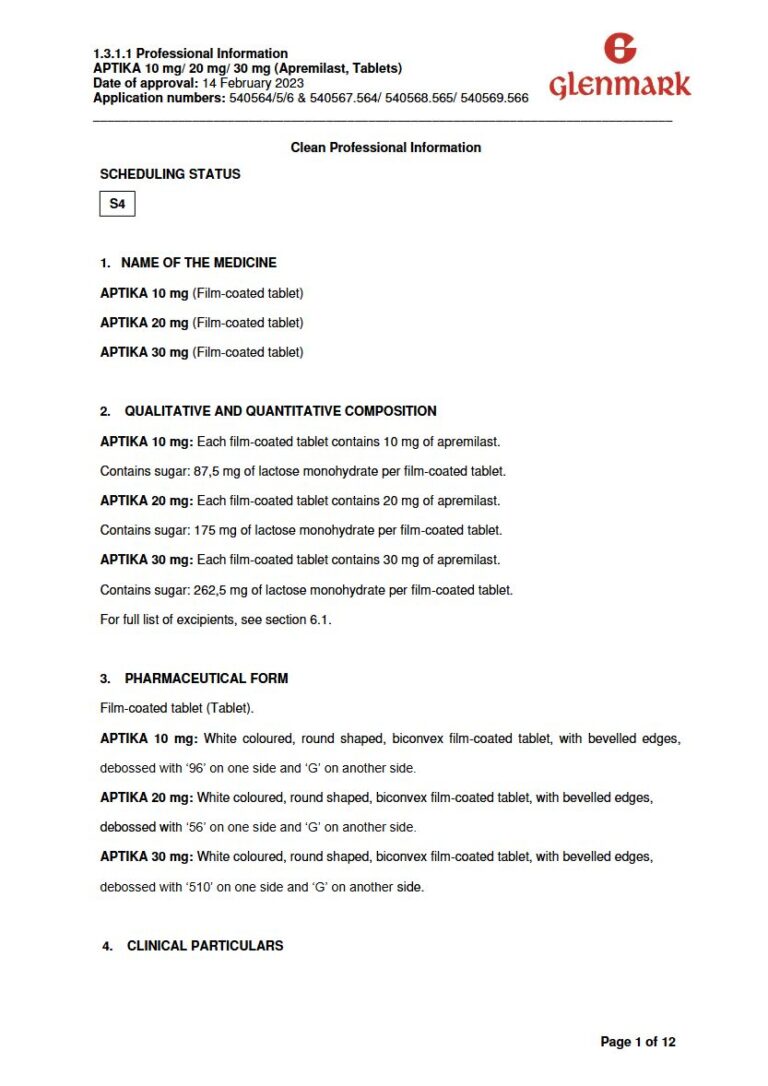
PDF Leaflet Revision Date: 14 February 2023
Clinical Summary
Quick overview from the medicine insert
Indication
Treatment of active psoriatic arthritis and moderate to severe chronic plaque psoriasis.
Dosage (summary)
Initial titration: 10 mg AM/PM for 5 days, then 30 mg twice daily.
Special Populations
- Elderly
- Renal impairment
- Hepatic impairment
Pregnancy & Breastfeeding
Contraindicated in pregnancy; not recommended during breastfeeding.
Key Drug Interactions
- Strong CYP3A4 inducers (e.g., rifampicin) reduce efficacy
- No significant interaction with methotrexate
Contraindications
- Hypersensitivity to apremilast
- Pregnancy
Common side effects
- Diarrhoea
- Nausea
- Vomiting
- Fatigue
- Depression
Counselling Points
- Take without regard to meals
- Report any mood changes
- Use contraception during treatment
Serious warnings
- Increased risk of depression and suicidal ideation
- Monitor for severe gastrointestinal symptoms
Important Disclaimer
The Aptika Tablets professional information leaflet below is the property of Glenmark Pharmaceuticals South Africa and is provided on Medinsert exactly as issued, with no.. alterations or editorial changes. We make every effort to keep content current by updating documents as soon as new versions become available. Medinsert serves as a trusted access point for healthcare professionals, but does not replace official sources or clinical judgement. For more details, please read our full disclaimer. read more>>
 Healthcare Professionals Only
This content is for registered healthcare professionals
Sign in or create a free account to read the full package insert.
Free for HPCSA-registered professionals. Powered by Medinsert.
Clinical Particulars
Section 4 of the official insert — extracted exactly as issued, no alterations
4.1 Therapeutic indications
Psoriatic arthritis: APTIKA , alone or in combination with Disease Modifying Antirheumatic Drugs (DMARDs) is indicated for the treatment of active psoriatic arthritis (PsA) in adult patients who have had an inadequate response or who have been intolerant to a prior DMARD therapy.
Psoriasis: APTIKA , is indicated for the treatment of moderate to severe chronic plaque psoriasis in adult patients who failed to or who have a contraindication to or are intolerant to other systemic therapy, including ciclosporin, methotrexate or psoralen and ultraviolet A light (PUVA).
4.2 Posology and method of administration
Posology: The recommended initial dosage titration of APTIKA from Day 1 to Day 5 is shown in Table 1. Following the 5-day titration, the recommended maintenance dosage is 30 mg twice daily taken orally starting on Day 6. No re-titration is required after initial titration. This titration is intended to reduce the gastrointestinal symptoms associated with initial therapy.
Table 1: Dosage Titration Schedule
| Day | AM | PM |
|---|---|---|
| 1 | 10 mg | |
| 2 | 10 mg | |
| 3 | 10 mg | |
| 4 | 10 mg | |
| 5 | 20 mg | |
| 6 & thereafter | 30 mg | 30 mg |
Special populations
Elderly patients: No dose adjustment is required for this patient population (see sections 4.8 and 5.2).
Dosage Adjustment in Patients with Renal Impairment: No dose adjustment is needed in patients with mild and moderate renal impairment. APTIKA dosage should be reduced to 30 mg once daily in patients with severe renal impairment (creatinine clearance (CLcr) of less than 30 mL per minute estimated by the Cockcroft u2013 Gault equation). For initial dosage titration in this group, it is recommended that APTIKA be titrated using only the AM schedule listed in Table 1 and the PM doses be skipped (see Section 5.2 ).
Patients with hepatic impairment: No dose adjustment is necessary for patients with hepatic impairment (see section 5.2 ). The safety of APTIKA was not evaluated in PsA or psoriasis in patients with hepatic impairment.
Paediatric population: The safety and efficacy of apremilast, as contained in APTIKA , in children < 18 years have not been established.
Method of administration: APTIKA is for oral use and can be administered without regard to meals. Do not crush, split, or chew the tablets.
4.3 Contraindications
- Patients with a known hypersensitivity to apremilast or to any of the excipients in the APTIKA formulation (see section 6.1 ).
- Pregnancy (see section 4.6 ).
4.4 Special warnings and precautions for use
Psychiatric disorders
Treatment with APTIKA is associated with an increase in occurrences of depression. APTIKA is also associated with an increased risk of other psychiatric disorders such as insomnia. Instances of suicidal ideation and behaviour, including suicide, have been observed in patients with or without history of depression (see section 4.8 ). The risks and benefits of starting or continuing treatment with APTIKA should be carefully assessed if patients report previous or existing psychiatric symptoms or if concomitant treatment with other medicinal products likely to cause psychiatric events is intended. Patients and caregivers should be instructed to notify the prescriber of any changes in behaviour or mood and of any suicidal ideation. If patients suffered from new or worsening psychiatric symptoms, or suicidal ideation or suicidal attempt is identified, it is recommended to discontinue treatment with apremilast.
Diarrhoea, Nausea, and Vomiting
There have been post-marketing reports of severe diarrhoea, nausea, and vomiting associated with the use of APTIKA . Most events occurred within the first few weeks of treatment. In some cases, patients were hospitalised. Patients aged 65 years or older and patients taking medications that can lead to volume depletion or hypotension may be at a higher risk of complications from severe diarrhoea, nausea, or vomiting. Monitor patients who are more susceptible to complications of diarrhoea or vomiting. Patients who reduced dosage or discontinued APTIKA generally improved quickly. Consider APTIKA dose reduction or discontinuation if patients develop severe diarrhoea, nausea, or vomiting.
Severe renal impairment
APTIKA should be dose reduced to 30 mg once daily in patients with severe renal impairment (see sections 4.2 and 5.2 ).
Underweight patients
Patients who are underweight at the start of treatment should have their body weight monitored regularly. In the event of unexplained and clinically significant weight loss, these patients should be evaluated by a medical practitioner and discontinuation of treatment should be considered.
Excipients:
APTIKA contains lactose. Patients with rare hereditary problems of galactose intolerance, lapp lactase deficiency or glucose-galactose malabsorption should not take this medicinal product.
4.5 Interaction with other medicines and other forms of interaction
Co-administration of strong cytochrome P450 3A4 (CYP3A4) enzyme inducer, rifampicin, resulted in a reduction of systemic exposure of apremilast, which may result in a loss of efficacy of apremilast. Therefore, the use of strong CYP3A4 enzyme inducers (e.g. rifampicin, phenobarbital, carbamazepine, phenytoin and St. John's Wort) with APTIKA is not recommended. Co-administration of apremilast with multiple doses of rifampicin resulted in a decrease in apremilast area-under-the-concentration time curve (AUC) and maximum serum concentration (C max ) by approximately 72 % and 43 %, respectively. Apremilast exposure is decreased when administered concomitantly with strong inducers of CYP3A4 (e.g. rifampicin) and may result in reduced clinical response.
In clinical studies, apremilast has been administered concomitantly with topical therapy (including corticosteroids, coal tar shampoo and salicylic acid scalp preparations) and UVB phototherapy. There was no clinically meaningful interaction between ketoconazole and apremilast. APTIKA can be co-administered with a potent CYP3A4 inhibitor such as ketoconazole. There was no pharmacokinetic interaction between apremilast and methotrexate in psoriatic arthritis patients. APTIKA can be co-administered with methotrexate. There was no pharmacokinetic interaction between apremilast and oral contraceptives containing ethinyl estradiol and norgestimate. APTIKA can be co-administered with oral contraceptives.
4.6 Fertility, pregnancy and lactation
Women of childbearing potential
Pregnancy should be excluded before treatment can be initiated. Women of childbearing potential should use an effective method of contraception to prevent pregnancy during treatment.
Pregnancy
APTIKA is contraindicated in pregnancy (see section 4.3 ).
Breast-feeding
It is not known whether apremilast or its metabolites are present in human milk. Mothers taking APTIKA should not breastfeed their infants (see section 4.3 ).
Fertility
No fertility data is available in humans.
4.7 Effects on ability to drive and use machines
Fatigue has been reported with apremilast, as contained in APTIKA . Patients should be advised not to drive or use machines until they know how APTIKA affects their ability to do so.
4.8 Undesirable effects
The most frequently reported adverse reactions apremilast clinical trails were gastrointestinal (GI) disorders including diarrhoea nausea and vomiting. Other frequently reported adverse reactions included upper respiratory tract infections, headache, and tension headache and back pain.
Tabulated summary of adverse reactions
The adverse reactions observed in patients treated with apremilast are listed below by system organ class (SOC) and frequency for all adverse reactions. Within each SOC and frequency grouping, adverse reactions are presented in order of decreasing seriousness.
Summary of adverse reactions in psoriatic arthritis (PsA) and/or psoriasis (PSOR)
| System Organ Class | Frequency | Adverse reaction |
|---|---|---|
| Infections and infestations | Frequent | Bronchitis, upper respiratory tract infection, nasopharangitis* |
| Immune system disorders | Less frequent | Hypersensitivity |
| Metabolism and nutrition disorders | Frequent | Decreased appetite |
| Psychiatric disorders | Frequent | Insomnia, depression |
| Less frequent | Suicidal ideation and behaviour | |
| Nervous system disorders | Frequent | Migraine*, tension headache*, headache* |
| Respiratory, thoracic, and mediastinal disorders | Frequent | Cough |
| Gastrointestinal disorders | Frequent | Diarrhoea*, nausea*, vomiting*, dyspepsia, frequent bowel movements, upper abdominal pain*, gastroesophageal reflux disease |
| Less frequent | Gastrointestinal haemorrhage | |
| Skin and subcutaneous tissue disorders | Less frequent | Rash, urticaria |
| Frequency unknown | angioedema | |
| Musculoskeletal and connective tissue disorders | Frequent | Back pain* |
| General disorders and administration site conditions | Frequent | Fatigue |
| Investigations | Less frequent | Weight decrease |
* At least one of these adverse reactions was reported as serious.
Reporting of suspected adverse reactions
Reporting suspected adverse reactions after authorisation of the medicine is important. It allows continued monitoring of the benefit/risk balance of the medicine. Health care providers are asked to report any suspected adverse reactions to SAHPRA via the u201c 6.04 Adverse Drug Reactions Reporting Form u201d, found online under SAHPRAu2019s publications: https://www.sahpra.org.za/Publications/Index/8
4.9 Overdose
In overdose, side effects can be precipitated and/or be of increased severity. Patients should be managed by symptomatic and supportive care should there be an overdose.
