
Aspen Pravastatin Tablets
Clinical Summary
Quick overview from the medicine insert
Indication
Hyperlipidemia management and cardiovascular risk reduction.
Dosage (summary)
Initial dose of 10 mg to 40 mg once daily, taken in the evening.
Onset of Action / Duration
Lipid-lowering effects may be observed within 1 to 2 weeks, with maximum effect typically seen after 4 to 6 weeks.
Special Populations
- Elderly patients
- Patients with renal impairment
- Patients with hepatic impairment
Pregnancy & Breastfeeding
Pravastatin is contraindicated during pregnancy and lactation due to potential harm to the fetus and nursing infant.
Key Drug Interactions
- Increased risk of myopathy with concomitant use of other lipid-lowering agents.
- Caution with drugs that inhibit CYP3A4, such as certain antifungals and antibiotics.
- May interact with anticoagulants, increasing the risk of bleeding.
Contraindications
- Active liver disease
- Pregnancy
- Breastfeeding
- Hypersensitivity to pravastatin or any component of the formulation
Common side effects
- Muscle pain or weakness
- Gastrointestinal disturbances (e.g., nausea, diarrhea)
- Headache
- Elevated liver enzymes
Counselling Points
- Advise patients to report any unexplained muscle pain or weakness.
- Instruct on the importance of adherence to diet and lifestyle changes.
- Inform patients to take the medication in the evening for optimal efficacy.
- Discuss potential side effects and the need for regular follow-up blood tests.
Serious warnings
- Monitor liver function tests before and during treatment.
- Use with caution in patients with a history of liver disease.
- Risk of diabetes may be increased with statin use.
Important Disclaimer
The Aspen Pravastatin Tablets professional information leaflet below is the property of Pharmacare and is provided on Medinsert exactly as issued, with no.. alterations or editorial changes. We make every effort to keep content current by updating documents as soon as new versions become available. Medinsert serves as a trusted access point for healthcare professionals, but does not replace official sources or clinical judgement. For more details, please read our full disclaimer. read more>>
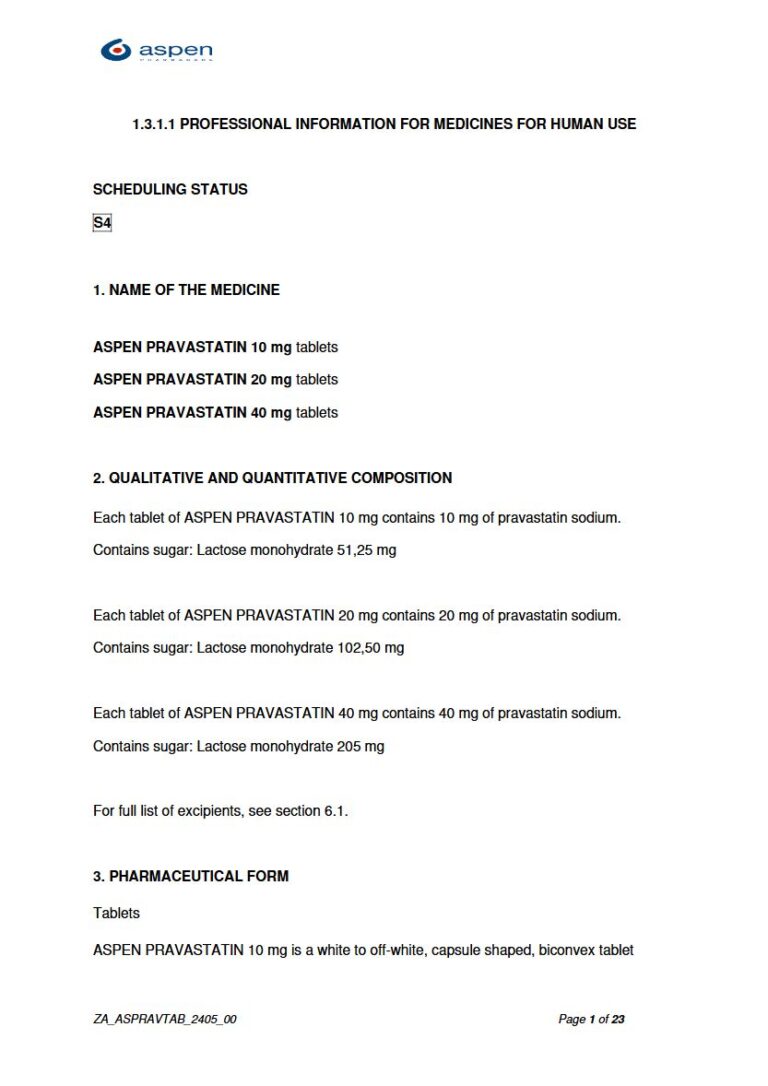 Healthcare Professionals Only
This content is for registered healthcare professionals
Sign in or create a free account to read the full package insert.
Free for HPCSA-registered professionals. Powered by Medinsert.
Clinical Particulars
Section 4 of the official insert — extracted exactly as issued, no alterations
4.1. Therapeutic indications
HYPERCHOLESTEROLAEMIA
ASPEN PRAVASTATIN is indicated, in combination with diet, to decrease elevated serum total cholesterol and LDL-cholesterol in patients with:
- Primary hypercholesterolaemia,
- heterozygous familial hypercholesterolaemia, or
- mixed hyperlipidaemia,
when response to diet or other non-pharmacological measures alone are not adequate.
CORONARY HEART DISEASE (PREVENTION)
ASPEN PRAVASTATIN is indicated in patients with coronary heart disease and hypercholesterolaemia unresponsive to diet, to:
- Reduce the risk of total mortality, by reducing coronary death,
- reduce the risk of non-fatal myocardial infarction,
- reduce the risk of undergoing myocardial revascularisation procedures (coronary artery bypass grafting and percutaneous transluminal coronary angioplasty) and
- slow the progression of coronary atherosclerosis.
4.2. Posology and method of administration
Posology
The patient must follow a cholesterol-lowering diet before initiation of, and while on ASPEN PRAVASTATIN therapy.
Adults
HYPERCHOLESTEROLAEMIA
Initial dose: 10 mg daily as a single dose in the evening. The dose of ASPEN PRAVASTATIN should be reduced if LDL-cholesterol levels fall below 1,94 mmol/l or total plasma cholesterol levels fall below 3,6 mmol/l.
CORONARY HEART DISEASE
Initial dose: 20 mg/day as a single dose in the evening.
Dosage Adjustments
If required, the dose should be adjusted at intervals of not less than 4 weeks, up to a maximum of 80 mg daily as a single dose in the evening. ASPEN PRAVASTATIN can be taken with meals or on an empty stomach.
Special populations
DOSAGE IN RENAL INSUFFICIENCY
ASPEN PRAVASTATIN does not undergo significant renal excretion, therefore modification of dose should not be necessary in patients with mild to moderate renal insufficiency. In patients with severe renal insufficiency ASPEN PRAVASTATIN therapy should be closely monitored and doses above 10 mg/day should be implemented with caution.
CONCOMITANT THERAPY
ASPEN PRAVASTATIN is effective alone or in combination with bile acid sequestrants. When both medicines are prescribed, ASPEN PRAVASTATIN should be given 1 hour before or 4 hours after cholestyramine administration (see section 4.5). A maximum daily dose of 10 mg ASPEN PRAVASTATIN is recommended in patients taking cyclosporin, fibrates or niacin concomitantly (see section 4.5).
Paediatric population
Use in paediatric patients is not recommended, as safety and efficacy have not been established.
Method of administration
For oral administration. ASPEN PRAVASTATIN can be taken as a single dose in the evening.
4.3. Contraindications
ASPEN PRAVASTATIN is contraindicated in:
- Patients with hypersensitivity to pravastatin sodium or to any excipients in ASPEN PRAVASTATIN (see section 6.1).
- Hypersensitivity to other HMG-CoA reductase inhibitors.
- Acute or chronic liver disease.
- Unexplained persistent elevations of serum transaminases.
- Pregnancy and lactation (see section 4.6).
- Porphyria: Safety has not been established.
4.4. Special warnings and precautions for use
Pravastatin has not been evaluated in patients with homozygous familial hypercholesterolaemia. Therapy is not suitable when hypercholesterolaemia is due to elevated HDL-cholesterol. As for other HMG-CoA reductase inhibitors, combination of pravastatin with fibrates is not recommended.
ASPEN PRAVASTATIN should be used with caution in patients who:
- Consume substantial amounts of alcohol and/or who have a history of liver disease.
- May be predisposed to developing renal failure secondary to rhabdomyolysis such as in those with severe acute infection, hypotension, severe metabolic, endocrine or electrolyte disorders, uncontrolled seizures, major surgery or trauma. There is an increased risk of developing renal failure if rhabdomyolysis occurs.
- Have severe renal impairment.
Hepatic Effects
Liver function tests, including serum transaminase determinations, are recommended prior to initiation of ASPEN PRAVASTATIN therapy and periodically until one year after the last elevation in dose. ASPEN PRAVASTATIN should be discontinued if the rise in transaminase levels is persistent and/or increases to three times or more the Upper Limit of Normal (ULN).
There have been rare post-marketing reports of fatal and non-fatal hepatic failure in patients taking statins, including pravastatin. If serious liver injury with clinical symptoms and/or hyperbilirubinaemia or jaundice occurs during treatment with pravastatin, treatment should be discontinued. If an alternate aetiology is not found, do not restart pravastatin.
As with other lipid-lowering medicines, moderate increases in liver transaminase levels have been observed. In the majority of cases, liver transaminase levels have returned to their baseline value without the need for treatment discontinuation. Special attention should be given to patients who develop increased transaminase levels and therapy should be discontinued if increases in alanine aminotransferase (ALT) and aspartate aminotransferase (AST) exceed three times the upper limit of normal and persist.
Myopathy
Reducing the risk of myopathy: General measures: Patients starting therapy with ASPEN PRAVASTATIN should be advised of the risk of myopathy and should report, promptly, unexplained muscle pain, tenderness or weakness. A creatine kinase (CK) level above 10 times the Upper Limit of Normal (ULN) in a patient, with unexplained symptoms, indicates myopathy. ASPEN PRAVASTATIN should be discontinued if myopathy is diagnosed or suspected.
The benefits and risks of using ASPEN PRAVASTATIN concomitantly with immunosuppressants, fibrates or lipid-lowering doses of niacin should be carefully considered. Concomitant administration with ciclosporin, itraconazole, ketoconazole, erythromycin, clarithromycin, HIV-protease inhibitors and nefazodone is not recommended.
In patients receiving ciclosporin, ASPEN PRAVASTATIN should be temporarily discontinued if systemic azole derivative-antifungal therapy is required.
As with other HMG-CoA reductase inhibitors (statins), pravastatin has been associated with the onset of myalgia, myopathy and very rarely, rhabdomyolysis. Myopathy must be considered in any patient under ASPEN PRAVASTATIN therapy presenting with unexplained muscle symptoms, such as pain or tenderness, muscle weakness, or muscle cramps. In such cases, creatine kinase (CK) levels should be measured.
ASPEN PRAVASTATIN therapy should be temporarily interrupted when CK levels are > 5 x ULN or when there are severe clinical symptoms. Very rarely (in about 1 case over 100,000 patient-years), rhabdomyolysis occurs, with or without secondary renal insufficiency. Rhabdomyolysis is an acute potentially fatal condition of skeletal muscle which may develop at any time during treatment and is characterised by massive muscle destruction associated with major increase in CK (usually > 30 or 40 x ULN) leading to myoglobinuria.
The risk of myopathy with statins appears to be exposure-dependent and therefore may vary with individual medicinal products (due to lipophilicity and pharmacokinetic differences), including their dose and potential for drug interactions. Although there is no muscular contraindication to the prescription of a statin, certain predisposing factors may increase the risk of muscular toxicity and therefore justify a careful evaluation of the benefit/risk and special clinical monitoring. CK measurement is indicated before starting ASPEN PRAVASTATIN therapy in these patients.
There have been very rare reports of an immune-mediated necrotising myopathy (IMNM) during or after treatment with some statins. IMNM is clinically characterised by persistent proximal muscle weakness and elevated serum creatine kinase, which persist despite discontinuation of statin treatment.
The risk and severity of muscular disorders during ASPEN PRAVASTATIN therapy is increased by the co-administration of interacting medicines. The use of fibrates alone is occasionally associated with myopathy. The combined use of a statin and fibrates should generally be avoided. The co-administration of statins and nicotinic acid should be used with caution. An increase in the incidence of myopathy has also been described in patients receiving other statins in combination with inhibitors of cytochrome P450 metabolism. This may result from pharmacokinetic interactions that have not been documented for pravastatin. When associated with ASPEN PRAVASTATIN therapy, muscle symptoms usually resolve following discontinuation of ASPEN PRAVASTATIN therapy.
ASPEN PRAVASTATIN must not be co-administered with systemic formulations of fusidic acid or within 7 days of stopping fusidic acid treatment. In patients where the use of systemic fusidic acid is considered essential, statin treatment should be discontinued throughout the duration of fusidic acid treatment. There have been reports of rhabdomyolysis (including some fatalities) in patients receiving fusidic acid and statins in combination. The patient should be advised to seek medical advice immediately if they experience any symptoms of muscle weakness, pain or tenderness.
ASPEN PRAVASTATIN therapy may be re-introduced seven days after the last dose of fusidic acid. In exceptional circumstances, where prolonged systemic fusidic acid is needed, e.g., for the treatment of severe infections, the need for co-administration of pravastatin and fusidic acid should only be considered on a case by case basis and under close medical supervision.
Cases of myopathy, including rhabdomyolysis, have been reported with pravastatin co-administered with colchicine, and caution should be exercised when prescribing pravastatin with colchicine (see section 4.5).
4.5. Interaction with other medicines and other forms of interaction
Myopathy caused by medicine interactions: Concomitant administration of medicines that inhibit cytochrome P450 isoenzyme CYP3A4 may result in high plasma levels of ASPEN PRAVASTATIN, thus increasing the risk of myopathy, and is not recommended. Medicines that inhibit cytochrome P450 isoenzyme CYP3A4 include: cyclosporin, itraconazole, ketoconazole, erythromycin, clarithromycin, HIV-protease inhibitors and nefazodone. This risk of myopathy is increased when other medicines that cause myopathy, such as fibrates and niacin, are given with ASPEN PRAVASTATIN. A maximum dose of 10 mg ASPEN PRAVASTATIN daily is recommended in patients taking cyclosporin, fibrates or lipid lowering doses of niacin (nicotinic acid).
The use of fibrates alone is occasionally associated with myopathy. An increased risk of muscle related adverse events, including rhabdomyolysis, have been reported when fibrates are co-administered with other statins. These adverse events with pravastatin cannot be excluded; therefore the combined use of pravastatin and fibrates (e.g. gemfibrozil, fenofibrate) should generally be avoided. If this combination is considered necessary, careful clinical and CK monitoring of patients on such regimen is required.
Measures to reduce the risk of myopathy caused by medicine interactions: The benefits and risks of using ASPEN PRAVASTATIN concomitantly with immunosuppressants, fibrates or lipid-lowering doses of niacin should be carefully considered, and the dose of ASPEN PRAVASTATIN should generally not exceed 10 mg/day.
Ciclosporin
Concomitant administration of pravastatin and ciclosporin leads to an approximately 4-fold increase in pravastatin systemic exposure. In some patients, however, the increase in pravastatin exposure may be larger. In patients receiving ciclosporin, ASPEN PRAVASTATIN should be temporarily discontinued if systemic azole derivative-antifungal therapy is required.
Fusidic acid: The risk of myopathy including rhabdomyolysis may be increased by the concomitant administration of systemic fusidic acid with statins. The mechanism of this interaction (whether it is pharmacodynamic or pharmacokinetic, or both) is yet unknown. There have been reports of rhabdomyolysis (including some fatalities) in patients receiving this combination.
If treatment with systemic fusidic acid is necessary, pravastatin treatment should be discontinued throughout the duration of the fusidic acid treatment.
Colchicine
Due to the increased risk of myopathy/rhabdomyolysis, clinical and biological monitoring is advised, especially when starting co-administration with pravastatin, as in ASPEN PRAVASTATIN, and colchicine.
Rifampicin: In an interaction study where pravastatin was given together with rifampicin, a nearby 3-fold increase in pravastatin AUC and Cmax was observed. Therefore, caution should be exercised when combining pravastatin, as in ASPEN PRAVASTATIN, to rifampicin if both are given at the same time. No interaction would be expected if their dosing is made at least two hours apart.
Lenalidomide: There is an increased risk of rhabdomyolysis when statins are combined with lenalidomide. Clinical and biological monitoring is warranted notably during the first weeks of treatment.
Digoxin: ASPEN PRAVASTATIN may cause increases in digoxin levels.
Coumarin-derivatives (e.g. Warfarin): A possible increase in the anticoagulant effect of the coumarin anticoagulants may occur. Patients taking coumarin anticoagulants should have their INR determined before starting ASPEN PRAVASTATIN therapy. The INR should be monitored frequently enough in the early stages of therapy until stabilised. Once a stable INR has been documented, INR can be monitored at the intervals usually recommended for patients on coumarin anticoagulants. When there is a dose adjustment of ASPEN PRAVASTATIN, this procedure should be repeated.
Bile acid sequestrants: Concomitant administration resulted in approximately 40 to 50 % decrease in the bioavailability of pravastatin. There was no clinically significant decrease in bioavailability or therapeutic effect when pravastatin was administered one hour before or four hours after cholestyramine or one hour before colestipol. ASPEN PRAVASTATIN should, therefore, be taken 1 hour before or 4 hours after cholestyramine. Concurrent use may decrease the bioavailability of ASPEN PRAVASTATIN.
4.6. Fertility, pregnancy and lactation
Pregnancy
ASPEN PRAVASTATIN is contraindicated during pregnancy. The active metabolite of ASPEN PRAVASTATIN is foetotoxic and teratogenic in rats and it should therefore not be used in female patients of child-bearing potential. Special caution is recommended in females of childbearing potential to ensure proper understanding of the potential risk associated with ASPEN PRAVASTATIN during pregnancy. If a patient plans to become pregnant or becomes pregnant, the doctor has to be informed immediately and ASPEN PRAVASTATIN should be discontinued because of the potential risk to the foetus.
Breastfeeding
Mothers should not breastfeed their baby while taking ASPEN PRAVASTATIN. A small amount of ASPEN PRAVASTATIN is excreted in human breast milk, therefore ASPEN PRAVASTATIN is contraindicated during breastfeeding (see section 4.3).
4.7. Effects on ability to drive and use machines
Since adverse events such as dizziness and visual disturbances have been reported in patients taking ASPEN PRAVASTATIN patients should not drive, use machinery or perform any tasks that require concentration, until they are certain that ASPEN PRAVASTATIN does not adversely affect their ability to do so. ASPEN PRAVASTATIN has a minor influence on the ability to drive or operate machinery.
4.8. Undesirable effects
a) Tabulated list of adverse reactions
System organ class
- Frequent
- Less frequent
- Frequency unknown (cannot be estimated from the available data)
Blood and the lymphatic system disorders
- Anaemia, neutropenia, thrombocytopenia, increased erythrocyte sedimentation rate
Immune system disorders
- Hypersensitivity reactions anaphylaxis, angioedema, lupus erythematous-like syndrome, malaise, urticaria, photosensitivity, fever, flushing, dyspnoea, toxic epidermal necrolysis
Endocrine disorders
- Diabetes mellitus, hyperglycaemia
Metabolism and nutrition disorders
- Mass gain has been reported
Psychiatric disorders
- Depression
Nervous system disorders
- Headache, dizziness, paraesthesia, peripheral neuropathy
Insomnia, reversible cognitive impairment
Myasthenia gravis, sleep disturbance insomnia
Eye disorders
- Vision disturbance (including blurred vision and diplopia)
Ocular myasthenia
Vascular disorders
- Vasculitis
Respiratory, thoracic and mediastinal disorders
- Interstitial lung disease
Gastrointestinal disorders
- Constipation, diarrhoea, nausea, vomiting, flatulence, dyspepsia, abdominal pain, cramps and pancreatitis
Hepatobiliary disorders
- Jaundice, hepatitis, fulminant hepatic necrosis
Fatal and non-fatal hepatic failure, reversible increases in serum-transaminase concentrations
Skin and subcutaneous tissue disorders
- Skin rash, alopecia
Pruritus, urticaria photosensitivity reaction
Rash including - lichenoid rash, dermatomyositis
Musculoskeletal and connective tissue disorders
- Myalgia, muscle cramps
Myopathy, myositis, rhabdomyolysis presenting as muscle pain with elevated creatine phosphokinase and myoglobinuria leading to renal failure, polymyalgia, polymyalgia rheumatic
Renal and urinary disorders
- Abnormal urination (including dysuria, frequency, nocturia), acute renal failure
Reproductive system and breast disorders
- Sexual dysfunction
General disorders and administrative site conditions
- Fatigue
The following adverse events have been reported with statins:
- Nightmares.
- Memory loss.
- Depression.
- Interstitial lung disease, especially with long term therapy.
- Diabetes mellitus.
b) Description of selected adverse reactions
LABORATORY TEST FINDINGS: Marked and persistent increases of serum transaminases and elevated alkaline phosphatase and gamma-glutamyl transpeptidase have been reported. Liver function test abnormalities have generally been mild and transient. Increases in serum creatine kinase (CK) levels, derived from skeletal muscle, have been reported (see section 4.4).
Reporting of suspected adverse reactions
Reporting suspected adverse reactions after authorisation of the medicine is important. It allows continued monitoring of the benefit/risk balance of the medicine. Health care providers are requested to report any suspected adverse drug reactions to SAHPRA via the Med Safety APP (Medsafety X SAHPRA) and eReporting platform (who-umc.org) found on SAHPRA website. Aspen Pharmacare: E-mail: [email protected] Tel: 0800 118 088/+27 (0)11 239-6200
4.9. Overdose
Symptoms
See section 4.8 and section 4.4.
Treatment
General measures should be adopted, and liver function should be monitored. Treatment is symptomatic and supportive.
