
Banogon Ointment
Clinical Summary
Quick overview from the medicine insert
Indication
Topical treatment of localized skin infections caused by susceptible strains of bacteria, including impetigo and folliculitis.
Dosage (summary)
Apply a thin layer of ointment to the affected area three times daily for up to 10 days.
Onset of Action / Duration
Improvement may be seen within 48 to 72 hours after initiation of treatment.
Special Populations
- Elderly patients
- Patients with renal impairment
- Patients with hepatic impairment
Pregnancy & Breastfeeding
Mupirocin is classified as Category B3. Use during pregnancy only if clearly needed. Caution is advised when used during lactation.
Key Drug Interactions
- No significant drug interactions have been reported with mupirocin when used topically.
Contraindications
- Hypersensitivity to mupirocin or any of the excipients in the formulation.
Common side effects
- Burning sensation at the application site
- Itching
- Erythema
- Dryness
Counselling Points
- Instruct patients to wash their hands before and after applying the ointment.
- Advise patients to avoid contact with eyes and mucous membranes.
- Inform patients to complete the full course of treatment even if symptoms improve.
Serious warnings
- Prolonged use may lead to overgrowth of non-susceptible organisms.
- Not for systemic use; avoid application to large areas of broken skin.
Important Disclaimer
The Banogon Ointment professional information leaflet below is the property of Pharmacare and is provided on Medinsert exactly as issued, with no.. alterations or editorial changes. We make every effort to keep content current by updating documents as soon as new versions become available. Medinsert serves as a trusted access point for healthcare professionals, but does not replace official sources or clinical judgement. For more details, please read our full disclaimer. read more>>
 Healthcare Professionals Only
This content is for registered healthcare professionals
Sign in or create a free account to read the full package insert.
Free for HPCSA-registered professionals. Powered by Medinsert.
Clinical Particulars
Section 4 of the official insert — extracted exactly as issued, no alterations
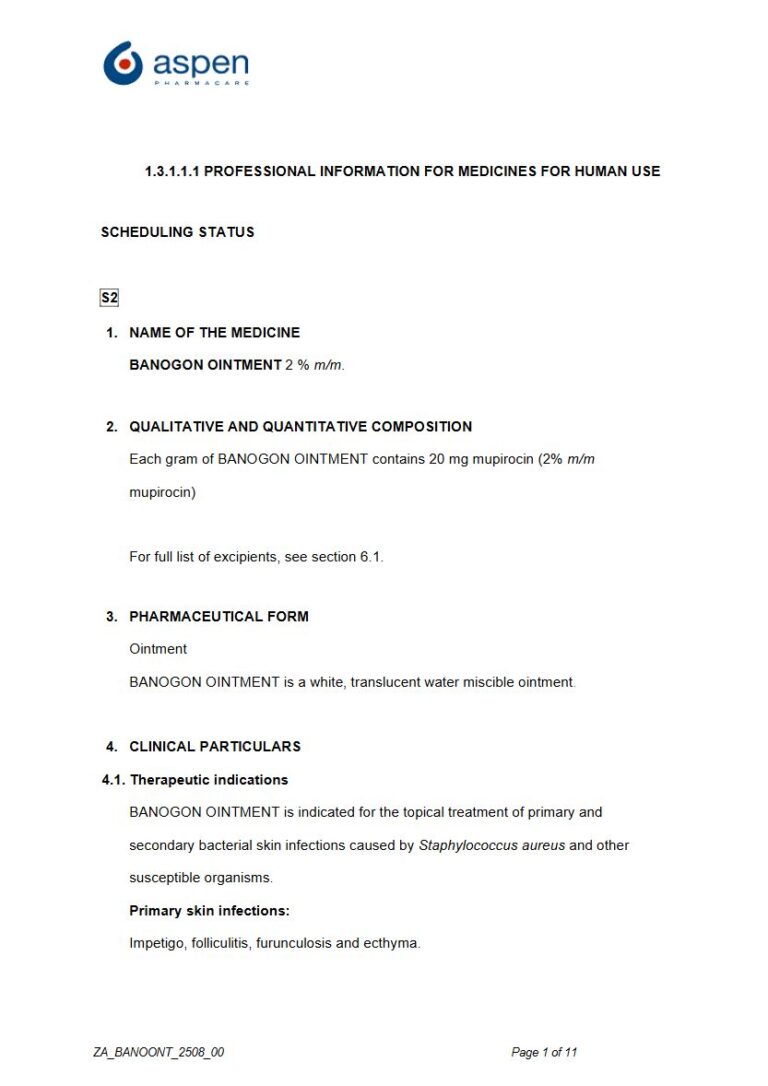
4.1. Therapeutic indications
BANOGON OINTMENT is indicated for the topical treatment of primary and secondary bacterial skin infections caused by Staphylococcus aureus and other susceptible organisms. Primary skin infections: Impetigo, folliculitis, furunculosis and ecthyma.
Secondary infections: Infected dermatoses e.g. infected eczema. Infected traumatic lesions e.g. abrasions, insect bites, minor (not requiring hospitalisation) wounds and burns.
Prophylaxis: BANOGON OINTMENT may be used to avoid bacterial contamination of small wounds, incisions and other clean lesions, and to prevent infection of abrasions and small cuts and wounds.
4.2. Posology and method of administration
Posology
Adults: Apply BANOGON OINTMENT two to three times a day for up to 10 days, depending on the response. The duration of treatment should not exceed 10 days. For external use only. Keep out of the eyes. Dilution not recommended. Not for long term use. (See section 4.4).
Special populations
Elderly
As above. No special dosing requirements for the elderly.
Renal impairment: No dosage adjustment is necessary (see section 4.4).
Hepatic impairment: As above
Paediatric population
The safety and efficacy of BANOGON OINTMENT in babies under 2 months has not yet been established. Children older than 2 months: Apply BANOGON OINTMENT two to three times a day for up to 10 days, depending on the response. The duration of treatment should not exceed 10 days. For external use only. Keep out of the eyes. Dilution not recommended. Not for long term use. (See section 4.4).
Method of administration
Before applying, wash affected areas and dry thoroughly.
For external use only.
u2022 A small quantity of BANOGON OINTMENT should be applied to cover the affected area.
u2022 The treated area may be covered by a gauze dressing if desired.
u2022 Any product remaining at the end of treatment should be discarded.
u2022 Do not dilute (mix) with other preparations (see section 4.5) as there is a risk of dilution, resulting in a reduction in the antibacterial activity and potential loss of stability of the mupirocin in the ointment.
u2022 Not for long-term use (see section 4.4.)
4.3. Contraindications
BANOGON OINTMENT is contraindicated in:
u2022 Patients with known hypersensitivity to mupirocin or to any of the excipients of BANOGON OINTMENT (see section 6.1)
u2022 the treatment of skin lesions infected with Pseudomonas aeruginosa.
4.4. Special warnings and precautions for use
The BANOGON OINTMENT formulation is not suitable for:
u2022 Intranasal use.
u2022 Use in conjunction with cannulae.
u2022 At the site of central venous cannulation.
u2022 Ophthalmic use. Avoid contact with the eyes. If contaminated, the eyes should be thoroughly irrigated with water until the ointment residues have been removed.
Treatment with BANOGON OINTMENT should be discontinued in the event of a possible sensitisation reaction or severe local irritation occurring. BANOGON OINTMENT should be rinsed off and appropriate alternative therapy for the infection should be prescribed.
Prolonged or irregular use may result in overgrowth of non-susceptible S. aureus and other organisms.
BANOGON OINTMENT should be used with caution in patients with extensive burns or wounds because of the possibility of polyethylene/macrogol toxicity (see 6.1).
Pseudomembranous colitis has been associated with antibiotic use and can vary in severity from mild to life-threatening. It is therefore important to consider its diagnosis in patients who develop diarrhoea during or after antibiotic treatment. While the risk is lower with topically applied mupirocin, any instance of prolonged or severe diarrhoea, or abdominal cramps, should prompt immediate discontinuation of the treatment and further investigation for the patient.
Renal impairment
Care is required in patients with moderate to severe renal impairment. Polyethylene glycol can be absorbed from open wounds, burns and damaged skin and is excreted by the kidneys. BANOGON OINTMENT should not be used in conditions where absorption of large quantities of polyethylene glycol is possible, especially if there is evidence of moderate or severe renal impairment. The excretion of polyethylene glycol may be impaired and could lead to nephrotoxicity and severe metabolic disturbances.
4.5. Interaction with other medicines and other forms of interaction
Do not mix with other preparations as there is a risk of dilution, resulting in reduction in the antibacterial activity and potential loss of stability of the mupirocin in the ointment.
4.6. Fertility, pregnancy and lactation
Pregnancy
The safety of BANOGON OINTMENT in pregnancy has not been established.
Breastfeeding
The safety of BANOGON OINTMENT in breastfeeding has not been established. It is not known whether BANOGON OINTMENT is excreted into breastmilk.
Fertility
There is no data on the effects of mupirocin on human fertility.
4.7. Effects on ability to drive and use machines
BANOGON OINTMENT has no or negligible influence on the ability to drive or operate machinery.
4.8. Undesirable effects
a) Tabulated list of adverse reactions
System organ class
Frequent
Less frequent
Frequency unknown
Immune system disorders
Systemic allergic reactions including anaphylaxis, generalised rash, urticaria and angioedema.
Skin and subcutaneous tissue disorders
Burning localised to the area of application
Itching, erythema, stinging and dryness localised to the area of application, cutaneous sensitisation reactions to mupirocin or the ointment base
Reporting of suspected adverse reactions
Reporting suspected adverse reactions after authorisation of the medicine is important. It allows continued monitoring of the benefit/risk balance of the medicine. Healthcare providers are requested to report any suspected adverse drug reactions to SAHPRA via the Med Safety APP (Medsafety X SAHPRA) and eReporting platform (who-umc.org) found on SAHPRA website. Aspen Pharmacare: E-mail: [email protected] Tel: 0800 118 088
4.9. Overdose
Symptoms
See section 4.8.
Treatment
The toxicity of mupirocin is very low. In the event of accidental ingestion of the ointment, symptomatic treatment should be provided. In the case of erroneous oral ingestion of large quantities of the ointment, renal function should be closely monitored in patients with renal insufficiency due to the possible side effects of polyethylene glycol. There is no specific treatment for an overdose of mupirocin. In the event of an overdose, the patient should be treated supportively with appropriate monitoring as necessary. Further management should be as clinically indicated or as recommended by the national poisons centre, where available.
