
Betapam 5 mg Tablet
PDF Leaflet Revision Date: 19 February 2026
Clinical Summary
Quick overview from the medicine insert
Indication
Treatment of anxiety, muscle relaxation, and pre-operative medication.
Dosage (summary)
Initial: 5-10 mg; Usual: 5-20 mg daily; Max single: 10 mg.
Special Populations
- Elderly
- Hepatic impairment
- Renal impairment
Pregnancy & Breastfeeding
Not recommended in pregnancy; may cause floppy-infant syndrome. Avoid in breastfeeding.
Key Drug Interactions
- Alcohol
- CNS depressants
- Anticonvulsants
Contraindications
- Hypersensitivity to benzodiazepines
- Severe respiratory insufficiency
- Severe hepatic insufficiency
- Sleep apnoea syndrome
- Myasthenia gravis
Common side effects
- Drowsiness
- Confusion
- Fatigue
- Ataxia
Counselling Points
- Avoid alcohol and CNS depressants
- Do not operate heavy machinery
- Treatment duration should be limited
Serious warnings
- Risk of dependence and withdrawal symptoms
- Caution in patients with a history of substance abuse
- May cause anterograde amnesia
Important Disclaimer
The Betapam 5 mg Tablet professional information leaflet below is the property of Ranbaxy Pharmaceuticals and is provided on Medinsert exactly as issued, with no.. alterations or editorial changes. We make every effort to keep content current by updating documents as soon as new versions become available. Medinsert serves as a trusted access point for healthcare professionals, but does not replace official sources or clinical judgement. For more details, please read our full disclaimer. read more>>
 Healthcare Professionals Only
This content is for registered healthcare professionals
Sign in or create a free account to read the full package insert.
Free for HPCSA-registered professionals. Powered by Medinsert.
Clinical Particulars
Section 4 of the official insert — extracted exactly as issued, no alterations
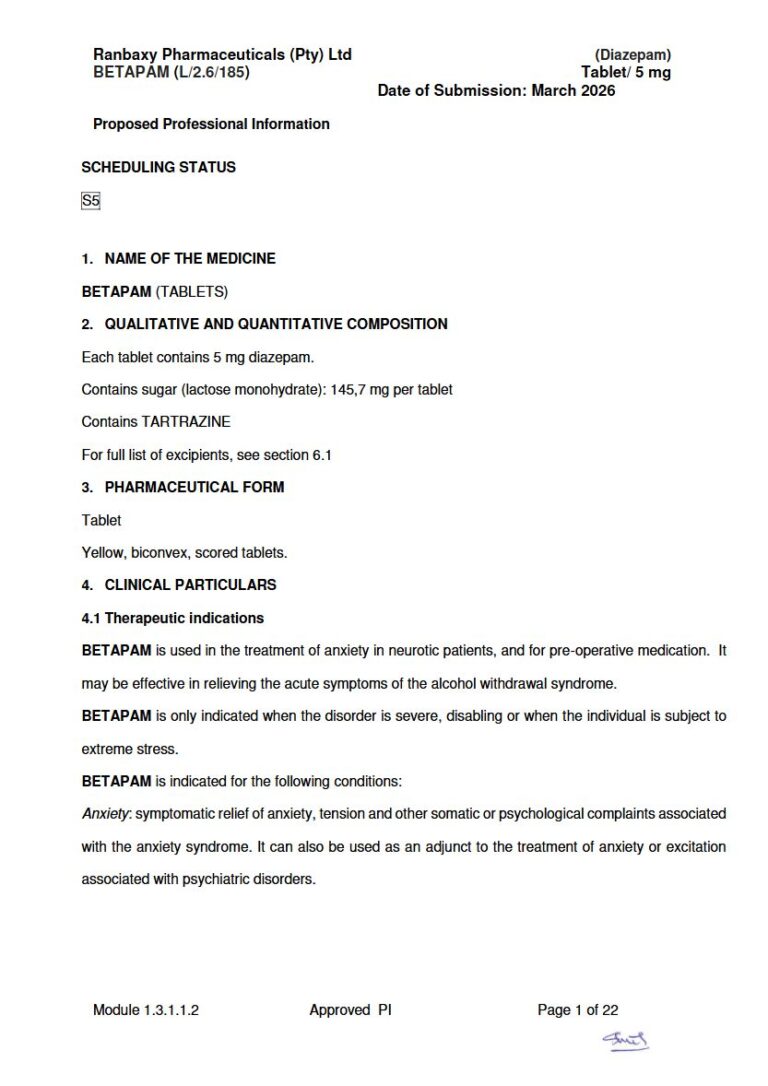
4.1 Therapeutic indications
BETAPAM is used in the treatment of anxiety in neurotic patients, and for pre-operative medication. It may be effective in relieving the acute symptoms of the alcohol withdrawal syndrome. BETAPAM is only indicated when the disorder is severe, disabling or when the individual is subject to extreme stress. BETAPAM is indicated for the following conditions:
- Anxiety: symptomatic relief of anxiety, tension and other somatic or psychological complaints associated with the anxiety syndrome. It can also be used as an adjunct to the treatment of anxiety or excitation associated with psychiatric disorders.
- Muscle relaxation: as an adjunct for the relief of reflex muscle spasm due to local trauma (injury, inflammation). It can also be used to combat spasticity arising from damage to spinal and supraspinal interneurons such as cerebral palsy and paraplegia, as well as athetosis and stiff-man syndrome.
Treatment should be as short as possible. The patient should be assessed regularly and the need for continued treatment should be re-evaluated especially when the patient is symptom-free. The overall duration of treatment of anxiety should not be more than 8 to 12 weeks, including a tapering off process. In certain cases extension beyond the maximum treatment period may be necessary. If so, it should not take place without re-evaluation of the patient's status.
4.2 Posology and method of administration
Duration of treatment
The duration of treatment should be as short as possible. The patient should be reassessed regularly and the need for continued treatment evaluated, especially if the patient is symptom free. It should not exceed 2 - 3 months, including the tapering-off period. Extension beyond this period should not take place without re-evaluation of the situation. It may be useful to inform the patient when treatment is started that it will be of limited duration and explain precisely how the dosage will be progressively decreased. Moreover, it is important that the patient be aware of the possibility of rebound phenomena, thereby minimising anxiety over such symptoms, should they occur during withdrawal.
There is evidence that, in case of short-acting benzodiazepines, withdrawal phenomena can become manifest within the dosage interval especially when the dosage is high. When long-acting benzodiazepines such as diazepam are being used, it is important to warn against changing to short acting benzodiazepines as withdrawal symptoms may develop.
Standard adult dosage
For optimal effect, the dosage should be carefully individualised. Treatment should begin at the lowest effective dose appropriate to the particular condition and the maximum dose should not be exceeded.
Average adult dosage for oral administration: Initial dose: 5 - 10 mg. Depending on symptom severity, the usual dose is 5 - 20 mg daily. The maximum single oral dose for adults should not exceed 10 mg.
Special dosage instructions
- Chronic respiratory depression, Elderly and debilitated patients: Elderly and debilitated patients who are at particular risk of over sedation, respiratory depression and ataxia should be given half of the usual adult dose. These patients should be checked regularly at the start of treatment in order to minimise the dosage and/or frequency of administration to prevent overdose due to accumulation.
- Impaired hepatic or renal function: Patients with impaired hepatic function should be given a reduced dose. The usual precautions in treating patients with impaired renal function should be observed.
- Childrenu2019s dosage: 0,1 - 0,3 mg/kg bodyweight daily. BETAPAM should not be given to children without careful assessment of the indication; the duration of treatment must be kept to a minimum. Safety and efficacy have not been demonstrated in children below 6 months of age.
Method of administration
Oral administration.
4.3 Contraindications
BETAPAM is contraindicated in patients with:
- a known history of hypersensitivity to benzodiazepines;
- Hypersensitivity to diazepam or to any of the excipients listed in section 6.1;
- severe respiratory insufficiency;
- severe hepatic insufficiency;
- sleep apnoea syndrome;
- myasthenia gravis;
- BETAPAM is not recommended for the primary treatment of psychotic illness.
- BETAPAM should not be used alone to treat depression or anxiety associated with depression as suicide may occur in such patients.
- Dependence on other CNS depressants including alcohol, except in the acute withdrawal reactions. (See section 4.4).
4.4 Special warnings and precautions for use
Concomitant use of alcohol/CNS depressants
The concomitant use of BETAPAM with alcohol or/and CNS depressants should be avoided. Such concomitant use has the potential to increase the clinical effects of BETAPAM possibly including severe sedation, clinically relevant respiratory and/or cardiovascular depression. (See section 4.5).
Medical history of alcohol or drug abuse
BETAPAM should be used with extreme caution in patients with a history of alcohol or drug abuse, see Medicine abuse and dependence below. BETAPAM should be avoided in patients with dependence on CNS depressants including alcohol. (see section 4.3).
An exception to the latter is the management of acute withdrawal reactions. A lower dose is recommended for patients with chronic respiratory insufficiency, due to the risk of respiratory depression, (see section 4.3). Lower doses should also be used for elderly and debilitated patients.
Psychiatric and u2018paradoxicalu2019 reactions
Paradoxical reactions such as restlessness, agitation, irritability, aggressiveness, delusion, rages, nightmares, hallucinations, psychoses, inappropriate behaviour and other adverse behavioural effects are known to occur when using BETAPAM. Should this occur, the use of BETAPAM should be discontinued. They are more likely to occur in children and in the elderly.
Hypotension
BETAPAM should be administered with caution to patients in whom a drop in blood pressure might lead to cardiac or cerebral complications. This is particularly important in elderly patients.
Amnesia
It should be borne in mind that BETAPAM may induce anterograde amnesia. Anterograde amnesia may occur using therapeutic dosages, the risk increasing at higher dosages. Amnestic effects may be associated with inappropriate behaviour.
Acute narrow-angle glaucoma
Caution should be used in the treatment of patients with acute narrow-angle glaucoma (because of atropine-like side effects).
Use in hepatic impairment
Use with caution when administering BETAPAM to patients with mild to moderate hepatic impairment (see section 4.2). Periodic liver function tests are recommended.
Use in renal impairment
Patients with impaired renal function should use benzodiazepine (as contained in BETAPAM) with caution and dosage reduction may be advisable (see section 4.2).
4.5 Interaction with other medicines and other forms of interaction
Pharmacodynamic Interactions
The response to treatment with oral anticoagulants may be variable in patients taking BETAPAM. Enhanced effects of sedation, respiration, and haemodynamics may occur when BETAPAM is coadministered with other centrally acting depressants such as antipsychotics (e.g. clozapine, phenothiazines, levomepromazine, olanzapine), anxiolytics or sedatives, antidepressants, hypnotics, anticonvulsants, narcotic analgesics (e.g. methadone), and sedative antihistamines, or alcohol. Concomitant use of barbiturates, alcohol or other central nervous system depressants increases cardiorespiratory depression with increased risk of apnoea. Alcohol should be avoided in patients receiving BETAPAM. (See section 4.4 and 4.9).
Reversible loss of control of Parkinsonu2019s disease has been seen in some patients treated with combined levodopa and BETAPAM. The xanthines, theophylline and caffeine, oppose the sedative and possibly anxiolytic effects of BETAPAM partially through blocking of adenosine receptors. Diazepam (as contained in BETAPAM) pre-treatment changes the pharmacodynamics and pharmacokinetics of the anaesthetic ketamine. Ketamine N-demethylation was inhibited leading to a prolonged half-life and prolonged ketamine-induced sleeping time. In the presence of diazepam, a reduced ketamine concentration is required to achieve adequate anaesthesia. The anti-cholinergic effects of other medicines including atropine and similar medicines, anti-histamines and antidepressants may be potentiated. Interactions have been reported between some benzodiazepines (as contained in BETAPAM) and anti-convulsants (e.g., diazepam with phenytoin or with carbamazepine), with changes in the serum concentration of the benzodiazepine or anticonvulsant. It is recommended that patients be observed for altered responses when BETAPAM and anti-convulsants are prescribed together and that serum level monitoring of the anti-convulsant is performed more frequently.
Pharmacokinetic Interactions
The metabolism of diazepam (as contained in BETAPAM) and its main metabolite, desmethyldiazepam depends on the cytochrome P450 isozymes CYP3A4 and CYP2C19. Modulators of these enzymes may lead to changes in diazepam disposition and effects. Stronger interactions are seen with compounds that affect more than one of diazepamu2019s oxidative metabolic pathways. Inhibitors of CYP3A4 and CYP2C19 decrease metabolic rate and may lead to higher than normal concentrations of diazepam and the desmethyl metabolite and consequently to increased/ prolonged sedation and anxiolytic effects. Such changes may exacerbate diazepamu2019s effects in patients with increased sensitivity, e.g. due to their age, reduced liver function or treatment with other medicine that impair oxidation. Inducers of CYP3A4 and CYP2C19 may lead to lower than expected concentrations and hence to a lack of desired efficacy.
Effect of other medicines on the pharmacokinetics of BETAPAM
Enzyme inhibitors
Grapefruit juice contains strong inhibitors of CYP3A4. Diazepam (as contained in BETAPAM) exposure was strongly increased (AUC 3,2-fold; C max 1,5-fold) and time to reach maximum concentration was delayed when diazepam was given with grapefruit juice instead of water. This may result in excessive or prolonged sedation. Patients should be advised to avoid grapefruit juice while taking BETAPAM. Antimycotic azole derivatives inhibit CYP3A4 and CYP2C19 pathways and lead to increased exposure to diazepam (as contained in BETAPAM). The increased exposure to diazepam may result in greater and more prolonged sedation. Therefore, it is recommended to avoid concomitant use of these medicines (including ketoconazole) with BETAPAM or reduce the dose of BETAPAM. The serotonin reuptake inhibitor fluvoxamine also inhibits both of diazepamu2019s (as contained in BETAPAM) CYP3A4 and CYP2C19 degradation pathways. Fluoxetine is a moderate inhibitor of CYP3A4. Fluoxetine showed a more moderate effect on diazepam AUC (approximately 50 % increase) and did not affect psychomotor response because combined concentrations of diazepam and desmethyldiazepam were similar with and without fluoxetine. Fluvoxamine and fluoxetine may lead to increased and prolonged sedation. For patients taking fluvoxamine, a benzodiazepine metabolised via a non-oxidative pathway is recommended. Patients receiving fluoxetine with BETAPAM should be monitored closely.
Combined hormonal contraceptives appear to reduce the clearance (by 40 %) and prolong elimination half-life (by 47 %) of diazepam (as contained in BETAPAM). Diazepam-induced psychomotor impairment in women on contraceptives may be higher during the 7-day menstrual pause when off the hormone preparation than when taking the contraceptive. Monitor the clinical response to BETAPAM in women taking concomitant oral contraception. There is some limited evidence that BETAPAM can increase the incidence of break-through bleeding in women with hormonal contraceptives.
The proton pump inhibitor omeprazole, a CYP2C19 and CYP3A4 inhibitor, increase diazepam (as contained in BETAPAM) AUC and the half-life. The elimination of desmethyldiazepam is reduced as well. The effect of omeprazole was seen in extensive, but not slow, metabolisers of CYP2C19. Esomeprazole (but not lansoprazole or pantoprazole) has the potential to inhibit the metabolism of diazepam to a similar degree as omeprazole. Patients being administered these medicines with BETAPAM should be monitored closely and the dose of BETAPAM should be reduced if necessary. The histamine H2-receptor antagonist cimetidine, an inhibitor of multiple CYP isozymes, including CYP3A4 and CYP2C19, reduces the clearance of diazepam (as contained in BETAPAM) and of desmethyldiazepam by 40 to 50 %. Enhanced sedation was seen with co-administration of cimetidine. Therefore, when used with cimetidine, a reduction in the dose of BETAPAM may be necessary. Ranitidine and famotidine do not affect the hepatic elimination of diazepam.
Disulfiram inhibits the metabolism of diazepam (as contained in BETAPAM) and probably the further metabolism of diazepamu2019s active metabolites. Enhanced sedative effects may result. Antituberculosis therapy may change the disposition of diazepam (as contained in BETAPAM). When used with isoniazid, monitor patients and reduce the dose of BETAPAM if necessary. The calcium channel blocker diltiazem, a substrate for the same CYP isozymes as diazepam and an inhibitor of CYP3A4, increased AUC (by approximately 25 %) and prolonged half-life (by 43 % in extensive CYP2C19 metabolisers) of diazepam. Exercise caution when using BETAPAM with diltiazem, irrespective of CYP2C19 metaboliser status. The psychostimulants modafinil and armodafinil induce CYP3A4 and inhibit CYP2C19; they may prolong the elimination of diazepam (as contained in BETAPAM) and cause excessive sedation. When used with these psychostimulants, monitor patients and reduce the dose of BETAPAM if necessary. The use of other CYP3A or CYP2C19 inhibitors (such as clarithromycin, erythromycin, ritonavir and verapamil) with BETAPAM may lead to increased and prolonged sedation.
Enzyme inducers
Rifampicin potently induces CYP3A4 and diazepam (as contained in BETAPAM), therefore BETAPAM should only be used together with rifampicin if no therapeutic alternative exists. Carbamazepine is a known inducer of CYP3A4 and accelerated elimination (increased clearance, reduced half-life) of diazepam 3-fold while increasing concentrations of desmethyldiazepam. This can result in a reduced effect of BETAPAM.
Food, antacids and medicine affecting gut motility
Food may lower the rate but will not lower the extent of diazepam (as contained in BETAPAM) absorption from the tablet; this may lead to attenuated effects after a single dose but not influence steady-state concentrations during multiple-dose therapy. Antacids may lower the rate but will not lower the extent of diazepam absorption from the tablet; this may lead to attenuated effects after a single dose but not influence steady-state concentrations during multiple-dose therapy. Prokinetic medicine e.g., cisapride, may lead to a temporary increase in the sedative effects of BETAPAM due to faster absorption. Intravenous but not oral metoclopramide increases the rate of absorption of diazepam (as contained in BETAPAM) and increases the maximum concentration achieved after oral dosing. Narcotics (morphine, pethidine) decrease the absorption rate and lower peak concentrations of diazepam (as contained in BETAPAM). However, due to the additive CNS depressant effect, the concomitant use of BETAPAM and opioids should be avoided. If a decision is made to prescribe BETAPAM concomitantly with opioids, prescribe the lowest effective dose and minimum duration of concomitant use. Follow patients closely for signs and symptoms of respiratory depression and sedation (see section 4.4 and 4.9). Advise both patients and caregivers about the risks of respiratory depression and sedation when BETAPAM is used with opioids. Advise patients not to drive or operate heavy machinery until the effects of concomitant use of the opioid have been determined (see section 4.7).
4.6 Fertility, pregnancy and lactation
Fertility
No data is currently available.
Pregnancy:
The safety of diazepam for use in pregnancy has not been established. An increased risk of congenital malformation associated with the use of benzodiazepines during the first trimester of pregnancy has been suggested. Continuous administration of benzodiazepines during pregnancy may give rise to the so-called floppy-infant syndrome, manifested by hypotension, reduced respiratory function and hypothermia in the newborn child. Withdrawal symptoms in newborn infants have been reported with BETAPAM. Special care must be taken when BETAPAM is used during labour and delivery, as high single doses may produce irregularities in the foetal heart rate and hypotonia, poor sucking, hypothermia and moderate respiratory depression in the neonate. With newborn infants it must be remembered that the enzyme system involved in the breakdown of the medicine is not yet fully developed (especially in premature infants).
Lactation:
Since diazepam passes into breast milk, BETAPAM should not be administered to breast feeding mothers.
4.7 Effects on ability to drive and use machines
Sedation, amnesia, impaired concentration and impaired muscle function may adversely affect the ability to drive or operate machinery. These symptoms may be aggravated by simultaneous intake of alcohol, opioids or other central nervous system depressant medicines (see section 4.5).
Patients should be advised, particularly at the initiation of therapy, against taking charge of vehicles or machinery or performing potentially hazardous tasks where loss of concentration could lead to accidents. Prior to receiving BETAPAM, the patient should be warned not to operate dangerous machinery or motor vehicles until completely recovered. The medical practitioner should decide when these activities may be resumed. Abilities may be impaired on the day following use.
4.8 Undesirable effects
System Organ Class Frequency Adverse Reaction
Blood and lymphatic system disorders Less frequent Occasional blood disorders, isolated instances of neutropenia
Psychiatric disorders Less frequent Drowsiness, confusion, numbed emotions, depression, reduced alertness, increase or decrease in libido. Paradoxical reactions such as restlessness, agitation, irritability, aggressiveness, delusion, rages, nightmares, hallucinations, psychoses, inappropriate behaviour and other adverse behavioural effects are known to occur when using benzodiazepines. If these occur, BETAPAM should be discontinued. There is potential for abuse. Withdrawal symptoms (including convulsions) have occurred following abrupt cessation, especially in patients who have received large doses for prolonged periods. Physical and psychic dependence, (see section 4.4).
Nervous system disorders Less frequent Fatigue, headache, ataxia, dizziness, hypersalivation, slurred speech, dysarthria, tremor, numbed emotions, anterograde amnesia u2013 (see section 4.4), reduced alertness, dry mouth, vertigo. BETAPAM may increase the frequency and severity of attacks of grand mal epilepsy, during treatment or abrupt withdrawal.
Eye disorders Less frequent Diplopia, visual disturbances such as blurred vision
Ear and labyrinth disorders Less frequent Vertigo
Cardiac disorders Less frequent Cardiac failure including cardiac arrest, variations in pulse rate. Large doses may produce syncope.
Vascular disorders Less frequent Hypotension
Respiratory, thoracic and mediastinal disorders Less frequent Circulatory depression, respiratory depression including respiratory failure due to a depressant effect on the respiratory centre and cardiovascular collapse.
Gastrointestinal disorders Less frequent Constipation, nausea, indigestion, dry mouth, changes in salivation e.g., hypersalivation, constipation and gastrointestinal disturbances such as diarrhoea
Hepato-biliary disorders Less frequent Elevated transaminases and blood alkaline phosphatase, jaundice, hepatic dysfunction.
Skin and subcutaneous tissue disorders Less frequent Skin reactions such as rashes
Renal and urinary disorders Less frequent Incontinence, urinary retention
Reproductive system and breast disorders Less frequent: Increase or decrease in libido, menstrual irregularities
General disorders and administration site conditions Frequent Fatigue, drowsiness and muscle weakness; they are usually dose-related. Drowsiness is more common in elderly and debilitated patients and in those receiving high doses.
Investigations Less frequent Elevated transaminases and alkaline phosphatase.
Injury and poisoning and procedural complications Less frequent There have been reports of falls and fractures in benzodiazepine users, including BETAPAM. The risk is increased in those taking concomitant sedatives (including alcoholic beverages) and in the elderly.
Reporting of suspected adverse reactions
Reporting suspected adverse reactions after authorisation of the medicine is important. It allows continued monitoring of the benefit/risk balance of the medicine. Health care providers are requested to report any suspected adverse drug reactions to SAHPRA via the Med Safety APP (Medsafety X SAHPRA) and eReporting platform (who-umc.org) found on SAHPRA website. Suspected adverse reactions can also be reported directly to the HCR via email: [email protected] or tel: +27(0) 12 643 2000.
4.9 Overdose
Symptoms
Manifestations of overdosage include somnolence, confusion, coma, respiratory and cardiovascular depression and hypotension. BETAPAM commonly caused drowsiness, ataxia, dysarthria and nystagmus. Overdose of BETAPAM may be life-threatening if the medicine is taken alone, and may lead to areflexia, apnoea, hypotension, cardiorespiratory depression and coma. Coma, if it occurs, usually lasts a few hours but it may be more protracted and cyclical, particularly in elderly patients. BETAPAMu2019s respiratory depressant effects are more serious in patients with respiratory disease. BETAPAM increases the effects of other central nervous system depressants, including alcohol.
Treatment
There is no specific treatment and recovery usually follows symptomatic and supportive therapy, with particular attention being paid to the maintenance of cardiovascular, respiratory and renal functions, and to the maintenance of electrolyte balance. Further absorption should be prevented using an appropriate method e.g. treatment within 1 - 2 hours with activated charcoal. If activated charcoal is used airway protection is imperative for drowsy patients. If CNS depression is severe consider the use of flumazenil, a benzodiazepine antagonist. This should only be administered under closely monitored conditions. It has a short half-life (about an hour), therefore patients administered flumazenil will require monitoring after its effects have worn off. Flumazenil is to be used with extreme caution in the presence of medicines that reduce seizure threshold (e.g. tricyclic antidepressants). Refer to the prescribing information for flumazenil, for further information on the correct use of this medicine.
