
Bimapres Fort Eye drops
PDF Leaflet Revision Date: 03 October 2023
Clinical Summary
Quick overview from the medicine insert
Indication
Reduction of intraocular pressure in open-angle glaucoma or ocular hypertension.
Dosage (summary)
One drop in affected eye(s) once daily.
Special Populations
- Renal impairment
- Hepatic impairment
Pregnancy & Breastfeeding
Not recommended during pregnancy; caution in breastfeeding.
Key Drug Interactions
- Calcium channel blockers
- Beta-adrenergic blockers
- Digoxin
Contraindications
- Hypersensitivity to bimatoprost or timolol
- Reactive airway disease
- Cardiac failure
Common side effects
- Conjunctival hyperaemia
- Burning sensation
- Dry eye
Counselling Points
- Wait until vision clears before driving
- Inform about potential eyelash growth and iris pigmentation
Serious warnings
- Systemic absorption may occur
- Caution in patients with cardiovascular diseases
Important Disclaimer
The Bimapres Fort Eye drops professional information leaflet below is the property of Austell Pharmaceuticals and is provided on Medinsert exactly as issued, with no.. alterations or editorial changes. We make every effort to keep content current by updating documents as soon as new versions become available. Medinsert serves as a trusted access point for healthcare professionals, but does not replace official sources or clinical judgement. For more details, please read our full disclaimer. read more>>
 Healthcare Professionals Only
This content is for registered healthcare professionals
Sign in or create a free account to read the full package insert.
Free for HPCSA-registered professionals. Powered by Medinsert.
Clinical Particulars
Section 4 of the official insert — extracted exactly as issued, no alterations
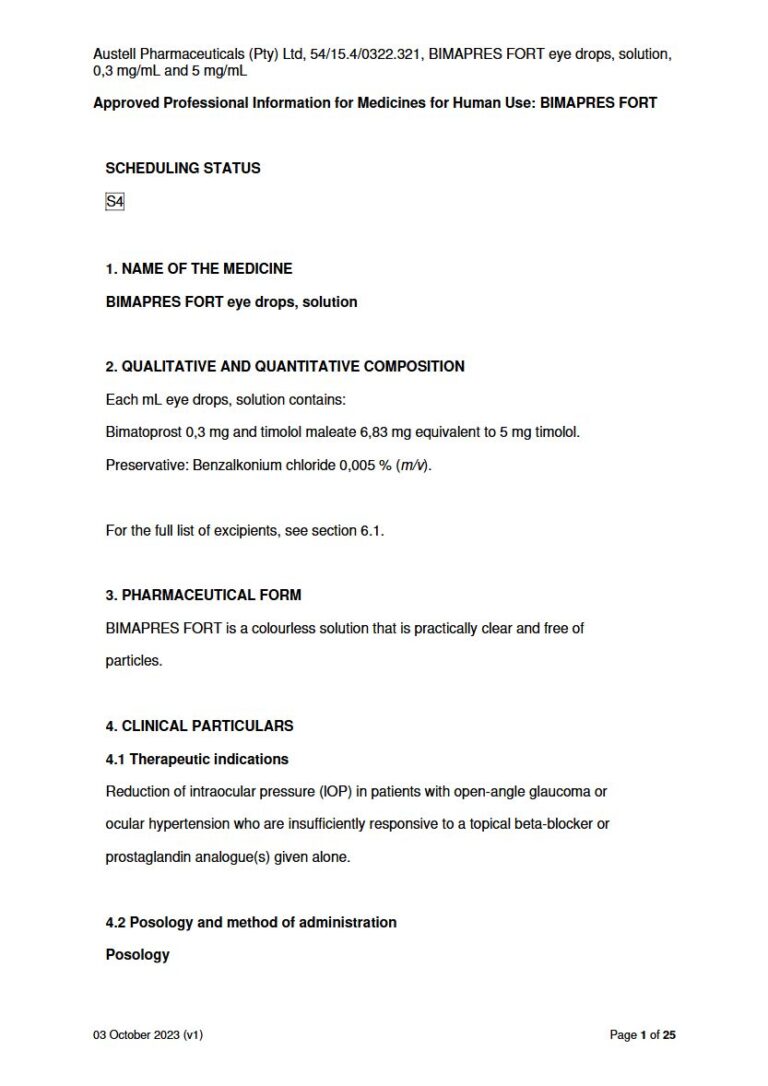
4.1 Therapeutic indications
Reduction of intraocular pressure (lOP) in patients with open-angle glaucoma or ocular hypertension who are insufficiently responsive to a topical beta-blocker or prostaglandin analogue(s) given alone.
4.2 Posology and method of administration
Posology
Recommended dosage in adults (including the elderly)
The recommended dose is one drop of BIMAPRES FORT in the affected eye(s) once daily, administered either in the morning or in the evening. If one dose is missed, treatment should continue with the next dose as planned. The dose should not exceed one drop in the affected eye(s) daily. If more than one topical ophthalmic product is to be used, the different products should be instilled at least 5 minutes apart. When using nasolacrimal occlusion or closing the eyelids for 2 minutes, the systemic absorption is reduced.
Special populations
Renal and hepatic impairment
BIMAPRES FORT has not been studied in patients with hepatic or renal impairment. Therefore, caution should be used in treating such patients.
Paediatric population
BIMAPRES FORT has only been studied in adults and therefore its use is not recommended in children or adolescents.
Method of administration
For ophthalmic use.
4.3 Contraindications
- Hypersensitivity to bimatoprost, timolol or to any of the excipients listed in section 6.1.
- Reactive airway disease including bronchial asthma or a history of bronchial asthma, severe chronic obstructive pulmonary disease.
- Sinus bradycardia, sick sinus syndrome, sino-atrial block, second or third degree atrioventricular block not controlled with a pace-maker, overt cardiac failure, cardiogenic shock.
4.4 Special warnings and precautions for use
The active substances (timolol/ bimatoprost) in BIMAPRES FORT may be absorbed systemically. No enhancement of the systemic absorption of the individual active substances has been observed with BIMAPRES FORT. Due to the beta-adrenergic component, timolol, the same types of cardiovascular, pulmonary and other adverse reactions (ADRs) as seen with systemic beta-blockers may occur. Incidence of systemic ADRs after topical ophthalmic administration is lower than for systemic administration. To reduce the systemic absorption, see section 4.2.
Cardiac disorders
Patients with cardiovascular diseases (e.g. coronary heart disease, Prinzmetal's angina and cardiac failure) and receiving hypotension therapy with beta-blockers should be critically assessed and therapy with other active substances should be considered. Patients with cardiovascular diseases should be watched for signs of deterioration of these diseases and of adverse reactions.
Due to the negative effect on conduction time, beta-blockers should only be given with caution to patients with first degree heart block.
Vascular disorders
Patients with severe peripheral circulatory disturbance/disorders (i.e. severe forms of Raynaud's disease or Raynaud's syndrome) should be treated with caution.
Respiratory disorders
Respiratory reactions, including death due to bronchospasm in patients with asthma, have been reported following administration of some ophthalmic beta-blockers. BIMAPRES FORT should be used with caution in patients with mild/moderate chronic obstructive pulmonary disease (COPD) and only if the potential benefit outweighs the potential risk.
Endocrine disorders
Beta-adrenergic blocking medicinal products should be administered with caution in patients subject to spontaneous hypoglycaemia or in patients with labile diabetes as beta-blockers may mask the signs and symptoms of acute hypoglycaemia. Beta-blockers may also mask the signs of hyperthyroidism.
Corneal diseases
Ophthalmic beta-blockers may induce dryness of eyes. Patients with corneal diseases should be treated with caution.
Other beta-blocking medicines
The effect on intra-ocular pressure or the known effects of systemic beta-blockade may be potentiated when timolol is given to patients already receiving a systemic beta-blocking medicine. The response of these patients should be closely observed. The use of two topical beta-adrenergic blocking medicines is not recommended (see section 4.5).
Anaphylactic reactions
While taking beta-blockers, patients with a history of atopy or a history of severe anaphylactic reaction to a variety of allergens may be more reactive to repeated challenge with such allergens and unresponsive to the usual dose of adrenaline used to treat anaphylactic reactions.
Choroidal detachment
Choroidal detachment has been reported with administration of aqueous suppressant therapy such as timolol after filtration procedures.
Surgical anaesthesia
Beta-blocking ophthalmological preparations may block systemic beta-agonist effects e.g. of adrenaline. The anaesthesiologist should be informed when the patient is receiving BIMAPRES FORT.
Hepatic
In patients with a history of mild liver disease or abnormal alanine aminotransferase (ALT), aspartate aminotransferase (AST) and/or bilirubin at baseline, bimatoprost eye drops had no adverse reactions on liver function over 24 months. There are no known adverse reactions of ocular timolol, as in BIMAPRES FORT, on liver function.
Ocular
Before treatment is initiated, patients should be informed of the possibility of eyelash growth, and periorbital skin hyperpigmentation since these have been observed during treatment with BIMAPRES FORT. Increased brown iris pigmentation has also been observed during treatment with BIMAPRES FORT. Increased iris pigmentation is likely to be permanent and may lead to differences in appearance between the eyes if only one eye is treated. After discontinuation of BIMAPRES FORT, pigmentation of iris may be permanent. After 12 months of treatment with bimatoprost and timolol eye drops the incidence of iris pigmentation was 0,2 %. After 12 months of treatment with bimatoprost eye drops alone, the incidence was 1,5 % and did not increase following 3 years of treatment. The pigmentation change is due to increased melanin content in the melanocytes rather than to an increase in the number of melanocytes. The long-term effects of increased iridial pigmentation are not known. Iris colour changes seen with ophthalmic administration of bimatoprost may not be noticeable for several months to years. Neither nevi nor freckles of the iris appear to be affected by treatment. Periorbital tissue pigmentation has been reported to be reversible in some patients.
Macular oedema, including cystoid macular oedema has been reported with bimatoprost and timolol eye drops. Therefore, BIMAPRES FORT single-dose should be used with caution in aphakic patients, in pseudophakic patients with a torn posterior lens capsule, or in patients with known risk factors for macular oedema (e.g. intraocular surgery, retinal vein occlusions, ocular inflammatory disease and diabetic retinopathy). BIMAPRES FORT should be used with caution in patients with active intraocular inflammation (e.g. uveitis) because the inflammation may be exacerbated.
Skin
There is a potential for hair growth to occur in areas where BIMAPRES FORT solution comes repeatedly in contact with the skin surface. Thus, it is important to apply BIMAPRES FORT as instructed and avoid it running onto the cheek or other skin areas.
Other conditions
BIMAPRES FORT has not been studied in patients with inflammatory ocular conditions, neovascular, inflammatory, angle closure, congenital or narrow-angle glaucoma. In studies of bimatoprost 0,3 mg/mL in patients with glaucoma or ocular hypertension, it has been shown that more frequent exposure of the eye to more than 1 dose of bimatoprost daily may decrease the IOP-lowering effect. Patients using BIMAPRES FORT with other prostaglandin analogues should be monitored for changes to their intraocular pressure.
4.5 Interaction with other medicines and other forms of interaction
No specific interaction studies have been performed with the bimatoprost/timolol fixed combination. There is a potential for additive effects resulting in hypotension, and/or marked bradycardia when ophthalmic beta-blocker solution is administered concomitantly with oral calcium channel blockers, guanethidine, beta-adrenergic blocking medicines, parasympathomimetics, anti-dysrhythmics (including amiodarone) and digoxin. Timolol as in BIMAPRES FORT can mask the signs and symptoms of and the bodyu2019s reaction to hypoglycaemia (see section 4.8). The hypertensive reaction to sudden withdrawal of clonidine can be potentiated when taking beta-blockers such as in BIMAPRES FORT. Potentiated systemic beta-blockade (e.g. decreased heart rate, depression) has been reported during combined treatment with CYP2D6 inhibitors (e.g. quinidine, fluoxetine, paroxetine, selective serotonin reuptake inhibitors (SSRIs)) and timolol. Mydriasis resulting from concomitant use of ophthalmic beta-blockers and adrenaline (epinephrine) has been reported.
4.6 Fertility, pregnancy and lactation
Pregnancy
There are no adequate data from the use of the bimatoprost / timolol fixed combination in pregnant women. BIMAPRES FORT should not be used during pregnancy unless clearly necessary. To reduce the systemic absorption, see section 4.2.
Bimatoprost
No adequate clinical data in exposed pregnancies are available. Animal studies have shown reproductive toxicity at high maternotoxic doses.
Timolol
Signs and symptoms of beta-blockade (e.g., bradycardia, hypotension, respiratory distress and hypoglycaemia) have been observed in the neonate when beta-blockers have been administered until delivery. If BIMAPRES FORT is administered until delivery, the neonate should be carefully monitored during the first days of life.
Lactation
Timolol
Beta-blockers are excreted in breast milk. However, at therapeutic doses of timolol in eye drops it is not likely that sufficient amounts would be present in breast milk to produce clinical symptoms of beta-blockade in the infant. To reduce the systemic absorption, see section 4.2.
Bimatoprost
It is not known if bimatoprost is excreted in human breast milk. BIMAPRES FORT should not be used by breastfeeding women.
Fertility
There are no data on the effects of BIMAPRES FORT on human fertility.
4.7 Effects on ability to drive and use machines
Transient blurred vision occurs at instillation, the patient should wait until the vision clears before driving or using machines.
4.8 Undesirable effects
a) Summary of the safety profile
The adverse reactions reported in the clinical study using bimatoprost and timolol eye drops, solution were limited to those earlier reported for the single active substances bimatoprost or timolol. No new adverse reactions specific for bimatoprost and timolol eye drops, solution have been observed in clinical studies. The majority of adverse reactions reported with bimatoprost and timolol eye drops, solution were ocular, mild in severity and none were serious. Based on a 12-week study of bimatoprost and timolol eye drops, solution administered once daily, the most commonly reported adverse reaction with bimatoprost and timolol eye drops, solution was conjunctival hyperaemia (mostly trace to mild and thought to be of a non-inflammatory nature).
b) Tabulated list of adverse reactions
Table 1 below shows all adverse drug reactions (ADRs) observed during clinical trials and postmarket spontaneous reports with bimatoprost and timolol eye drops, solution.
4.9 Overdose
In overdose, side-effects may be exacerbated and exaggerated (see section 4.8). Symptoms of systemic timolol overdose include bradycardia, hypotension, bronchospasm, headache, dizziness, shortness of breath, and cardiac arrest. Timolol does not dialyse readily. If overdose occurs treatment should be symptomatic and supportive.
