
Bio Zopiclone 7,5mg Tablets
PDF Leaflet Revision Date: 06 December 2022
Clinical Summary
Quick overview from the medicine insert
Indication
Short-term treatment of severe insomnia in adults.
Dosage (summary)
Adults: 7.5 mg orally before bedtime; Elderly/Impaired: start with 3.75 mg.
Special Populations
- Elderly
- Renal impairment
- Hepatic impairment
Pregnancy & Breastfeeding
Not recommended in pregnancy or breastfeeding.
Key Drug Interactions
- CNS depressants
- Alcohol
- Opioids
- CYP3A4 inhibitors
Contraindications
- Hypersensitivity to zopiclone
- Respiratory failure
- Severe sleep apnoea
- Severe hepatic insufficiency
- Myasthenia gravis
- Children under 18
Common side effects
- Bitter taste
- Drowsiness
- Ataxia
- Dry mouth
Counselling Points
- Take before bedtime for full sleep duration.
- Avoid alcohol and other CNS depressants.
- Do not drive or operate machinery after taking.
Serious warnings
- Risk of dependence
- Withdrawal symptoms
- Caution in elderly and patients with history of substance abuse
Important Disclaimer
The Bio Zopiclone 7,5mg Tablets professional information leaflet below is the property of Biotech Laboratories and is provided on Medinsert exactly as issued, with no.. alterations or editorial changes. We make every effort to keep content current by updating documents as soon as new versions become available. Medinsert serves as a trusted access point for healthcare professionals, but does not replace official sources or clinical judgement. For more details, please read our full disclaimer. read more>>
 Healthcare Professionals Only
This content is for registered healthcare professionals
Sign in or create a free account to read the full package insert.
Free for HPCSA-registered professionals. Powered by Medinsert.
Clinical Particulars
Section 4 of the official insert — extracted exactly as issued, no alterations
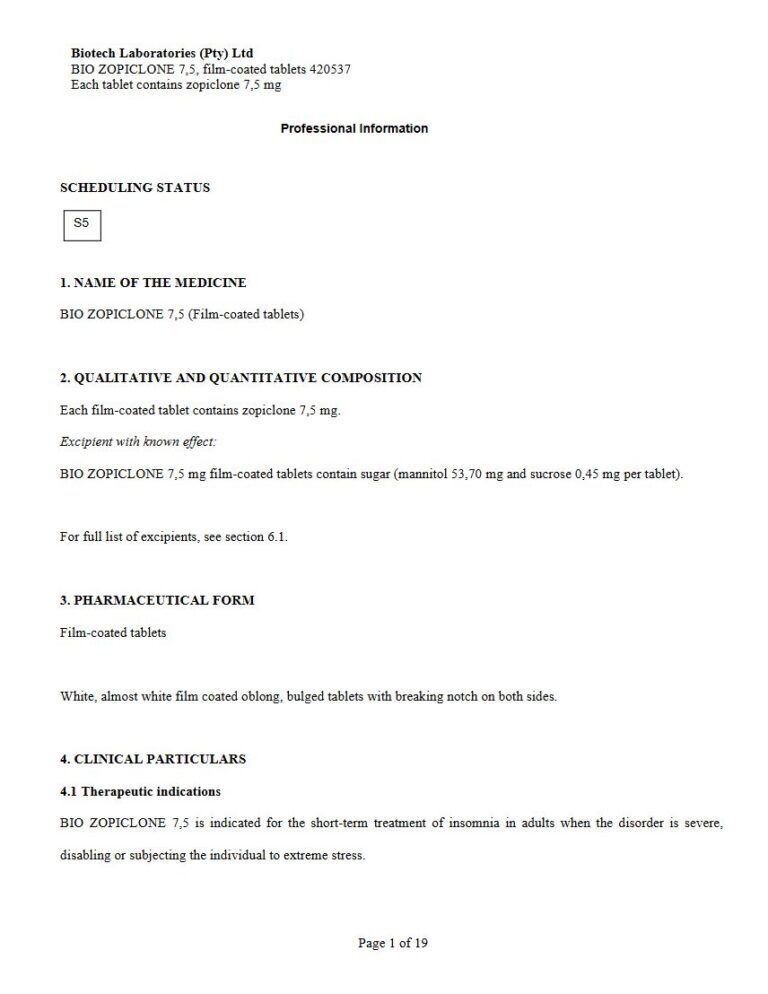
4.1 Therapeutic indications
BIO ZOPICLONE 7,5 is indicated for the short-term treatment of insomnia in adults when the disorder is severe, disabling or subjecting the individual to extreme stress.
4.2 Posology and method of administration
BIO ZOPICLONE 7,5 therapy should be used for as short a time as possible. Generally the duration of treatment varies from a few days to two weeks, with a maximum, including tapering off process, of four weeks. Use for any longer periods requires re-evaluation of the patient.
Treatment should be started with the lowest recommended dose and the maximum dose should not be exceeded.
Adults: 7,5 mg orally, shortly before retiring. This dose should not be exceeded.
Elderly patients and patients with impaired hepatic function or chronic respiratory insufficiency: The lower dose of 3,75 mg BIO ZOPICLONE 7,5 should be used initially in these patients, and if necessary, the dose may be increased to 7,5 mg.
Renal insufficiency: Patients with impaired function should start treatment with 3,75 mg, although accumulation of BIO ZOPICLONE 7,5 or its metabolites has not been seen during treatment of insomnia in patients with renal insufficiency.
4.3 Contraindications
BIO ZOPICLONE 7,5 is contraindicated in patients with:
- Hypersensitivity to zopiclone or to any of the other ingredients of BIO ZOPICLONE 7,5 listed in section 6.1.
- Respiratory failure
- Severe sleep apnoea syndrome
- Severe hepatic insufficiency.
- Who have previously experienced complex sleep behaviours after taking BIO ZOPICLONE 7,5 (see section 4.4)
- Myasthenia gravis
- BIO ZOPICLONE 7,5 should not be used in children under the age of 18 years.
- Safety in pregnancy and lactation has not been established (see section 4.6).
- Pre-existing central nervous system depression or coma, acute pulmonary insufficiency or sleep apnoea.
4.4 Special warnings and precautions for use
Drowsiness and incoordination on waking can occur. Psychotic illness BIO ZOPICLONE 7,5 is not recommended for the primary treatment of psychotic illness. BIO ZOPICLONE 7,5 should not be used alone to treat depression or anxiety with depression (suicide may be precipitated in such patients). BIO ZOPICLONE 7,5 should be used with extreme caution in patients with a history of alcohol or drug abuse. Use with care in patients with chronic pulmonary insufficiency. BIO ZOPICLONE 7,5 should be given with care to elderly or debilitated patients who may be more prone to adverse effects. Caution is required in patients with impaired kidney function. Severe hepatic insufficiency (serum albumin less than 30 g/L or presence of gross oedema) may significantly interfere with the elimination of BIO ZOPICLONE 7,5 (see u201cSpecific Patient Groupsu201d below and section 4.3). The standard one tablet dose may be cautiously prescribed to patients with moderate (compensated) renal insufficiency, but higher doses are not recommended in these patients. BIO ZOPICLONE 7,5 is removed by dialysis. Caution is required in patients with organic brain changes, particularly arteriosclerosis. BIO ZOPICLONE 7,5 has less frequently provoked seizures in epileptic patients; seizures may also occur on abrupt withdrawal of therapy. The cause of insomnia should be identified wherever possible, and the underlying factors treated before a hypnotic is prescribed. The lack of relief from insomnia after 7-10 days of treatment possibly indicates the presence of a primary psychiatric and / or medical pathology or the presence of an erroneous perception of the state of sleep.
Specific patient groups Benzodiazepines (e.g., BIO ZOPICLONE 7,5) are not indicated to treat patients with severe hepatic insufficiency as they may precipitate encephalopathy (see section 4.3).
Use in Paediatric population BIO ZOPICLONE 7,5 should not be used children and adolescents less than 18 years. The safety and efficacy of BIO ZOPICLONE 7,5 in children and adolescents aged less than 18 years have not been established.
Use in Elderly patients Elderly should be given a reduced dose (see section 4.2). Due to the muscle relaxant effect of BIO ZOPICLONE 7,5 there is a risk of fall, especially in the elderly if they get up during the night.
Rebound insomnia A transient syndrome whereby the symptoms that led to treatment with BIO ZOPICLONE 7,5 a benzodiazepine or benzodiazepine-like agent recur in an enhanced form on discontinuation of therapy. It may be accompanied by other reactions including mood changes, anxiety and restlessness. Since the risk of withdrawal phenomena/rebound phenomena is greater after prolonged treatment, or abrupt discontinuation of treatment, it is, therefore recommended that the dosage is decreased gradually and to advise the patient accordingly. A course of treatment should employ the lowest effective dose for the minimum length of time necessary for effective treatment. For guidance on a possible treatment regimen, see section 4.2. A course of treatment should not continue for longer than 4 weeks including any tapering off.
Risk of dependence Clinical experience to date with BIO ZOPICLONE 7,5 suggests that the risk of dependence is minimal when the duration of treatment is limited to not more than 4 weeks. The use of benzodiazepines and benzodiazepine-like substances (even at therapeutic doses) can lead to the development of physical and psychological dependence as well as a potential for abuse especially with prolonged use and high doses. The risk of dependence or abuse is also greater in patients with a history of alcohol or other psychotropics or drug abuse or those who have marked personality disorders. This should be considered when taking the decision to use a hypnotic in such patients. If physical dependence occurs, sudden discontinuation of the treatment will be accompanied by withdrawal symptoms. These may be expressed as headaches, muscle pain, extreme anxiety, tension, restlessness, confusion and irritability. In severe cases the following symptoms may occur: derealisation, depersonalisation, hyperacusis, numbness and tingling of extremities, hypersensitivity to light, noise and physical contact, hallucinations or epileptic seizures. Rare cases of abuse have been reported.
Duration of treatment The duration of treatment should be as short as possible (see section 4.2), but should not exceed 4 weeks for insomnia, including tapering off process. Extension beyond these periods should not take place without re-evaluation of the situation. It may be useful to inform the patient when treatment is started that it will be of limited duration and explain precisely how the dosage will be progressively decreased. Moreover, it is important that the patient should be aware of the possibility of rebound phenomena, thereby minimizing anxiety over such symptoms, should they occur while BIO ZOPICLONE 7,5 is being discontinued.
Withdrawal The termination of treatment with BIO ZOPICLONE 7,5 is unlikely to be associated with withdrawal effects when duration of treatment is limited to 4 weeks. Patients may benefit from tapering of the dose before discontinuation (see section 4.8). BIO ZOPICLONE 7,5 does not constitute a treatment for depression and may even unmask its symptoms (suicide may be precipitated in such patients). Any underlying cause of insomnia should be addressed carefully before symptomatic treatment to avoid under treating potentially serious effects of depression. Suicidal tendencies may be present, therefore the least amount of BIO ZOPICLONE 7,5 that is feasible should be supplied to these patients to avoid the possibility of intentional overdose by the patient. Since insomnia may be a symptom of depression, the patient should be re-evaluated if insomnia persists.
Suicidality Some epidemiological studies indicate an increased incidence of suicide and suicide attempts in patients with or without depression, and treated with benzodiazepines or hypnotics, including BIO ZOPICLONE 7,5. However, a causal association has not been demonstrated.
Tolerance Some loss of efficacy to the hypnotic effect of benzodiazepines and benzodiazepine-like medicines may develop after repeated use for a few weeks. However, with BIO ZOPICLONE 7,5 there is an absence of any marked tolerance during treatment periods of up to 4 weeks.
Amnesia Anterograde amnesia may occur, especially when sleep is interrupted or when retiring to bed is delayed after taking the tablet. Therefore, patients should ensure that they take the tablet when certain of retiring for the night and they are able to have a full nightu2019s sleep (uninterrupted sleep of about 7 u2013 8 hours).
Psychomotor impairment BIO ZOPICLONE 7,5 has CNS-depressant effects. The risk of psychomotor impairment, including impaired driving ability, is increased if: BIO ZOPICLONE 7,5 is taken within 12 hours of performing activities that require mental alertness, a dose higher than the recommended dose is taken, or BIO ZOPICLONE 7,5 is coadministered with other CNS-depressants, alcohol or with other medicines that increase the blood levels of BIO ZOPICLONE 7,5 (see section 4.5). Patients should be cautioned against engaging in hazardous occupations requiring complete mental alertness or motor coordination such as operating machinery or driving a motor vehicle following administration of BIO ZOPICLONE 7,5 and in particular during the 12 hours following that administration.
Other Psychiatric and paradoxical reactions Other psychiatric and paradoxical reactions have been reported (see section 4.8), like restlessness, agitation, irritability, aggression, delusion, anger, nightmares, hallucinations, inappropriate behaviour and other adverse behavioural effects are known to occur when using sedative/hypnotic medicines like BIO ZOPICLONE 7,5. Should this occur, use of BIO ZOPICLONE 7,5 should be discontinued. These reactions are more likely to occur in the elderly.
Somnambulism and associated behaviour Complex sleep behavior, including sleep walking and other associated behaviours such as sleep driving, preparing and eating food, or making phone calls, with amnesia of the event, have been reported in patients who have taken BIO ZOPICLONE 7,5 and were not fully awake. These events may occur following the first or any subsequent use of BIO ZOPICLONE 7,5. The use of alcohol and other CNS depressants with BIO ZOPICLONE 7,5 appears to increase the risk of such behaviours, as does the use of BIO ZOPICLONE 7,5 at doses exceeding the maximum recommended dose. Discontinuation of BIO ZOPICLONE 7,5 should be strongly considered for patients who report such behaviours (see section 4.3).
Risk from concomitant use of opioids Concomitant use of BIO ZOPICLONE 7,5 and opioids may result in sedation, respiratory depression, coma and death. Because of these risks, concomitant prescribing of sedative medicines such as benzodiazepines or related drugs such as BIO ZOPICLONE 7,5 with opioids should be reserved for patients for whom alternative treatment options are not possible. If a decision is made to prescribe BIO ZOPICLONE 7,5 concomitantly with opioids, the lowest effective dose should be used, and the duration of treatment should be as short as possible (see section 4.2). The patients should be followed closely for signs and symptoms of respiratory depression and sedation. In this respect, it is strongly recommended to inform patients and their caregivers (where applicable) to be aware of these symptoms (see section 4.5).
Excipients BIO ZOPICLONE 7,5 contains sucrose. Patients with rare hereditary problems of fructose intolerance, glucose-galactose malabsorption or sucrase-isomaltase insufficiency should not take BIO ZOPICLONE 7,5. BIO ZOPICLONE 7,5 contains mannitol and may have a mild laxative effect.
4.5 Interaction with other medicines and other forms of interaction
Sedation or respiratory and cardiovascular depression may be enhanced by other medicines with central nervous system depressant properties; these include alcohol, antidepressants, antihistamines, antipsychotics, general anaesthetics, other hypnotics or sedatives and opioid analgesics. Erythromycin increases the rate of absorption of BIO ZOPICLONE 7,5 and prolongs its elimination.
Association not recommended Concomitant use with alcohol is not recommended because the sedative effect of BIO ZOPICLONE 7,5 may be intensified when used in combination with alcohol. This may affect the ability to drive or operate machines.
Combination to be taken into account In combination with CNS depressant an enhancement of the central depressive effect may occur. The therapeutic effect of co-administration antipsychotics (neuroleptics), hypnotics, anxiolytics/sedatives, antidepressant medicines, narcotic analgesics, antiepileptic medicines, anaesthetics and sedative antihistamines should therefore be carefully weighed. Concomitant use of benzodiazepines or benzodiazepine-like medicines with narcotic analgesics may enhance their euphoric effect and may lead to an increase in psychic dependence. Compounds which inhibit certain hepatic enzymes (particularly cytochrome P450) may enhance the activity of benzodiazepines and benzodiazepine-like medicines. Since BIO ZOPICLONE 7,5 is metabolised by the cytochrome P450 (CYP) 3A4 isoenzyme (see section 5.2), plasma levels of zopiclone may be increased when co-administered with CYP3A4 inhibitors, such as erythromycin, clarithromycin, ketoconazole, itraconazole, and ritonavir. A dose reduction for BIO ZOPICLONE 7,5 may be required when it is co-administered with CYP3A4 inhibitors.
Co-administration with medicines which induce CYP3A4, like phenobarbital, phenytoin, carbamazepine, rifampicin and products containing St John's wort, may reduce BIO ZOPICLONE 7,5 plasma levels and thus the effect of BIO ZOPICLONE 7,5. A dose increase for BIO ZOPICLONE 7,5 may be required when it is co-administered with CYP3A4 inducers. The AUC of BIO ZOPICLONE 7,5 is increased by 80 % in presence of erythromycin which indicates that erythromycin can inhibit the metabolism of medicines metabolised by CYP 3A4. As a consequence, the hypnotic effect of BIO ZOPICLONE 7,5 may be enhanced. Opioids The concomitant use of benzodiazepines and other sedative-hypnotic medicines, including BIO ZOPICLONE 7.5, and opioids increases the risk of sedation, respiratory depression, coma, and death because of additive CNS depressant effect (see section 4.4).
4.6 Fertility, pregnancy and lactation
Women of childbearing potential / Contraception in males and females If BIO ZOPICLONE 7,5 is prescribed to a woman of childbearing potential, she should be warned to contact her medical practitioner regarding discontinuation of the product if she intends to become or suspects that she is pregnant.
Pregnancy BIO ZOPICLONE 7,5 should not be used during pregnancy. Animal studies do not indicate direct or indirect harmful effects with respect to reproductive toxicity. BIO ZOPICLONE 7,5 crosses the placenta. Cases of reduced foetal movement and foetal heart rate variability have been described after administration of benzodiazepines or benzodiazepine-like substances during the second and/or third trimester of pregnancy. Moreover, if BIO ZOPICLONE 7,5 is prescribed during the last three months of pregnancy or during labour, due to the pharmacological action of the product, effects on the neonate, such as hypothermia, hypotonia, feeding difficulties (floppy infant syndrome) and respiratory depression can be expected due to the pharmacological action of the product. Cases of severe neonatal respiratory depression have been reported. Infants born to mothers who took benzodiazepines or benzodiazepine-like medicines chronically during the latter stages of pregnancy may have developed physical dependence and may be at some risk of developing withdrawal symptoms in the postnatal period. Appropriate monitoring of the newborn in the postnatal period is recommended.
Breastfeeding BIO ZOPICLONE 7,5 is distributed in the breast milk. Although the concentration of BIO ZOPICLONE 7,5 in the breast milk is low, BIO ZOPICLONE 7,5 should not be used by breastfeeding mothers (see section 4.3).
Fertility In a double-blind long-term study on healthy male volunteers, no negative changes in sperm volume, sperm concentration, sperm motility and cell morphology were found in spermatograms at doses of 7.5 mg zopiclone over a period of 84 days.
4.7 Effects on ability to drive and use machines
BIO ZOPICLONE 7,5 may adversely affect the ability to drive or use machines. The risk of psychomotor impairment, including impaired driving ability, is increased if: (see section 4.4).
- BIO ZOPICLONE 7,5 is taken within 12 hours of performing activities that require mental alertness,
- a dose higher than the recommended dose is taken, or
- BIO ZOPICLONE 7,5 is co-administered with other CNS depressants, alcohol, or with other medicines that increase the blood levels of zopiclone (e.g., BIO ZOPICLONE 7.5).
Patients should be cautioned against engaging in hazardous occupations requiring complete mental alertness or motor coordination such as operating machinery or driving a motor vehicle following administration of BIO ZOPICLONE 7,5 and in particular during the 12 hours following that administration.
4.8 Undesirable effects
The side effect most commonly recorded is bitter or metallic after taste. Drowsiness, sedation and ataxia are also frequent side effects. They generally decrease on continued administration and are a consequence of central nervous system depression. Less frequent side effects include vertigo, slurred speech or dysarthria, tremor, visual disturbances, urinary retention or incontinence, gastrointestinal disturbances, changes in salivation and amnesia. Some patients may experience a paradoxical excitation which may lead to hostility, aggression and disinhibition. Jaundice, blood disorders and hypersensitivity reactions have been reported rarely. Hypotension occasionally occur with high dosage. Rebound insomnia may be the result of tolerance to the effect of BIO ZOPICLONE 7,5 or part of a withdrawal syndrome (see section 4.4).
Immune system disorders: Less frequent: angiooedema, anaphylactic reaction, Stevens-Johnson Syndrome, toxic epidermal necrosis, erythema multiforme.
Psychiatric disorders: Less frequent: nightmare, agitation, confusional state, irritability, aggression, hallucination Frequency unknown: restlessness, delusion, anger, abnormal behaviour (possibly associated with amnesia) and complex sleep behaviours including somnambulism (see section 4.4), dependence, withdrawal syndrome (see below)
Nervous system disorders: Frequent: dysgeusia (bitter taste), residual somnolence Less Frequent: dizziness, headache, anterograde amnesia Frequency unknown: ataxia, paraesthesia, cognitive disorders such as memory impairment, disturbance in attention, speech disorder
Eye disorders: Frequency unknown: diplopia
Gastrointestinal disorders: Frequent: dry mouth Less Frequent: nausea, vomiting, diarrhoea Frequency unknown: dyspepsia
Skin and subcutaneous tissue disorders: Less Frequent: pruritus, rash, urticaria
Musculoskeletal and connective tissue disorders: Frequency unknown: muscular weakness
Respiratory, thoracic and mediastinal disorders: Less Frequent: dyspnoea (see section 4.4).
Frequency unknown: respiratory depression (see section 4.4)
Hepato-biliary disorders: Less Frequent: transaminases increased and/or blood alkaline phosphatase increased (mild to moderate)
General disorders and administration site conditions: Less Frequent: chills, sweating, fatigue Frequency unknown: light headedness, incoordination injury, poisoning and procedural complications
Injury, poisoning and procedural complications: Less Frequent: fall (predominantly in elderly patients) Withdrawal symptoms have been reported upon discontinuation of BIO ZOPICLONE 7,5. Withdrawal symptoms may vary and may include rebound insomnia and other symptoms (see section 4.4 u2013 Withdrawal phenomena). In very rare cases, seizures may occur.
4.9 Overdose
Symptoms of overdose: (See section 4.8) Overdose is usually manifested by varying degrees of central nervous system depression according to the quantity ingested. In mild cases, symptoms include drowsiness, confusion, and lethargy; in more serious cases, symptoms may include ataxia, hypotonia, hypotension, respiratory depression and coma. Overdose may be life-threatening especially when combined with other CNS depressants (including alcohol). Other risk factors such as the presence of concomitant illness and the debilitated state of the patient may contribute to the severity of the symptoms and can result in fatal outcome.
Treatment of overdose: Symptomatic and supportive treatment in an adequate clinical environment is recommended, with special attention being paid to respiratory and cardiovascular functions. Haemodialysis is of no value due to the large volume of distribution of BIO ZOPICLONE 7,5. Flumazenil may be a useful antidote.
