
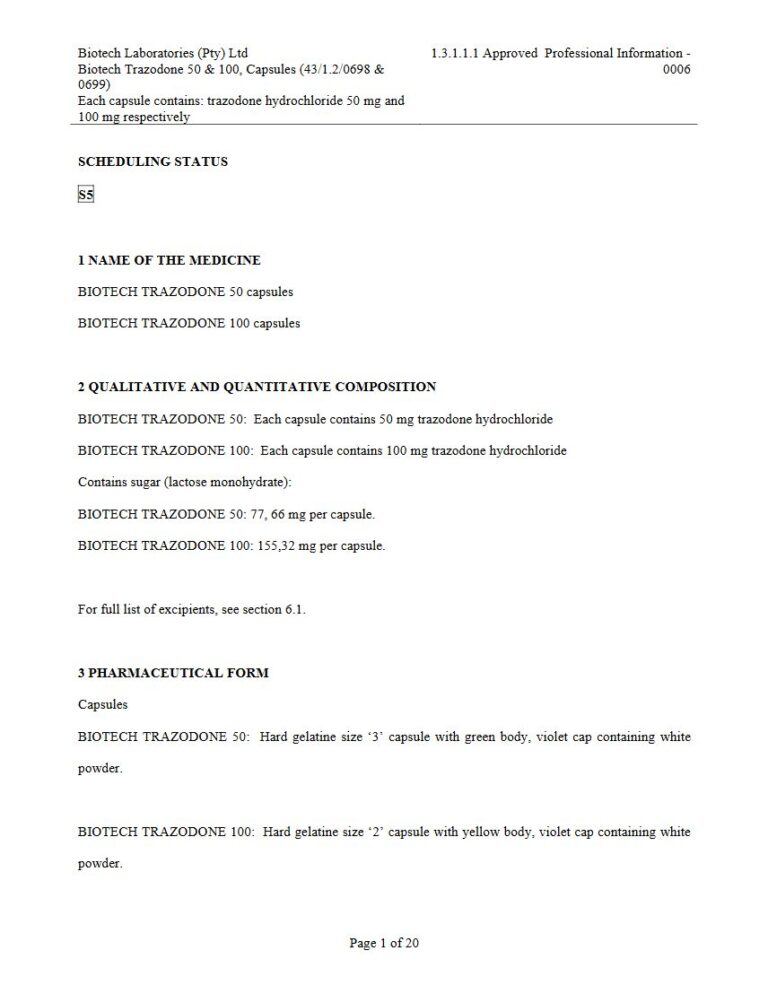
Biotech Trazodone 50mg & 100mg Capsules
PDF Leaflet Revision Date: 26 January 2026
Clinical Summary
Quick overview from the medicine insert
Indication
Treatment of depression and mixed anxiety and depression.
Dosage (summary)
Adults: 150 mg/day initially, titrated to 300-400 mg/day in three divided doses.
Special Populations
- Elderly
- Renal impairment
- Hepatic impairment
Pregnancy & Breastfeeding
Safety not established during pregnancy and lactation.
Key Drug Interactions
- CYP3A4 inhibitors
- Alcohol
- Antidepressants
- Antihypertensives
Contraindications
- Hypersensitivity to trazodone
- Acute myocardial infarction
- Alcohol intoxication
Common side effects
- Drowsiness
- Dizziness
- Nausea
- Dry mouth
Counselling Points
- Take with food
- Avoid alcohol
- Monitor for suicidal thoughts
- Gradual withdrawal recommended
Serious warnings
- Risk of suicidal thoughts
- Serotonin syndrome
- Severe hepatic disorders
Important Disclaimer
The Biotech Trazodone 50mg & 100mg Capsules professional information leaflet below is the property of Biotech Laboratories and is provided on Medinsert exactly as issued, with no.. alterations or editorial changes. We make every effort to keep content current by updating documents as soon as new versions become available. Medinsert serves as a trusted access point for healthcare professionals, but does not replace official sources or clinical judgement. For more details, please read our full disclaimer. read more>>
 Healthcare Professionals Only
This content is for registered healthcare professionals
Sign in or create a free account to read the full package insert.
Free for HPCSA-registered professionals. Powered by Medinsert.
Clinical Particulars
Section 4 of the official insert — extracted exactly as issued, no alterations
4.1 Therapeutic indications
BIOTECH TRAZODONE is indicated in the treatment of:
- Depression
- Mixed anxiety and depression
4.2 Posology and method of administration
Posology
The dosage of BIOTECH TRAZODONE must be individualised for each patient by titration and will depend on the diagnosis and severity of the condition as well as the individual patientu2019s response. The daily dosage is usually administered as three divided doses.
Adults: For the treatment of depression: The optimal dosage range is between 300 u2013 400 mg/day in three divided doses. A starting dose of 150 mg/day is suggested for the first week, gradually increasing it to 300 mg/day or higher depending on the clinical response. (Dosages of 600 mg/day have been reported as used in hospital patients). For the treatment of mixed anxiety and depression: A starting dose of 100 u2013 150 mg/day is recommended. When depression is the predominant symptom, an increased dose of 300 u2013 400 mg/day may be required to achieve a satisfactory response.
Withdrawal of BIOTECH TRAZODONE should be gradual. Abrupt discontinuation of the treatment should be avoided. (see section 4.4)
Special populations
Elderly population: Elderly patients are more likely to experience the sedative and hypotensive effects of BIOTECH TRAZODONE, and a lower initial dose is recommended with adjustments made as needed and tolerated (see section 4.4).
Method of administration
For oral use. BIOTECH TRAZODONE should be taken with food.
4.3 Contraindications
- Hypersensitivity to trazodone or to any of the excipients of BIOTECH TRAZODONE listed in section 6.1.
- Myocardial infarction during the acute recovery phase.
- Pregnancy and lactation (see section 4.6).
- Alcohol intoxication and intoxication with hypnotics.
4.4 Special warnings and precautions for use
Use in children and adolescents under 18
BIOTECH TRAZODONE is not recommended for use in children and adolescents under 18 years old. Suicidal behaviour (suicidal attempt and suicidal planning) and hostility (essentially aggressiveness, opposing behaviour and anger) has been observed in children and adolescents treated with antidepressants such as BIOTECH TRAZODONE. Safety data on children and adolescents regarding growth, maturation and cognitive and behavioural development are not available.
Cardiovascular disorders
BIOTECH TRAZODONE should be used with caution in patients with cardiovascular disorders, such as ischaemic heart disease, dysrhythmias, angina pectoris, conduction disorders or AV blocks of different degree and recent myocardial infarction. Caution is advised when prescribing BIOTECH TRAZODONE with medicines known to prolong QT interval and should be used with caution in patients with known cardiovascular disease including those associated with prolongation of the QT interval (see section 4.5).
Concomitant administration of antihypertensive therapy with BIOTECH TRAZODONE may require a reduction in the dose of the antihypertensive medicine, because of reports of hypotension, including orthostatic hypotension and syncope when using BIOTECH TRAZODONE (see section 4.5).
Epilepsy
BIOTECH TRAZODONE should be used with caution in epilepsy. In general, antidepressants may antagonise the activity of antiepileptics by lowering the convulsive threshold (see section 4.5). Abrupt increases or decreases of BIOTECH TRAZODONE dosage should be avoided.
Renal and hepatic impairment
BIOTECH TRAZODONE should be used with caution in patients with renal- or hepatic impairment, particularly if severe. Severe hepatic disorders with potential fatal outcome have been reported with BIOTECH TRAZODONE use (see section 4.8). Patients should be instructed to report immediately signs such as asthenia, anorexia, nausea, vomiting, abdominal pain or icterus to a medical practitioner. Investigations including clinical examination and biological assessment of liver function should be undertaken immediately, and withdrawal of BIOTECH TRAZODONE therapy be considered. Should jaundice occur in a patient, BIOTECH TRAZODONE therapy must be withdrawn.
Suicide/suicidal thoughts or clinical worsening
Suicidal thoughts, self-harm and suicide (suicide-related events) are inherent risks in a depressed patient and patients should be closely monitored during early antidepressant therapy with BIOTECH TRAZODONE until significant improvement is observed. The risk of suicide may increase in the early stages of recovery. Other psychiatric conditions for which BIOTECH TRAZODONE is prescribed can also be associated with an increased risk of suicide related events. In addition, these conditions may be co-morbid with major depressive disorder. The same precautions observed when treating patients with major depressive disorder should therefore be observed when treating patients with other psychiatric disorders. Patients with a history of suicide-related events, or those exhibiting a significant degree of suicidal ideation prior to commencement of treatment are known to be at greater risk of suicidal thoughts or suicide attempts and should receive careful monitoring during treatment. Adult patients less than 25 years old with psychiatric disorders showed an increased risk of suicidal behaviour with antidepressants such as BIOTECH TRAZODONE. Patients and in particular those at high risk should be closely monitored especially in early treatment and following dose changes. Patients (and caregivers of patients) should be alerted about the need to monitor for any clinical worsening, suicidal behaviour or thoughts and unusual changes in behaviour and to seek medical advice immediately if these symptoms present. To minimise the potential risk of suicide attempts, particularly at therapy initiation, only restricted quantities of BIOTECH TRAZODONE should be prescribed at each occasion.
Administration of BIOTECH TRAZODONE in patients with schizophrenia or other psychotic disorders may result in a possible worsening of psychotic symptoms. Paranoid thoughts may be intensified. During therapy with BIOTECH TRAZODONE a depressive phase can change from a manicu2013depressive psychosis into a manic phase. In that case BIOTECH TRAZODONE must be stopped.
Serotonin syndrome
Concomitant administration of BIOTECH TRAZODONE and buprenorphine/opioids may result in serotonin syndrome, a potentially life-threatening condition (see section 4.5). Interactions in terms of serotonin syndrome/malignant neuroleptic syndrome have been described in case of concomitant use of other serotonergically acting substances like other antidepressants (e.g., tricyclic antidepressants, SSRI's, SNRI's and MAO-inhibitors) and neuroleptics, and may also occur with BIOTECH TRAZODONE. Malignant neuroleptic syndromes with fatal outcome have been reported in cases of co-administration with neuroleptics, for which this syndrome is a known possible side effect (see section 4.5 and section 4.8). If concomitant treatment with other serotonergic medicines is clinically warranted, careful observation of the patient is advised, particularly during treatment initiation and dose increases. Symptoms of serotonin syndrome may include mental-status changes, autonomic instability, neuromuscular abnormalities, and/or gastrointestinal symptoms. If serotonin syndrome is suspected, a dose reduction or discontinuation of therapy should be considered depending on the severity of the symptoms.
General
It is recommended that careful dosing and regular monitoring is adopted in patients with the following conditions:
- Hyperthyroidism
- Micturition disorders, such as prostate hypertrophy
- Acute narrow angle glaucoma, raised intraocular pressure.
Agranulocytosis may clinically reveal itself with influenza-like symptoms, sore throat and fever. In these cases it is recommended to check haematology.
The safe use of BIOTECH TRAZODONE in patients with porphyria has not been established. BIOTECH TRAZODONE should be administered with care in patients receiving barbiturates, muscle relaxants and volatile anaesthetics since it can potentiate the CNS depressant effects of these substances (see section 4.5). The concurrent administration with other psychotropic medicines should only be done with due recognition of the possibility of potentiation of the effect (see section 4.5). Potent CYP3A4 inhibitors may lead to increases in trazodone (as in BIOTECH TRAZODONE) serum levels (see section 4.5). BIOTECH TRAZODONE may cause priapism that may be treated with an intracavernosum injection of an alpha-adrenergic medicine such as adrenaline or metaraminol. However, there are reports of BIOTECH TRAZODONE induced priapism which have required surgical intervention or led to permanent sexual dysfunction. Patients developing this suspected adverse reaction should cease BIOTECH TRAZODONE immediately (see section 4.8). Careful consideration should be given to the potential for additive effects with concomitant medication use such as with other psychotropics or antihypertensives or in the presence of risk factors such as comorbid disease, which may exacerbate these reactions. The patient/carer should be informed of the potential for these reactions and monitored closely for such effects following initiation of therapy, prior to and following upward dose titration.
BIOTECH TRAZODONE therapy should be withdrawn gradually (see section 4.2), to minimise the occurrence of withdrawal symptoms, characterised by nausea, headache, and malaise.
Elderly
The elderly are more prone to experience somnolence, orthostatic hypotension and other anticholinergic effects with the use of BIOTECH TRAZODONE (see section 4.2).
Excipients
BIOTECH TRAZODONE contains lactose. Patients with the rare hereditary problems of galactose intolerance, total lactase deficiency or glucose-galactose malabsorption should not take BIOTECH TRAZODONE.
4.5 Interaction with other medicines and other forms of interaction
The metabolism of BIOTECH TRAZODONE is accelerated due to hepatic effects by oral contraceptives, phenytoin, carbamazepine and barbiturates. The metabolism of BIOTECH TRAZODONE is inhibited by cimetidine and some other antipsychotics. BIOTECH TRAZODONE may enhance the CNS depressant effects such as drowsiness, dry mouth, tachycardia, blurred vision and constipation of:
- Muscle relaxants
- Antidyskinetics e.g., levodopa
- Volatile anaesthetics
- Phenothiazines
- Sedatives
- Antidepressants
- Alcohol
- Antihistamines
- Barbiturates
- Pimozide
- Anxiolytics
Dosage reductions are recommended in such instances (see section 4.4). Trazodone intensifies the sedative effects of alcohol. Alcohol should be avoided during BIOTECH TRAZODONE therapy. BIOTECH TRAZODONE may increase plasma concentrations of:
- Digoxin and resultant digoxin toxicity
- Phenytoin and possibly other hydantoin anticonvulsants
- Carbamazepine
Monitoring of serum levels should be considered in these patients. Severe orthostatic hypotension has been observed in case of concomitant use of phenothiazines, e.g., chlorpromazine, fluphenazine, levomepromazine, perphenazine. BIOTECH TRAZODONE can accelerate the metabolism of levodopa. In general, antidepressants such as BIOTECH TRAZODONE may antagonise the activity of antiepileptics by lowering the convulsive threshold (see section 4.4).
Concurrent administration with monoamine oxidase inhibitors (MAOIs) or within two weeks of stopping treatment with BIOTECH TRAZODONE is not recommended. The concurrent administration of BIOTECH TRAZODONE with tricyclic or related antidepressants and lithium may enhance neurotoxic side effects (see section 4.3). Serotonin syndrome and cardiovascular side effects are possible. Fluoxetine: Cases have been reported of elevated trazodone plasma levels and adverse effects when BIOTECH TRAZODONE had been combined with fluoxetine, a CYP1A2/2D6 inhibitor. Serotonin syndrome: BIOTECH TRAZODONE should be used cautiously when co-administered with: Buprenorphine/opioids, as the risk of serotonin syndrome, a potentially life-threatening condition, is increased (see section 4.4). The concurrent use of BIOTECH TRAZODONE with amiodarone or medicines known to prolong the QT interval may increase the risk of ventricular dysrhythmias, including torsade de pointes. Caution should be used when these medicines are co-administered with BIOTECH TRAZODONE. Antihypertensives with CNS depressant effects such as clonidine may potentiate CNS depression when concurrently used with BIOTECH TRAZODONE and the dose of other antihypertensives may need to be reduced because BIOTECH TRAZODONE may increase the likelihood of hypotension. The dose of warfarin may need to be increased when used with BIOTECH TRAZODONE. BIOTECH TRAZODONE is metabolised by the cytochrome P450 isoenzyme CYP3A4 and inhibitors of this isoenzyme may limit the elimination of trazodone. Therefore, the dosage of BIOTECH TRAZODONE may need to be reduced when given with medicine known to be potent inhibitors of CYP3A4 such as the azole antifungals itraconazole and ketoconazole, erythromycin, and HIV-protease inhibitors such as ritonavir, indinavir and nefazodone. Exposure to ritonavir during initiation or resumption of treatment in patients receiving BIOTECH TRAZODONE will increase the potential for excessive sedation, cardiovascular, and gastrointestinal effects. The co-administration of BIOTECH TRAZODONE and potent CYP3A4 inhibitors should be avoided where possible. Inducers of CYP3A4 such as carbamazepine may reduce the plasma concentration of trazodone as in BIOTECH TRAZODONE. Patients should be closely monitored to see if there is a need for an increased dose of BIOTECH TRAZODONE when taken with carbamazepine. Undesirable effects may be more frequent when BIOTECH TRAZODONE is administered together with preparations containing Hypericum perforatum (St John's Wort).
4.6 Fertility, pregnancy and lactation
Pregnancy
Safety during pregnancy has not been established (see section 4.3).
Breastfeeding
Safety during lactation has not been established (see section 4.3).
Fertility
No data available.
4.7 Effects on ability to drive and use machines
BIOTECH TRAZODONE can cause drowsiness, dizziness, light-headedness and hypotension. Patients affected should not be driving a motor vehicle or operate machinery.
4.8 Undesirable effects
Tabulated summary of adverse reactions
MedDRA System Organ Class Frequency and adverse reaction
Blood and lymphatic system disorders Frequency not known: Blood dyscrasias (including agranulocytosis, thrombocytopenia, anaemia, eosinophilia, and leukopenia)
Immune system disorders Frequency not known: Allergic reaction
Endocrine disorders Frequency not known: Syndrome of Inappropriate Antidiuretic Hormone Secretion
Metabolism and nutrition disorders Frequency not known: Hyponatraemia 1, anorexia, increased appetite, weight loss
Psychiatric disorders Frequency not known: Suicidal ideation or suicidal behaviours 2, confusional state, insomnia, disorientation, mania, anxiety, nervousness, agitation may exacerbate to delirium), delusion, aggressive reaction, hallucinations, nightmares, libido decreased, withdrawal syndrome
Nervous system disorders Frequent: Headache, dizziness, drowsiness 3 Less frequent: Tremors, confusional states, weakness, unusual excitement Frequency not known: Decreased alertness, neuroleptic malignant syndrome, memory disturbance, vertigo, myoclonus, expressive aphasia, paraesthesia, dystonia, taste altered, restlessness, irritability, insomnia, serotonin syndrome and convulsions (especially during concurrent use with other psychotropic medicine) (see section 4.3).
Eye disorders Less frequent: Blurred vision
Cardiac disorders Less frequent: Tachycardia, hypotension Frequency not known: Cardiac dysrhythmias (including Torsade de Pointes, palpitations, premature ventricular contractions, ventricular couplets, ventricular tachycardia), bradycardia, ECG abnormalities (QT prolongation) 2
Vascular disorders Frequency not known: Orthostatic hypotension, hypertension, syncope
Respiratory, thoracic and mediastinal disorders Frequency not known: Nasal congestion, dyspnoea
Gastrointestinal disorders Frequent: Nausea, vomiting, dry mouth and an unpleasant taste Less frequent: Constipation, diarrhoea Frequency not known: Dyspepsia, stomach pain, gastroenteritis, increased salivation, paralytic ileus
Hepato-biliary disorders Frequency not known: Hepatic function abnormalities (including jaundice and hepatocellular damage) 5, cholestasis intrahepatic, severe hepatic disorders such as hepatitis/fulminant hepatitis, hepatic failure with potential fatal outcome
Skin and subcutaneous tissue disorders Less frequent: Skin rash Frequency not known: Pruritus, hyperhidrosis
Musculoskeletal and connective tissue disorders Frequency not known: Arthralgia, weakness, muscle tremors, pain in limb, back pain, myalgia
Renal and urinary disorders Frequency not known: Micturition disorder
Reproductive system and breast disorders Less frequent: Priapism 2
General disorders and administration site conditions Frequency not known: Weakness, oedema, influenza-like symptoms, fatigue, chest pain, fever
Investigations Frequency not known: Elevated liver enzymes
1 Fluid and electrolyte status should be monitored in symptomatic patients. 2 See section 4.4 3 BIOTECH TRAZODONE is a sedative antidepressant and drowsiness, sometimes experienced during the first days of treatment, usually disappears on continued therapy. 5 Adverse effects on hepatic function, sometimes severe, have been reported. Should such effects occur, BIOTECH TRAZODONE should be immediately discontinued.
4.9 Overdose
Signs and symptoms of an overdosage may include drowsiness, loss of muscle coordination, nausea and vomiting, priapism. In more serious cases coma, tachycardia, hypotension, hyponatraemia, convulsions, respiratory arrest, have been reported. ECG changes may include bradycardia, QT prolongation and torsade de pointes. Symptoms may appear 24 hours or more after overdose. No specific antidote is known. Activated charcoal should be considered in adults who have ingested more than 1 g BIOTECH TRAZODONE, or in children who have ingested more than 150 mg BIOTECH TRAZODONE within 1 hour of presentation. Observe for at least 6 hours after ingestion. Monitor blood pressure, pulse and Glasgow Coma Scale (GCS). Monitor oxygen if GCS is reduced. Cardiac monitoring is appropriate in symptomatic patients. Single brief convulsions do not require treatment. Control frequent or prolonged convulsions with intravenous diazepam (0,1 to 0,3 mg/kg body weight) or lorazepam (4 mg in an adult and 0,05 mg/kg in a child). If these measures do not control the fits, an intravenous infusion of phenytoin may be useful. Give oxygen and correct acid base and metabolic disturbances as required.
Treatment is symptomatic and supportive in the case of hypotension and excessive sedation. If severe hypotension persists consider use of inotropes, e.g., dopamine or dobutamine.
