
Clopidogrel Aspirin 75 Mg Film-Coated Tablets
PDF Leaflet Revision Date: 30 September 2025
Clinical Summary
Quick overview from the medicine insert
Indication
Reduction of atherothrombotic events in adults with acute coronary syndrome.
Dosage (summary)
One tablet daily after initial loading dose; no loading dose for patients >75 years.
Special Populations
- Elderly
- Renal impairment
- Hepatic impairment
Pregnancy & Breastfeeding
Contraindicated in pregnancy and breastfeeding.
Key Drug Interactions
- Warfarin
- NSAIDs
- SSRIs
- CYP2C19 inhibitors
Contraindications
- Hypersensitivity to clopidogrel or ASA
- Active bleeding
- Severe hepatic impairment
- Thrombocytopenia
Common side effects
- Bleeding
- Gastrointestinal upset
- Dizziness
- Rash
Counselling Points
- Report unusual bleeding
- Avoid NSAIDs
- Inform healthcare providers before surgery
Serious warnings
- Risk of TTP
- Increased bleeding risk
- Caution in patients with history of GI bleeding
Important Disclaimer
The Clopidogrel Aspirin 75 Mg Film-Coated Tablets professional information leaflet below is the property of Pharma Dynamics and is provided on Medinsert exactly as issued, with no.. alterations or editorial changes. We make every effort to keep content current by updating documents as soon as new versions become available. Medinsert serves as a trusted access point for healthcare professionals, but does not replace official sources or clinical judgement. For more details, please read our full disclaimer. read more>>
 Healthcare Professionals Only
This content is for registered healthcare professionals
Sign in or create a free account to read the full package insert.
Free for HPCSA-registered professionals. Powered by Medinsert.
Clinical Particulars
Section 4 of the official insert — extracted exactly as issued, no alterations
4.1 Therapeutic indications
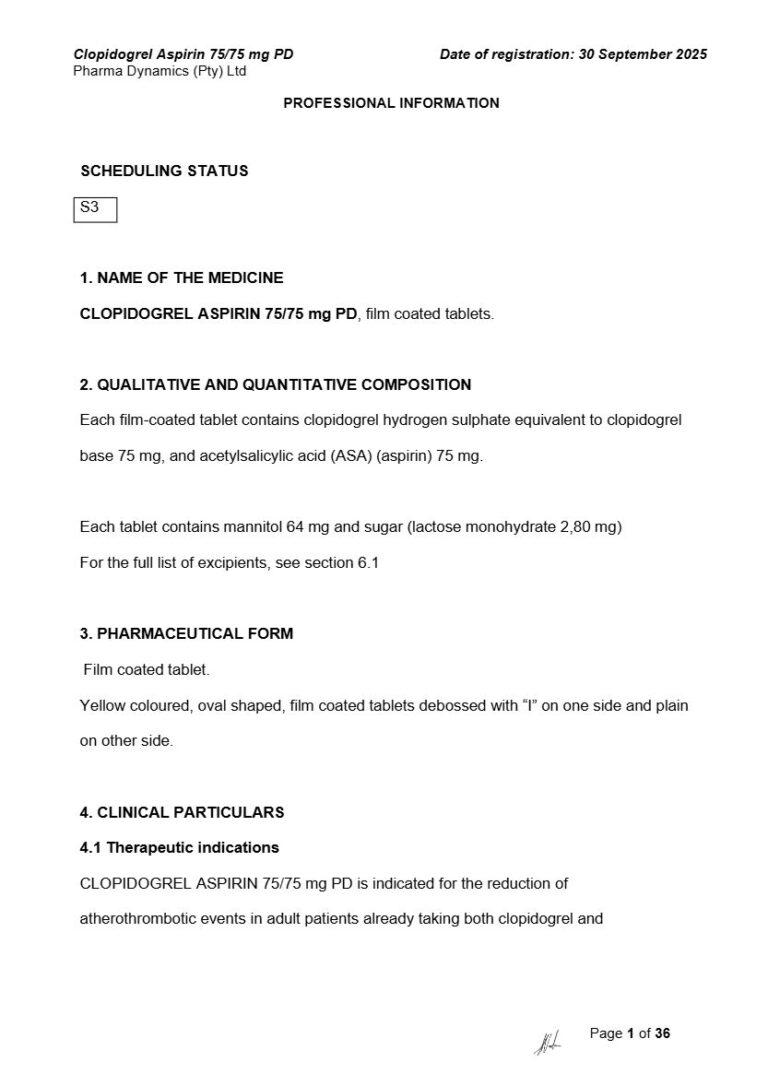
CLOPIDOGREL ASPIRIN 75/75 mg PD is indicated for the reduction of atherothrombotic events in adult patients already taking both clopidogrel and acetylsalicylic acid (ASA). CLOPIDOGREL ASPIRIN 75/75 mg PD is a fixed - dose combination product for continuation of therapy in:
- Acute Coronary Syndrome: For patients with non-ST-segment elevation acute coronary syndrome (unstable angina/non-Q-wave myocardial infarction [MI]) including patients who are to be managed medically and those who are to be managed with percutaneous coronary intervention (with or without stent) or CABG (coronary artery bypass graft), clopidogrel in combination with ASA has been shown to decrease the rate of a combined endpoint of cardiovascular death, myocardial infarction (MI), or stroke as well as the rate of a combined endpoint of cardiovascular death, MI, stroke, or refractory ischaemia.
- For patients with ST-segment elevation acute myocardial infarction, clopidogrel in combination with ASA has been shown to reduce the rate of death from any cause and the rate of a combined endpoint of death, re-infarction or stroke.
4.2 Posology and method of administration
Acute Coronary Syndrome: CLOPIDOGREL ASPIRIN 75/75 mg PD should be given as a single daily dose (i.e. one tablet daily). CLOPIDOGREL ASPIRIN 75/75 mg PD is used following an initial loading dose of clopidogrel in combination with ASA.
In patients with non - ST segment elevation acute coronary syndrome (unstable angina or non-Q-wave myocardial infarction): The optimal duration of treatment has not been formally established. Clinical trial data support use up to 12 months, but the maximum benefit was seen at 3 months.
In patients with ST segment elevation acute myocardial infarction: Therapy should be started as early as possible after symptoms start and continued for at least four weeks. The benefit of the combination of clopidogrel with ASA beyond four weeks has not been studied in this setting. For patients older than 75 years of age therapy should be initiated without a loading dose of clopidogrel.
Special populations
- Pharmacogenetics: CYP2C19 poor metaboliser status is associated with diminished antiplatelet response to clopidogrel. An appropriate dose regimen for this patient population has not been established in clinical outcome trials.
- Paediatric population: CLOPIDOGREL ASPIRIN 75/75 mg PD is not indicated for use in children under the age of 18 years as safety and efficacy have not been established.
Method of administration: For oral use. CLOPIDOGREL ASPIRIN 75/75 mg PD may be given with or without food.
Missed dose: Medical practitioners should advise patients who forget to take CLOPIDOGREL ASPIRIN 75/75 mg PD to take a dose as soon as possible and then continue with the normal dose. Patients should not take a double dose to compensate for the missed dose.
4.3 Contraindications
Due to the presence of clopidogrel and acetylsalicylic acid (aspirin) in the medicine, CLOPIDOGREL ASPIRIN 75/75 mg PD is contraindicated in case of:
- hypersensitivity to clopidogrel, acetylsalicylic acid or to any of the ingredients of CLOPIDOGREL ASPIRIN 75/75 mg PD (see section 6.1)
- active or history of pathological bleeding such as recurrent peptic ulcer/haemorrhage/perforations or intracranial haemorrhage
- safety and efficacy in children below the age of 18 have not been established. ASA has been implicated in Reyeu2019s syndrome, a rare but serious illness in children and teenagers with chickenpox and influenza. A medical practitioner should be consulted before aspirin is used in these patients
- safety and efficacy in pregnancy and lactation have not been established (see section 4.6)
- severe hepatic impairment
- thrombocytopenia and platelet dysfunction.
In addition, due to the presence of ASA, CLOPIDOGREL ASPIRIN 75/75 mg PD is also contraindicated in:
- patients with hypersensitivity (allergy) to non-steroidal anti-inflammatory drugs (NSAIDs) and syndrome of asthma, rhinitis, and nasal polyps. Patients with pre - existing mastocytosis, in whom the use of acetylsalicylic acid may induce severe hypersensitivity reactions (including circulatory shock with flushing, hypotension, tachycardia and vomiting)
- patients with severe renal impairment
- patients with heart failure
- patients with a history of gastrointestinal bleeding, ulceration or perforation (PUBs) related to previous NSAIDs
- pregnancy and lactation (see section 4.6).
4.4 Special warnings and precautions for use
THROMBOTIC THROMBOCYTOPENIC PURPURA (TTP) HAS BEEN REPORTED TO OCCUR WITH CLOPIDOGREL ASPIRIN 75/75 mg PD DURING POST- MARKETING EXPERIENCE. MOST CASES WERE REPORTED IN THE FIRST TWO WEEKS OF TREATMENT. PRESCRIBERS SHOULD ALSO WARN PATIENTS ABOUT THE SIGNS AND SYMPTOMS OF THROMBOTIC THROMBOCYTOPENIC PURPURA. IT IS CHARACTERISED BY THROMBOCYTOPENIA AND MICROANGIOPATHIC HAEMOLYTIC ANAEMIA ASSOCIATED WITH EITHER NEUROLOGICAL FINDINGS, RENAL DYSFUNCTION OR FEVER. TTP IS A POTENTIALLY FATAL CONDITION REQUIRING PROMPT TREATMENT, INCLUDING PLASMAPHERESIS (PLASMA EXCHANGE).
Recent transient ischaemic attack or stroke: In patients with recent transient ischaemic attack or stroke who are at high risk of recurrent ischaemic events, the combination of aspirin and clopidogrel has been shown to increase major bleeding.
Acquired haemophilia: Following use of clopidogrel, acquired haemophilia has been reported. In cases of confirmed isolated activated Partial Thromboplastin Time (aPTT) prolongation with or without bleeding, acquired haemophilia should be considered. Patients with a confirmed diagnosis of acquired haemophilia should be managed and treated by specialists, and CLOPIDOGREL ASPIRIN 75/75 mg PD should be discontinued.
Fluid retention and oedema: In view of the inherent potential of NSAIDs, including ASA, to cause fluid retention, heart failure may be precipitated in some compromised patients. As fluid retention and oedema have been reported in association with CLOPIDOGREL ASPIRIN 75/75 mg PD therapy, caution is required in patients with a history of hypertension and/or heart failure.
Elderly: The elderly have an increased frequency of adverse reactions to NSAIDs, especially gastrointestinal bleeding, ulceration and perforation (PUBs) which may be fatal.
Due to the presence of ASA caution is required in the following:
- patients with a history of asthma or allergic disorders since they are at increased risk of hypersensitivity reactions
- patients with gout since low doses of ASA increase serum uric acid concentrations
- children: as there is an association between ASA and Reyeu2019s syndrome (a very rare disease which can be fatal) when ASA is given to children
- alcohol may increase the risk of gastrointestinal injury when taken with ASA. Alcohol should therefore be used with caution in patients taking CLOPIDOGREL ASPIRIN 75/75 mg PD (see section 4.5). Patients should be counselled about the bleeding risks involved with chronic, heavy alcohol use while taking CLOPIDOGREL ASPIRIN 75/75 mg PD
- in patients with glucose-6-phosphate dehydrogenase (G6PD) deficiency, CLOPIDOGREL ASPIRIN 75/75 mg PD must be administered under close medical supervision due to the risk of haemolysis (see section 4.8)
- concomitant treatment with levothyroxine and salicylates, specifically at doses greater than 2,0 g/day, should be avoided (see section 4.5).
Bleeding and haematological disorders: CLOPIDOGREL ASPIRIN 75/75 mg PD produces irreversible inhibition of platelet aggregation for the life of the platelet, which is 7-10 days. Due to the risk of bleeding and haematological undesirable effects, blood cell count determination and/or other appropriate testing should be promptly considered whenever such suspected clinical symptoms arise during the course of treatment (see section 4.8). As there is a risk of bleeding intensity, concomitant administration of CLOPIDOGREL ASPIRIN 75/75 mg PD with warfarin is not recommended (see section 4.5).
Caution is required when administering CLOPIDOGREL ASPIRIN 75/75 mg PD to patients who may be at risk of increased bleeding from trauma, surgery or other pathological conditions associated with bleeding diathesis as well as in patients receiving treatment with other non-steroidal anti-inflammatory medicines including Cox-2 inhibitors, heparin, glycoprotein IIb/IIIa inhibitors, selective serotonin reuptake inhibitors (SSRIs), or CYP2C19 strong inducers, or thrombolytics (see section 4.5). Patients should be monitored continuously and carefully for any signs of bleeding (including occult bleeding) especially but not limited to during the first weeks of treatment and/or after invasive cardiac procedures or surgery.
CLOPIDOGREL ASPIRIN 75/75 mg PD should be discontinued 7 days prior to surgery in those patients who are to undergo elective surgery where an antiplatelet effect is not desired.
The concomitant administration of CLOPIDOGREL ASPIRIN 75/75 mg PD with oral anticoagulants is not recommended since it may increase the intensity of bleeding (see section 4.5). CLOPIDOGREL ASPIRIN 75/75 mg PD prolongs bleeding time and should therefore be used with caution in patients who have lesions with a propensity to bleed (particularly gastrointestinal and intra-ocular). Spinal and epidural anaesthesia should not be administered to a patient taking CLOPIDOGREL ASPIRIN 75/75 mg PD or for 7 days thereafter. No lumbar puncture should be done during these 7 days due to risk of haematoma formation following lumbar puncture or spinal and epidural anaesthesia.
Patients should be told that it may take longer than usual to stop bleeding whilst on CLOPIDOGREL ASPIRIN 75/75 mg PD therapy, and that they should report any unusual bleeding (site or duration) to their medical practitioner. Patients should inform medical practitioners and dentists that they are taking CLOPIDOGREL ASPIRIN 75/75 mg PD before any surgery is scheduled and before any new medicine is taken.
Gastrointestinal: In patients with a history of gastrointestinal disease (e.g. ulcerative colitis, Crohnu2019s disease, hiatus hernia, gastro-oesophageal reflux disease, angiodysplasia), peptic ulcer, gastroduodenal haemorrhage or minor upper gastrointestinal symptoms, CLOPIDOGREL ASPIRIN 75/75 mg PD should be used with caution as the condition may be exacerbated or may be due to gastric ulceration which in turn may lead to gastric bleeding. In patients with a history of ulcers, and the elderly the risk of gastrointestinal bleeding, ulceration or perforation (PUBs) is higher with increasing doses of CLOPIDOGREL ASPIRIN 75/75 mg PD. Should gastrointestinal bleeding, perforation or ulceration occur in patients receiving CLOPIDOGREL ASPIRIN 75/75 mg PD, therapy should be stopped.
Gastrointestinal side effects including stomach pain, heartburn, nausea, vomiting, and GI bleeding may occur. Although minor upper GI symptoms (such as dyspepsia) are common and can occur anytime during therapy, medical practitioners should remain alert for signs of ulceration and bleeding, even in the absence of previous GI symptoms. Patients should be told about signs and symptoms of GI side effects and what steps to take if they occur.
In patients concomitantly receiving nicorandil and NSAIDs including acetylsalicylic acid (ASA) and lysine acetylsalicylate (LAS), there is an increased risk for severe complications such as gastrointestinal ulceration, perforation and haemorrhage (see section 4.5).
Skin reactions: Serious skin reactions, some of them fatal, including exfoliative dermatitis, Stevens- Johnson syndrome, and toxic epidermal necrolysis have been reported. CLOPIDOGREL ASPIRIN 75/75 mg PD should be discontinued at the first appearance of skin rash, mucosal lesions, or any other sign of hypersensitivity.
Cytochrome P450 2C19 (CYP2C19): Pharmacogenetics: In patients who are poor CYP2C19 metabolisers, clopidogrel at recommended doses forms less of the active metabolite of clopidogrel and has a smaller effect on platelet function. Poor metabolisers with acute coronary syndrome or undergoing percutaneous coronary intervention treated with clopidogrel at recommended doses may exhibit higher cardiovascular event rates than do patients with normal CYP2C19 function. Tests are available to identify a patientu2019s CYP2C19 genotype; these tests can be used as an aid in determining therapeutic strategy (see section 5.2: Pharmacogenetics and section 4.2).
Use of medicines that induce the activity of CYP2C19 would be expected to result in increased medicine levels of the active metabolite of clopidogrel and might potentiate the bleeding risk. As a precaution, concomitant use of strong CYP2C19 inducers should be discouraged (see section 4.5).
CYP2C8 substrates: Caution is required in patients treated concomitantly with clopidogrel and CYP2C8 substrate medicinal products (see section 4.5).
Cross - reactivity among thienopyridines: As cross-reactivity among thienopyridines has been reported, patients should be evaluated for history of hypersensitivity to another thienopyridine (such as ticlopidine, prasugrel) (see section 4.8). Thienopyridines may cause mild to severe allergic reactions such as rash, angioedema, or haematological reactions such as thrombocytopenia and neutropenia. Patients who had developed a previous allergic reaction and/or haematological reaction to one thienopyridine may have an increased risk of developing the same or another reaction to another thienopyridine. Monitoring for cross-reactivity is advised.
Hepatic impairment: CLOPIDOGREL ASPIRIN 75/75 mg PD is contraindicated in patients with severe hepatic impairment (see section 4.3). Caution is advised in patients with mild and moderate hepatic impairment. Therapeutic experience is limited in patients with moderate hepatic disease who may have bleeding diatheses. Therefore CLOPIDOGREL ASPIRIN 75/75 mg PD should be used with caution in this population.
Renal impairment: CLOPIDOGREL ASPIRIN 75/75 mg PD is contraindicated in patients with severe renal impairment (see section 4.3). Therapeutic experience with CLOPIDOGREL ASPIRIN 75/75 mg PD is limited in patients with mild to moderate renal impairment. CLOPIDOGREL ASPIRIN 75/75 mg PD should therefore be used with caution in this population.
Excipients with known effect: CLOPIDOGREL ASPIRIN 75/75 mg PD contains lactose. Patients with the rare hereditary conditions of galactose intolerance, total lactase deficiency or glucose- galactose malabsorption should not take CLOPIDOGREL ASPIRIN 75/75 mg PD. CLOPIDOGREL ASPIRIN 75/75 mg PD contains hydrogenated castor oil which may cause stomach upset and diarrhoea.
4.5 Interaction with other medicines and other forms of interaction
There are no studies on the concomitant use of clopidogrel and acetylsalicylic acid with other medicines. The information below was obtained with clopidogrel or ASA alone. Safety of CLOPIDOGREL ASPIRIN 75/75 mg PD and the concomitant use with the medicines mentioned below have not been established.
Medicines associated with bleeding risk: There is an increased risk of bleeding due to the potential additive effect. The concomitant administration of medicines associated with bleeding risk should be undertaken with caution (see section 4.4).
Nicorandil: In patients concomitantly receiving nicorandil and NSAIDs including acetylsalicylic acid (ASA) and lysine acetylsalicylate (LAS), there is an increased risk for severe complications such as gastrointestinal ulceration, perforation and haemorrhage (see section 4.4).
Injectable anticoagulants: In healthy subjects, clopidogrel did not necessitate modification of the heparin dose or alter the effect of heparin on coagulation. Co-administration of heparin had no effect on the inhibition of platelet aggregation induced by clopidogrel, however, as a pharmacodynamic interaction between CLOPIDOGREL ASPIRIN 75/75 mg PD and heparin is possible, concomitant use should be undertaken with caution.
Thrombolytics: The safety of the concomitant administration of clopidogrel, fibrin or non - fibrin specific thrombolytic agents and heparins was assessed in patients with acute myocardial infarction with the incidence of clinically significant bleeding being similar to that as observed when thrombolytic medicines and heparins are co-administered with acetylsalicylic acid. However, the concomitant use of CLOPIDOGREL ASPIRIN 75/75 mg PD with thrombolytic medicines should be undertaken with caution.
Oral anticoagulants: Concomitant administration of warfarin with CLOPIDOGREL ASPIRIN 75/75 mg PD is not recommended due to the increased risk of bleeding (see section 4.4).
Glycoprotein IIb/IIIa inhibitors: CLOPIDOGREL ASPIRIN 75/75 mg PD should be used with caution in patients who may be at risk of increased bleeding from trauma, surgery or other pathological conditions and who receive concomitant glycoprotein IIb/IIIa inhibitors.
Non - Steroidal Anti - Inflammatory Drugs (NSAIDs): In healthy volunteers, the concomitant administration of clopidogrel and naproxen increased occult gastrointestinal blood loss. Consequently, the concomitant use of NSAIDs, including Cox-2 inhibitors, is not recommended with CLOPIDOGREL ASPIRIN 75/75 mg PD (see section 4.4). When they are dosed concomitantly, experimental data suggests that ibuprofen may inhibit the effect of low dose aspirin on platelet aggregation (see section 5.1). However, the limitations of these data and the uncertainties regarding extrapolation of ex vivo data to the clinical situation imply that no firm conclusions can be made for regular ibuprofen use, and no clinically relevant effect is considered to be likely for occasional ibuprofen use.
Selective Serotonin Reuptake Inhibitors (SSRIs): The concomitant administration of SSRIs with clopidogrel should be undertaken with caution as SSRIs affect platelet activation and increase the risk of bleeding.
Other concomitant therapy with clopidogrel: Inducers of CYP2C19: Since clopidogrel is metabolised to its active metabolite partly by CYP2C19, use of medicines that induce the activity of this enzyme would be expected to result in increased medicine levels of the active metabolite of clopidogrel. Rifampicin strongly induces CYP2C19, resulting in both an increased level of clopidogrel active metabolite and platelet inhibition, which in particular might potentiate the risk of bleeding. As a precaution, concomitant use of strong CYP2C19 inducers should be discouraged (see section 4.4).
Inhibitors of CYP2C19: Since clopidogrel is metabolised to its active metabolite partly by CYP2C19, use of medicine that inhibit the activity of this enzyme would be expected to result in reduced medicine levels of the active metabolite of clopidogrel and a reduction in clinical efficacy. Concomitant use of strong or moderate CYP2C19 inhibitors (e.g., omeprazole and esomeprazole) should be discouraged (see section 4.4 and section 5.2, Pharmacogenetics). If a proton pump inhibitor is to be used concomitantly with CLOPIDOGREL ASPIRIN 75/75 mg PD, consider using one with less CYP2C19 inhibitory activity.
Other medicinal products: No clinically significant pharmacodynamic interactions were observed when clopidogrel was co-administered with atenolol, nifedipine, or both atenolol and nifedipine. The pharmacodynamic activity of clopidogrel was not significantly influenced by the co- administration of phenobarbital or estrogen. The pharmacokinetics of digoxin or theophylline were not modified by the co- administration of clopidogrel. Antacids did not modify the extent of clopidogrel absorption. Data from studies with human liver microsomes indicated that clopidogrel could inhibit the activity of one of the Cytochrome P450 (CYP) enzymes (CYP2C9). This could potentially lead to increased plasma levels of medicines such as phenytoin, tolbutamide, torsemide, tamoxifen, fluvastatin and NSAIDs which are metabolised by CYP2C9. Data indicate that phenytoin and tolbutamide can be safely co-administered with clopidogrel.
CYP2C8 substrate medicines: Clopidogrel has been shown to increase repaglinide exposure in healthy volunteers. In vitro studies have shown the increase in repaglinide exposure is due to inhibition of CYP2C8 by the glucuronide metabolite of clopidogrel. Due to the risk of increased plasma concentrations, concomitant administration of clopidogrel and medicines primarily cleared by CYP2C8 metabolism (e.g. repaglinide, paclitaxel) should be undertaken with caution.
Rosuvastatin: Clopidogrel has been shown to increase rosuvastatin exposure in patients by 1.4-fold (AUC) without effect on C max, after repeated administration of a 75 mg clopidogrel dose.
Other concomitant therapy with ASA: Interactions with the following medicinal products have been reported with ASA: Uricosurics: Caution is required because ASA may inhibit the effect of uricosuric agents through competitive elimination of uric acid. Methotrexate: Due to the presence of ASA, methotrexate used at doses higher than 20 mg/week should be used with caution with CLOPIDOGREL ASPIRIN 75/75 mg PD as it can inhibit renal clearance of methotrexate, which may lead to bone marrow toxicity. Metamizole: Metamizole may reduce the effect of ASA on platelet aggregation when taken concomitantly. Therefore, this combination should be used with caution in patients taking low-dose ASA for cardio-protection. NSAIDs: Use of two or more NSAIDs concomitantly could result in an increase in side effects. Corticosteroids: Increased risk of gastrointestinal perforation, ulceration or bleeding (PUBs). Selective serotonin reuptake inhibitors (SSRIs): Increased risk of gastrointestinal bleeding. Acetazolamide: Due to the increased risk of metabolic acidosis, caution is recommended when co - administering salicylates with acetazolamide. Varicella vaccine: Cases of Reyeu2019s syndrome have occurred following the use of salicylates during varicella infections. It is therefore recommended that patients not be given salicylates for an interval of six weeks after receiving the varicella vaccine. (see section 4.4). Levothyroxine: Thyroid hormone levels should be monitored as salicylates, specifically at doses greater than 2,0 g/day, may inhibit binding of thyroid hormones to carrier proteins and thereby lead to an initial transient increase in free thyroid hormones, followed by an overall decrease in total thyroid hormone levels. Valproic acid: The concomitant administration of salicylates and valproic acid may result in decreased valproic acid protein binding and inhibition of valproic acid metabolism resulting in increased serum levels of total and free valproic acid. Tenofovir: Concomitant administration of tenofovir disoproxil fumarate and NSAIDs may increase the risk of renal failure.
4.6 Fertility, pregnancy and lactation
Pregnancy: CLOPIDOGREL ASPIRIN 75/75 mg PD is contraindicated during pregnancy (see section 4.3).
Breastfeeding: Studies in rats have shown that clopidogrel and/or its metabolites are excreted in the milk. It is not known whether clopidogrel is excreted in human breast milk. ASA is known to be excreted in human breast milk. CLOPIDOGREL ASPIRIN 75/75 mg PD is contraindicated whilst breastfeeding (see section 4.3).
Fertility: There are no fertility data with clopidogrel/acetylsalicylic acid.
4.7 Effects on ability to drive and use machines
CLOPIDOGREL ASPIRIN 75/75 mg PD has no or negligible influence on the ability to drive and use machines.
4.8 Undesirable effects
Summary of the safety profile: Bleeding is the most common reaction reported both in clinical studies where frequencies varied from common to very common, as well as in post-marketing experience.
Tabulated summary of adverse reactions
CLOPIDOGREL ASPIRIN 75/75 mg PD
| System Organ Class | Frequency | Side effects |
|---|---|---|
| Blood and lymphatic system disorders | Less frequent | Thrombocytopenia (sometimes severe), increased bleeding time, leucopenia, eosinophilia, neutropenia (sometimes severe), platelets decreased, aplastic anaemia |
| Blood and lymphatic system disorders | Frequency unknown | Bleeding* |
| Nervous system disorders | Less frequent | Intracranial bleeding, headache, dizziness, paraesthesia |
| Eye disorders | Less frequent | Eye bleeding (mainly conjunctival), ocular, retinal |
| Ear and labyrinth disorders | Less frequent | Vertigo |
| Vascular disorders | Frequent | Haematoma |
| Respiratory, thoracic and mediastinal disorders | Frequent | Epistaxis |
| Gastrointestinal disorders | Frequent | Dyspepsia, abdominal pain, diarrhoea, gastrointestinal haemorrhage |
| Gastrointestinal disorders | Less frequent | Nausea, gastritis, flatulence, constipation, vomiting, gastric ulcer, duodenal ulcer |
| Skin and subcutaneous tissue disorders | Frequent | Bruising |
| Skin and subcutaneous tissue disorders | Less frequent | Rash, pruritus, purpura |
| Renal and urinary disorders | Less frequent | Haematuria |
| General disorders and administrative site conditions | Frequent | Bleeding at the puncture site |
*Post marketing events.
Tabulated summary of adverse reactions Clopidogrel
| System Organ Class | Frequency | Side effects |
|---|---|---|
| Blood and lymphatic system disorders | Frequency unknown | Serious cases of bleeding, mainly skin, musculoskeletal (haemarthrosis), eye (conjunctival, ocular, retinal) and respiratory tract bleeding (haemoptysis, pulmonary haemorrhage), epistaxis, haematuria and haemorrhage of operative wound; cases of bleeding with fatal outcome (especially intracranial, gastrointestinal and retroperitoneal haemorrhage), acquired haemophilia A, serious haemorrhage in patients taking CLOPIDOGREL ASPIRIN 75/75 mg PD with or without heparin, thrombotic thrombocytopenic purpura (TTP), aplastic anaemia/pancytopenia, agranulocytosis, severe thrombocytopenia, granulocytopenia, anaemia |
| Immune system disorders | Frequency unknown | Anaphylactoid reactions, serum sickness, cross-reactive medicine hypersensitivity among thienopyridines, such as ticlopidine or prasugrel, insulin autoimmune syndrome, which can lead to severe hypoglycaemia, particularly in patients with HLA DRA4 subtype (more frequent in the Japanese population) |
| Cardiac disorders | Frequency unknown | Kounis syndrome (vasospastic allergic angina/allergic myocardial infarction) in the context of a hypersensitivity reaction due to clopidogrel |
| Psychiatric disorders | Frequency unknown | Confusion, hallucinations |
| Nervous system disorders | Frequency unknown | Taste disturbances, ageusia |
| Vascular disorders | Frequency unknown | Vasculitis, hypotension |
| Respiratory, thoracic and mediastinal disorders | Frequency unknown | Bronchospasm, interstitial pneumonitis, eosinophilic pneumonia |
| Gastrointestinal disorders | Frequency unknown | Colitis (including ulcerative or lymphocytic colitis), stomatitis, pancreatitis |
| Hepatobiliary disorders | Frequency unknown | Acute liver failure, hepatitis, abnormal liver function test |
| Skin and subcutaneous tissue disorders | Frequency unknown | Maculopapular, erythematous or exfoliative rash; urticaria; pruritus; angioedema; bullous dermatitis (erythema multiforme, Stevens-Johnson syndrome, toxic epidermal necrolysis, acute generalised exanthematous pustulosis (AGEP)); drug-induced hypersensitivity syndrome (DiHS), drug rash with eosinophilia and systemic symptoms (DRESS), eczema; lichen planus |
| Musculoskeletal, connective tissue and bone disorders | Frequency unknown | Arthritis, arthralgia, myalgia |
| Renal and urinary disorders | Frequency unknown | Glomerulonephritis, increased blood creatinine |
| Reproductive system and breast disorders | Frequency unknown | Gynaecomastia |
| General disorders and administrative site conditions | Frequency unknown | Fever |
4.9 Overdose
Signs and symptoms: There is no information concerning overdosage with CLOPIDOGREL ASPIRIN 75/75 mg PD - the fixed-dose combination tablets, however due to the pharmacological activity of both clopidogrel and ASA individually, overdose may be associated with increased bleeding and subsequent bleeding complications.
Symptoms of the individual active ingredients are as follows:
Clopidogrel: Overdose following clopidogrel administration may lead to prolonged bleeding time and subsequent bleeding complications.
Acetylsalicylic acid (ASA): Moderate overdose: dizziness, ringing in the ears, sensation of reduced hearing, headaches, vertigo and gastrointestinal symptoms (nausea, vomiting and gastric pain). Severe overdose: fever, hyperventilation, ketosis, respiratory alkalosis, metabolic acidosis, coma, cardiovascular collapse, respiratory failure, severe hypoglycaemia, hyperthermia and perspiration, leading to dehydration. Non-cardiogenic pulmonary oedema can occur with acute and chronic acetylsalicylic acid overdose (see section 4.8).
Management of overdose:
Clopidogrel: Appropriate therapy should be considered if bleedings are observed. No antidote to the pharmacological activity of clopidogrel has been found. If prompt correction of prolonged bleeding time is required, platelet transfusion may reverse the effects of clopidogrel. Further treatment is symptomatic and supportive.
Acetylsalicylic acid (ASA): If a toxic dose has been ingested, admission to hospital is necessary. With moderate intoxication an attempt can be made to induce vomiting. Activated charcoal (adsorbent) and sodium sulphate (laxative) are then administered. Alkalising of the urine (250 mmol sodium bicarbonate for 3 hours) while monitoring the urine pH is indicated. Haemodialysis is the preferred treatment for severe intoxication. Treat other signs of intoxication symptomatically.
