
Cuatro Capsules
PDF Leaflet Revision Date: 09 September 2025
Clinical Summary
Quick overview from the medicine insert
Indication
Treatment of HIV-1 infection in children aged u2265 3 months and weighing 3 to 19.9 kg.
Dosage (summary)
Administered twice daily with food based on weight bands.
Special Populations
- Hepatic impairment
- Renal impairment
Pregnancy & Breastfeeding
Contraindicated in pregnancy and breastfeeding due to potential risks.
Key Drug Interactions
- Rifampicin
- St. John's Wort
- CYP3A4 inhibitors
Contraindications
- Hypersensitivity to components
- Moderate to severe hepatic impairment
Common side effects
- Nausea
- Vomiting
- Diarrhoea
- Rash
- Fatigue
Counselling Points
- Screen for HLA-B*5701 allele before use
- Never restart after hypersensitivity
- Monitor for symptoms of lactic acidosis
Serious warnings
- Hypersensitivity reactions
- Lactic acidosis
- Severe hepatomegaly
Important Disclaimer
The Cuatro Capsules professional information leaflet below is the property of Cipla Medpro Manufacturing and is provided on Medinsert exactly as issued, with no.. alterations or editorial changes. We make every effort to keep content current by updating documents as soon as new versions become available. Medinsert serves as a trusted access point for healthcare professionals, but does not replace official sources or clinical judgement. For more details, please read our full disclaimer. read more>>
 Healthcare Professionals Only
This content is for registered healthcare professionals
Sign in or create a free account to read the full package insert.
Free for HPCSA-registered professionals. Powered by Medinsert.
Clinical Particulars
Section 4 of the official insert — extracted exactly as issued, no alterations
4.1. Therapeutic indications
CUATRO is a fixed dose combination medicine containing two nucleoside analogues (abacavir and lamivudine) and two protease inhibitors (lopinavir and ritonavir), indicated for the treatment of HIV-1 infection in children aged u2265 3 months, weighing u2265 3 to u2264 19,9 kg (WHO weight band 1 (WB1), WB 2, WB 3 and WB 4), and stabilised on concomitant use of the actives as separate formulations before switching to the fixed dose combination if similar doses of the actives can be achieved with CUATRO.
4.2. Posology and method of administration
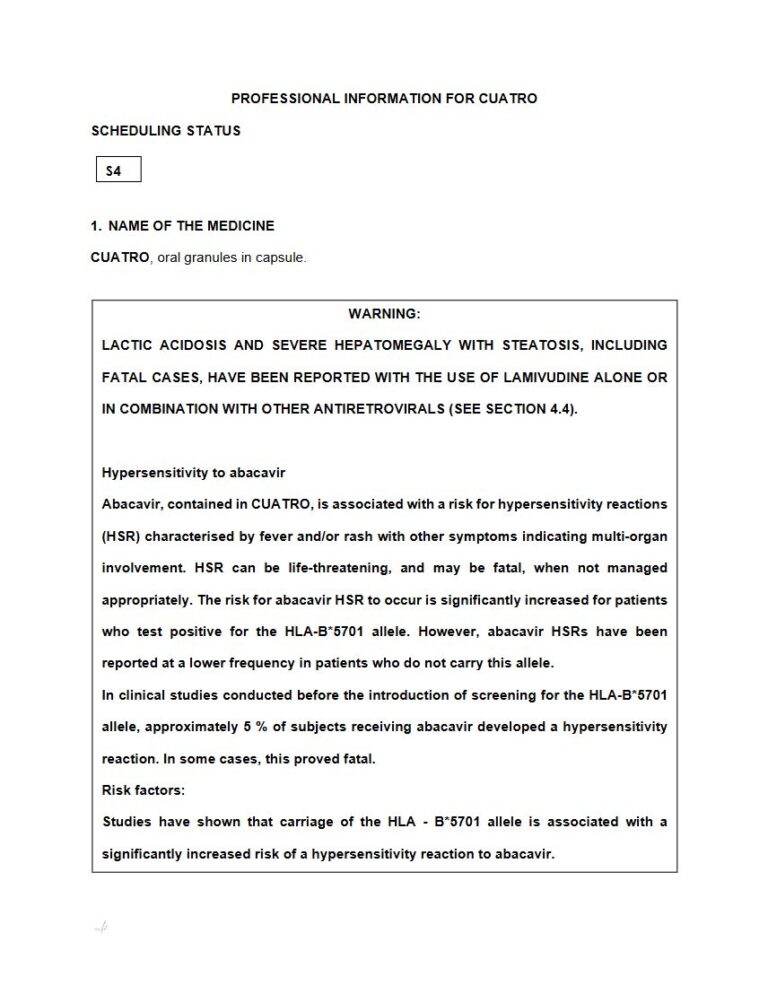
Patients should be screened for the HLA-B*5701 allele prior to initiating therapy with CUATRO (see boxed warning).
Posology:
Table 1: CUATRO should be administered twice daily with food according to weight band as follows:
- Weight (in kg) Number of capsules to be administered
- In the morning
- In the evening
- 3,0 to 5,9 2 2
- 6,0 to 9,9 3 3
- 10, 0 to 13,9 4 4
- 14,0 to 19,9 5 5
CUATRO should not be administered to neonates before a postmenstrual age (first day of the motheru2019s last menstrual period to birth plus the time elapsed after birth) of 42 weeks and a postnatal age of at least 14 days has been attained.
Dose adjustment: In case of concomitant therapy with efavirenz or nevirapine, a dose increase of lopinavir and ritonavir may be required. However, precise dose titration will not be possible with CUATRO. Thus, it is recommended that other formulation of individual components be used in this situation.
Method of administration:
Caution: Capsules should not be swallowed whole. Contents of CUATRO capsules should be administered with age-appropriate soft food/liquid, as described below.
Method of administration with milk/drinking water:
- Obtain the prescribed number of capsules needed for a dose.
- Dose the required number of capsules one by one.
- Hold one capsule vertically with the brown cap at the top and white body at the bottom and then gently tap on top of the capsule. Open the capsule by gently twisting and pulling up the cap.
- Pour the contents of capsule into a spoon.
- Add milk/drinking water to the spoon till the spoon fills and feed to the child immediately.
- Repeat this step for the prescribed number of capsules. Additional milk/drinking water can be taken after each dose if required.
Method of administration with soft food (e.g. porridge or mashed fruit):
- Prepare porridge/ fruit and cool to room temperature.
- Obtain the prescribed number of capsules needed for a dose.
- Dose the required number of capsules one by one.
- Take a small amount of porridge or fruit on the spoon.
- Hold one capsule vertically with the brown cap at the top and white body at the bottom and then gently tap on top of the capsule. Open the capsule by gently twisting and pulling up the cap.
- Pour the contents of capsule on the spoon containing porridge / fruit and feed to the child immediately. The porridge/ fruit with the drug sprinkled on top should be swallowed immediately and should not be stored for future use.
- Repeat this step for the prescribed number of capsules.
- Administration of the required dose should be followed by more food or drinking water/ milk, to ensure that no granules remain in the mouth.
4.3. Contraindications
CUATRO is contraindicated in:
- Patients with previously demonstrated clinically significant hypersensitivity (e.g., toxic epidermal necrolysis, Stevens-Johnson syndrome, erythema multiforme, urticaria, angioedema) to abacavir, lamivudine, lopinavir, ritonavir or any of the ingredients of CUATRO listed on section 6.1.
- Patients with moderate (Child-Pugh class B) or severe hepatic impairment (Child-Pugh class C) (see section 4.4).
- Combination with medicines that are highly dependent on CYP3A for clearance and for which elevated plasma concentrations are associated with serious and/or life-threatening reactions (see sections 4.5 and 5.2).
- Combination with medicines that are potent CYP3A inducers where significantly reduced lopinavir plasma concentrations may be associated with the potential for loss of virologic response and possible resistance and cross-resistance (see sections 4.5 and 5.2).
- Pregnancy and lactation (see section 4.6).
4.4. Special warnings and precautions for use
Hypersensitivity to abacavir: Refer to section boxed warning included under section 1 and side effects described in section 4.8. Some patients with the HLA-B*5701 allele developed abacavir-associated hypersensitivity reactions, which were fatal in some cases. Hypersensitivity is characterised by the appearance of symptoms indicating multi-organ/body-system involvement. Patients who develop a hypersensitivity reaction must discontinue CUATRO and must not be rechallenged with CUATRO, or any other product containing abacavir.
Medicine interactions:
Anti-mycobaterials: Rifampicin: CUATRO should not be co-administered with rifampicin because large decreases in lopinavir concentrations may significantly decrease the therapeutic effect (see section 4.5).
Bedaquiline: co-administration of bedaquiline with strong CYP3A4 inhibitors (e.g.: Lopinavir and ritonavir contained in CUATRO) may increase the systemic exposure of bedaquiline, which could potentially increase the risk of bedaquiline-related adverse reactions (see section 4.5). Bedaquiline must be used cautiously with CUATRO, only if the benefit of co-administration outweighs the risk.
Delamanid: co-administration of delamanid with a strong inhibitor of CYP3A4 (lopinavir/ritonavir contained in CUATRO) may slightly increase exposure to delamanid metabolite, which has been associated with QTc prolongation. Therefore, if co-administration of delamanid with CUATRO is considered necessary, frequent ECG monitoring throughout the full delamanid treatment period is recommended (see section 4.5).
Corticosteroids: Concomitant use of lopinavir/ritonavir as contained in CUATRO and inhaled, injectable, or intranasal fluticasone, budesonide, triamcinolone, or other glucocorticoids that are metabolised by CYP3A4 is not recommended unless the potential benefit of treatment outweighs the risk of systemic corticosteroid effects, including Cushingu2019s syndrome and adrenal suppression.
PDE5 inhibitors: Co-administration of CUATRO with avanafil is not recommended. Particular caution should be used when prescribing sildenafil, tadalafil or vardenafil for the treatment of erectile dysfunction in patients receiving CUATRO. Co-administration of CUATRO with these medicines is expected to substantially increase their concentrations and may result in increased associated adverse events such as hypotension, and prolonged erection.
Lactic acidosis / hyperlactataemia: Long-term use of CUATRO can result in potentially fatal lactic acidosis because of mitochondrial dysfunction. Symptomatic hyperlactataemia and lactic acidosis are not frequent. Clinical features are non-specific, and include nausea, vomiting, abdominal pain, dyspnoea and tachypnoea, fatigue and weight loss.
Diagnosis of lactic acidosis is confirmed by demonstrating metabolic acidosis with an increased anion gap and raised serum lactate level. Antiretroviral therapy should be stopped in any patient with a raised serum lactate level.
4.5. Interactions with other medicines
Based on the results of in vitro experiments and the known major metabolic pathways of abacavir, the potential for medicine interactions involving abacavir is low. Abacavir shows no potential to inhibit metabolism mediated by the cytochrome P450 3A4 enzyme. It has also been shown in vitro not to interact with medicines that are metabolised by CYP3A4, CYP2C9 or CYP2D6 enzymes.
Lopinavir/ritonavir is a potent inhibitor of CYP3A (cytochrome P450 3A) both in vitro and in vivo. Co-administration of CUATRO and medicines primarily metabolised by CYP3A (e.g. dihydropyridine calcium channel blockers, HMG-CoA reductase inhibitors, immunosuppressants and PDE5 inhibitors may result in increased plasma concentrations of the other medicines that could increase or prolong their therapeutic and adverse effects.
Medicines that are contraindicated specifically due to the expected magnitude of interaction and potential for serious adverse events are listed in section 4.3.
4.6. Fertility, pregnancy and lactation
Pregnancy: CUATRO is contraindicated during pregnancy. Abacavir: Safety in human pregnancy has not been established. Abacavir should not be used during pregnancy and lactation since teratogenicity and/or foetal toxicity cannot be excluded (see section 4.3).
Breastfeeding: Studies have indicated that components of CUATRO (abacavir, lamivudine and lopinavir) are excreted in breast milk. Therefore, nursing mothers should not breastfeed their children while on CUATRO therapy.
Fertility: There are no data on fertility.
4.7. Effects on ability to drive and use machines
There are less frequent reports of visual impairment due to use of CUATRO. Patients need to be aware of how CUATRO affects them before engaging in potentially dangerous activities such as driving or operating machinery.
4.8. Undesirable effects
Summary of the safety profile: Some patients with hypersensitivity reactions were initially thought to have gastroenteritis, respiratory disease (pneumonia, bronchitis, pharyngitis) or a flu-like illness. This delay in diagnosis of hypersensitivity has resulted in abacavir being continued or re-introduced, leading to more severe hypersensitivity reactions or death. Therefore, the diagnosis of hypersensitivity reaction should be carefully considered for patients presenting with symptoms of these diseases.
Symptoms usually appeared within the first six weeks (median time to onset 11 days) of initiation of treatment with abacavir, as contained in CUATRO, although these reactions may occur at any time during therapy. Close medical supervision is necessary during the first two months, with consultations every two weeks.
Tabulated list of adverse reactions: The adverse reactions are listed by body system, organ class and absolute frequency.
4.9. Overdose
Abacavir/ lamivudine component: Symptoms and signs: In overdose, side effects can be precipitated and/or be of increased severity. No specific symptoms or signs have been identified following acute overdose with abacavir or lamivudine, apart from those listed as side effects.
Treatment: If overdose occurs the patient should be monitored for evidence of toxicity. Treatment is symptomatic and supportive. Since lamivudine is dialysable, continuous haemodialysis could be used in the treatment of overdose, although this has not been studied.
Lopinavir / ritonavir component: Treatment of overdose with lopinavir / ritonavir should consist of general supportive measures including monitoring of vital signs and observation of the clinical status of the patient. There is no specific antidote for overdose with lopinavir / ritonavir.
