
Cytagil Iv 50 mg Powder for solution for infusion.
PDF Leaflet Revision Date: 25 April 2023
Clinical Summary
Quick overview from the medicine insert
Indication
Severe life-threatening infections in adults.
Dosage (summary)
Initial 100 mg IV, then 50 mg every 12 hours.
Onset of Action / Duration
Onset: 30 mins, Duration: 5-14 days
Special Populations
- Renal impairment
- Hepatic impairment
- Elderly
Pregnancy & Breastfeeding
Not recommended during pregnancy or lactation.
Key Drug Interactions
- Warfarin
- Calcineurin inhibitors
- Oral contraceptives
Contraindications
- Hypersensitivity to tigecycline
- Pregnancy
- Lactation
Common side effects
- Nausea
- Vomiting
- Dizziness
- Pneumonia
Counselling Points
- Monitor for superinfection
- Use additional contraception
- Caution in hepatic impairment
Serious warnings
- Anaphylaxis
- Hepatic failure
- Superinfection risk
Important Disclaimer
The Cytagil Iv 50 mg Powder for solution for infusion. professional information leaflet below is the property of Pharma Dynamics and is provided on Medinsert exactly as issued, with no.. alterations or editorial changes. We make every effort to keep content current by updating documents as soon as new versions become available. Medinsert serves as a trusted access point for healthcare professionals, but does not replace official sources or clinical judgement. For more details, please read our full disclaimer. read more>>
 Healthcare Professionals Only
This content is for registered healthcare professionals
Sign in or create a free account to read the full package insert.
Free for HPCSA-registered professionals. Powered by Medinsert.
Clinical Particulars
Section 4 of the official insert — extracted exactly as issued, no alterations
4.1 Therapeutic indications
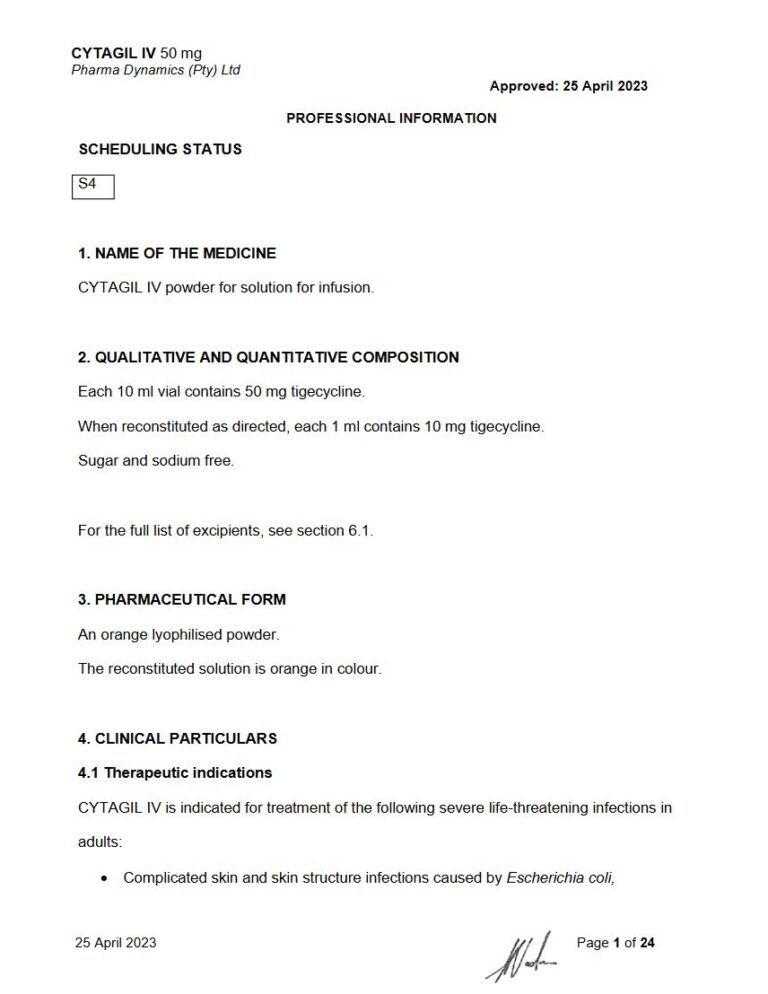
CYTAGIL IV is indicated for treatment of the following severe life-threatening infections in adults:
- Complicated skin and skin structure infections caused by Escherichia coli, Enterococcus faecalis (vancomycin-susceptible isolates only), Staphylococcus aureus (methicillin-susceptible and -resistant isolates), Streptococcus agalactiae, Streptococcus anginosus group (includes S.anginosus, S.intermedius and S. constellatus), Streptococcus pyogenes and Bacteroides fragilis.
- Complicated intra-abdominal infections caused by Citrobacter freundii, Enterobacter cloacae, Escherichia coli, Klebsiella oxytoca, Klebsiella pneumoniae, Enterococcus faecalis (vancomycin-susceptible isolates only), Staphylococcus aureus (methicillin-susceptible isolates only), Streptococcus anginosus group (includes S.anginosus, S.intermedius and S. constellatus), Bacteroides fragilis, Bacteroides thetaiotaomicron, Bacteroides uniforms, Bacteroides vulgatus, Clostridium perfringens and Peptostreptococcus micros.
4.2 Posology and method of administration
Posology
The recommended dosage regimen for CYTAGIL IV is an initial dose of 100 mg, followed by 50 mg every 12 hours. Intravenous (IV) infusions of CYTAGIL IV should be administered over approximately 30 to 60 minutes every 12 hours. The recommended duration of treatment with CYTAGIL IV for complicated skin and skin structure infections, or for complicated intra-abdominal infections is 5 to 14 days. The duration of therapy should be guided by the severity and site of the infection and the patientu2019s clinical and bacteriological progress.
Special populations
Patients with renal impairment
No dosage adjustment of CYTAGIL IV is necessary in patients with renal impairment or in patients undergoing haemodialysis (see section 5.2).
Patients with hepatic impairment
No dosage adjustment is necessary in patients with mild to moderate hepatic impairment (Child Pugh A and Child Pugh B). Based on the pharmacokinetic profile of CYTAGIL IV in patients with severe hepatic impairment (Child Pugh C), the dose of CYTAGIL IV should be altered to 100 mg followed by 25 mg every 12 hours. Patients with severe hepatic impairment (Child Pugh C) should be treated with caution and monitored for treatment response (see section 5.2).
Use in elderly
No dosage adjustment is necessary in elderly patients (see section 5.2).
Race and gender
No dosage adjustment is necessary based on race or gender (see section 5.2).
Pediatric population
Safety and effectiveness in patients under 18 years of age have not been established. Therefore, use in patients under 18 years of age is not recommended (see section 4.4).
Method of administration
Intravenous infusion. CYTAGIL IV must be reconstituted, transferred and further diluted for I.V. infusion. For instructions on reconstitution & dilution of the medicinal product before administration, see section 6.6.
4.3 Contraindications
- Hypersensitivity to tigecycline or to any of the ingredients of CYTAGIL IV (see section 6.1).
- Pregnancy and lactation (see section 4.6).
4.4 Special warnings and precautions for use
Superinfection
Use of CYTAGIL IV may result in overgrowth of non-susceptible organisms, including fungi. Patients, especially those developing impaired healing (e.g. of a surgical wound), should be carefully monitored during therapy. If superinfection occurs, appropriate measures should be taken. Patients who develop superinfections, in particular nosocomial pneumonia, appear to be associated with poorer outcomes. Patients should be closely monitored for the development of superinfection. If a focus of infection other than skin and soft tissue infection (cSSTI) or intra-abdominal infections (cIAI) is identified after initiation of CYTAGIL IV therapy consideration should be given to instituting alternative antibacterial therapy that has been demonstrated to be efficacious in the treatment of the specific type of infection(s) present.
Anaphylaxis
Anaphylaxis/anaphylactoid reactions have been reported with nearly all antibacterial medicines, including CYTAGIL IV, and may be life-threatening.
Hepatic failure
Isolated cases of significant hepatic dysfunction and hepatic failure have been reported in patients being treated with tigecycline. Although hepatic failure may occur in patients treated with CYTAGIL IV due to the underlying conditions or concomitant medicinal products, a possible contribution of CYTAGIL IV should be considered (see section 4.8).
Tetracycline class antibiotics
Glycylcycline class antibiotics are structurally similar to tetracycline class antibiotics, such as CYTAGIL IV, and may have similar side effects. Such effects may include photosensitivity, pseudotumour cerebri, and anti-anabolic action (which has led to increased blood urea nitrogen (BUN), azotaemia, acidosis, and hyperphosphataemia). Therefore CYTAGIL IV should be administered with caution in patients with known hypersensitivity to tetracycline class antibiotics.
Pancreatitis
As with tetracycline, pancreatitis has been reported with the use of CYTAGIL IV. The diagnosis of acute pancreatitis should be considered in patients taking CYTAGIL IV who develop clinical symptoms, signs, or laboratory abnormalities suggestive of acute pancreatitis. Most cases of pancreatitis develop after at least one week of treatment and can also develop without known risk factors for pancreatitis. Patients usually improve after CYTAGIL IV discontinuation. Consideration should be given to the cessation of treatment with CYTAGIL IV in patients suspected of having developed pancreatitis.
Coagulopathy
Tigecycline may prolong both prothrombin time (PT) and activated partial thromboplastin time (aPTT). Additionally, hypofibrinogenaemia has been reported with the use of tigecycline, as in CYTAGIL IV. Therefore, blood coagulation parameters such as PT or other suitable anticoagulation test, including blood fibrinogen, should be monitored prior to treatment initiation with CYTAGIL IV and regularly while on treatment. Special care is recommended in seriously ill patients and in patients also using anticoagulants (see section 4.5).
Underlying diseases
Experience in the use of tigecycline, as in CYTAGIL IV, for treatment of infections in patients with severe underlying diseases is limited. Caution is advised when treating patients with underlying conditions such as diabetes, peripheral vascular disease, intravenous substance abuse, HIV-positive infection, concurrent bacteraemia, patients with APACHE II scores > 15, surgically apparent multiple intra-abdominal abscesses and immunocompromised patients. Consideration should be given to the use of combination antibacterial therapy whenever CYTAGIL IV is to be administered to severely ill patients with cIAI secondary to clinically apparent intestinal perforation or patients with incipient sepsis or septic shock (see section 4.8). The effect of cholestasis in the pharmacokinetics of tigecycline, as in CYTAGIL IV has not been properly established. Biliary excretion accounts for approximately 50 % of the total tigecycline excretion. Therefore, patients presenting with cholestasis should be closely monitored.
Pseudomembranous colitis
Pseudomembranous colitis has been reported with the use of tigecycline, as in CYTAGIL IV. Therefore, it is important to consider this diagnosis in patients who present with diarrhoea subsequent to the administration of CYTAGIL IV.
Intra-abdominal infections
Caution should be exercised when considering CYTAGIL IV monotherapy in patients with complicated intra-abdominal infections (cIAI) secondary to clinically apparent intestinal perforation. Intestinal perforations and sepsis/septic shock have been reported in this patient group, however the relationship of this outcome to CYTAGIL IV treatment has not been established.
Hospital acquired pneumonia
The safety and efficacy of CYTAGIL IV in patients with hospital acquired pneumonia have not been established.
Tooth discolouration
CYTAGIL IV may be associated with permanent tooth discolouration during tooth development.
Abuse and dependence
Medicine abuse and dependence have not been demonstrated and are unlikely.
Elderly patients
No unexpected overall differences in safety or effectiveness have been observed between older patients (> 65 years old) and younger patients, however greater sensitivity to side effects by some elderly patients cannot be ruled out.
Pediatric population
Safety and effectiveness in patients under 18 years of age have not been established. Therefore, use of CYTAGIL IV in patients under 18 years of age is not recommended.
4.5 Interactions with other medicines
Calcineurin inhibitors
Concomitant use of CYTAGIL IV and calcineurin inhibitors such as tacrolimus or cyclosporin may lead to an increase in serum trough concentrations of the calcineurin inhibitors. Therefore, serum concentrations of the calcineurin inhibitor should be monitored during treatment with CYTAGIL IV to avoid medicine toxicity.
Warfarin
Concomitant administration of CYTAGIL IV (100 mg followed by 50 mg every 12 hours) and warfarin (25 mg single dose) to healthy subjects resulted in a decrease in clearance of R-warfarin and S-warfarin by 40 % and 23 %, and an increase in AUC by 68 % and 29 %, respectively. CYTAGIL IV does not significantly alter the effects of warfarin on increased international normalized ratio (INR). In addition, warfarin does not affect the pharmacokinetic profile of CYTAGIL IV. However, prothrombin time or other suitable anticoagulation test should be monitored if CYTAGIL IV is administered with warfarin.
Oral contraceptives
Concurrent use of antibiotics, such as CYTAGIL IV, with oral contraceptives may render oral contraceptives less effective. Patients should be advised to use additional contraception during treatment with CYTAGIL IV.
Digoxin
CYTAGIL IV (100 mg followed by 50 mg every 12 hours) decreases the C max of digoxin (0,5 mg followed by 0,25 mg every 24 hours) were co-administered to healthy subjects in a drug interaction study. CYTAGIL IV slightly decreased the C max of digoxin by 13 % but did not affect the AUC or clearance of digoxin. This small change in C max does not affect the steady-state pharmacodynamic effects of digoxin as measured by changes in ECG intervals. In addition, digoxin does not affect the pharmacokinetic profile of CYTAGIL IV. Therefore, no dosage adjustment is necessary when CYTAGIL IV is administered with digoxin.
CYP 450 isoforms
In vitro studies in human liver microsomes indicate that CYTAGIL IV does not inhibit metabolism mediated by any of the following 6 cytochrome CYP450 isoforms: 1A2, 2C8, 2C9, 2C19, 2D6 and 3A4. Therefore, CYTAGIL IV is not expected to alter the metabolism of medicines metabolised by these enzymes. In addition, because CYTAGIL IV is not extensively metabolised, clearance of CYTAGIL IV is not expected to be affected by medicines that inhibit or induce the activity of these CYP450 isoforms.
Antibiotic medicines
In in vitro studies, no antagonism has been observed between CYTAGIL IV and other commonly used antibiotic classes.
P-gp inhibitors and inducers
Based on an in vitro study tigecycline, as in CYTAGIL IV, is a P-gp substrate. Co-administration of P-gp inhibitors (e.g., ketoconazole or cyclosporin) or P-gp inducers (e.g., rifampicin) could affect the pharmacokinetics of CYTAGIL IV.
Interference with laboratory and other diagnostic tests
There are no reported medicine-laboratory test interactions.
4.6 Fertility, pregnancy and lactation
Contraception in males and females
Women of childbearing potential should ensure effective contraception. For maximal protection, use of additional non-hormonal contraception (e.g. barrier contraceptives) is recommended during treatment and also for some time after the treatment is stopped.
Pregnancy
CYTAGIL IV may cause foetal harm when administered to a pregnant woman. Results of animal studies indicate that CYTAGIL IV crosses the placenta and is found in foetal tissues. There are no adequate and well-controlled studies of CYTAGIL IV in pregnant women, nor its use during labour and delivery.
Breastfeeding
Results from animal studies using 14 C-labeled tigecycline, as in CYTAGIL IV, indicate that CYTAGIL IV is excreted readily via the milk of lactating rats. It is not known whether tigecycline is excreted in human milk. CYTAGIL IV should therefore not be used during pregnancy or lactation (see section 4.3).
4.7 Effects on ability to drive and use machines
CYTAGIL IV can cause dizziness which may impair the ability to drive and/or operate machinery.
4.8 Undesirable effects
a) Summary of the safety profile
Studies indicate that the most common adverse reactions, nausea and vomiting, occur in early treatment (days 1 and 2), are reversible and mild or moderate in severity.
b) Tabulated list of adverse reactions
| System Organ Class | Frequency | Side effects |
|---|---|---|
| Infections and Infestations | Frequent | Sepsis/septic shock, abscess, infections |
| Respiratory, thoracic and mediastinal disorders | Frequent | Pneumonia |
| Blood and lymphatic system disorders | Frequent | Prolonged activated partial thromboplastin time (aPTT), prolonged prothrombin time (PT), thrombocytopenia |
| Less frequent | Increased international normalised ratio (INR), hypofibrinogenaemia | |
| Immune system disorders | Frequency unknown | Anaphylaxis/anaphylactoid reactions |
| Metabolism and nutrition disorders | Frequent | Bilirubinaemia, hypoproteinaemia, hypoglycaemia |
| Nervous system disorders | Frequent | Dizziness |
| Vascular disorders | Frequent | Phlebitis |
| Less frequent | Thrombophlebitis | |
| Gastrointestinal disorders | Frequent | Nausea, vomiting, diarrhoea, anorexia, abdominal pain, dyspepsia |
| Less frequent | Acute pancreatitis | |
| Frequency unknown | Pseudomembranous colitis, tooth discolouration of developing teeth | |
| Hepato-biliary disorders | Frequent | Elevated aspartate aminotransferase (AST) in serum, elevated alanine aminotransferase (ALT) in serum, hyperbilirubinaemia |
| Less frequent | Jaundice, liver injury, mostly cholestatic | |
| Frequency unknown | Hepatic cholestasis, hepatic failure | |
| Skin and subcutaneous tissue disorders | Frequent | Pruritus, rash |
| Frequency unknown | Severe skin reactions including Stevens-Johnson Syndrome | |
| General disorders and administrative site conditions | Frequent | Headache, injection site reaction, impaired healing |
| Less frequent | Injection site inflammation, injection site pain, injection site oedema, injection site phlebitis | |
| Investigations | Frequent | Elevated amylase in serum, increased blood urea nitrogen (BUN) |
Reporting of suspected adverse reactions
Reporting suspected adverse reactions after authorisation of the medicine is important. It allows continued monitoring of the benefit/risk balance of the medicine. Healthcare professionals are asked to report any suspected adverse reactions to SAHPRA via the online service for adverse drug reaction reporting by following the link: https://www.sahpra.org.za/Publications/Index/8. An email can be sent directly to the company, [email protected] to ensure safety of the product.
4.9 Overdose
Signs and symptoms
No specific information is available on the treatment of overdosage with CYTAGIL IV. Intravenous administration of CYTAGIL IV at a single dose of 300 mg over 60 minutes results in an increased incidence of nausea and vomiting.
Management of overdose
CYTAGIL IV is not removed in significant quantities by haemodialysis.
